
Government Notifies Inter-services Organisations (Command, Control and Discipline) Rules, 2025
Syllabus: GS3/ Defence
In News
- The Ministry of Defence recently notified the Inter-Services Organisations (Command, Control & Discipline) Rules, 2025, under the Inter-Services Organisations (ISO) Act, 2023.
Background
- The ISO Act, 2023 was enacted to enable smoother functioning of joint defence structures like Joint Commands and Inter-Service Establishments.
- The newly notified rules, effective from May 27, 2025, operationalise the Act by specifying how command and disciplinary powers will be exercised within Inter-Service Organisations.
Objectives of the Rules
- Enhance Unified Command: Ensure smooth command and control within Joint Services Commands.
- Faster Disciplinary Action: Enable quick disposal of cases and avoid procedural duplication.
- Strengthen Jointness: Build interoperability between the Army, Navy, and Air Force through legal and administrative cohesion.
ISO Act, 2023 – Structural Provisions
- Constitution of ISOs: The Central Government is empowered to create ISOs like Joint Commands, composed of personnel from at least two services.
- Superintendence: Overall authority remains with the Central Government, which can issue directions in national security or public interest.
- Commanding Officer (CO): The Act provides for a CO to lead any unit, ship, or establishment within an ISO framework.
Key Provisions of the ISO Rules, 2025
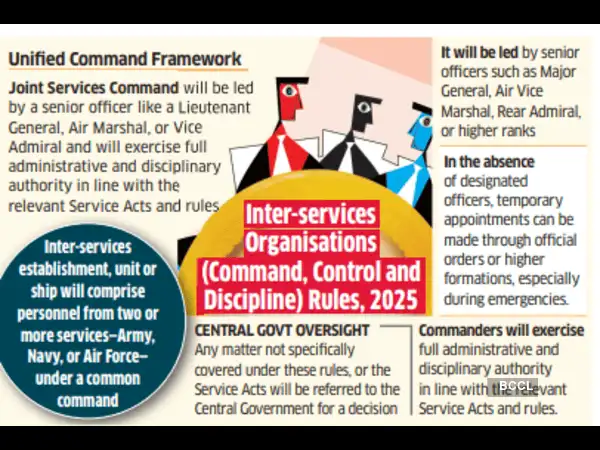
- Empowerment of Commanders: The Commander-in-Chief (CiC) of a Joint Services Command (JSC), the Officer-in-Command (OiC) of Inter-Service Establishments, and the Commanding Officer (CO) of Inter-Services Units will have full disciplinary and administrative powers over all personnel posted or attached, regardless of their parent service.
- Retention of Service Acts: While authority is delegated, the original service rules (Army Act, Navy Act, Air Force Act) still apply to individuals, maintaining service-specific identities.
- Residuary Powers: Any matter not explicitly covered under these rules or the Act will be escalated to the Central Government for resolution.
- Chain of Command: If the CiC, OiC, or CO is absent or on leave, a replacement will be notified officially. In emergencies, higher formations can appoint interim officers until formal notification.
Challenges in Implementation
- Service Culture Clashes: Integrating command cultures of the three forces may face resistance from within.
- Ambiguity in Dual Jurisdiction: Possibility of friction between ISO authority and parent service chain of command.
- Legal Interpretation Conflicts: Different Acts governing service personnel may complicate disciplinary matters unless harmonised.
Importance of the Deputy Speaker in Lok Sabha
Syllabus: GS2/ Polity and Governance
Context
- The position of the Deputy Speaker has been lying vacant for the last six years raising questions on constitutional adherence and democratic resilience.
Deputy Speaker of Lok Sabha
- The Deputy Speaker serves as the Second-in-Command Presiding Officer of the Lower House of Parliament of India – the Lok Sabha.
- According to Article 95(1), the Deputy Speaker performs the duties of the Speaker if the post is vacant.
- The Deputy Speaker acts as the Speaker when the latter is absent from the sitting of the House.
- The Deputy Speaker presides over joint sittings of both Houses of Parliament in case the Speaker is absent from such a sitting.
Election of Deputy Speaker
- The Deputy Speaker of Lok Sabha is elected by the Lok Sabha itself from amongst its members.
- Article 93 states that “The House of the People shall, as soon as may be, choose two members of the House to be respectively Speaker and Deputy Speaker”.
- The election of Deputy Speaker is governed by Rule 8 of the Rules of Procedure and Conduct of Business in Lok Sabha. According to Rule 8, the election “shall be held on such date as the Speaker may fix”.
- Usually, the Speaker is chosen from the ruling party or ruling alliance, while the Deputy Speaker is selected from the opposition party or opposition alliance.
- However, there have been exceptions to this convention.
- The first four Deputy Speakers, from 1952 to 1969, were from the ruling party.
- There was no Deputy Speaker for the entire duration of the 17th Lok Sabha (2019-24).
Powers and Privileges
- While performing the duties of or acting as the Speaker of Lok Sabha (i.e. while presiding over the sitting of Lok Sabha or a Joint Sitting of both the Houses), he/she assumes all the powers of the Speaker of Lok Sabha.
- Thus, in such times, the Deputy Speaker cannot vote in the first instance, rather he/she can only exercise a Casting Vote in case of a tie.
- When the Speaker presides over the House, the Deputy Speaker is like any other Ordinary Member of the House.
- Thus, in such times, the Deputy Speaker can speak in the House, participate in its proceedings, and vote in the first instance on any question before the House.
- He/she has one special privilege -Whenever the Deputy Speaker of Lok Sabha is appointed as a member of a Parliamentary Committee, he/she automatically becomes its chairman.
Removal of Deputy Speaker of Lok Sabha
- The Deputy Speaker of Lok Sabha can be removed by a resolution passed by the Lok Sabha by an Effective Majority (i.e. a majority of the total membership of the House excluding the vacant seats).
- A motion of removal of the Deputy Speaker of Lok Sabha can be moved only after giving 14 days’ advance notice to the Speaker.
- When a resolution for removal of the Deputy Speaker is under consideration, he/she cannot preside at the sitting of the house, though he may be present.
Concerns Over Prolonged Vacancy
- The absence of the Deputy Speaker contradicts the intent of constitutional norms and undermines the concept of an inclusive and pluralist parliamentary democracy.
- It dilutes the representational balance between government and Opposition.
- In the event of the Speaker’s resignation or incapacity, legislative functioning may stall, leading to institutional paralysis.
Concluding remarks
- The office of the Deputy Speaker is a constitutional necessity, not a political choice. Its prolonged vacancy violates the spirit of the Constitution and undermines democratic norms.
- The issue calls for urgent correction to restore institutional balance and ensure the proper functioning of the Lok Sabha in accordance with constitutional values.
Experiential Learning
Syllabus: GS2/Education
Context
- The current education system needs to integrate experiential learning.
About
- The Nature of Learning and the Changing Landscape: Humans are inherently learning beings, and today’s digital world has transformed access to information.
- With AI and bots capable of teaching concepts, traditional schools are at risk of becoming obsolete if their role is limited to content delivery.
What is Experiential Learning?
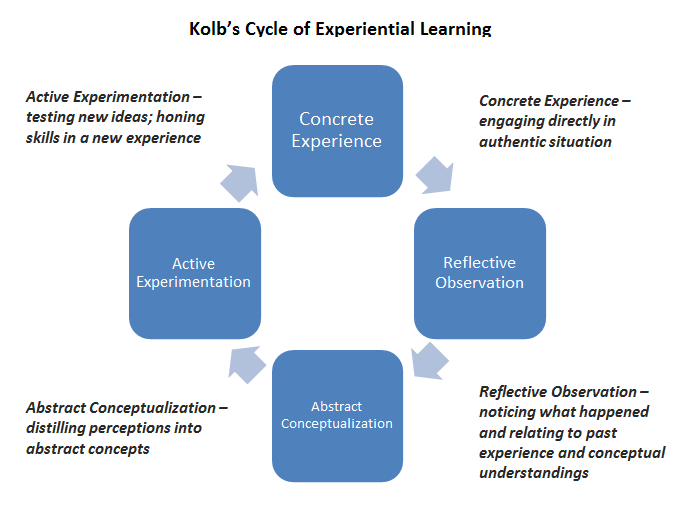
- Experiential learning is a method of learning through direct experience, reflection, and application.
- David A. Kolb is widely credited with developing and popularizing the theory of experiential learning.
- Instead of just reading about a concept or listening to a lecture, learners actively engage in activities that allow them to “learn by doing.”
- The focus is on the process of learning rather than just the outcome.
Benefits of Experient Learning:
- Improves critical thinking and problem-solving.
- Enhances engagement and motivation.
- Encourages collaboration and communication.
- Builds transferable, real-world skills.
Challenges
- Requires more time, planning, and resources.
- Difficult to implement uniformly in large classrooms.
- Not all students may be initially ready for self-directed learning.
Need for the Reforms in India
- Schools are affected by infrastructure gaps, teacher shortages, and unequal access, especially in rural and under-resourced contexts.
- Current systems are overly exam-centric and reward memorisation, which limits critical thinking and creativity.
- Neuroplasticity supports the idea that brains can adapt and learn through varied experiences over time.
Best Models of Education System around the world
- Finland: Known for its focus on student well-being and a lack of academic pressure, Finland’s system emphasizes play-based learning in early years and focuses on critical thinking and problem-solving.
- Singapore: High Standards and Rigorous Outcomes.
- World-leading performance in Programme for International Student Assessment (PISA) rankings (math, reading, science).
- Carefully structured curriculum.
- High investment in teacher development.
- Japan: Discipline and Consistency.
- Strong cultural value on education and respect.
- Uniform national curriculum.
- Emphasis on character education and responsibility (e.g., students clean classrooms).
- Strong work ethic and moral development.
Conclusion
- The challenges facing the Indian education system are deep-rooted but not invincible.
- Addressing them requires a multi-pronged approach involving government policy, community participation, teacher empowerment, and technological innovation.
- By investing in inclusive, adaptive, and learner-centric reforms, India can build an education system that equips its citizens for the challenges and opportunities of a rapidly evolving world.
Poverty Fell Significantly Last Year
Syllabus: GS 3/Economy
In News
- The latest Household Consumption Expenditure Surveys by the NSO for 2022–23 and 2023–24 show a sharp decline in poverty and a modest reduction in inequality in India.
What is Poverty?
- Poverty refers to a condition where individuals are unable to meet their basic needs. Its definition and measurement vary across countries.
- In India, poverty is assessed by the number of people living below the Poverty Line, which represents a threshold income level.
- Households with consumption below this level are considered poor.
- The poverty line represents the minimum income level necessary to meet basic needs, and varies across countries depending on their overall economic conditions.
Poverty measurement in India
- India’s poverty estimation has evolved over decades, starting with V N Dandekar and N Rath in 1971 who defined the poverty line based on calorie consumption (2,250 calories per person per day, based on National Sample Survey data of 1960-61), setting it at Rs 15 for rural and Rs 22.5 for urban areas.
- In 1979, the Y K Alagh Task Force set poverty lines based on calorie needs of 2,400 calories (rural) and 2,100 calories (urban), which remained the official method until the 1990s.
- but this approach was criticized for not accurately reflecting poverty.
- In 1993, the Lakdawala Committee introduced state-specific poverty lines considering regional price differences but faced criticism for moving away from calorie standards.
- In 2009, the Tendulkar Committee recommended major changes, including shifting focus from calorie-based poverty lines to nutritional outcomes, using a uniform basket for rural and urban areas, adjusting price calculations, and including health and education expenses in poverty measurement.
- According to this method, the 2009–10 poverty line was set at ₹673 per month for rural areas and ₹860 for urban areas.
- Individuals spending less than these amounts were classified as living below the poverty line.
- The last official poverty data from 2011-12, based on Tendulkar’s line, showed 21.9% of Indians below poverty.
- In response, the Rangarajan Committee (2012-14) reinstated separate rural and urban poverty lines, raising poverty thresholds significantly.
- However, the government did not officially adopt this report.
| Do you know? – The World Bank updated the global poverty line in September 2022 to $2.15 per person per day, replacing the 2017 poverty line of $1.90, based on purchasing power parity (PPP). |
Trends of poverty in India
- The overall poverty rate dropped from 29.5% in 2011–12 to 9.5% in 2022–23 and further to 4.9% in 2023–24.
- This trend aligns with an increase in GDP growth and a decline in general inflation, although food inflation rose slightly.
- Welfare programmes remained largely unchanged, suggesting that economic growth may be a key factor in recent poverty reduction.
- The World Bank recently released a Poverty & Equity Brief for over 100 developing countries.
- It reported a substantial decline in extreme poverty, from 16.2% in 2011–12 to 2.3% in 2022–23.
- Analysis shows most of the poor are clustered just below the poverty line, while many non-poor are slightly above it, indicating that poverty is not deeply entrenched.
- Even when poverty lines are raised to 125%, the decline remains significant.
- Inequality, measured by the Gini coefficient, fell from 0.310 in 2011–12 to 0.253 in 2023–24, with an unusually sharp decline between 2022–23 and 2023–24.
Governments Steps
- The Government of India has made significant strides in enhancing the quality of life and reducing poverty in its many forms.
- The programme implemented by the government to generate Employment and alleviate poverty are – The Mahatma Gandhi National Rural Employment Guarantee Scheme (MGNREGS), Swarnjayanti Gram Swarozgar Yojana (SGSY), and Swarna Jayanti Sahari Rozgar Yojna (SJSRY).
- Key initiatives such as Poshan Abhiyan and Anemia Mukt Bharat have notably improved access to healthcare, leading to a marked reduction in deprivation.
- The government also operates one of the world’s largest food security programs—the Targeted Public Distribution System under the National Food Security Act.
- Decisions, such as extending free food grain distribution under Pradhan Mantri Garib Kalyan Anna Yojana for another five years, exemplify the Government’s commitment.
- Various programs addressing maternal health, clean cooking fuel distribution through Ujjwala Yojana, improved electricity coverage via Saubhagya, and transformative campaigns like Swachh Bharat Mission and Jal Jeevan Mission have collectively elevated living conditions and overall well-being of people.
- Additionally, flagship programs like Pradhan Mantri Jan Dhan Yojana and PM Awas Yojana have played pivotal roles in financial inclusion and providing safe housing for the underprivileged.
Global Temperature Likely to Breach 1.5°C in Next Five Years: WMO
Syllabus: GS3/Environment and Ecology
Context
- The World Meteorological Organisation (WMO) has released the ‘Global Annual to Decadal Climate Update (2025-2029)’.
Key Temperature Projections:
- 2024: The year 2024 was not only the hottest year on record but also the first year to breach 1.5°C above the 1850–1900 baseline.
- 2025–2029: There is a 70% chance that the average global temperature for the 2025-2029 period will exceed pre-industrial levels by more than 1.5°C.
- 80% chance of at least one of the next 5 years surpassing 2024 temperature.
- 86% chance that at least one year will cross the 1.5°C threshold.
- Avg. global temperature predicted to be between 1.2°C and 1.9°C higher than avg. for 1850-1900.
- Predicted precipitation patterns for May-Sep 2025-2029 to be wetter than average.
- 1% chance of at least one year exceeding 2°C of warming in the next five years .
Regional Climate Outlook
- South Asia: Expected to continue with wetter-than-usual years (except 2023), and this trend is expected to continue between 2025 and 2029, although some seasons might still be dry.
- Arctic: Projected warming of ~2.4°C over winters—3.5x faster than global average over the next five winters (November to March).
- Sea ice is likely to shrink even more between 2025 and 2029 in parts of the Arctic like the Barents Sea, Bering Sea and Sea of Okhotsk.
- Regional anomalies (2025–2029):
- Wetter: Sahel, Northern Europe, Alaska, Northern Siberia.
- Drier: Amazon region.
- India: India received above-normal rainfall during the monsoon season in four of the past five years.
- IMD predicts above-normal monsoon rainfall in 2025.
| Paris Agreement – It is a legally binding international treaty on climate change, adopted in 2015, at the COP21 to the United Nations Framework Convention on Climate Change (UNFCCC). – It aims to limit global warming to below 2 degrees Celsius above pre-industrial levels, with efforts to limit the increase to 1.5 degrees Celsius. – The 1.5°C limit is a goal, not a legal boundary. 1. A permanent breach implies long-term warming over 20–30 years, not a single year. – The Paris Agreement emphasizes nationally determined contributions (NDCs) and encourages all countries to take climate action. 1. Countries must review and update their NDCs every five years to enhance their efforts and increase ambition over time. 2. 180 of the 195 UNFCCC countries are yet to submit their next round of NDCs for 2031-35 before the 30th Conference of the Parties (COP30). World Metrological Organisation – It is an intergovernmental organization with a membership of 193 Member States and Territories established in 1950. – It is the specialised agency of the United Nations for meteorology (weather and climate), operational hydrology and related geophysical sciences. – It is headquartered in Geneva. – Its supreme body is the World Meteorological Congress. |
MISCELLANEOUS
Seven Summits
Syllabus: GS1/Places in News
Context
- Hyderabad teenager Vishwanath Karthikey Padakanti has become the youngest Indian and the second youngest person in the world to complete the legendary 7 Summits challenge.
About
- The Seven Summits are defined as the highest peaks on each of the seven continents; it ranks among the most prestigious in global mountaineering.
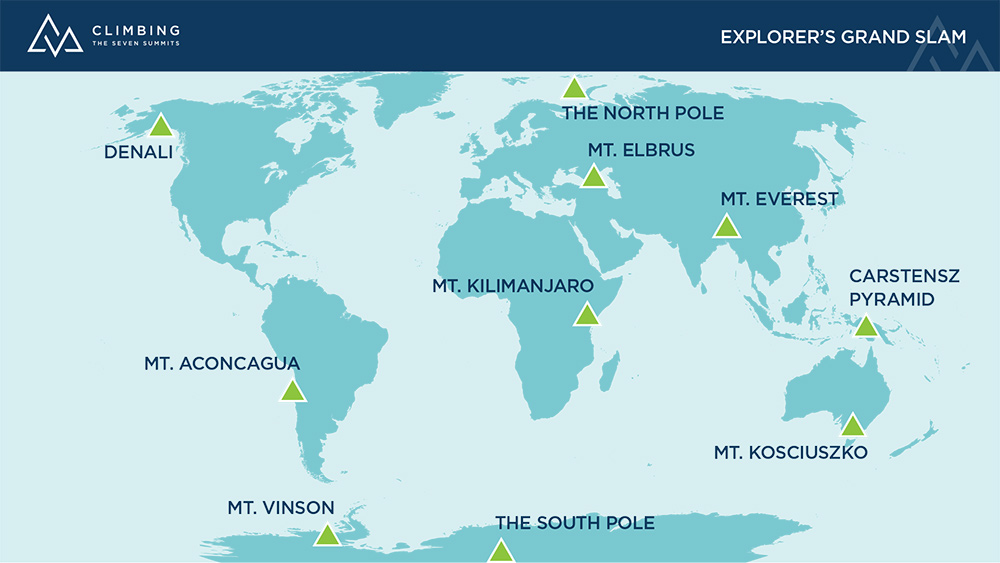
- The seven mountain peaks are Mt. Everest (Asia), Mt. Kilimanjaro (Africa), Mt. Elbrus (Europe), Mt. Aconcagua (South America), Mount Kosciuszko (Australia), Mt.Vinson (Antarctica) and Mt. Denali (North America).
- Some people define ‘continent’ differently leading to an alternate ‘seventh summit’ i.e. Australia: Mount Kosciuszko or Australasia: Carstensz Pyramid.
- Mount Everest in Asia is the tallest of the seven, while Mount Kosciuszko in Australia is the shortest.
- The Descending order of Summits: Mount Everest, Aconcagua, Denali, Mount Kilimanjaro, Mount Elbrus, Vinson Massif, Carstensz Pyramid and Mount Kosciuszko.
| Do you know? – Jordan Romero, an American mountaineer, became the youngest person in the world to complete the Seven Summits upon climbing Vinson Massif in December 2011, at the age of 15 years, 5 months, and 12 days. He broke the previous record held by George Atkinson. – The first person to complete the Seven Summits was Richard Bass, an American businessman and mountaineer, in 1985. |
Source: TH
Know Your DIGIPIN and ‘Know Your PIN Code’ Web Portals
Syllabus: GS2/Governance
Context
- The Department of Posts, Ministry of Communications, launched two transformative digital platforms: ‘Know Your DIGIPIN’ and ‘Know Your PIN Code’.
About
- These platforms were launched in alignment with the National Geospatial Policy 2022, which envisions the development of an advanced geospatial infrastructure to support digital governance and public service delivery.
- The DIGIPIN (Digital Postal Index Number): It is an open-source, interoperable, geo-coded, grid-based digital address system developed by the Department of Posts in collaboration with IIT Hyderabad and NRSC, ISRO.
- It offers Address-as-a-Service (AaaS) — an array of services associated with address data management to support secure and efficient interactions between users, government entities, and private sector organisations.
- The ‘Know Your DIGIPIN’ portal enables users to: Retrieve their DIGIPIN based on precise geolocation.
- Input latitude and longitude coordinates to fetch corresponding DIGIPINs and vice versa.
- This initiative simplifies location mapping, enhances logistics and emergency response, and ensures last-mile delivery, especially in rural and underserved areas.
- It is now available to all Ministries, State Governments, institutions for integration into their workflows, and users for their own use.
Measles Vaccine Prevented ‘9 Crore Deaths’ Worldwide
Syllabus: GS2/ Health
Context
- Measles has seen a dramatic decline in global mortality rates due to the development and scale-up of effective vaccination programs.
- Since the introduction of the measles vaccine an estimated 9 crore (90 million) deaths have been prevented worldwide
Measles
- Measles is a highly contagious viral disease, which affects mostly children.
- Transmission: It is transmitted via droplets from the nose, mouth or throat of infected persons.
- Symptoms usually appear 10–12 days after infection, including high fever, runny nose, bloodshot eyes, and tiny white spots on the inside of the mouth.
- Complications: Pneumonia, encephalitis, blindness, and death, especially in children with poor nutrition or immune deficiency.
- Prevention: Community-wide vaccination is the most effective way to prevent measles.
- John Enders developed the first effective measles vaccine in 1963, from the ‘Edmonston-B’ strain.
Source: TH
Modified Interest Subvention Scheme (MISS)
Syllabus: GS3/ Economy
Context
- The Union Cabinet approved the continuation of the Interest Subvention (IS) component under the Modified Interest Subvention Scheme (MISS) for the financial year 2025-26.
About
- MISS is a Central Sector Scheme aimed at ensuring the availability of short-term credit to farmers at an affordable interest rate through Kisan Credit card (KCC).
- Under the Scheme:
- Farmers received short-term loans of up to Rs.3 lakh through Kisan Credit Cards (KCC) at a subsidized interest rate of 7%, with 1.5% interest subvention provided to eligible lending institutions.
- Additionally, farmers repaying loans promptly are eligible for an incentive of up to 3% as Prompt Repayment Incentive (PRI) effectively reducing their interest rate on KCC loans to 4%.
- For loans taken exclusively for animal husbandry or fisheries, the interest benefit is applicable up to Rs.2 lakh.
Key highlights of Agriculture Credit
- Institutional credit disbursement through KCC increased from Rs.4.26 lakh crore in 2014 to Rs. 10.05 lakh crore by December 2024.
- Overall agricultural credit flow also rose from Rs.7.3 lakh crore in FY 2013-14 to Rs.25.49 lakh crore in FY 2023-24.
- Digital reforms such as the launch of the Kisan Rin Portal (KRP) in August 2023 have enhanced transparency and efficiency in claim processing.
Source: PIB
Cabinet Approves Hike in MSP for Kharif Crops
Syllabus: GS3/Economy
In News
The government has increased the Minimum Support Prices (MSP) of Kharif Crops for Marketing Season 2025-26, to ensure remunerative prices to the growers for their produce.
- The highest absolute increase in MSP over the previous year has been recommended for nigerseed (Rs.820 per quintal) followed by Ragi (Rs.596 per quintal), Cotton (Rs.589 per quintal) and Sesamum (Rs.579 per quintal).
Minimum Support Prices (MSP)
- It is the minimum rate at which farmers sell their crops to the government.
- This price prevents farmers from market fluctuation and offers stability and income security.
- The Commission for Agricultural Costs and Prices (CACP), established in 1965, recommends MSPs after considering multiple factors.
- The final decision on MSP is made by the Cabinet Committee on Economic Affairs, which is chaired by the Prime Minister.
- Factors: CACP considers the cost of production, demand-supply dynamics, domestic and global prices, inter-crop price parity, and the broader economic impact. MSPs ensure at least a 50% profit margin over production costs.
- These costs include all paid expenses such as labor, land rent, seeds, fertilizers, irrigation, machinery use, fuel, interest on capital, and the value of family labor.
Source :TH
Index of Industrial Production (IIP)
Syllabus :GS3/Economy
In News
- India’s industrial production growth dropped to an eight-month low of 2.7% in April, mainly due to a decline in mining output, a high base effect, and slower electricity production.
About Index of Industrial Production (IIP)
- The Central Statistical Organisation (CSO) has been compiling the Index of Industrial Production (IIP) since 1950.
- The IIP measures industrial output using Laspeyre’s formula, primarily based on physical production data, though some items like machinery are reported in value terms and adjusted using the Wholesale Price Index (WPI)
- The scope of the IIP as recommended by the United Nations Statistical Office (UNSO) includes mining, manufacturing, construction, electricity, gas and water supply.
- But due to constraints of data availability, the IIP compiled in India has excluded construction, gas and water supply sectors.
- The Eight Core Industries—Coal, Crude Oil, Natural Gas, Refinery Products, Fertilizers, Steel, Cement, and Electricity—collectively account for 40.27% of the weight of items included in the Index of Industrial Production (IIP).
Source :TH
Electric Hansa (E-Hansa)
Syllabus: GS3/ Defence
Context
- India has initiated the process to develop Electric Hansa (E-Hansa), a next-generation two-seater electric trainer aircraft.
About
- The Electric Hansa (E-HANSA) trainer is an aircraft developed by CSIR-National Aerospace Laboratories (NAL).
- The E-HANSA is part of the larger HANSA-3 (NG) trainer aircraft program, which is designed to be a cost-effective and indigenous option for pilot training in India.
- India’s E-Hansa aircraft will also mark a key step toward India’s green aviation goals and use of green or clean energy fuel in running aircrafts.
- It is expected to cost significantly less than imported alternatives.
Source: PIB
Dholes
Syllabus :GS3/Species
In News
- Visakhapatnam’s Indira Gandhi Zoological Park is celebrating World Dhole Day.
Dholes
- They are also known as the Asiatic wild dog (Cuon alpinus).
- They are a canid native to southeast Asia.
- They typically live 10-13 years in the wild, but can live up to 16 years in captivity.
- Distribution: Their global population is estimated to be between 949 and 2,215 adults, mainly located in India and Thailand.
- Factors Contributing to Decline : Habitat loss, declining prey, persecution, disease, and competition with other species have fragmented dhole populations.
- Conservation Status: It is included in CITES – Appendix II
- Dholes are classified as endangered on the IUCN Red List.
