
Landslide Hits Army Station in Sikkim
Syllabus: GS1/ Geography, GS3/ Environment
Context
- A landslide triggered by heavy rainfall hit a military camp in Sikkim’s Lachen district causing casulities & loss to property.
What is Landslide?
- Landslides are a geological phenomenon that involves the sudden and rapid movement of a mass of rock, soil, or debris down a slope under the influence of gravity.
- Landslides, usually, occur in areas having characteristics like steep terrain such as hilly or mountainous areas, presence of joints and fissures or areas where surface runoff is directed or land is heavily saturated with water.
Causes of Landslides
- Natural Causes:
- Heavy Rainfall: Heavy rainfall is one of the most common triggers of landslides. It increases pore water pressure as well as the weight of soil by making it saturated.
- Erosion: Clay and vegetation present within the soil or rock act as cohesive elements and help bind particles together. Due to removal of these cohesive elements, erosion makes an area more prone to landslides.
- Earthquakes: Intense ground shaking due to earthquakes causes instability in rocks and soils, thus triggering landslides.
- Volcanic Eruptions: Ash and debris deposited by volcanic eruptions overload slopes while the accompanied seismic activity causes instability.
- Anthropogenic Causes
- Deforestation: By holding soils as well as obstructing the flow of falling debris, vegetation cover plays an important role in preventing landslides in any area. Deforestation takes away this preventive cover and increases vulnerability to landslides.
- Encroachment in Vulnerable Terrains: Of late, humans have been encroaching in landslide-prone areas such as hilly terrains. This has led to increased construction activities in these areas and increased chances of landslides.
- Uncontrolled Excavation: Unauthorized or poorly planned excavation activities, such as mining, quarrying, etc destabilize slopes and increase the chances of landslides.
Landslide Vulnerability in India
- India is highly prone to landslides due to its tectonic position.
- The northward movement of the Indian landmass at a rate of 5 cm/year accumulates stress to which natural disasters like landslides are attributed.
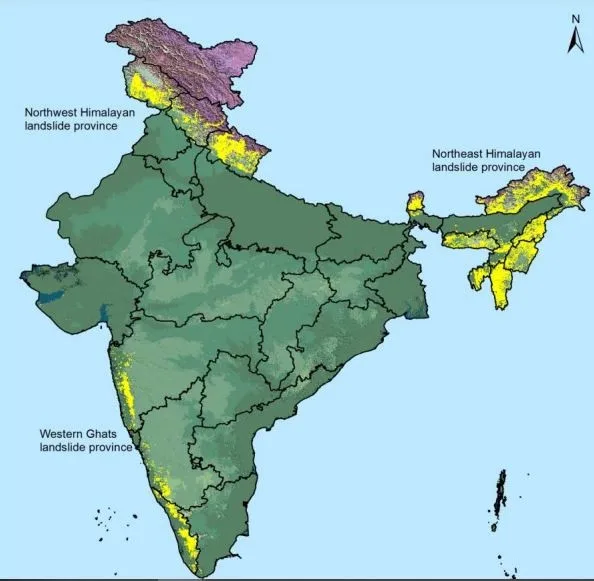
- The Landslide Atlas of India released by the Indian Space Research Organisation (ISRO) listed some of the country’s most vulnerable areas.
- India is among the top five landslide-prone countries in the world.
- Apart from snow-covered areas, around 12.6% of India is vulnerable.
- Among them around 66.5% are in the north-western Himalayas, 18.8% are in the north-eastern Himalayas and around 14.7% are in the Western Ghats region.
Measures taken by India
- The Disaster Management Act, of 2005 provides a comprehensive legal and institutional framework for the management of various disasters including landslides.
- The National Landslide Risk Management Strategy (2019) covers all aspects of landslide disaster risk reduction and management, such as hazard mapping, monitoring, and early warning systems.
- The National Disaster Management Authority (NDMA) has issued Guidelines on Landslide Hazard Management (2009) that outline the steps that should be taken to reduce the risk of landslides.
- The National Institute of Disaster Management (NIDM) has been providing capacity building and other support to various national and state-level disaster management authorities.
- Landslide Hazard Zonation Maps (LHZM): The Geological Survey of India (GSI) and the National Remote Sensing Centre (NRSC) have developed hazard zonation maps to identify landslide-prone areas.
- These maps help in planning safer land use, infrastructure development, and disaster preparedness.
- Early Warning system: Efforts have been made towards better prediction of weather. E.g. Ensemble Prediction System. This will help predict disasters like landslides.
Way Ahead
- Comprehensive Hazard Zonation: Landslide Hazard Zonation Maps should be updated regularly using advanced tools like LiDAR, drones, and GIS-based techniques.
- Reforestation and Ecosystem Restoration: Afforestation drives using native species and slope stabilization using bioengineering techniques can help reduce erosion and soil instability.
- Climate-Responsive Adaptation: As climate change increases the frequency of intense rainfall events, localized adaptation strategies such as building resilient infrastructure and improving drainage systems are critical.
India and Japan Agrees to Deepen Maritime Relations
Syllabus: GS2/ International Relations
In News
- India and Japan have formally agreed to deepen maritime relations, reaffirming their shared commitment to regional cooperation in the maritime sector.
Key Highlights of Maritime Cooperation
- Smart Islands and Renewable Energy: Japan has extended support to develop Andaman & Nicobar and Lakshadweep Islands into smart, green islands using renewable energy, disaster-resilient infrastructure, and sustainable maritime ecosystems.
- Port Digitisation and Emission Reduction: The two sides have agreed on using digital technologies in port operations to enhance efficiency, reduce logistical costs, and minimise carbon emissions. This aligns with India’s smart port initiative.
- Employment and Skilling of Seafarers: With over 1.54 lakh trained Indian seafarers, Japan has expressed interest in recruiting Indian maritime professionals to meet its skilled labour shortage in the maritime sector.
- Investment in Maritime Infrastructure: Japan’s Imabari Shipbuilding is proposing a greenfield shipyard project in Andhra Pradesh, reflecting Japan’s intent to bolster India’s domestic shipbuilding capacity, vital for its Maritime India Vision 2030.
- R&D and Technology Transfer: Enhanced cooperation in next-generation ship design, sustainable maritime technologies, and joint R&D through Cochin Shipyard Limited (CSL) is on the agenda. This includes clean fuel vessels and automation in shipbuilding.
Significance of the Maritime Agreement
- Strategic Leverage: Strengthens India’s position in Indo-Pacific maritime security and port logistics.
- Green Shipping: Supports India’s vision of carbon-neutral maritime logistics, in sync with Maritime Amrit Kaal Vision 2047.
- Employment Creation: Utilises India’s skilled maritime workforce to plug labour gaps in Japan. Indian seafarers account for nearly 10% of the global maritime workforce.
- Technology Advancement: Facilitates transfer of clean, smart maritime technologies, bolstering India’s innovation base.
Overview of India–Japan Relations
- Foundation:
- Historical and Cultural Links: Relations are rooted in ancient cultural exchanges, particularly the shared heritage of Buddhism. Figures like Swami Vivekananda, Rabindranath Tagore, and Justice Radha Binod Pal have played roles in fostering connections.
- Post-WWII Treaty: India was one of the first countries to sign a peace treaty with Japan after World War II in 1952, waiving all reparation claims, signifying an early foundation of goodwill.
- Strategic Partnership:
- Indo-Pacific Vision: Both nations share the vision of a “Free and Open Indo-Pacific” (FOIP) and “Indo-Pacific Oceans Initiative (IPOI),” crucial for regional peace, stability, and prosperity.
- Quadrilateral Security Dialogue (Quad): India and Japan are key members of the Quad, alongside the United States and Australia, which aims to promote security and stability in the Indo-Pacific.
- Supply Chain Resilience Initiative (SCRI): They work together under the SCRI framework to diversify supply chains and reduce reliance on single sources, particularly to counter China’s dominance.
- Defense Cooperation: This includes joint military exercises (e.g., JIMEX, Dharma Guardian), 2+2 dialogues (ministerial-level discussions), and agreements like the Acquisition and Cross-Servicing Agreement (ACSA) for logistics support. There’s a growing focus on co-production of defense equipment, such as the UNICORN mast system.
- Economic Engagement:
- Growing Trade: Japan’s bilateral trade with India totaled US$ 22.85 billion during FY 2023-24.
- Investment Target: Japan aims for five trillion-yen (Rs 3.2 lakh crore) in public and private investment and financing in India by 2027. Japan is the fifth-largest source of FDI in India, with over 1,400 Japanese companies operating there.
- Comprehensive Economic Partnership Agreement (CEPA): Signed in 2011, CEPA aims to strengthen bilateral trade, though challenges remain in fully leveraging it.
- Official Development Assistance (ODA): Japan has been India’s largest bilateral donor since 1958, supporting major infrastructure and development projects.
- Infrastructure Development:
- Flagship Projects: Japan is a crucial partner in major infrastructure projects, notably the Mumbai-Ahmedabad High-Speed Rail (Bullet Train) and metro systems in various Indian cities (e.g., Delhi, Ahmedabad, Bengaluru, Chennai).
- North-East Development: Japan actively invests in infrastructure development in India’s Northeast region, aligning with India’s Act East Policy, focusing on road networks, bridges, and urban infrastructure.
- Partnership for Quality Infrastructure: This Japanese model emphasizes high-quality and sustainable infrastructure.
- Energy and Technology Collaboration:
- Civil Nuclear Agreement (2017): Facilitates cooperation in civil nuclear energy.
- Space Collaboration: Joint projects like the Lunar Polar Exploration Mission by ISRO and JAXA.
- Technology Transfer: Efforts to promote Japanese environmental technologies and sustainable practices in Indian industries.
- People-to-People Ties:
- Skill Development: Programs like the Technical Intern Training Programme (TITP) and Specified Skilled Worker (SSW) facilitate the supply of skilled Indian manpower to Japan’s aging economy.
- Cultural Exchange: Continued exchanges rooted in Buddhism, academic programs, and growing youth engagement.
Nuclear Sharing Model
Syllabus: GS2/IR
Context
- French President Emmanuel Macron stated that France is “open to dialogue” on potentially stationing its nuclear weapons in other European countries.
About
- This development occurred amid security concerns in Europe due to the ongoing Russia-Ukraine war.
- France’s consideration of a broader European role for its nuclear deterrent aligns with its “European strategic autonomy” policy, which aims to enhance the EU’s capacity to act independently in security and defence matters.
- Historically, France has fiercely guarded the independence of its nuclear deterrent, viewing it as a strictly national tool.
- This openness, thus, signifies an evolution in its strategic thinking.
Nuclear Sharing Model
- “Nuclear sharing” involves a nuclear-weapon state stationing nuclear weapons on allied non-nuclear-weapon states’ territory, with specific arrangements for potential use.
- Within NATO, the U.S. has maintained such arrangements for decades.
- Currently, U.S. B61 tactical nuclear gravity bombs are understood to be deployed in five NATO states: Belgium, Germany, Italy, the Netherlands, and Turkiye.
- Under these arrangements, the U.S. retains legal ownership and custody of the warheads.
- The U.S. president also retains the power to make the decision to use these weapons, following NATO consultation.
- This Cold War-era posture aims to demonstrate alliance solidarity, and share nuclear risks.
Implications
- It could enhance deterrence against Russia by increasing NATO’s nuclear assets and demonstrating European resolve.
- Russia would likely view such deployments as a significant escalation, potentially leading to “military-technical measures” in response.
- Russian officials have repeatedly warned against NATO’s eastward military expansion.
Is it legal under international law?
- The 1968 Nuclear Non-Proliferation Treaty (NPT) is the primary legal instrument for regulating nuclear weapons.
- Article I of the treaty prohibits nuclear-weapon states (like France) from transferring nuclear weapons or control over them.
- Existing NATO nuclear sharing is justified by participants as being NPT-compliant because no “transfer” of legal ownership or control occurs in peacetime; the U.S. maintains custody.
- Non-proliferation advocates and various research institutions have consistently challenged this legality.
| About NATO – NATO, or the North Atlantic Treaty Organization, is a military alliance of countries. – Establishment: It was founded in 1949 with the signing of the North Atlantic Treaty, more popularly known as the Washington Treaty. – Aim: To ensure the security and defense of its member countries through collective defense. – Founding Members: The original members of NATO were Belgium, Canada, Denmark, France, Iceland, Italy, Luxembourg, the Netherlands, Norway, Portugal, the United Kingdom, and the United States. – Collective Defense: The cornerstone of NATO is Article 5 of the North Atlantic Treaty, which states that an armed attack against one or more of its members is considered an attack against all members. – Decision-Making: Decisions within NATO are made on the basis of consensus among member countries. The North Atlantic Council, which includes the ambassadors of all member countries, is the principal political decision-making body. – Members: It has 32 member countries, Finland and Sweden became the 31st and 32nd members respectively. On signing the Treaty, countries voluntarily commit themselves to participating in the political consultations and military activities of the Organization. |
Heatwaves Impacting Labour Productivity
Syllabus :GS 3/Environment
In News
- India is facing increasingly severe heatwaves with 2024 and early 2025 seeing record temperatures and early heatwave conditions.
Heat waves
- They are periods of unusually high temperatures relative to a region’s normal climate.
- The threshold for declaring a heat wave varies by location based on historical temperature patterns.
- Heat wave is considered if maximum temperature of a station reaches at least 40 degree C or more for Plains and at least 30 degree C or more for Hilly regions
- Factors like high humidity, strong winds, and prolonged duration can worsen their impact.
Impacts
- According to the International Labour Organization (ILO), India lost an estimated $100 billion in productivity due to heat-related work disruptions, particularly impacting informal and outdoor workers like farmers, construction workers, and delivery partners.
- The World Bank estimates that 75% of India’s workforce (380 million people) work in heat-exposed sectors.
- Heatwaves also harm agriculture, reducing crop yields (e.g., wheat yields drop 5.2% per 1°C rise) and affecting livestock.
- Urban areas face the “urban heat island” effect, where infrastructure retains heat, worsening nighttime temperatures.
- The CEEW report reveals that 57% of Indian districts are at high heat risk. States like Delhi, Rajasthan, Tamil Nadu, and Uttar Pradesh are particularly vulnerable.
- Rapid urbanisation and poor housing exacerbate heat risks, especially in Tier-II and Tier-III cities.
Government Steps
- Government response includes heat action plans at city and State levels, NDMA guidelines, and measures like shaded shelters, water supply, and urban greening. Some cities, like Chennai, have mapped urban heat islands for planning.
- However, rural areas remain underprotected, lacking robust healthcare and infrastructure.
- Experts suggest insurance schemes for heat-affected workers, strategic long-term investments, and compensation models for income loss due to heat-related work stoppages
- Heatwaves are a growing climate threat that demands coordinated short-term action and long-term policy solutions focused on resilience, equity, and sustainable urban development.
Opportunity for Investment in India’s Aviation Sector
Syllabus: GS 3/Economy
In News
- Prime Minister Narendra Modi recently highlighted India’s rapidly growing aviation sector as a major investment opportunity.
India’s aviation sector
- It is rapidly expanding, driven by rising demand and strong government support through strategic policies.
- This transformation has made India the world’s third-largest domestic aviation market, after the U.S. and China.
- Government initiatives have played a key role in modernizing and empowering the industry, positioning it as a major player in the global aviation landscape.
Government Steps
- Parliament passed the Protection of Interest in Aircraft Objects Bill, 2025, aligning India’s aviation leasing laws with global standards to reduce leasing costs.
- The Bharatiya Vayuyan Adhiniyam 2024 modernized India’s aviation sector, replacing the colonial-era Aircraft Act from 1934.
- Entering its 9th year, the UDAN scheme has successfully operationalized 619 routes and 88 airports, with plans to expand to 120 additional destinations.
- UDAN Yatri Cafés launched at Kolkata and Chennai Airports, providing passengers with affordable, quality food.
- Rapid aviation infrastructure expansion continued, with significant progress in operationalizing Greenfield airports and upgrading existing facilities nationwide.
- A uniform 5% Integrated Goods and Services Tax (IGST) rate has been introduced for aircraft parts to promote India as a competitive global Maintenance, Repair & Overhaul (MRO) hub.
- 100% Foreign Direct Investment (FDI) under the automatic route, GST reduction, and tax rationalisation measures have given a momentum to India’s MRO sector.
Progress
- The total number of air passengers annually has exceeded 350 million, firmly establishing India as the third-largest aviation market globally.
- Over the past decade, domestic air passenger traffic has grown 10-12% annually.
- India’s domestic air passenger traffic reached a historic milestone, surpassing 5 lakh passengers in a single day in 2024.
- International routes also experienced substantial growth, with 64.5 million passengers carried between January and November 2024, marking an 11.4% increase.
- India boasts 13–18% of women pilots, which ranks among the highest globally.
- The Directorate General of Civil Aviation (DGCA) targets 25% representation of women in all aviation roles by 2025.
Concerns
- India’s aviation industry is poised for rapid growth, but experts caution that it faces challenges due to heavy reliance on imported components and a shortage of skilled talent, even as domestic carriers increase aircraft orders and air traffic rises.
- India’s aviation industry is largely untapped with huge growth opportunities, considering that air transport is still expensive for the majority of the country’s population, of which nearly 40% is the upwardly mobile middle class.
Conclusion and Way Forward
- The industry stakeholders should engage and collaborate with policymakers to implement efficient and rational decisions that would boost India’s civil aviation industry.
- With record passenger traffic, improved regional connectivity, and updated aviation frameworks, India is progressing toward becoming a major global aviation hub, supporting economic growth and the national goal of Viksit Bharat @2047.
Guidelines For Electric Passenger Vehicle Manufacturing Scheme
Syllabus: GS3/ Science and Technology
Context
- The Ministry of Heavy Industries (MHI) has notified the detailed guidelines for the “Scheme to Promote Manufacturing of Electric Passenger Cars in India (SPMEPCI)”, aiming to position India as a major electric vehicle (EV) manufacturing hub.
SPMEPCI Scheme
- Nodal Ministry: Ministry of Heavy Industries (MHI)
- Launch Date: Announced in 2024
- Objective:
- Attract global investments in India’s EV sector
- Promote domestic manufacturing of EVs
- Align with India’s climate commitments (net-zero by 2070)
- Support job creation and industrial growth.
- Guidelines:
- Under the scheme, approved companies will be allowed to import a limited number of completely built electric four-wheelers (e-4W) at a reduced customs duty rate of 15 percent for a period of five years.
- These imports must meet a minimum cost, insurance and freight (CIF) value of USD 35,000 per unit.
- The concession is capped at 8,000 units per year, with the flexibility to carry forward unused quotas.
- The total duty foregone will be limited to either Rs 6,484 crore or the actual investment made by the applicant, whichever is lower.
Significance of the Scheme
- Encourages cutting-edge EV technology transfer to India.
- It strengthens Make in India and Aatmanirbhar Bharat initiatives.
- The scheme enhances clean mobility adoption and contributes to climate goals.
- It aims to generate high-skilled employment in manufacturing and R&D.
- It seeks to position India as a preferred destination for global EV investments.
| Other initiatives for Electric Vehicle mobility in India – Electric Mobility Promotion Scheme 2024 (EMPS) with an outlay of ₹ 778 Crore for a period 6 months (April 2024-September 2024) which provides incentives to buyers of e-2W and e-3W. – Production Linked Incentive Scheme for Automobile and Auto Component Industry (PLI-AAT) with a budgetary outlay of ₹ 25,938 Crore. 1. The scheme incentivises various categories of electric vehicles including e-2W, e-3W, e-4W, e-buses & e-trucks also. – Production Linked Incentive Scheme for manufacturing of Advanced Chemistry Cell (PLI-ACC) in the country with a budgetary outlay of ₹18,100 Crore. – PM E-DRIVE Scheme: It stands for PM Electric Drive Revolution in Innovative Vehicle Enhancement (PM E-DRIVE). 1. The PM E-DRIVE will replace Faster Adoption and Manufacturing of Electric Vehicles in India Phase II (FAME India Phase II). 2. The scheme will focus on promoting electric buses, trucks, and ambulances. Electric cars for private or shared mobility will not be covered under this new scheme. |
India Hub For Illegal Online Betting: CUTS International
Syllabus: GS3/Security
Context
- According to a report by CUTS International, India has emerged as a major hub for illegal online betting, with unauthorized gambling platforms recording over 5 billion visits in FY25.
| Consumer Unity and Trust Society (CUTS) International – It is a non-profit, non-governmental organization dedicated to promoting social justice and economic equity across borders. – It was established in 1983 in India, and has expanded its operations globally, with advocacy centers and resource hubs in countries like Zambia, Kenya, the UK, and Vietnam. |
Key Findings of the Report
- Massive User Engagement: The top 15 illegal betting platforms, including 1xBet, Parimatch, Stake, Fairplay, and BateryBet, collectively logged over 5.4 billion visits in FY25.
- Financial Scale: Annual deposits on these platforms are estimated to be around $100 billion, raising concerns about money laundering and tax evasion.
- Regulatory Loopholes: Many of these platforms bypass KYC and age verification, exposing minors to gambling risks.
- Advertising & Payment Issues: Offshore operators exploit India’s advertising and payment infrastructure, making it easier for users to access these sites.
About Online Gambling / Betting in India
- Online gambling refers to the practice of participating in gambling activities over the internet.
- It involves placing bets or wagers on various games and events with the aim of winning money or other prizes.
- Online betting platforms in India continue to operate, often through offshore entities.
Key Concerns
- Money Laundering & Fraud: Reports indicate that online gambling platforms are being used for money laundering and terror financing, prompting calls for stricter oversight.
- Addiction & Mental Health Issues: The rise of real-money gaming has led to concerns about gambling addiction, with cases of financial distress and mental health struggles among users.
- Jurisdictional Issues: The cross-border nature of online betting complicates enforcement, as many platforms operate from jurisdictions beyond Indian authorities’ reach.
- Misleading Advertisements: High-profile endorsements of betting platforms contribute to their widespread appeal.
- The Advertising Standards Council of India (ASCI) flagged hundreds of offshore betting ads, highlighting the need for stricter advertising regulations.
Legal Framework in India
- Public Gambling Act, 1867: This central law prohibits gambling in most parts of India but does not explicitly address online betting.
- State-Specific Laws: States like Goa, Sikkim, and Nagaland have legalized certain forms of gambling, including online betting, under regulated conditions.
- Supreme Court & High Court Rulings: Courts have distinguished between games of skill and games of chance, allowing skill-based gaming platforms like fantasy sports while restricting pure gambling sites.
- Information Technology Act, 2011: It was amended to include provisions related to online gambling which states that any website that offers online gambling services must be located outside of India.
- Consumer Protection: The Central Consumer Protection Authority (CCPA) has issued advisories warning against the promotion of illegal betting platforms.
MISCELLANEOUS
Paraguay
Syllabus: GS1/ Places in News
In News
- Paraguay President Santiago is on a state visit to India.
About Paraguay
- It is a landlocked country in South America.
- It is bordered by Argentina to the south and southwest, Brazil to the east and northeast, and Bolivia to the northwest.
- Geographically, the Tropic of Capricorn passes through Paraguay.
- Paraguay is a member of MERCOSUR, the South American trade bloc that includes Brazil, Argentina, and Uruguay.
- India has a Preferential Trade Agreement (PTA) with MERCOSUR, and Paraguay is keen to enhance trade, investment, and technology exchanges under this framework.
Source: TH
Telangana Formation Day
Syllabus: GS2/Polity and Governance
Context
- Telangana Formation Day, also known as Telangana Statehood Day, is celebrated annually on June 2.
About
- Telangana, India’s youngest state, was officially formed on June 2, 2014, by bifurcating the northwestern part of Andhra Pradesh, following the enactment of the Andhra Pradesh Reorganisation Act, 2014.
- At the time of formation, it was agreed that Hyderabad would serve as the joint capital of both Andhra Pradesh and Telangana for a period of ten years, after which Andhra Pradesh would establish a new capital.
- The day is marked by cultural programs, official ceremonies, and public celebrations across Telangana.
Do you know?
- Article 3 of the Indian Constitution provides that Parliament may by law:
- Form a new State by separation of territory from a State or by uniting two or more States or parts of States;
- Increase the area of any State;
- Diminish the area of any State;
- Alter the boundaries of any State;
- Alter the name of any State.
Source: IE
DHRUVA Initiative
Syllabus: GS3/ Infrastructure
Context
- The Department of Posts has released a comprehensive policy document titled DHRUVA (Digital Hub for Reference and Unique Virtual Address), aimed at establishing a national Digital Address Digital Public Infrastructure (DPI).
What is DHRUVA?
- About: DHRUVA is a Digital Public Infrastructure (DPI) project being developed by the Department of Posts (DoP) in India. Its primary goal is to provide a unique digital address for every home in India.
- Objectives: To establish address information management as a foundational public infrastructure.
- To enable effective governance, inclusive service delivery, and enhanced user experience through accurate address sharing.
Structural Components of DHRUVA
- Digital Postal Index Number (DIGIPIN): A 10-digit alphanumeric code assigned to a 4×4 metre grid over India’s landmass using latitude-longitude coordinates.
- Each DIGIPIN uniquely identifies a physical location, thus eliminating ambiguity and duplication in address data.
- Digital Address Layer: A user-centric and consent-based layer built over the DIGIPIN, allowing users to create custom labels for their address (e.g., “Home”, “Office”, “Warehouse”).
- It integrates descriptive elements (landmarks, floor numbers, house names) while retaining precise geospatial tagging.
Source: PIB
Regional Rapid Transit System (RRTS)
Syllabus: GS3/ Infrastructure
Context
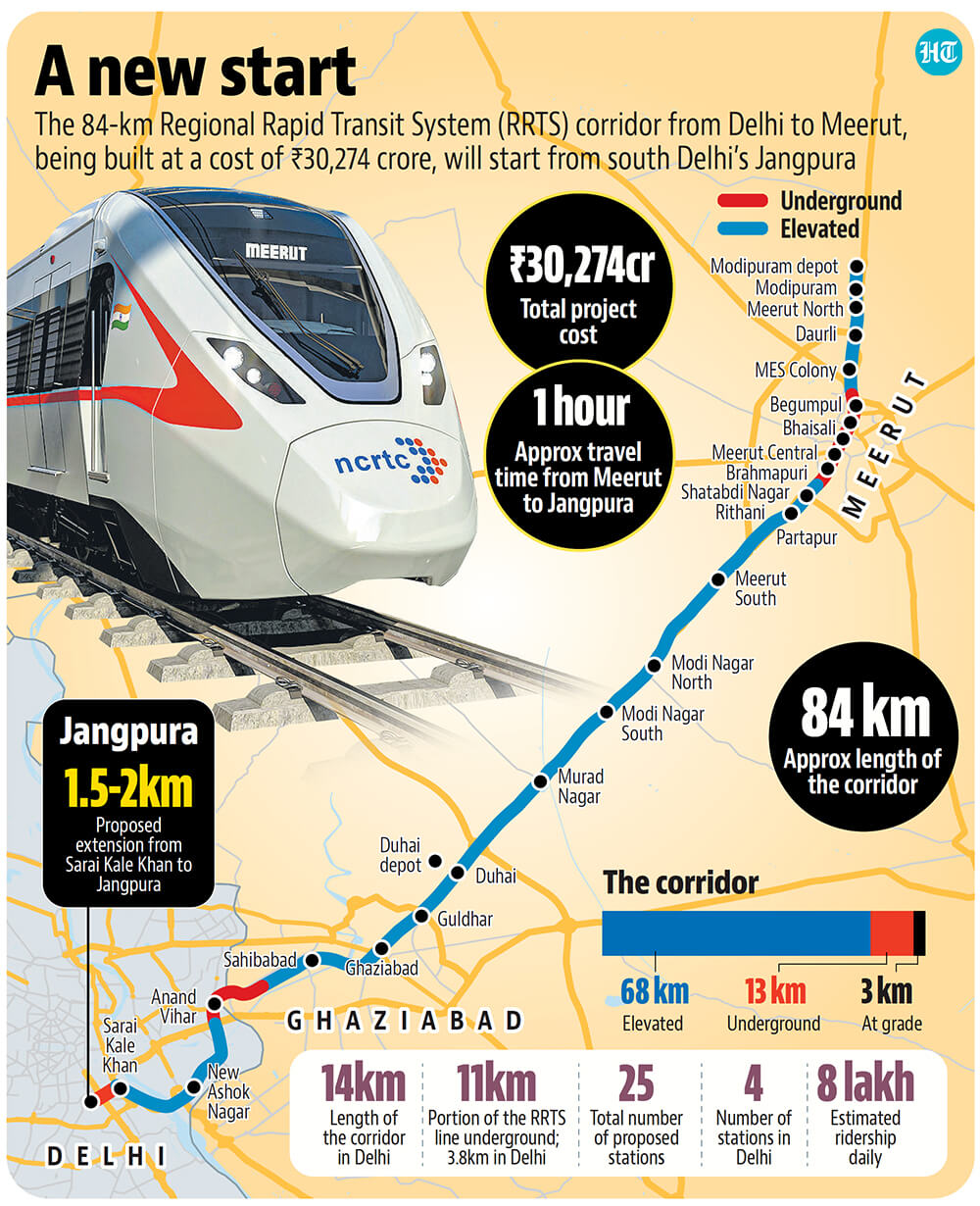
- The Delhi-Ghaziabad-Meerut RRTS, also known as NaMo Bharat, has become operational in its first phase, significantly enhancing semi-high-speed rail connectivity in the National Capital Region (NCR).
Regional Rapid Transit System (RRTS)
- The Regional Rapid Transit System (RRTS) is a semi-high-speed rail-based commuter transit system designed to improve regional mobility within NCR.
- It is implemented by the National Capital Region Transport Corporation (NCRTC), a joint venture between:
- Central Government, and
- State Governments of Delhi, Haryana, Rajasthan, and Uttar Pradesh.
Key Features of RRTS
- Passenger Control Mode: The trains are equipped with a unique ‘passenger control mode’, allowing doors to open only when a button is pressed by passengers.
- Train Speed:
- Average speed: 80 km/h and
- Maximum speed: 160 km/h.
Significance of RRTS
- Decongests urban traffic by offering a fast alternative to road transport.
- Reduces travel time from Meerut to Delhi significantly — a major boost for daily commuters.
- Promotes regional development by improving intercity connectivity and accessibility.
BharatGen Launched
Syllabus: GS3/Science and Technology
In News
- The Union Minister of State (Independent Charge) for Science & Technology launched ‘Bharat Gen’.
BharatGen
- It is India’s first government-funded multimodal Large Language Model (LLM) designed for 22 Indian languages.
- It integrates text, speech, and images to provide ethical, inclusive, and region-specific AI solutions.
- It is developed under the National Mission on Interdisciplinary Cyber-Physical Systems and led by IIT Bombay’s TIH Foundation.
- It is supported by the Department of Science and Technology (DST) and brings together a robust consortium of leading academic institutions, experts, and innovators.
- It aims to revolutionize AI development across India’s linguistic and cultural spectrum.
Importance
- It has potential to revolutionize healthcare, education, agriculture, and governance by enabling AI-powered solutions like telemedicine that allow doctors to communicate in patients’ native languages, enhancing healthcare access and trust in remote areas.
| About Multimodal Large Language Model (LLM) – MLLMs are deep learning models capable of interpreting and generating information from multiple data sources. – A Multimodal Large Language Model (MLLM) merges the reasoning capabilities of Large Language Models (LLMs), for instance GPT or LLaMA-3 , with the ability to receive, reason, and output with multimodal information. – MLLMs are crucial in advancing artificial intelligence due to their ability to process and integrate multiple data types such as text, images, audio, and video. |
Impact of Iron Aerosol on Ocean
Syllabus: GS3/Environment
Context
- Recent studies have highlighted the critical role of iron aerosols, largely originating from anthropogenic industrial emissions in East Asia, in influencing marine ecosystems.
Key Points of the Study
- During spring, strong westerly winds transport these airborne particles across the North Pacific, depositing iron into the surface ocean waters.
- This anthropogenic contribution accounts for approximately 39% of surface ocean iron content during springtime, significantly boosting phytoplankton productivity, especially north of the Transition Zone Chlorophyll Front (TZCF) — the natural divide between nutrient-rich and nutrient-poor waters.
- The surge in iron availability stimulates phytoplankton blooms, which in turn accelerate nitrate consumption, pushing marine systems more rapidly toward nitrogen limitation.
- This leads to faster depletion of nutrients and a consequent expansion of nutrient-poor zones, threatening marine biodiversity and productivity.
- The situation is worsened by climate change, as ocean warming and stratification reduce vertical nutrient mixing.
What are Planktons?
- Plankton are tiny organisms that drift in oceans, seas, and freshwater bodies. They are categorized into two main types:
- Phytoplankton: These are microscopic plants, primarily algae, that perform photosynthesis and are crucial for producing oxygen and serving as the base of aquatic food webs.
- Zooplankton: These are small animals or the larval stages of larger animals. They feed on phytoplankton and other zooplankton.
- They are important for nutrient cycling and serve as food for many marine species, including fish and whales.
Plankton Bloom
- A plankton bloom refers to a sudden increase in the population of plankton—both phytoplankton and zooplankton in aquatic ecosystems.
