
Does the Civil Services Examination Need Reform?
Syllabus: GS2/Governance
Context
- The Civil Services Examination (CSE), conducted by UPSC, serves as the gateway to India’s administrative services, shaping governance and policy implementation.
- However, over the years, concerns have emerged regarding its structure, fairness, and effectiveness, prompting discussions on the need for reform.
About the Civil Services in India
- The Civil Services of India form the backbone of India’s administrative system, ensuring governance, policy implementation, and public service delivery.
- Structure:
- All India Services include Indian Administrative Service (IAS), Indian Police Service (IPS), and Indian Forest Service (IFoS).
- Central Civil Services include Indian Foreign Service (IFS), Indian Revenue Service (IRS), and Indian Audit and Accounts Service (IAAS), among others.
- State Civil Services are managed by individual states through their State Public Service Commissions (SPSC).
- India’s first Home Minister Sardar Vallabhbhai Patel coined the term ‘Steel Frame of India’ to the civil services on April 21, 1947 because of their role in nation-building, governance, and policy execution.
- India celebrates Civil Services Day on April 21 every year to honor the contributions of civil servants.
Historical Evolution and Existing Format
- Macaulay Report of 1854: It laid the foundation for merit-based selection, and post-independence.
- Kothari Committee (1975): It introduced the three-tier system—comprising a preliminary exam, main examination, and an interview.
- It has remained largely unchanged, several modifications have been made to enhance transparency and inclusivity.
- Key Reforms Over the Years:
- 2005: The Right to Information Act led to increased transparency in UPSC’s evaluation process.
- 2011: The S.K. Khanna Committee recommended replacing the optional paper in prelims with a common paper, leading to the introduction of Paper-I (General Studies) and Paper-II (Aptitude Test).
- 2013: The Arun Nigvekar Committee proposed restructuring the General Studies papers, covering diverse subjects such as Indian Polity, Governance, Economy, and Science & Technology.
| Constitutional Provisions Related To Public Services in India – Indian Constitution provides a framework under Part XIV (Services under the Union and the States). – Establishment of Public Service Commissions: 1. Article 315: Mandates the formation of a Union Public Service Commission (UPSC) and State Public Service Commissions (SPSC). 2. States can also form a Joint Public Service Commission through a resolution passed by their legislatures. – Appointment and Tenure: 1. Article 316: The President appoints the UPSC Chairman and members, while State Governors appoint SPSC members.Members serve for six years or until the age of 65 (UPSC) / 62 (SPSC).Functions and Responsibilities:Article 320: Defines the duties of Public Service Commissions, including: (a). Conducting examinations for civil services. (b). Advising on recruitment, promotions, and disciplinary matters. (c). Handling claims for pension and legal expenses. – Removal and Safeguards: 1. Article 317: Members can be removed by the President on grounds of misbehavior, following an inquiry by the Supreme Court. 2. Their conditions of service cannot be altered to their disadvantage. – Financial Independence: 1. Expenses of UPSC and SPSC are charged on the Consolidated Fund of India/State, ensuring autonomy. |
Challenges in the Current System
- Preliminary Examination as a Filtering Mechanism: The prelims, originally designed to select the most deserving candidates, now function as a highly competitive elimination round, reducing over five lakh aspirants to around 10,000.
- This intense filtering process raises concerns about fairness and accessibility.
- Bias in Paper-II (CSAT): While Paper-II is now a qualifying paper, it still favors candidates with backgrounds in Science and Engineering, making it challenging for Humanities students.
- Unpredictability: Paper-I has become increasingly unpredictable, making preparation resource-intensive and high-cost, leading to concerns about equity in access.
- Issues in the Main Examination: Short-answer format in General Studies prioritizes factual recall over analytical skills, which are crucial for administrative roles.
- Absence of long-form questions limits the ability to assess critical thinking.
- Optional subjects, chosen based on scoring trends rather than aspirants’ academic backgrounds, undermine specialization.
- Issues Related To Lateral Entry: It has been challenged for conflicting with Article 309, which governs recruitment rules for public servants.
- Lateral entrants are appointed for three years, which may be insufficient for meaningful contributions.
Need for Reform
- Revising the preliminary exam structure to ensure a fairer selection process.
- Balancing Paper-II to accommodate aspirants from diverse academic backgrounds.
- Introducing long-form analytical questions in the main examination.
- Replacing optional subjects with common papers such as Governance and Policy, aligning with administrative responsibilities.
- Retaining age and attempt limits until 2030 to ensure inclusivity in bureaucratic selection.
Future Adjustments Post-2030
- Post-2030, appropriate revisions can be made based on changing demographics, education accessibility, and social advancements.
- Any modifications should ensure continued inclusivity while maintaining merit-based selection.
New Regulations for Jobs and Domicile in Ladakh
Syllabus: GS2/ Polity and Governance
Context
- The Centre has notified a series of regulations for Ladakh’s land, jobs, and cultural preservation, aimed at addressing concerns raised by the civil society in Ladakh over the past five years.
Background
- Ladakh became a Union Territory in 2019 without a Legislative Assembly after Article 370 of the Constitution was read down by the Parliament.
- A year later, the region comprising Buddhist-dominated Leh and Muslim-dominated Kargil district, erupted in protests pressing forth constitutional safeguards such as;
- Statehood for Ladakh,
- inclusion of Ladakh in the Sixth Schedule of the Constitution thus giving it a tribal status,
- job reservation for locals and a parliamentary seat each for Leh and Kargil.
What are the new regulations?
- Ladakh Civil Services Decentralization and Recruitment (Amendment) Regulation, 2025: This regulation introduces a domicile requirement for recruitment in government posts under the Union Territory of Ladakh, for the first time.
- The domicile is defined as a person who has resided in Ladakh for 15 years,
- a person who has studied for 7 years and appeared in either Class 10 or 12 examination in Ladakh,
- Children of Central Government employees who have served in Ladakh for at least 10 years; and children and spouses of domiciles.
- Ladakh Civil Services Domicile Certificate Rules, 2025: These rules lay out the procedure and documentation required to obtain a domicile certificate.
- The tehsildar is designated as the issuing authority, while the Deputy Commissioner is the appellate authority.
- Union Territory of Ladakh Reservation (Amendment) Regulation, 2025: This regulation caps the total reservation for Scheduled Castes (SC), Scheduled Tribes (ST), Other Backward Classes (OBC), and other socially and educationally backward groups at 85%, excluding the 10% reservation for Economically Weaker Sections (EWS).
- Ladakh Official Languages Regulation, 2025: This law recognises English, Hindi, Urdu, Bhoti, and Purgi as the official languages of Ladakh.
- It also mandates institutional support for the promotion of Shina, Brokskat, Balti, and Ladakhi, for preserving Ladakh’s linguistic and cultural diversity.
- Ladakh Autonomous Hill Development Councils (Amendment) Regulation, 2025: This amends the LAHDC Act of 1997 to reserve one-third of the seats for women in the Ladakh Autonomous Hill Development Councils of Leh and Kargil, through rotation.
Limitations of the new regulations
- No Constitutional Protection: Made under Article 240, these executive rules lack permanence and can be altered by the Centre anytime, unlike the constitutionally guaranteed Sixth Schedule.
- No Land Safeguards: Absence of restrictions on land ownership by non-domiciles raises concerns over demographic changes, tourism pressure, and ecological impact.
- No Legislative Autonomy: LAHDCs remain administrative bodies without law-making powers, unlike Sixth Schedule councils with authority over land, forests, and customs.
- Symbolic cultural protection: While local languages have been recognised, there is no roadmap for their official use in education, governance, or the judiciary.
Concluding remarks
- The new regulations for Ladakh mark a step towards addressing long-standing local concerns over identity, employment, and representation.
- However, in the absence of constitutional safeguards, the measures remain limited in scope.
- For long-term stability and trust, the government must engage meaningfully with local stakeholders and consider stronger constitutional provisions to ensure autonomy and preservation of Ladakh’s unique socio-cultural and ecological landscape.
| Sixth Schedule of the Constitution – The Sixth Schedule was adopted under Article 244 of the Constitution with provisions for formation of autonomous administrative divisions within a state. 1. The Sixth Schedule is applicable to what are officially called as ‘tribal areas’ in the States of Assam, Meghalaya, Mizoram and Tripura. There are 10 such ‘tribal areas’ at present in these four States. 2. These divisions, in the form of Autonomous District Councils (ADCs), were granted certain legislative, judicial and administrative autonomy within the state. – Composition: According to the Sixth Schedule, the ADCs administering a region within a state have 30 members with a term of five years. 1. The Bodoland Territorial Council in Assam is an exception to this with more than 40 members and rights to make laws on 39 issues. – Jurisdiction: ADCs can make laws, rules and regulations with regard to land, forest, water, agriculture, village councils, health, sanitation, village and town level policing, inheritance of property, marriage and divorce, social customs, and mining, among other issues. 1. ADCs also have powers to form courts to hear cases where both parties are members of Scheduled Tribes and the maximum sentence is less than 5 years in prison. |
Any Law Passed By Parliament Or State Legislature Can’t Be Held To Be Contempt Of Court
Syllabus: GS2/ Polity
In News
- While closing the 2007 Salwa Judum case, the Supreme Court recently observed that any law made by the Parliament or a State Legislature cannot be held to be an act of contempt of Court.
SC’s Direction
- Every State Legislature has plenary powers to pass an enactment and so long as the said enactment has not been declared to be ultra vires the Constitution or, in any way, null and void by a constitutional court, the said enactment would have the force of law.
- The top court affirmed that the legislature can pass a law to nullify the basis of a judgment or amend a struck-down law to align it with a constitutional court’s ruling.
- This is the core of the doctrine of separation of powers and must always be acknowledged in a constitutional democracy.
About Contempt of the Court
- Definition: It refers to any act or omission that obstructs or interferes with the due administration of justice or shows disrespect to the authority, dignity, and integrity of a court.
- Types of Contempt:
- Civil Contempt: Wilful disobedience to any judgment, order, direction, or decree of a court, or wilful breach of an undertaking given to a court.
- Criminal Contempt: Any act that scandalizes or lowers the authority of the court, prejudices or interferes with judicial proceedings, obstructs administration of justice in any other manner.
- Constitutional and Statutory Basis:
- Article 129: Supreme Court shall be a court of record and shall have all the powers to punish for its contempt.
- Article 215: High Courts enjoy similar powers.
- Contempt of Courts Act, 1971: Statutory framework defining and regulating contempt proceedings in India.
- Article 142(2): Also empowers the Supreme Court to make orders for the punishment of contempt, subject to any law made by Parliament.
- Safeguards:
- Truth as Defence: Post-2006 Amendment, truth can be a valid defence if it is in public interest and made in a bona fide manner.
- Fair and Reasonable Criticism: Constructive and balanced criticism of judicial decisions is permitted.
- Apology: A genuine, unqualified apology can often lead to dropping of charges.
Issues and Concerns
- Potential restriction on freedom of speech and expression (Article 19(1)(a))
- Vagueness of definitions, especially “scandalizing the court,” which can be subjective.
- Potential for misuse to shield the judiciary from legitimate criticism.
- The fact that similar laws have been abolished in some countries, like the UK.
Recent Developments
- Law Commission 274th Report (2018): Recommended retaining criminal contempt in its current form, citing persistent challenges like non-compliance and erosion of respect for courts.
Building-Integrated Photovoltaics (BIPV)
Syllabus: GS 3/Environment
In News
- Recently, it has been observed that India has the potential to scale-up Building-Integrated Photovoltaics (BIPV) adoption due to its strong manufacturing base and commitment to sustainability.
BIPV (Building-Integrated Photovoltaics)
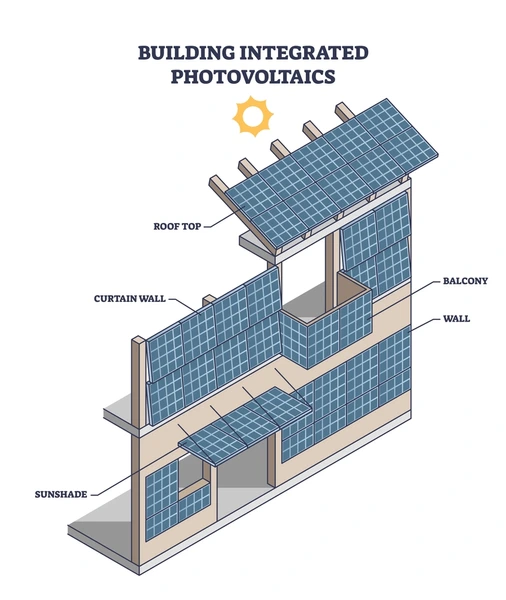
- Building-Integrated Photovoltaics (BIPV) refers to the integration of photovoltaic (solar) cells into the building envelope — including glass panels, rooftops, railings, façades, and cladding.
- These systems replace conventional materials and simultaneously generate electricity, effectively turning buildings into power generators.
Key Features
- Aesthetic Flexibility: Can be customized in terms of color, shape, size, and transparency, ensuring architectural harmony.
- Thermal Benefits: Semi-transparent panels cut solar heat gain, improving indoor energy efficiency.
- Efficient Land Use: They are ideal for residential, commercial, and public infrastructure due to their customizable, space-efficient, and visually discreet design.
- Photovoltaic Integration: Solar cells are directly incorporated into various construction elements, such as glass panels, roofing materials, and even shading devices.
Importance for India
- BIPVs are crucial for India’s urban future due to limited rooftop space and growing population.
- They allow efficient use of building surfaces like façades and balconies for solar power generation, especially in high-rises.
- For example, a south-facing façade can produce nearly four times more power than a rooftop system.
- Sunlight is absorbed by these cells and converted into electricity, feeding directly into the building’s power system.
- The panels help reduce heat ingress, cutting down on air-conditioning demand.
- BIPVs can also benefit homes without rooftop access, as seen in Germany, where balcony solar panels significantly cut electricity bills.
Challenges
- BIPV adoption in India has been limited by high initial costs, policy gaps, inadequate technical capacity, and reliance on imports.
- Low awareness, lack of dedicated incentives, and absence of clear standards also pushed BIPV out of early building-design considerations.
Suggestions and Way Forward
- With an estimated potential of 309 GW in existing buildings and vast urban growth ahead, prioritizing BIPV is key for India’s clean energy goals, requiring strong policy, innovation, and market support.
- India could increase subsidies (similar to Seoul’s 80% cost support), expand existing solar schemes to include BIPV for commercial and industrial sectors, and embed BIPV requirements in building codes.
- Pilot projects, public-private partnerships, and boosting local manufacturing through incentives and R&D are vital.
- Financial models like Renewable Energy Service Companies and long-term power agreements can improve viability.
MISCELLANEOUS
Kheer Bhawani Festival
Syllabus: GS1/Culture
Context
- The Kheer Bhawani festival, an annual celebration held on Jyeshta Ashtami, is currently taking place at the Kheer Bhawani temple in Ganderbal, Jammu and Kashmir.
About Kheer Bhawani Temple
- The original temple was built by Maharaja Pratap Singh around 1912. It was later embellished and renovated by Maharaja Hari Singh.
- It is dedicated to Goddess Ragnya Devi, who is considered an incarnation of Goddess Durga.
- A distinctive feature of the temple is a hexagonal spring located at its center, revered for its sacred water.
- Both the temple and the festival derive their name from the sweet dish ‘kheer’, which is distributed as prasad (a religious offering) to devotees.
Kerch Strait
Syllabus: GS1/ Geography, Locations
In News
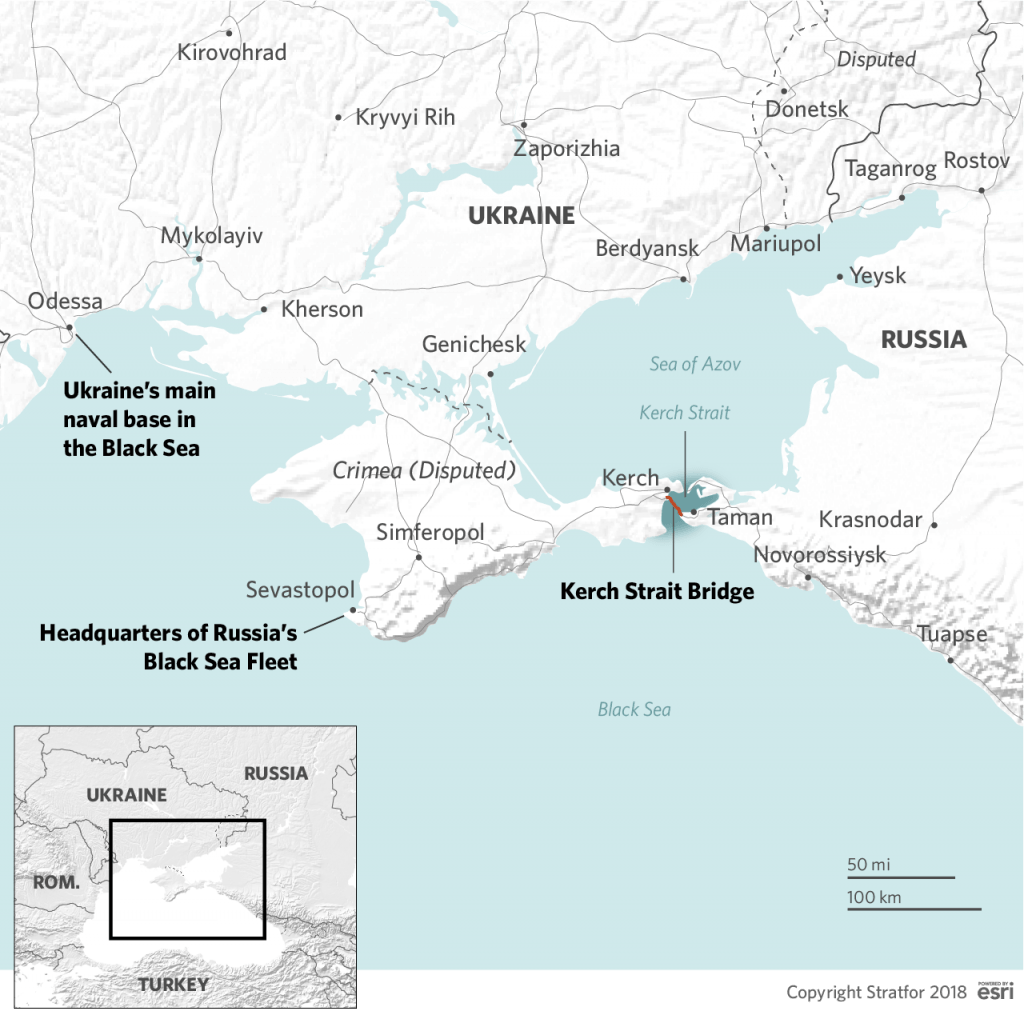
- Ukraine says it hit Kerch Strait Bridge also known as the Crimean Bridge with underwater explosives.
- Opened in 2018, the Kerch Bridge is a road and rail bridge that connects the Russian mainland with Crimea, crossing over the Kerch Strait.
About Kerch Strait
- Location: The Kerch Strait is a narrow waterway that connects the Sea of Azov to the Black Sea.
- Geography: It is approximately 4 kilometers wide at its narrowest point and serves as a crucial shipping lane.
- Control and Access: Since Russia annexed Crimea in 2014, it has gained control over the entire Kerch Strait area, including the waters and surrounding infrastructure, including the Kerch Bridge.
Motion of Impeachment Against High Court Judge
Syllabus :GS 2/Governance
In News
- The government will move an impeachment motion against Justice Yashwant Varma of the Allahabad High Court in the upcoming Monsoon Session.
- The move follows a committee report indicting him after unaccounted cash was found at his residence following a fire.
Constitutional Provisions
- Articles 124 and 217 of the Constitution allow the President to remove Supreme Court or High Court judges for ‘proved misbehaviour’ or ‘incapacity’ after both Houses of Parliament pass a motion with a special majority.
- While these terms aren’t defined in the Constitution, the Supreme Court interprets misbehaviour as misconduct like corruption or moral wrongdoing, and incapacity as a physical or mental medical condition.
Process
- The Judges (Inquiry) Act, 1968 outlines the removal process for judges.
- A removal motion must be signed by at least 50 Rajya Sabha or 100 Lok Sabha members.
- The Speaker or Chairman may admit or reject it. If admitted, a three-member committee investigates.
- If the judge is cleared, the motion is dropped
- If found guilty, both Houses must pass the motion with a special majority (Two-thirds of members present and voting, and majority of total membership) for the removal.
- Once both Houses pass the motion, it is sent to the President, who gives the final order for removal.
Key Fact
- No judge has been impeached till date, though motions have been initiated earlier (e.g. Justice V. Ramaswami in 1993).
Source: TH
C CARES Version 2.0
Syllabus :GS2/Governance
In News
- The Ministry of Coal announced the launch of a new version of web portal (C CARES Version 2.0) to streamline the provident fund (PF) and pension disbursement.
C CARES Version 2.0 portal
- It streamlines PF/Pension disbursement for coal workers by unifying workers, management, and Coal Mines Provident Fund Organisation (CMPFO) on a single digital platform.
- It allows claims to be tracked in real-time, thus reducing settlement time to fulfil the objective of providing social security to the workers.
- It is developed and designed by the Centre for Development of Advanced Computing (C-DAC).
Benefits
- It enhances transparency, accountability, and efficiency by enabling real-time claim tracking and faster settlements, ensuring better social security for coal sector workers.
- It is a step towards Prime Minister Narendra Modi’s vision of ‘Minimum Government, Maximum Governance’ through digital India.
| Coal Mines Provident Fund Organisation (CMPFO) – It is an autonomous organization under the aegis of the Ministry of Coal. – It was established in 1948 for administering Provident Fund and Pension schemes for the purpose of providing social security to the coal sector workers. – It is presently rendering services to about 3.3 lakh Provident Fund subscribers and 6.3 lakh pensioners of coal sector. |
Source :TH
ECOWAS
Syllabus: GS2/IR
Context
- According to a recent study, 54% of Togolese citizens believe their country would benefit from exiting the Economic Community of West African States (ECOWAS) to join the Alliance of Sahel States (AES).
About: ECOWAS
- Also known as CEDEAO in French and Portuguese, it is headquartered in Abuja, Nigeria.
- It was established in 1975 through the Lagos Treaty to promote economic integration among its members. ECOWAS has also worked to address some security issues by developing a peacekeeping force for conflicts in the region.
- It initially had 15 members: Benin, Burkina Faso, Cabo Verde, Cote d’Ivoire, The Gambia, Ghana, Guinea, Guinea-Bissau, Liberia, Mali, Niger, Nigeria, Senegal, Sierra Leone, and Togo. However, in January 2025, the military-led governments of Mali, Niger, and Burkina Faso formally withdrew from ECOWAS, reducing the bloc to 12 members.
Do you know?
- On 16 September 2023, the three West African junta-led countries of Burkina Faso, Mali, and Niger declared the creation of the Alliance of Sahel States, or L’Alliance des États du Sahel (AES).
Shangri-La Dialogue 2025
Syllabus: GS2/IR
Context
- Chief of Defence Staff (CDS) General Anil Chauhan attended the 22nd Shangri-La Dialogue (2025) to enhance defence diplomacy and engage with global military leadership.
About the Dialogue
- Hosted annually by the International Institute for Strategic Studies (IISS).
- Named after the Shangri-La Hotel in Singapore, where it has been held since its inception in 2002.
- It is Asia’s premier defence and security summit that brings together defence ministers, military chiefs, policy makers and strategic experts across the globe.
- The 22nd edition witnessed participation from 40 nations, focusing on emerging security challenges in the Indo-Pacific region.
