
4th Meeting of the India – Central Asia Dialogue
Syllabus: GS2/International Relations
Context
- Recently, EAM Dr. S. Jaishankar hosted a high-level meeting at 4th edition of the ‘India Central Asia Dialogue’ to explore economic growth opportunities and strengthen India-Central Asia relations.
Key Highlights of the Meeting
- Strengthening Financial Cooperation: EAM highlighted the opening of special rupee vostro accounts by Central Asian banks in Indian financial institutions, facilitating seamless transactions.
- It included the potential use of India’s UPI for cross-border payments, enhancing financial integration.
- Boosting Trade & Connectivity: The Central Asian leaders stressed the importance of diversifying trade baskets to ensure sustainable and predictable economic interactions.
- EAM emphasized the need to expand air services and streamline transit procedures, making trade more efficient.
- Commitment from Central Asian Nations:
- Kazakhstan praised India’s innovation-driven business community, expressing commitment to deepening economic ties.
- Kyrgyzstan reaffirmed the strategic partnership between India and Central Asia, highlighting the potential for mutual growth.
- Turkmenistan described India as a major and promising partner, recognizing its role in shaping a modern geo-economic architecture in Asia.
About Central Asia
- The five Central Asian Republics (CARS) viz Kazakhstan, Kyrgyzstan, Tajikistan, Turkmenistan and Uzbekistan.
- These countries attained independence on the disintegration of the Soviet Union in 1991.
- All the 5 countries are land-locked.
- All the five countries are richly endowed with natural and mineral resources.
- Kazakhstan has huge commercially viable quantities of most minerals like coal, oil, gas, uranium, gold, lead, zinc, iron ore, tin, copper, manganese, chromite, bauxite and several more.
- Turkmenistan contains the world’s fourth largest reserves of natural gas while having significant quantities of cotton, uranium, petroleum, salt and sulfur.
- Uzbekistan is richly endowed with gas, uranium, cotton, silver and gold.
- Tajikistan and Kyrgyzstan have significant supplies of fresh water.
- Kyrgyzstan has significant reserves of gold, uranium, mercury and lead.
- India’s engagement with Central Asia has evolved into a strategic partnership, focusing on trade, connectivity, security, and cultural exchange.
India-Central Asia Ties
- Early Times: India has several millennia old historical, cultural and civilisational links with Central Asia.
- Brisk trade of goods, ideas and thoughts took place from India (and China) to Central Asia and beyond over the Silk Road from 3rd century BC to 15th century AD.
- Buddhism travelled to Afghanistan, Central Asia and Western China from India through the Silk Road.
- Alexander of Macedonia, Kushans, Babar, Mughals and Sufism are evidence of vigorous links between India and the Central Asian region over the ages.
- Trade & Economic Cooperation: India and Central Asia focus on energy, pharmaceuticals, textiles, and technology.
- Both have emphasized the need for greater investment and trade facilitation, particularly through Chabahar Port.
- Connectivity & Infrastructure Development: India is actively promoting regional connectivity through initiatives like the International North-South Transport Corridor (INSTC) and air service expansion.
- Security & Geopolitical Collaboration: Both share concerns over regional security, particularly in counter-terrorism and stability in Afghanistan.
- The India-Central Asia Dialogue has strengthened cooperation in defense, intelligence sharing, and cybersecurity, ensuring a secure and stable regional environment.
- Cultural & Educational Exchange: Both continue to flourish through student exchanges, tourism, and diplomatic initiatives.
- Indian universities attract thousands of Central Asian students, fostering strong people-to-people connections.
Strategic Challenges in India-Central Asia Relations
- Trade Barriers & Limited Economic Integration: India’s trade with Central Asia hovers below $2 billion annually—negligible compared to China’s ~$50 billion with the region.
- Logistical challenges, high tariffs, and regulatory complexities continue to limit trade expansion.
- Connectivity & Infrastructure Bottlenecks: Transit inefficiencies, bureaucratic delays, and geopolitical tensions slow progress.
- The lack of direct land access to Central Asia further complicates trade routes.
- Security & Geopolitical Challenges: Concerns over regional security, particularly in counter-terrorism and stability in Afghanistan.
- China’s growing influence in the region and Pakistan’s strategic positioning create diplomatic hurdles.
- Financial & Digital Integration Issues: Regulatory misalignment and limited banking infrastructure in Central Asia pose challenges to seamless financial transactions.
Way Ahead
- Infrastructure and Connectivity: Accelerate Chabahar Port Phase-2 and Chabahar-Zahedan rail link.
- Expand cooperation on the International North-South Transport Corridor (INSTC), linking Mumbai to Central Asia via Iran and the Caucasus.
- Institutional Strengthening: Create a Central Asia Task Force within the MEA.
- Regularise the India-Central Asia Dialogue and Leaders’ Summits.
- Trade and Economic Diplomacy: Work towards a Central Asia-India FTA or regional trade pact.
- Energy Cooperation: Explore partnerships in green hydrogen, solar energy, and critical minerals. Re-engage with the TAPI pipeline diplomatically.
- Multilateral Engagement: Propose SCO-led initiatives on cybersecurity, counterterrorism, and health diplomacy.
- Soft Power and Cultural Diplomacy: Expand ICCR scholarships, host cultural festivals, and promote Bollywood and yoga diplomacy.
- Establish India-funded centres of excellence in education and technology.
India, Vietnam Decide to Cooperate in Media & Entertainment Sector
Syllabus: GS2/IR
Context
- India and Vietnam have agreed to step up cooperation in the media and entertainment sector during a meeting between the Minister of State for Information and Broadcasting and a delegation from Vietnam.
About
- Some of the priority areas identified include:
- Content exchange between national broadcasters (e.g., Doordarshan and Vietnam Television).
- Joint film production and co-hosted film festivals.
- Capacity building and training in journalism, media management, and digital broadcasting.
- Exchange programs for media professionals, scholars, and film artists.
- Promotion of shared cultural and historical narratives, especially around Buddhism and regional heritage.
Highlights of the India-Vietnam Relations:
- In 2022, the two countries celebrated the 50th anniversary of the establishment of diplomatic relations.
- Comprehensive Strategic Partnership:
- 2016: Elevated from Strategic to Comprehensive Strategic Partnership during PM Modi’s visit.
- 2020: “Joint Vision for Peace, Prosperity and People” adopted.
- 2022: 50th anniversary of diplomatic ties celebrated.
- 2024: Bilateral momentum strengthened through multiple high-level exchanges.
- Trade & Economic Relations:
- India-Vietnam bilateral trade (Apr 2023–Mar 2024): USD 14.82 billion (India’s exports: USD 5.47 bn; Imports: USD 9.35 bn).
- India–Vietnam Defence Cooperation Frameworks:
- MoU on Defence Cooperation (2009), Joint Vision Statement (2015).
- Joint Vision Statement on India–Vietnam Defence Partnership towards 2030 signed in June 2022.
- Defence Training and Supplies: India provides training to Vietnamese military personnel.
- Defence Line of Credit (LoC) worth US$ 500 million to Vietnam.
- INS Kirpan gifted to Vietnam ( 2023) — first major warship transfer to an ASEAN country.
- Joint Exercises and Naval Cooperation: Regular bilateral naval exercises (e.g., PASSEX), the joint military exercise VINBAX, port calls, and collaboration on maritime domain awareness.
- Regional and Global Cooperation: Shared vision for free, open, and inclusive Indo-Pacific.
- Vietnam supports India’s bid for UNSC permanent membership.
- Close coordination in ASEAN, East Asia Summit (EAS), and Mekong frameworks.
- India supports Vietnam’s role in regional architecture under Act East Policy.
- Recent Developments and Cooperation:
- 2024 Plan of Action (2024–2028) signed to implement the strategic partnership.
- Vietnam joined the Coalition for Disaster Resilient Infrastructure (CDRI).
- Joint stamp issued celebrating 50 years, featuring Kalaripayattu and Vovinam.
Challenges
- China Factor: Both countries face maritime disputes with China, but Vietnam remains cautious in overtly aligning with India on regional security.
- Trade Imbalance: Vietnam enjoys a trade surplus with India (e.g., USD 9.35 bn imports vs USD 5.47 bn exports in 2023–24).
- India’s export potential remains underutilized due to non-tariff barriers, logistics costs, and limited market access.
- Slow Progress in FTA Review: The ASEAN-India Trade in Goods Agreement (AITIGA) is under review since 2022 but progress has been sluggish.
- Connectivity Bottlenecks: Limited direct connectivity hampers people-to-people ties, tourism, and trade facilitation.
- Maritime Security Constraints: While naval cooperation is improving, joint patrols or maritime domain awareness (MDA) sharing is limited.
- Vietnam’s lack of naval interoperability with India compared to China’s footprint in South China Sea complicates deep defence engagement.
- Competing Economic Models: Vietnam is more deeply integrated with East Asian supply chains and free trade agreements (RCEP) than India.
- This reduces Vietnam’s dependence on India as a trading partner.
Way Ahead
- To strengthen ties, India and Vietnam must work towards a balanced trade relationship and expedite the review of ASEAN-India Trade in Goods Agreement (AITIGA).
- Defence and maritime cooperation should deepen through joint training, logistics support, and shipbuilding collaboration.
- Improving connectivity, promoting bilateral investments, and enhancing digital, startup, and energy partnerships are key.
- Both countries should also align on a rules-based Indo-Pacific order and cooperate closely in regional and multilateral forums.
India Pushes for WTO Reforms at Paris Ministerial
Syllabus: GS3/ Economy
In News
- India raised concerns and proposed reforms at a mini-ministerial WTO meet in Paris (2025), attended by 25 member nations.
- It aims to strengthen the multilateral trading system, revive WTO’s functioning, and protect the interests of developing economies.
India’s 3-Pronged Reform Agenda
- Tackle Non-Tariff Barriers (NTBs): NTBs like sanitary and phytosanitary (SPS) measures, technical barriers to trade (TBT) & arbitrary standards are increasingly used to block exports from developing countries. India wants stricter oversight and transparency.
- Example: Indian mangoes and basmati rice often face SPS-related rejections in EU and U.S. markets.
- Curb Non-Market Economy Distortions: Address the impact of national economies with heavy state control—primarily China—that distort global trade through practices such as subsidies, dumping, and lack of transparency.
- Example: India’s steel and solar industries have been impacted by cheap Chinese imports, prompting safeguard duties and anti-dumping cases.
- Revive the Dispute Settlement System: WTO’s appellate body has been paralyzed since 2009 due to U.S. blockade of judge appointments. India calls for full restoration of a binding, impartial dispute resolution system.
- Example: India’s disputes with the U.S. on steel tariffs and ICT product tariffs remain unresolved due to the appellate body deadlock.
Relevance of WTO in a Multipolar World
- Dispute Resolution: Crucial for managing trade tensions among rising powers (India, China, US, EU).
- Rule-Making: Essential to regulate new sectors (e-commerce, digital trade).
- Level Playing Field: Protects interests of developing nations from dominance of richer countries.
- Trade Facilitation: Helps standardize procedures for smoother global trade.
Need for Structural Change: Why Reform is Inevitable?
- Rising protectionism, trade wars (U.S.-China) bypassing WTO norms.
- Initiatives like Investment Facilitation for Development (IFD) are backed by 128 countries, but lack consensus. India fears fragmentation and dilution of multilateralism.
- Permanent solution for public foodgrain stockholding still pending since Bali 2013.
Conclusion
- India’s reform agenda signals a pragmatic yet principled approach—preserving the WTO’s developmental character, resisting coercive plurilateralism, and modernizing core functions.
Should India Amend its Nuclear Energy Laws?
Syllabus: GS3/Energy
Context
- Discussions are ongoing in India to amend the nuclear liability framework, regulated by the Civil Liability for Nuclear Damages Act (CLNDA), 2010, and the Atomic Energy Act (AEA), 1962.
- It aims to allow private companies to build and operate nuclear energy-generation facilities.
About
- India’s clean energy transition goals and net-zero commitments necessitate ramping up non-fossil energy, including nuclear.
- The Civil Liability for Nuclear Damage Act, 2010 (CLNDA) assigns liability to suppliers, deterring foreign investment.
- The debate hinges on whether amending this law is necessary or whether the obstacles are deeper and more structural.
Legal Reforms Underway
- Easing Nuclear Liability Law (Civil Liability for Nuclear Damage Act, 2010): Its objective is to limit the liability of equipment vendors in case of a nuclear accident. Key Proposed Changes:
- Monetary Cap: Liability may be capped to the original contract value.
- Time Limit: Introduce a statute of limitations for how long liability applies.
- Amendment to the Atomic Energy Act, 1962: Its objective is to allow private and foreign players to enter nuclear power generation.
- Current Restriction: Only state-owned entities like NPCIL and NTPC Ltd can operate nuclear plants.
- Proposed Change: Permit minority equity participation by foreign/private entities in upcoming projects.
Arguments for Amending India’s Nuclear Laws
- Legal Impediment to Foreign Investment: CLNDA creates supplier liability, which is a global anomaly.
- Companies from the U.S., France, Japan, and even Russia (post-2010) avoid entering the Indian market.
- Supply Chain & Technology Access: Without foreign suppliers, India can’t reach 100 GW due to domestic industrial capacity limits.
- Amending the law is necessary for technology access, especially with SMRs (Small Modular Reactors), a promising frontier.
- International Precedents – CSC Framework: India is part of the Convention on Supplementary Compensation (CSC), which emphasizes operator liability, not supplier liability.
- SMRs and other new technologies should be encouraged via an investor-friendly legal framework.
Arguments Against Amending the Law:
- Misdiagnosing the Real Problem: The issue isn’t primarily legal or investment-related; it’s technological, economic, and political.
- Expansion assumptions (to 100 GW) are unrealistic; even advanced economies like the U.S. and France have not grown at that pace.
- No Guarantees of Technology Transfer: Experience in defence shows no meaningful tech transfer despite 100% FDI.
- SMRs are untested at scale; investment and transfer are unlikely without guaranteed returns, which India cannot ensure.
- Over-reliance on Hypotheticals: Policy cannot be made on the assumption that private companies will change behaviour once the law is amended.
- India’s plan to build five small reactors domestically shows it may be more realistic to scale indigenous designs.
- Sovereignty and Public Safety: Diluting supplier liability may reduce accountability and compromise public interest.
- India’s unique liability regime was created in the wake of Bhopal and Chernobyl experiences; it’s rooted in justice and deterrence.
Way Ahead
- India’s push to expand nuclear energy to meet its clean energy targets by 2047 faces a key legal obstacle in its liability law.
- While some argue that amending the law is essential to attract foreign investment and technology, others caution that the real issues lie in economic viability, safety, and over-reliance on foreign participation.
- A balanced path may involve nurturing indigenous capabilities, selectively opening up to foreign participation under tight regulatory frameworks, and ensuring public safety is not compromised.
MISCELLANEOUS
Pre-Harappan Coastal Settlements in Kachchh
Syllabus: GS1/ Ancient History
Context
- The study by the researchers of the Indian Institute of Technology Gandhinagar (IITGN), has uncovered archaeological evidence that pushes back the human presence in this region by at least 5,000 years prior to the arrival of Harappans.
Findings of the study
- Early Human Settlement in Kachchh: The study suggests that early communities inhabited a mangrove-dominated landscape and relied on shell species (both bivalves like oysters and gastropods), naturally adapted to such environments, as a significant food source.
- The presence of stone tools (for cutting, scraping, and splitting) and tool-making cores indicates the existence of semi-permanent or settled communities.
- Pre-Harappan Culture with Regional Linkages: The findings suggest a cultural continuity and regional interaction among early coastal communities from:
- Las Bela and Makran regions (now in Pakistan), and
- The Oman Peninsula, indicating similar subsistence and survival strategies.
- This challenges the long-held belief that urbanisation in Kachchh emerged solely under the influence of the Sindh-based Harappan culture, suggesting instead a more complex and indigenous developmental trajectory.
Method to determine the age of the sites
- The research team used Accelerator Mass Spectrometry (AMS) dating of shell remains, a highly precise technique that measures the radioactive isotope Carbon-14 (C-14) absorbed by living organisms.
- After death, C-14 begins to decay and is reduced by half every 5,730 years.
- As atmospheric C-14 levels have varied over time, the results were calibrated using tree-ring data.
- Trees form one ring per year, and these tree-ring sequences can be matched and extended back over thousands of years, allowing scientists to construct an accurate reference timeline of atmospheric C-14.
Source: PIB
Index Cards
Syllabus: GS2/ Governance
In News
- The Election Commission has streamlined a technology-driven system to generate Index Cards and various statistical reports after the conduct of the elections.
- Earlier, this information was manually filled at the Constituency level using various statutory formats in Physical Index Cards.
About Index Cards
- It is a non-statutory, post-election Statistical Reporting Format developed as a suo moto initiative by the Election Commission of India (ECI) to promote accessibility of election-related data at the constituency level for all stakeholders.
- It is designed to disseminate data across multiple dimensions—such as candidates, electors, votes polled, votes counted, party-wise and candidate-wise vote share, gender-based voting patterns, regional variations, and performance of political parties.
Source: PIB
S Mahendra Dev Appointed New Chief of EAC-PM
Syllabus: GS2/Governance
In News
- Economist S Mahendra Dev has been appointed as Chairman of the Economic Advisory Council to the Prime Minister (EAC-PM), replacing current head Suman Bery.
| Do you know? – S Mahendra Dev is an expert in agriculture and rural economy and is also editor of Economic and Political Weekly and chairs the Institute for Development Studies, Andhra Pradesh. – Previously, he served as director of Indira Gandhi Institute of Development Research and held roles at Kotak Mahindra Bank. 1. Dev holds a PhD from Delhi School of Economics and completed post-doctoral research at Yale University. |
The Economic Advisory Council to the Prime Minister (EAC-PM)
- It is an independent body constituted to give advice on economic and related issues to the Government of India, specifically to the Prime Minister.
- Functions: It includes analyzing economic or other issues referred by the Prime Minister, addressing macroeconomic matters, providing advice, and undertaking any additional tasks requested by the Prime Minister.
- These tasks can be initiated by the Council itself or on referral.
Source :IE
Ayush Nivesh Saarthi
Syllabus:GS2/Governance
In News
- The Government of India launched the Ayush Nivesh Saarthi portal to position India as a global hub for traditional medicine and wellness.
Ayush Nivesh Saarthi
- It is a dedicated, investor-centric digital platform developed by the Ministry of Ayush in collaboration with Invest India.
- It brings together policy frameworks, incentive structures, investment-ready projects, and real-time facilitation under one unified interface.
- It is designed to support both domestic and global investors.
Importance
- It is a strategic tool that strengthens India’s standing as a global investment destination for traditional systems of medicine.
- India’s Ayush industry has emerged as one of the fastest-growing sectors in the country, recording an annual growth of 17% between 2014 and 2020.
- The Ayush sector’s relevance is also strongly reflected in its contributions to medical value travel (MVT) and the global wellness economy. Ranked among the top five health services in India, Ayush is a key driver of the country’s USD 13 billion MVT sector Globally.
- The portal is expected to drive FDI, support entrepreneurs, and promote India’s leadership in traditional health systems.
Source :PIB
United Nations Security Council Counter-Terrorism Committee
Syllabus :GS 2/IR
In News
- Pakistan’s appointment to key UN counter-terrorism bodies has caused concern in India, especially following recent terror incidents and military tensions.
Counter-Terrorism Committee (CTC)
- It was established by UN Security Council resolution 1373 (2001), which was adopted unanimously on 28 September 2001 in the wake of the 11 September terrorist attacks in the United States.
- It comprises all 15 Security Council members and it monitors countries’ implementation of measures such as criminalizing terrorism financing, freezing terrorist assets, denying support and safe haven to terrorists, and promoting international cooperation.
- The Resolution 1624 (2005) expanded its scope to include criminalizing incitement to terrorism and promoting intercultural dialogue.
Source :PIB
ECINET App
Syllabus: GS2/Governance
Context
- Due to the alleged discrepancies in the voter turnout data, the Election Commission of India has introduced a new streamlined and tech-driven system to provide such data.
About
- The new one-stop platform, ECINET, will integrate and reorient over 40 of ECI’s existing mobile and web applications.
- It will have an aesthetic User Interface (UI) and a simplified User Experience (UX) by providing a singular platform for all electoral-related activities.
- The Presiding Officer of each polling station will enter the turnout figures on the new ECINET app every two hours on polling day in order to reduce the time lag.
- This will be automatically aggregated at the constituency level.
- Need for the App: Previously, voter turnout data were collected manually by Sector Officers and relayed to Returning Officers (ROs) through phone calls, SMS, or messaging apps.
- The polling percentage trends were often updated hours later due to physical records arriving late leading to delays.
- Significance of the App: Now, approximate voter turnout will be updated faster and more accurately on the Voter Turnout app.
- While Form 17C under Rule 49S remains the official record, this tech-driven process aims to improve transparency, timeliness, and public trust.
Source: TH
Chenab and Anji Rail Bridges
Syllabus: GS3/Infrastructure
Context
- Prime Minister Narendra Modi inaugurated the Chenab and Anji rail bridges in Jammu and Kashmir, marking a historic moment for infrastructure and connectivity in the region.
About the Chenab Rail Bridge
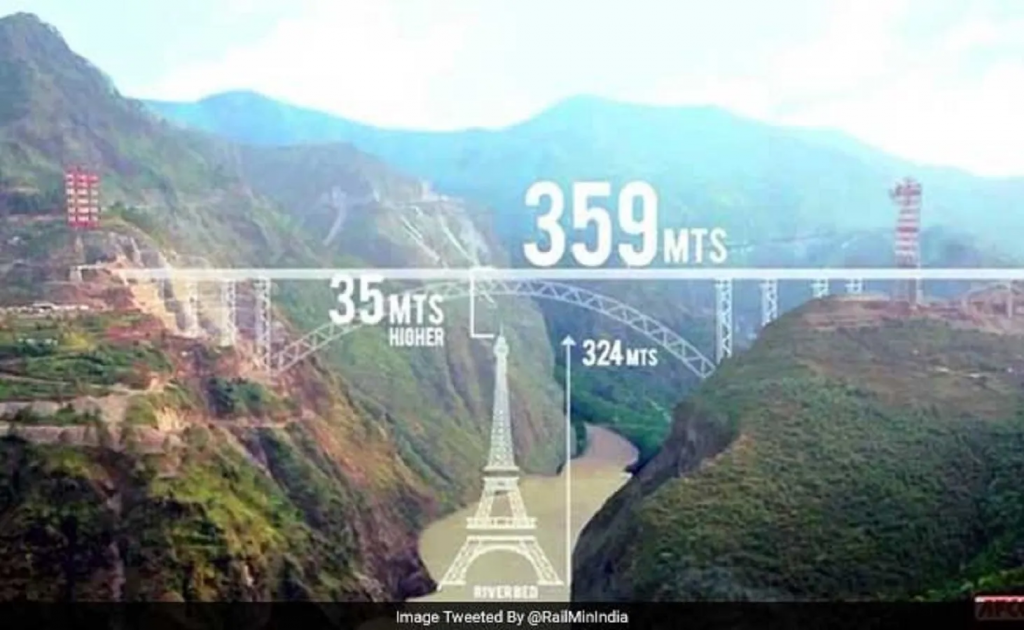
- The Chenab Rail Bridge, situated 359 meters above the Chenab River, is the world’s highest railway arch bridge.
- It is a 1,315-metre-long steel arch bridge engineered to withstand seismic and wind conditions.
- A key impact of the bridge will be in enhancing connectivity between Jammu and Srinagar. It will take just about 3 hours to travel between Katra and Srinagar.
About the Anji Rail Bridge
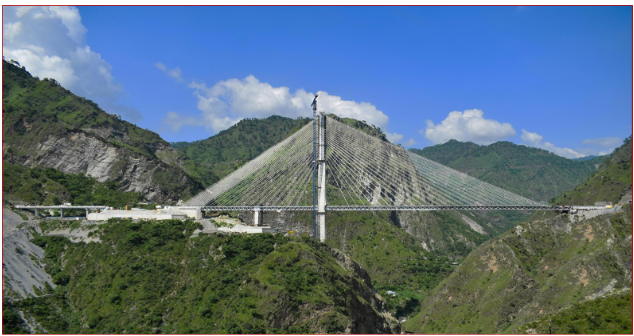
- The Anji Bridge, India’s first cable-stayed railway bridge, is located in the Reasi district, spanning 473 meters across the Anji River, a tributary of the Chenab.
- The bridge is part of the Udhampur-Srinagar-Baramulla Rail Link project.
- The bridge will enhance connectivity to the Kashmir Valley, playing a crucial role in improving trade, travel, and defense logistics in the area.
Aravalli Green Wall Project
Syllabus: GS3/ Environment
In News
- The Prime Minister launched the Aravalli Green Wall project to combat the threat of desertification.
About Aravalli Green Wall Project
- It is a flagship initiative launched by the Ministry of Environment, Forest and Climate Change (MoEFCC) to combat land degradation.
- The project aims to establish a 5-km-wide green buffer along the entire 700-km stretch of the Aravalli Range (one of the oldest in the world), which runs through Gujarat, Rajasthan, Haryana, and Delhi.
- It is an afforestation and reforestation initiative, focusing on native species, water harvesting, and community involvement.
- The project directly contributes to India’s commitments under various international conventions, including the United Nations Convention to Combat Desertification (UNCCD), the Convention on Biological Diversity (CBD), and the United Nations Framework Convention on Climate Change (UNFCCC).
Source: TH
EnviStats India 2025: Environment Statistics
Syllabus: GS3/ Environment
Context
- The Ministry of Statistics and Programme Implementation (MoSPI) has released the 8th edition of EnviStats India 2025, offering a detailed statistical assessment of India’s environmental landscape.
About
- Launched in 2018, EnviStats India is an annual publication prepared by the National Statistics Office (NSO).
- It follows the UN’s Framework for the Development of Environment Statistics (FDES) 2013, ensuring global comparability and standardisation.
- A comprehensive and integrative framework developed by the United Nations.
- Offers a structured approach to collect, compile, and present environment statistics at the national level.
- The report is a critical tool for policymakers, environmentalists, and researchers, covering data across a wide spectrum of environmental domains.
Key Features of EnviStats India 2025
- Expert Consultation: An expert group was constituted with members from relevant Ministries and domain experts to;
- Expand the publication’s scope
- Identify new data sources
- Refine presentation and design
- Component-Wise Restructuring: The report is now organized in alignment with FDES’s component-wise format, improving clarity and usability.
- Indicator Concordance: A mapping exercise was conducted to align EnviStats indicators with FDES 2013. A full list of FDES indicators is included in the publication.
- New data on the population’s access to electricity, transport, and sanitation is included.
Key Highlights of the publication
- The annual mean temperature increased from 25.05°C in 2001 to 25.74°C in 2024.
- Similarly, the annual minimum and maximum temperature rose from 19.32°C to 20.24°C and 30.78°C to 31.25°C respectively, during the same period.
- The annual rainfall data from 2001 to 2024 highlights significant year-to-year variability influenced by monsoon patterns. Despite this variability, the data does not indicate any clear long-term upward or downward trend in total annual rainfall
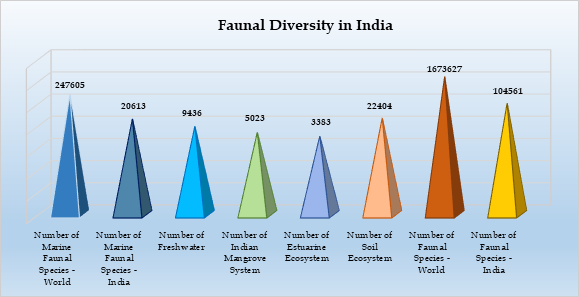
- Globally, there are 2,47,605 marine faunal species, while India accounts for 20,613.
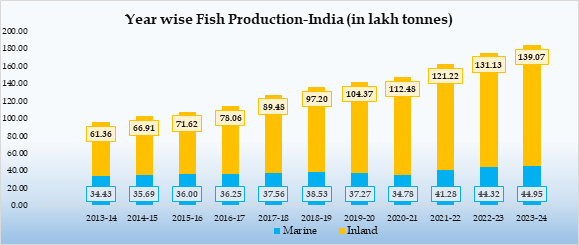
- Inland fish production has increased from 61.36 lakh tonnes in 2013-14 to 139.07 lakh tonnes in 2023–24, possibly indicating inland aquaculture and freshwater fisheries.
- The Environment Sustainability Sector shows the highest expenditure share as Rs. 2433.24 crore in 2021-22.
- The Conservation of Natural Resource Sector shows an upward trend and the Agro-Forestry Sector exhibits the lowest expenditure among the three sectors: Agro-Forestry, Conservation of Natural Resources, and Environment Sustainability.
