
Nine years of Pradhan Mantri Surakshit Matritva Abhiyan
Syllabus: GS2/ Health
In Context
- As of now, 6.19 crore pregnant women have been examined under Pradhan Mantri Surakshit Matritva Abhiyan (PMSMA).
About Pradhan Mantri Surakshit Matritva Abhiyan (PMSMA)
- Launched in June 2016, it is a flagship initiative of the Ministry of Health and Family Welfare, Government of India.
- It was designed to provide assured, comprehensive, and quality antenatal care (ANC) services free of cost to all pregnant women on the 9th of every month, particularly during the second and third trimesters.
- The PMSMA aligns with the broader goals of the Reproductive, Maternal, Newborn, Child, and Adolescent Health plus Nutrition (RMNCAH+N) strategy under the National Health Mission (NHM).
- This has led to a significant improvement in India’s Maternal Mortality Ratio (MMR), which declined from 130 per lakh live births in 2014-16 to 80 per lakh live births in 2021-23—a notable reduction of 50 points.
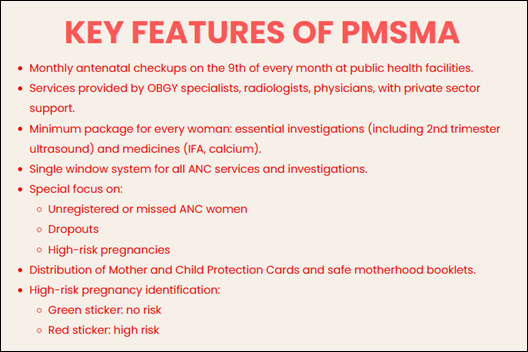
Extended PMSMA (E-PMSMA)
- About: Launched in 2022 to ensure tracing and tracking of High-Risk Pregnant (HRP) women till a safe delivery is achieved by provisioning financial incentivization for the identified HRP women.
- Features: Name-based line listing of HRPs.
- Provision of additional PMSMA Session (Max 4 times in a month).
- Individual tracking of HRP up to a healthy outcome (till 45th day after delivery).
- SMS alert to beneficiary as well as to the ASHA for registration of HRP & follow-up visits.
Integration with National Health Policies
- PMSMA complements other existing programs of the government like:
- Janani Suraksha Yojana (JSY): Launched to incentivize institutional deliveries through conditional cash transfers. This scheme has benefitted over 11.07 crore women as of March 2025.
- Janani Shishu Suraksha Karyakram (JSSK): Launched to promote free institutional delivery and neonatal care. More than 16.60 crore beneficiaries have been served since 2014–15.
- LaQshya: Initiative for improving quality of care in labour rooms.
- Surakshit Matritva Aashwasan (SUMAN): Launched to strengthen respectful and quality care for pregnant women. 90,015 SUMAN health facilities have been notified across the country by March 2025.
- POSHAN Abhiyaan: Launched to target the most vulnerable—children, adolescent girls, pregnant women, and lactating mothers—by revamping the nutrition services. As of present, there are 6.97 crore Poshan Pakhwadas across the country.
- Pradhan Mantri Matru Vandana Yojana (PMMVY): Launched to promote institutional delivery and ensuring maternal health, the scheme provides direct cash benefits of ₹5,000 to pregnant and lactating women.
Brahmaputra Flow in India and Impact of Chinese Dams
Syllabus: GS1/Geography
In Context
- India is closely monitoring Chinese infrastructure projects on the Brahmaputra River, particularly hydropower developments, due to their potential impact on downstream regions such as Arunachal Pradesh and Assam.
Brahmaputra River System
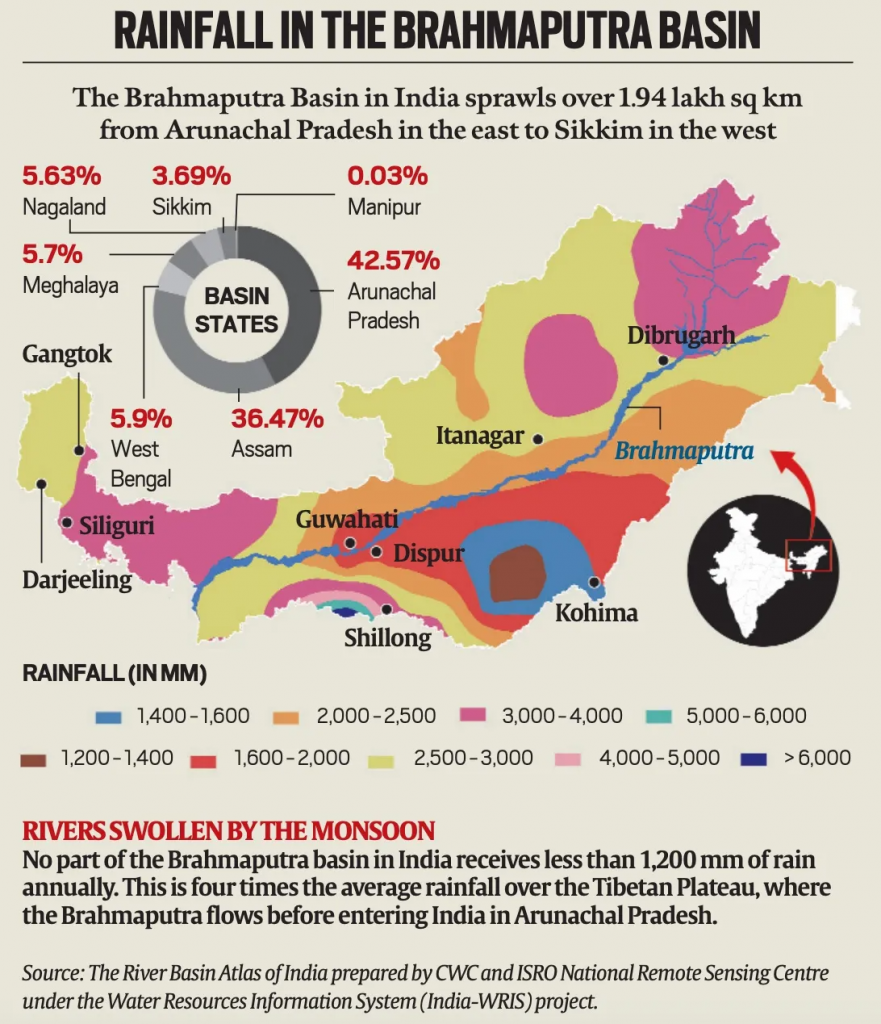
- The Brahmaputra River originates in the Kailash ranges at 5,150 m elevation, flows 2,900 km in total, including 916 km in India.
- It originates as Yarlung Tsangpo in Tibet .
- Its basin spans across Tibet (China), Bhutan, India, and Bangladesh.
- In India, it covers Arunachal Pradesh, Assam, West Bengal, Meghalaya, Nagaland, and Sikkim.
- It enters India near Gelling in Arunachal Pradesh.
- The river, which is called Siang in Arunachal, is joined by many tributaries in Assam as it flows down the plains before entering Bangladesh, where it is called Jamuna.
- Tributaries: Key right-bank tributaries include the Lohit, Dibang, Subansiri, and Teesta.
- Left-bank tributaries include the Burhidihing and Kopili.
- River-Linking Projects:
- Manas-Sankosh-Teesta-Ganga Link: Connects Brahmaputra to Ganga via Sankosh & Teesta.
- Jogighopa-Teesta-Farakka Link: Links Brahmaputra via Jogighopa Barrage to Farakka on Ganga.
- Host Riverine Island: It hosts Majuli, the world’s largest river island, and Umananda, the smallest river island in the world, both located in Assam.
How Could Chinese Dams Affect the Brahmaputra in India?
- Hydrological Impact: The Chinese dams may alter natural water flow patterns, affecting seasonal water availability.
- Example: Medog Hydropower Project (proposed 60,000 MW) near the ‘Great Bend’ of the Yarlung Tsangpo in Tibet.
- A sudden release of water or temporary water retention can exacerbate floods or worsen dry spells in Arunachal Pradesh and Assam, especially during the lean season.
- Ecological Disruptions: Reduced sediment flow, altered flood regimes, and biodiversity loss.
- Example: The Kaziranga National Park, home to the one-horned rhinoceros, depends on regular flooding of the Brahmaputra for ecological regeneration.
- Strategic & Geopolitical Risk: Gives China a perceived upper hand in water diplomacy; potential tool for coercion. Like during the 2017 Doklam standoff, China withheld hydrological data on the Brahmaputra, which it is obligated to share under a bilateral agreement.
- Economic Consequences: Uncertainty in water flow can affect irrigation, agriculture, and hydropower generation downstream.
- Example: Any disruption in Subansiri and Siang tributaries, where India has planned large hydropower projects (e.g., Lower Subansiri Hydro Project), can delay infrastructure timelines or reduce output.
- Inter-State Tensions in India: Unpredictable flow from upstream may aggravate water-sharing conflicts between Indian states.
China’s Contribution Vs India’s Share
- Multiple expert studies (e.g., by PK Saxena and Teerath Mehra) indicate that China contributes only 22–30% of Brahmaputra’s annual discharge.
- 70–78% of the river’s flow is generated within India, primarily due to monsoonal rainfall and tributary inflows in Arunachal Pradesh and Assam.
- Hydrologically, China’s control over the river’s headwaters has limited influence on its overall flow in India.
- Even to address water scarcity, two river-linking projects have been proposed: the Manas-Sankosh-Teesta-Ganga Link and the Jogighopa-Teesta-Farakka Link.
Way Forward
- India should conduct detailed scientific studies and develop an adaptive strategy to assess the impact of Chinese projects on the Brahmaputra.
- It must strengthen diplomatic efforts to access hydrological data and establish data-sharing protocols with China for early warnings and disaster preparedness.
- India can use forums like BIMSTEC, SCO, and Quad to internationalize the issue and press for sustainable and equitable transboundary river management.
Demand for Compulsory Licensing for Rare Disease
Syllabus: GS2/ Health
Context
- A growing number of rare disease patients in India are urging the government to invoke the compulsory licensing provision under the Indian Patents Act, 1970.
About
- Compulsory licensing is a legal tool under Section 84 of the Indian Patents Act, 1970, which allows the government or any third party to manufacture a patented product or use a patented process without the consent of the patent owner in certain conditions.
- It aims to protect public health and access to affordable medicines.
- A compulsory license in India can be granted three years after a patent is issued if:
- The patented invention is not available to the public at a reasonable price.
- The reasonable requirements of the public are not being satisfied.
- The invention is not being worked on in the territory of India.
Legal Policy Landscape
- Patent Law Amendments: India’s 1970 Patents Act originally allowed only process patents, enabling generic drug manufacturing.
- Hence, India became the “pharmacy of the world” by producing affordable medicines.
- Safeguards Against Monopoly Abuse: India’s law includes anti-evergreening provisions (Section 3(d)) to prevent companies from extending monopoly through minor modifications.
- It also allows for pre- and post-grant opposition to patents.
TRIPS Agreement and Flexibilities
- India became a member of the World Trade Organization (WTO) and was required to align its intellectual property laws with the TRIPS Agreement (Trade-Related Aspects of Intellectual Property Rights), which came into effect in 1995.
- The TRIPS Agreement provides for the compulsory licensing (CL).
- India amended its Patents Act in 2005, allowing for both product and process patents in the pharmaceutical sector.
- These patents are now valid for a period of 20 years from the date of filing.
- The Doha Declaration on TRIPS and Public Health (2001) further clarified that:
- Countries may issue a compulsory license in the interest of public health emergencies, although the presence of an emergency is not a mandatory condition.
- Each country has the sovereign right to determine the grounds on which it can issue a compulsory license.
- The patent holder must be compensated through the payment of “adequate remuneration,” the amount of which is to be determined by the issuing country based on the economic value of the license.
- A waiver in 2003, later made permanent in 2017, allowed countries to import affordable drugs produced under CL from other nations.
- This created a legal route for cross-border access to affordable medicines.
| What are Rare Diseases? – Rare diseases, also known as orphan diseases, are conditions that occur infrequently within a population. 1. They are characterized by three key markers: Total number of people with the disease, Prevalence and Availability /Non-availability of treatment options. – The World Health Organization (WHO) defines a rare disease as a condition that affects a small percentage of the population, typically fewer than 1 in 1,000 to 2,000 people. Initiatives taken for rare diseases in India – National Policy for Rare Diseases (NPRD), 2021: It was launched in 2021, under which financial assistance up to Rs 50 lakh is provided to patients receiving treatment at an identified Centre of Excellence (CoE). – The Health Ministry has opened a Digital Portal for Crowdfunding & Voluntary Donations with information about patients and their rare diseases. 1. Donors can choose the CoE and patient treatments they wish to support. – Each Centre of Excellence (CoE) also has its own Rare Disease Fund, which is used with approval from its governing authority. – The Department of Pharmaceuticals has launched the Production Linked Incentive (PLI) Scheme for Pharmaceuticals, offering financial incentives to selected manufacturers for domestic production of orphan drugs. |
India-Türkiye Relations
Syllabus: GS2/International Relations
Context
- India is carefully balancing its trade relations with Türkiye (Turkey), ensuring that economic advantages are not compromised despite geopolitical concerns.
About India-Turkey Relations
- Historical and Early Diplomatic Engagements: India and Turkey share a long history of diplomatic and cultural exchanges, dating back to the Ottoman era.
- The first exchange of diplomatic missions between the Ottoman Sultans and the Muslim rulers of the subcontinent dates back to the years 1481-82.
- The Sufi Philosophy of Mevlana Jelaluddin Rumi found a natural resonance Bhakti movement in India.
- Political Engagement: Both have maintained formal diplomatic ties since 1948.
- Turkish President Recep Tayyip Erdoğan visited India for the G20 Summit in 2023.
- Both nations focused on trade, investment, defense, and security cooperation.
- Turkey has participated in multilateral forums such as the Shanghai Cooperation Organization (SCO) and ASEAN meetings, where officials from both nations have engaged in dialogue.
- Trade and Economic Relations: The Bilateral Trade Agreement between India and Turkey was signed in 1973.
- It was followed by an Agreement on setting up an India–Turkey Joint Commission on Economic and Technical Cooperation (JCETC) in 1983.
Current Trade Statistics
- India has a trade surplus of $2.73 billion with Turkey, primarily driven by engineering goods, electronics, and chemicals.
- In FY25, India’s exports to Turkey totaled $5.72 billion, with engineering exports accounting for over 50% of the total.
- Turkey had increased petroleum product imports from India following the Ukraine war, but it has seen a significant decline in FY25.
- However, Turkey’s exports to India remain limited to fruits, nuts, gold, and marble.
| Do You Know? – Türkiye is currently the 8th largest destination of Indian engineering merchandise. – India is the 3rd top supplier to Turkey after Russia and UAE for aluminium and its products, 10th supplier for electrical machinery & equipment and 11th supplier for medical & surgical equipment and pharmaceutical machinery. – In the last five fiscal years, India’s engineering exports to Turkey increased by 24%. |
- Defense and Security Cooperation: Türkiye has expressed interest in defense collaboration, including joint military exercises and technology exchange.
Concerns & Challenges in India-Turkey Relations
- Geopolitical Challenges: Turkey’s support for Pakistan, including military supplies, has led to security clearance cancellations for Turkish firms operating in India.
- Additionally, Turkey has historically backed Pakistan on the Kashmir issue, further straining diplomatic ties.
- Security & Infrastructure Issues: India recently revoked security clearance for Çelebi Airport Services India citing national security concerns.
- It reflects India’s growing scrutiny of Turkish firms involved in critical infrastructure.
- Additionally, concerns over Turkish drones used by Pakistan in military conflicts have strained relations.
India’s Response
- India has been actively engaging with Greece, Cyprus, and Armenia to counterbalance Turkey’s influence and military expansion in South Asia.
New Base Year for GDP, CPI, IIP from Early 2026
Syllabus: GS3/Economy
Context
- As per the Ministry of Statistics and Programme Implementation (MoSPI), Gross Domestic Product (GDP), Index of Industrial Production (IIP) and Consumer Price Index (CPI) will see a new base from next year onwards.
About
- In 2024, MoSPI has set up a 26-member Advisory Committee on National Accounts Statistics to decide the base year for GDP data.
- Biswanath Goldar has been appointed as its chairman.
- For GDP, the new series is scheduled to be released on February 27, 2026 with financial year 2022-23 as base year.
- For IIP, 2022 -23 has been tentatively identified as the revised base. IIP on revised base would be released from 2026-27.
- For CPI, 2024 has been identified as the revised base year as the item basket and the weightage of the items would be decided based on the NSO’s Household Consumer Expenditure Survey (HCES) conducted in 2023-24.
- The new CPI series is expected to be published from the first quarter of 2026.
What is Base Year?
- A base year is a benchmark year used for comparison in economic and statistical calculations.
- It provides a reference point against which current values of indicators like GDP, CPI, and IIP are measured to track real changes over time.
- Significance:
- It allows us to remove the effect of inflation and see real growth.
- Helps in creating index numbers (like CPI = 100 in base year).
- Ensures that the data reflects the current structure of the economy, consumption patterns, and prices.
Need for the Change of the Base Year?
- It is usually changed every 7–10 years to reflect:
- New consumption patterns;
- Changes in economic structure;
- Introduction of new goods and services.
- Ensures data remains relevant and accurate.
- This will give a clearer picture about the state of the economy which will help the government to design its economic policies.
Economic Datasets
- Gross Domestic Product (GDP): GDP is the total monetary value of all final goods and services produced within a country’s domestic territory during a specific period (usually a quarter or a year).
- It is calculated by adding up all the expenditures made in the economy, including expenditures by Indians in their individual capacity, expenditures by governments, expenditures by private businesses, etc.
- This provides a picture of the demand side of the economy.
- Current base year used 2011–12.
- Released By: National Statistical Office (NSO), Ministry of Statistics and Programme Implementation (MoSPI).
- Index of Industrial Production (IIP): IIP measures the volume of production in the industrial sector, including mining, manufacturing, and electricity.
- It is a volume-based index, not value-based like GDP.
- Indicates industrial activity, helping assess the short-term economic momentum.
- Published monthly and the base year currently is 2011–12 (revision to 2022–23 is underway).
- Released By: NSO, MoSPI.
- Consumer Price Index (CPI): CPI measures the average change in prices paid by consumers for a basket of goods and services over time — i.e., it tracks retail inflation.
- Tracks cost of living and purchasing power.
- Includes items like food, housing, clothing, transport, etc.
- It is published monthly, the current base year: 2012 (to be revised to 2024).
- Released By: NSO, MoSPI.
Conclusion
- By updating the base years—GDP and IIP to 2022–23 and CPI to 2024—India aims to capture recent shifts in consumption patterns, industrial output, and price structures.
- These changes will ensure that the data used for economic analysis and policy formulation is more accurate, relevant, and reflective of contemporary conditions.
- This, in turn, will enhance the effectiveness of government planning, policymaking, and monitoring of the country’s economic progress.
Consultative Regulation-making
Syllabus: GS3/Economy
Context
- The Reserve Bank of India (RBI) issued a policy framework for how it will publish regulations, directions, guidelines and notifications.
Background
- This follows a similar move by the Securities and Exchange Board of India (SEBI), which published regulations setting out the procedure it would follow to issue regulations.
- Both RBI and SEBI are statutory regulators with quasi-legislative powers, have initiated reforms to improve transparency and accountability in regulation-making.
- These reforms are in line with global best practices and are essential to uphold the rule of law.
Recent Reforms
- RBI will now conduct impact analyses before issuing regulations.
- SEBI will clarify the regulatory intent and objectives of its proposals.
- Both regulators will invite public comments for at least 21 days and will periodically review their existing regulations.
Significance
- Strengthens Democratic Legitimacy: It ensures that rule-making by unelected bodies (like RBI and SEBI) is democratically accountable.
- Improves Regulatory Quality: Inviting feedback from stakeholders (businesses, experts, civil society) helps regulators design better, more effective rules.
- Increases Public Trust: Transparency in regulation-making builds trust in the regulatory process.
- Enhances Compliance and Implementation: Regulations developed through consultation are more likely to be realistic and practical, leading to better compliance.
- Facilitates Periodic Review and Reform: Public inputs and defined review mechanisms ensure that outdated or ineffective regulations are identified and amended or repealed.
- Aligns with Global Best Practices: Advanced jurisdictions like the US, UK, and the EU have institutionalised consultative mechanisms.
Challenges
- Slows Down the Regulatory Process: Consultation and impact assessment add time to the regulation-making process.
- Risk of Regulatory Capture: Powerful interest groups or industry lobbies may dominate consultations.
- Resource and Capacity Constraints: Regulators like RBI and SEBI face limited administrative capacity and technical expertise.
- Conducting detailed impact assessments, public consultations, and cost-benefit analyses for each regulation can overburden staff and divert resources from enforcement or supervision.
- Confidentiality and Sensitivity: Certain regulatory matters (e.g., monetary policy, cybersecurity, systemic risks) require confidentiality.
- Public consultations in such cases can lead to speculation, market volatility, or information leakage.
Conclusion
- India has begun moving toward more transparent and consultative financial regulation-making through reforms by RBI and SEBI.
- However, further steps—like mandating economic justification, strengthening accountability mechanisms, and enacting a comprehensive procedural law—are needed to institutionalize good regulatory practices across the board.
Kerala Wants Centre to Amend the Wildlife Protection Act
Syllabus: GS3/ Environment
Context
- The Kerala government has urged the Union Ministry of Environment, Forests and Climate Change to amend the Wildlife (Protection) Act, 1972 (WLPA), so it can be allowed to kill wild animals that foray into human habitats.
Kerala’s Demands to the Union government
- Amend WLPA, 1972 to allow culling of “man-eating” or dangerous wild animals without excessive procedural delays.
- Declare Wild Boars as Vermin under Section 62 of the Act, permitting their hunting in designated areas for a limited time.
- Remove Bonnet Macaques from Schedule I, thus allowing wildlife authorities to take direct action like capture and relocation.
Reasons for increase in human-wildlife conflict
- Degraded Habitats: Deforestation, developmental activities, and agricultural expansion have shrunk and fragmented wildlife habitats.
- Rise in Certain Animal Populations: Explosion in the population of wild pigs and monkeys, especially bonnet macaques, has worsened the conflict.
- Human Activities: Grazing of cattle in forest areas and changes in cropping patterns attract wild animals.
- Ecological Imbalances: Decline in top predator species due to historical hunting policies has led to an unnatural increase in herbivorous species.
| The Wild Life (Protection) Act, 1972 – The WLPA, 1972 contains six schedules that assign different levels of protection: 1. Schedule I & II: Provide the highest protection to species like tigers, elephants, etc. Offences under these schedules attract the most stringent penalties. 2. Schedule V: Lists species classified as ‘vermin’, such as common crows, fruit bats, rats, and mice, which can be hunted without restriction. Procedure to declare Vermin – State Government’s Request: A state government can request the Central Government to declare a wild animal as vermin if it is causing significant issues like property damage, crop damage, or posing a threat to human life or livestock. – Central Government Notification: The Central Government can, by notification, declare a wild animal (except those in Schedule I and Part II of Schedule II) as vermin for a specific area and time period. – Loss of Protection: Once declared vermin, the animal loses its protection under the Wildlife Protection Act and can be hunted or culled without penalty. |
What are the Concerns?
- Ecological Disruption: Mass culling creates vacuum in the food chain and affects predator-prey balance.
- Risk to Non-target Species: Traps for wild boars have caught tigers and leopards in states like Karnataka.
- Lack of Data: Many decisions are made without comprehensive data on species population, crop damage, or conflict hotspots.
- Ethical Concerns:
- Sanctity of Animal Life: Unjustified or mass culling raises moral concerns about the right to life of wild animals.
- Species Discrimination: Labelling certain animals as ‘vermin’ can lead to systemic extermination based on human convenience, not ecological necessity.
- Welfare Violations: Lethal traps and inhumane killing methods often cause unnecessary suffering to both target and non-target species.
International Conference on Disaster Resilient Infrastructure 2025
Syllabus :GS3/Disaster Management
In News
- The Prime Minister Shri Narendra Modi addressed the International Conference on Disaster Resilient Infrastructure 2025.
International Conference on Disaster Resilient Infrastructure 2025
- It brings together governments, organizations, institutions, the media, and infrastructure stakeholders to strengthen the global discourse on disaster and climate-resilient infrastructure.
- It is being hosted in Europe for the very first time.
- It is aligned with the United Nations Office for Disaster Risk Reduction (UNDRR) Global Platform on Disaster Risk Reduction (GPDRR) in Geneva, and third U.N. Oceans Conference (UNOC3).
- The theme, ‘Shaping a Resilient Future for Coastal Regions,’ highlights the vulnerability of coastal areas and islands to natural disasters and climate change.
- Recent events like Cyclone Remal in India and Bangladesh, Hurricane Beryl in the Caribbean, Typhoon Yagi in South-east Asia, Hurricane Helene in the United States, Typhoon Usagi in Philippines and Cyclone Chido in parts of Africa.
- Such disasters caused damage to lives and property.
- Recent events like Cyclone Remal in India and Bangladesh, Hurricane Beryl in the Caribbean, Typhoon Yagi in South-east Asia, Hurricane Helene in the United States, Typhoon Usagi in Philippines and Cyclone Chido in parts of Africa.
Key Points
- Prime Minister Narendra Modi recalled India’s experiences with past disasters, such as the 1999 super-cyclone and the 2004 tsunami, noting the country’s progress in building cyclone shelters and a tsunami warning system.
- He praised the Coalition for Disaster Resilient Infrastructure’s (CDRI) work with 25 Small Island Developing States and welcomed the African Union’s involvement.
- He outlined five key priorities: integrating disaster resilience in education, creating a global digital repository of best practices, ensuring innovative financing for developing nations, supporting Small Island Developing States, and strengthening early warning systems.
- African Union joins India’s Coalition for Disaster Resilient Infrastructure at international conference on disaster infrastructure

