
Mapping the Application of Artificial Intelligence in Traditional Medicine
Syllabus: GS3/Science and Technology; GS2/Health; GS1/Culture (Indian Knowledge Systems).
Context: The World Health Organization (WHO) has released its first-ever roadmap for the use of Artificial Intelligence (AI) in traditional medicine, a document titled “Mapping the Application of AI in Traditional Medicine.” This landmark brief, prepared in collaboration with the International Telecommunication Union (ITU) and the World Intellectual Property Organization (WIPO), highlights India’s pioneering efforts in integrating AI with its traditional systems of medicine, particularly Ayush (Ayurveda, Yoga, Unani, Siddha, and Homeopathy).
Key Applications of AI in Traditional Medicine
The WHO report and India’s ongoing initiatives showcase a range of applications where AI is merging with ancient medical wisdom to enhance research, diagnosis, and treatment.
- Digitization and Preservation of Traditional Knowledge:
- Traditional Knowledge Digital Library (TKDL): India’s TKDL, a repository of digitized text-based formulations and practices, is a global model. AI tools, including Natural Language Processing (NLP), are being used to catalogue and semantically analyze ancient texts, making centuries-old therapeutic knowledge accessible and preventing “biopiracy” by unauthorized patenting of traditional knowledge.
- Enhanced Diagnostic Support Systems:
- AI-powered diagnostic systems are being developed to assist practitioners. These systems integrate traditional diagnostic methods like pulse reading (nadi pariksha), tongue examination, and analysis of a patient’s Ayurvedic constitution (Prakriti) with modern machine learning algorithms and deep neural networks.
- Ayurgenomics: This groundbreaking initiative combines the principles of Ayurveda with modern genomics. AI-based analysis is used to identify predictive disease markers and personalize health recommendations based on an individual’s unique genomic and Ayurvedic constitution.
- Drug Discovery and Formulation Analysis:
- AI is streamlining the slow and resource-intensive process of traditional drug discovery.
- Virtual Screening: AI algorithms can screen thousands of herbal compounds to predict their medicinal efficacy and potential side effects, thereby accelerating the identification of promising new drug candidates.
- Network Pharmacology: AI is used to analyze the complex interactions of multiple compounds in traditional herbal formulations and to understand their mechanisms of action at the molecular level.
- Personalized and Preventive Healthcare:
- Traditional systems like Ayurveda emphasize personalized care plans based on a person’s unique constitution. AI can analyze a patient’s lifestyle, medical history, and Prakriti to generate highly customized recommendations for diet, lifestyle, and treatment, leading to more effective and preventive care.
- AI-driven Chatbots and Virtual Assistants: These tools can provide real-time health advice and follow-up consultations, improving accessibility and convenience for patients.
- Quality Control and Authentication:
- AI-powered image recognition and spectral analysis are used to identify and authenticate medicinal plants, even in their powdered or dried forms. This ensures the quality, purity, and authenticity of raw materials and final products, which is crucial for the safety and effectiveness of traditional medicines.
Challenges and Ethical Considerations
Despite the immense potential, the integration of AI into traditional medicine faces several challenges:
- Data Quality and Standardization: Traditional medicine data is often qualitative, subjective, and lacks a standardized format. Creating large, reliable, and high-quality datasets for AI models to train on is a significant hurdle.
- Ethical Concerns: There are serious ethical considerations, including data privacy and the need to uphold Indigenous Data Sovereignty (IDSov). The WHO brief emphasizes the importance of obtaining “free, prior, and informed consent” from communities whose traditional knowledge is used to develop AI applications.
- Philosophical Differences: AI models, while powerful, cannot fully replicate the holistic, intuitive, and interpersonal aspects of the doctor-patient relationship, which are central to traditional healing practices.
- Lack of Interoperability: Integrating traditional practices with modern AI and healthcare systems requires a robust framework to bridge the gap between different philosophies and methodologies.
The WHO’s roadmap is a crucial step toward addressing these challenges. By acknowledging India’s leadership and setting global standards, it provides a framework for the responsible and ethical application of AI, ensuring that this technology becomes a tool for empowerment rather than exploitation.
Centre Moves SC to Review Ruling on IPS Deputation in CAPFs
Syllabus: GS2/Indian Polity & Governance (Judiciary, Government Policies); Internal Security (Security Forces and Agencies).
Context: The Union Government has filed a review petition in the Supreme Court against its landmark judgment of May 23, 2025. The Supreme Court’s ruling had directed a “progressive reduction” in the deputation of Indian Police Service (IPS) officers to senior posts in the Central Armed Police Forces (CAPFs).
The Supreme Court’s Ruling
- The Case: The judgment was the outcome of a long-standing legal battle initiated by Group ‘A’ officers of the CAPFs, who had sought a more equitable promotional structure.
- Key Directives: The Supreme Court directed that:
- CAPFs as “Organised Services”: Group ‘A’ officers of the CAPFs (including CRPF, BSF, ITBP, CISF, and SSB) must be treated as “Organised Services” for all purposes. This status, already accorded to other services like the IAS and IPS, grants benefits like Non-Functional Financial Upgradation (NFFU) and a structured career progression path.
- Phased Reduction of IPS Deputation: The number of posts reserved for IPS officers on deputation, particularly at the Senior Administrative Grade (SAG) level (up to the rank of Inspector General), should be progressively reduced and phased out within a two-year period.
- Objective: The court’s ruling was aimed at addressing the severe career stagnation and low morale among cadre officers of the CAPFs, who often spend decades in service without a promotion due to the high number of senior posts occupied by deputed IPS officers.
Why is the Government Seeking a Review?
The Ministry of Home Affairs (MHA), which is the cadre-controlling authority for both IPS and CAPF officers, has justified its review petition on several grounds:
- Maintaining All-India Character: The government argues that the deputation of IPS officers is essential to maintain the all-India character of the Central Armed Police Forces. Since IPS officers work across different states, their deputation to central forces facilitates better Centre-State coordination and ensures a uniform standard of leadership.
- Operational and Functional Necessity: The government’s submission to the court highlighted that the presence of IPS officers is vital for the operational readiness of these forces. Their experience in handling diverse law and order situations in states provides a critical perspective for central forces deployed in complex internal security environments.
- Policy Decision: The MHA’s petition posits that the structure of the forces and the deputation policy are a matter of administrative and policy discretion. It argues that the judiciary should not interfere in how government organizations are structured and run.
- Central Deputation Reserve: The MHA also cited the existence of a Central Deputation Reserve (CDR) for IPS officers, which requires a certain percentage of them to be on central deputation at any given time. The government has to find postings for these officers.
Key Issues at the Core of the Debate
- Morale and Stagnation: The central issue is the long-standing grievance of CAPF cadre officers. Currently, up to 50% of the Inspector General (IG) posts in these forces are reserved for IPS officers. This leads to massive career stagnation, with some CAPF officers taking 25 years to reach the rank of Commandant, a position they should ideally achieve in 13 years.
- Cadre-Based Leadership: CAPF officers argue that it is a matter of natural justice and professional integrity that senior posts in their own forces be filled by officers who have risen through the ranks and possess deep institutional knowledge and experience specific to the force’s mandate (e.g., border guarding, industrial security).
- Constitutional Principles: The petitioners have invoked Articles 14 (Right to Equality) and 16 (Equality of Opportunity in Public Employment), arguing that the current deputation policy denies them an equal chance at career advancement.
Way Forward
The Supreme Court’s decision on the review petition will have far-reaching implications for the future of India’s internal security architecture. It will not only determine the career paths of thousands of officers but also shape the command and control structure of some of the country’s most vital security forces
UGC’s Anti-ragging System Has Utterly Failed: Delhi HC
Syllabus: GS2/Governance (Government Policies & Interventions), Social Justice (Issues relating to development and management of Social Sector/Services relating to Health, Education, Human Resources).
Context: The Delhi High Court, in a scathing critique, has stated that the University Grants Commission (UGC)‘s anti-ragging system has “utterly failed” to curb the menace in higher educational institutions. The court’s remarks came during a hearing on a petition alleging that the UGC had diluted a robust anti-ragging framework that was put in place after a Supreme Court directive in 2009.
Background of Anti-Ragging Regulations
- Aman Kachroo Case (2009): The tragic death of a medical student, Aman Kachroo, due to brutal ragging in 2009, served as a turning point. It brought the issue to national attention and prompted the Supreme Court to take a decisive stand.
- Supreme Court Directives: The Supreme Court mandated the UGC to frame comprehensive regulations to curb ragging. This led to the creation of the UGC Regulations on Curbing the Menace of Ragging in Higher Educational Institutions, 2009.
- Raghavan Committee: The Supreme Court-appointed Raghavan Committee‘s recommendations formed the basis of these regulations, which included measures like a 24×7 helpline, an anti-ragging committee and squad in every college, and a system for real-time tracking of complaints.
Delhi High Court’s Observations and Concerns
The Delhi High Court’s recent criticism stems from a petition filed by the Aman Satya Kachroo Trust, which has been at the forefront of the anti-ragging movement. The court highlighted several key failures:
- Underfunding and Ineffectiveness: The court noted with dismay that a “meagre amount” of ₹44 lakh was spent on anti-ragging initiatives for a student population of several lakhs. It concluded that this low funding showed a lack of seriousness and had made the entire mechanism ineffective.
- Dilution of the Original System: The petitioner alleged that the UGC had awarded the contract for the anti-ragging helpline to an unqualified consortium, which subsequently discontinued several core components of the original system. Crucial elements like the 24×7 helpline with trained responders and the ability to file anonymous complaints have allegedly been withdrawn.
- Rise in Incidents: The court expressed alarm at the rising number of ragging complaints and student suicides. Data from the National Crime Records Bureau (NCRB) was cited, showing that student suicides have surpassed the combined number of deaths among farmers and agricultural labourers. The number of ragging complaints received on the UGC helpline has also increased steadily in recent years.
- Lack of Accountability: The court criticized the UGC for failing to monitor and enforce its own regulations. It noted that the anti-ragging measures often remain on paper, with institutions merely fulfilling formalities like taking affidavits from students without any real action.
Impact on Students and the Education System
The court’s observations underscore the devastating impact of ragging:
- Psychological Trauma: Ragging, often dismissed as a “rite of passage,” can lead to severe psychological trauma, including anxiety, depression, and Post-Traumatic Stress Disorder (PTSD).
- Academic Dropout: Many students, unable to bear the harassment, are forced to drop out of their courses, wasting years of their lives and their families’ investments.
- Loss of Life: In the most extreme cases, ragging has led to suicides and even murders, as seen in the tragic incidents that brought the issue to the fore.
Way Forward
The Delhi High Court’s strong stance may lead to significant reforms:
- Suo Motu Public Interest Litigation (PIL): The court has hinted that it may initiate a PIL to suo motu monitor the government’s and UGC’s efforts to curb the menace.
- Increased Funding: The court has called on the Centre to allocate more funds for anti-ragging campaigns and systems.
- Revival of the Original Framework: There is a strong push to restore the original, more robust anti-ragging mechanism that was proven to be effective in bringing down complaints in the past.
- Digital Solutions: Experts suggest implementing technology-based solutions like dedicated portals for anonymous reporting and using AI to monitor online communication and social media for signs of harassment.
The court’s ruling serves as a powerful reminder that while laws and regulations exist, their true impact lies in their stringent and compassionate implementation. The onus is now on the UGC and higher education institutions to create a truly safe and inclusive environment for students.
Who is Qualified as ‘Ordinarily Resident’?
Syllabus: GS2/ Polity and Governance
Context
- The Election Commission’s Special Intensive Revision (SIR) of electoral rolls in Bihar has reignited debate over the eligibility of migrant workers as ‘ordinarily resident’ for voter registration.
Who is ‘ordinarily resident’?
- The term “ordinarily resident” is defined and interpreted through the Representation of the People Act, 1950 (RP Act), under Section 19 and Section 20.
- Section 19 of the RP Act requires that a person is ‘ordinarily resident’ in a constituency for inclusion in its electoral roll.
- Section 20 provides the meaning of the term ‘ordinarily resident’.
- It specifies that mere ownership or possession of a house does not make one ordinarily resident.
- However a person temporarily absent from their place of residence will still be considered ordinarily resident there.
- Specific categories of individuals (e.g., armed forces, government officials posted outside India, constitutional office holders) are deemed to be ordinarily resident in their home constituency despite being physically away.
- Registration of Electors Rules, 1960 (RER) framed under the RP Act, governs the procedures for inclusion, exclusion, and corrections in electoral rolls.
- The rules are executed by Electoral Registration Officers and supervise the application of the term “ordinarily resident.”
- The Gauhati High Court in the Manmohan Singh case (1999), indicated that the term ‘ordinarily resident’ shall mean a habitual resident of that place.
- It must be permanent in character and not temporary or casual. It must be a place where the person has the intention to dwell permanently.
Challenges for Migrant Workers
- India has a large migrant workforce, especially from poorer regions like Bihar, Uttar Pradesh, Odisha, Jharkhand, and Chhattisgarh.
- The Periodic Labour Force Survey (2020-21) estimates that around 11% of Indians migrate for employment, which amounts to over 15 crore people. Key Issues are;
- Temporary Nature of Migration: Most labourers migrate for short-term work and live in makeshift homes or worksite camps without permanent addresses.
- Voter Identity and Registration Gaps: Many migrants fail to register as voters in their place of work due to lack of documentation and mobility.
- Reluctance to Shift Voter Registration: Migrants have stronger social and economic ties with their home villages or towns. They choose to vote where their families live and their properties exist.
- Disenfranchisement Risk: Removal from rolls in the original constituency, combined with no registration at the new workplace, may leave many completely disenfranchised.
Way Ahead
- Amendments in RP Act and RER: Introduce special provisions for migrant workers, akin to those for service voters and NRIs.
- Allow dual documentation to maintain residence proof in the original place even while temporarily living elsewhere.
- Use of Technology: Use Aadhaar-linked electoral rolls to ensure;
- One person, one vote (preventing multiple registrations),
- Seamless transfer of voting rights across locations.
- Alternative Voting Mechanisms: Explore options like Postal ballots for migrants, Mobile polling stations at major work clusters, and Remote voting technologies piloted by the ECI.
Green Revolution: Its Legacy and India’s Strategic Role in Agricultural R&D
Syllabus: GS3/Agriculture
Context
- India is facing both a responsibility and a historic opportunity — to repay the debt owed to regions that fueled India’s food security, and to reimagine agriculture for a sustainable future.
About the Green Revolution
- The term ‘Green Revolution’ was coined by William S. Gaud, then Administrator of the United States Agency for International Development (USAID), in 1968.
- It turned a famine-prone nation into a food-secure one, ushering in self-sufficiency in grain production and empowering millions of farmers.
- In India, the Green Revolution benefited Punjab, Haryana, and western Uttar Pradesh with its focus on high-yielding rice and wheat varieties, irrigation expansion, and intensive chemical input.
India’s Agricultural Gains
- India’s Green Revolution was catalyzed by International Maize and Wheat Improvement Center (CIMMYT) and IRRI germplasm. Varieties like Kalyan Sona and Sonalika (1967–68) came from CIMMYT breeding lines.
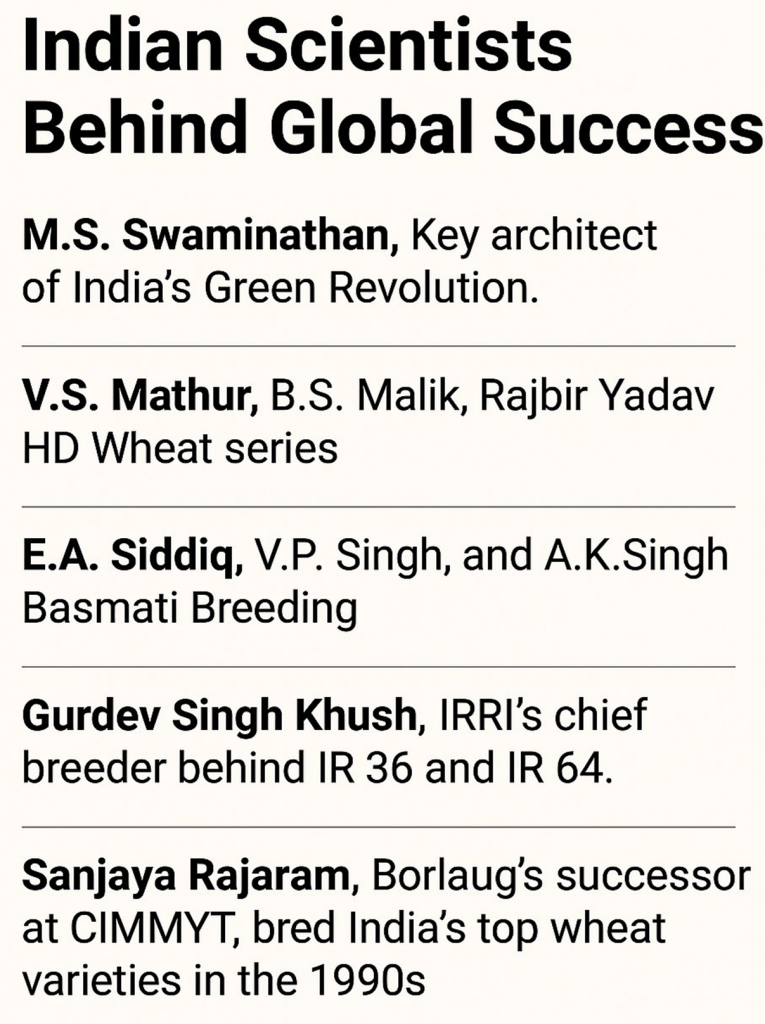
- Later, Indian institutions like the Indian Agricultural Research Institute (IARI) developed indigenous varieties pushing yields to 7 tonnes/hectare.
- In rice, IARI and regional institutes released iconic varieties like Swarna (1982), Samba Mahsuri (1986), and Pusa Basmati 1121 (2003).
- In 2024–25, India exported 6.1 million tonnes of basmati rice worth $5.94 billion, over 90% from IARI-developed varieties.
| Do You Know? – International Maize and Wheat Improvement Center (CIMMYT) bred semi-dwarf wheat varieties like Lerma Rojo 64A, Sonora 63, and Mayo 64, which were first introduced in India in 1964-65. – CIMMYT was funded heavily by the United States Agency For International Development (USAID), and closely associated with Norman Borlaug. 1. USAID provided $83 million of its $211 million grant revenue in 2024. 2. CIMMYT has lost a major funder, with the Trump administration shutting down USAID. – Norman Borlaug’s wheat enabled Indian farmers to achieve 4–4.5 tonnes/hectare, up from 1–1.5 tonnes. – International Rice Research Institute (IRRI)’s rice varieties raised yields from 1–3 tonnes to 4.5 – 10 tonnes/hectare, reducing crop duration to 110–130 days. |
Green Revolution: Legacy & and Its Costs
- Continued Reliance on Global Research: As of 2024–25, 6 of the top 10 wheat varieties sown over 20 million hectares in India were directly derived from CIMMYT material.
- HD 2967 remains the only recent major indigenous variety.
- While northern states thrived, others — especially eastern and central India — remained underdeveloped. The excessive focus on procurement, subsidies, and irrigation for a narrow set of crops led to:
- Soil nutrient depletion and water table collapse.
- Stifled crop diversification and ecological imbalance.
- Farmer dependency on input-intensive monocultures.
Policy Levers to Address the Imbalance
- Decentralized Procurement: Expanding procurement beyond wheat and rice to include pulses, millets, and oilseeds from underserved regions like central India and the Northeast.
- Agroecological Transition: Supporting states to adopt regenerative agricultural practices and reduce chemical dependency.
- Water-Smart Farming: Incentivizing crops suited to local climates and water availability, rather than forcing uniform choices.
- Income Diversification: Promoting agro-processing, farm cooperatives, and access to rural credit to give farmers alternative revenue streams.
- Regional Equity: Diversifying procurement policies to include pulses, oilseeds, and millets from underrepresented regions.
India’s Opportunity and Responsibility
- Despite its gains, India contributed just $0.8 million to CIMMYT and $18.3 million to IRRI in 2024. According to Rajendra Singh Paroda, former DG of ICAR, India should fund strategic and collaborative research in:
- Heat and drought tolerance;
- Nitrogen use efficiency;
- Gene editing;
- Artificial intelligence in breeding
- Recent initiatives like the International Year of Millets, ‘Bringing Green Revolution in Eastern India’ and the push for regenerative farming offer encouraging signals — but scale and sincerity are key.
GST Reforms: Home Minister to open talks for Consensus on Rate Rationalisation
Syllabus: GS2/Indian Polity & Governance; GS3/Indian Economy (Taxation).
Context: In a significant development, the Union Home Minister, Amit Shah, is set to lead discussions with state governments and various central ministries to build a political consensus on the long-pending Goods and Services Tax (GST) rate rationalisation reforms. This intervention at the highest political level signals the government’s seriousness in overhauling the eight-year-old tax regime to make it simpler and more efficient.
What is GST Rate Rationalisation?
- Goal: The primary aim of GST rate rationalisation is to simplify India’s multi-tiered GST structure by reducing the number of tax slabs and correcting classification anomalies and inverted duty structures.
- Current Structure: India’s GST regime, implemented in 2017, operates with five major slabs: 0%, 5%, 12%, 18%, and 28%, in addition to special cess rates on luxury and sin goods and different rates for precious metals.
- The Core Proposal: A key proposal that has been hanging fire for a long time is the removal of the 12% GST slab. The idea is to merge this slab by shifting items to either the lower 5% slab (for essential goods) or the higher 18% slab (for semi-essential and other goods).
Why is Rate Rationalisation Needed?
- Simplification: The current multi-slab structure leads to confusion for businesses, especially small and medium enterprises (MSMEs), and creates classification disputes. A simplified structure would enhance the “ease of doing business.”
- Addressing Inverted Duty Structure: In many sectors (e.g., textiles, footwear), the GST rate on finished goods is lower than the rate on raw materials, leading to an “inverted duty structure.” This blocks the flow of Input Tax Credit (ITC) and negatively impacts the working capital of businesses.
- Reducing Litigation: Ambiguity in tax rates and classification leads to a large number of tax disputes and litigation. A clear and simplified structure would minimize these issues.
- Improving Revenue: While the immediate effect of rationalisation might be a revenue loss, a simpler and more transparent system can lead to better compliance, a broader tax base, and improved tax buoyancy in the long run.
Key Challenges and The Need for Consensus
The rate rationalisation process has been stalled for years due to several contentious issues, and this is where the Home Minister’s intervention is crucial:
- Revenue Loss Concerns: The primary reason for states’ reluctance is the estimated revenue loss of ₹70,000-₹80,000 crore if the 12% slab is scrapped. States, both from the ruling and opposition parties, are wary of this financial hit, especially as the GST compensation cess, which was meant to offset revenue loss, has now ended.
- Impact on Consumers: Shifting items from the 12% to the 18% slab could lead to an inflationary impact on common-use items like packaged foods, household goods, and medical products. Any such move is politically sensitive and requires broad support.
- The Federal Nature of GST: The GST Council, which is a joint forum of the Centre and states, requires a majority of not less than three-fourths of the weighted votes for any decision. The Centre has one-third of the voting power, while the states collectively have two-thirds. This necessitates a strong consensus-based approach, which the Home Minister is now tasked with building.
Way Forward
The Home Minister’s involvement marks a shift from a purely technical discussion in the GST Council to a high-level political negotiation. This is expected to:
- Accelerate Reforms: Provide the political impetus needed to break the deadlock and move forward on the reforms.
- Address States’ Concerns: Allow for direct engagement with state governments to address their revenue fears and find a mutually acceptable solution.
- Strengthen Cooperative Federalism: Showcase how a federal institution like the GST Council can be made more effective through political will and dialogue.
The success of these reforms will not only simplify India’s tax system but also have a significant impact on the country’s economic growth and competitiveness.
Environment Ministry Exempts 78% of Coal Plants from Installing FGD Systems
Syllabus: GS3/Environment and Ecology (Conservation, Environmental Pollution and Degradation); Government Policies and Interventions.
Context: The Ministry of Environment, Forest, and Climate Change (MoEFCC) has revised its emission norms, effectively exempting a large majority of India’s thermal power plants from installing Flue-Gas Desulphurisation (FGD) systems. This decision, which has been widely criticized by environmentalists, marks a significant shift in India’s policy on air pollution from the power sector.
What are FGD Systems?
- Purpose: FGD systems are devices installed in coal-based power plants to remove Sulphur Dioxide (SO2) from the exhaust flue gases before they are released into the atmosphere.
- Mechanism: They work by passing the flue gas through a chemical absorbent (usually a limestone slurry) which reacts with the SO2 to produce a by-product, most commonly gypsum, a key component in cement manufacturing.
- Necessity: SO2 is a major air pollutant that causes acid rain and contributes to the formation of particulate matter (PM2.5), which is a key driver of respiratory diseases.
The Revised Emission Norms and Exemptions
- The Original Mandate (2015): In 2015, the MoEFCC had mandated all thermal power plants to install FGD systems by a set deadline to reduce SO2 emissions. This was a crucial step to tackle India’s severe air pollution crisis.
- The New Exemption: The revised rules now state that power plants located in “non-populous areas” and those “not operating at more than half of their plant load factor (PLF)” will be exempt from installing FGD systems.
- The Impact: According to the Centre for Research on Energy and Clean Air (CREA), this new policy will exempt 78% of India’s coal-fired thermal power capacity from installing this crucial pollution control technology.
Justification for the Revisions
The government and power sector have put forth several arguments to justify the revised norms:
- High Cost of Installation: The installation of FGD systems is capital-intensive, with costs ranging from ₹40-50 lakh per megawatt. Power companies have long argued that this would significantly increase electricity tariffs and make power generation unviable.
- Operational Viability: The argument is that plants operating at a low PLF do not contribute as much to pollution and the cost of installing and running FGDs would be uneconomical for them.
- Technology Challenges: There have been issues with the import of equipment, a lack of skilled personnel, and delays in the supply chain for FGD components.
- No Direct Link to Population Centers: The “non-populous areas” argument is that these plants are not a direct threat to public health as they are located away from cities and major towns.
Criticism from Environmentalists
Environmental groups and air quality experts have heavily criticized the decision, labeling it a major step backward in India’s fight against air pollution.
- Ignoring Health Impacts: Critics argue that the “non-populous areas” argument is flawed. Air pollutants, particularly fine particulate matter and SO2, do not respect geographical boundaries and can travel long distances, affecting communities far from the source.
- Risking Public Health: The revised norms directly contradict India’s own national clean air goals and will have a detrimental impact on public health, especially for the communities living near these power plants.
- Diluting Climate Commitments: The decision is also seen as a dilution of India’s climate commitments and a missed opportunity to transition to a cleaner, more sustainable energy mix.
- Creating a Loopholes: The “non-populous” and “low PLF” definitions are seen as loopholes that could be easily exploited by the power companies to avoid compliance.
Way Forward
The decision highlights the ongoing tension between economic development and environmental protection. While the government’s aim to keep electricity costs in check is understandable, the long-term health and environmental costs of this policy could be far greater.
- Need for Green Transition: The episode underscores the urgent need for a faster transition to renewable energy sources, which would negate the need for such contentious decisions.
- Robust Regulatory Framework: Experts have called for a more robust and transparent regulatory framework with strict enforcement and real-time public monitoring of emissions from power plants.
Nomination to Rajya Sabha
Syllabus: GS2/Indian Polity (Parliament); GS1/Indian Art & Culture.
What is Nomination to the Rajya Sabha?
The Rajya Sabha, or the Council of States, is the upper house of the Indian Parliament. While the majority of its members are indirectly elected by the State Legislative Assemblies, a specific number of members are nominated by the President of India. This unique feature of the Indian Constitution is based on the principle of providing a place in Parliament for eminent persons who have contributed significantly to society but may not be inclined to contest elections.
Constitutional Provisions and The Rationale
- Article 80 (3) of the Constitution: This article lays down the power of the President to nominate members to the Rajya Sabha.
- Number of Nominated Members: The President nominates 12 members to the Rajya Sabha.
- Fields of Expertise: The Constitution specifies that these nominated members should be persons who have special knowledge or practical experience in the fields of:
- Art
- Literature
- Science
- Social Service
- Rationale: The rationale behind this provision, as articulated by the framers of the Constitution, was to ensure that the Council of States would not only represent the political will of the states but would also be enriched by the expertise and wisdom of eminent individuals who might not otherwise be able to enter the political arena. It allows for non-partisan, distinguished voices to contribute to legislative debates.
Process and Term
- Term: Nominated members, like the elected members, serve a term of six years.
- Retirement: One-third of the members retire every second year, and fresh nominations are made at the beginning of the third year to fill the vacancies.
- Disqualification: A nominated member is disqualified from the Rajya Sabha if they join a political party after the expiry of six months from the date on which they take their seat in the House. This provision is part of the Anti-Defection Law (Tenth Schedule) and is designed to ensure that nominated members remain non-partisan for a reasonable period.
Comparison with Other Houses
- Lok Sabha: Unlike the Rajya Sabha, the President’s power to nominate members to the Lok Sabha was discontinued. Previously, the President could nominate two members from the Anglo-Indian community if they were not adequately represented. This provision was abolished by the 104th Constitutional Amendment Act, 2019.
- American Senate: In contrast to India’s Rajya Sabha, the American Senate does not have any nominated members. All members are directly elected by the people of their respective states.
Notable Nominated Members
Over the years, India has seen a wide range of distinguished individuals nominated to the Rajya Sabha, including:
- Prithviraj Kapoor (Art)
- Maithili Sharan Gupt (Literature)
- Satyendranath Bose (Science)
- Rukmini Devi Arundale (Art)
- Dr. Lokesh Chandra (Art & Literature)
- Ilaiyaraaja (Art)
- Sudha Murty (Social Service)
- P. T. Usha (Sports)
Jarawa Tribe
The Jarawa are an indigenous tribe residing in the Andaman Islands of India. They are one of the most isolated and ancient communities in the world, with a history spanning back thousands of years. They are a crucial component of India’s unique socio-cultural and biological heritage.
Key Facts
- Location: The Jarawa live in the dense evergreen forests of the Middle and South Andaman Islands. Their territory is a legally protected reserve.
- Official Status: They are one of the six main indigenous tribes of the Andaman and Nicobar Islands and are officially classified as a Particularly Vulnerable Tribal Group (PVTG) by the Government of India.
- Ancestry and Demographics: The Jarawa are believed to be of Negrito descent, with physical features such as short stature, dark skin, and curly hair. Their population is relatively small, with recent estimates placing their numbers at around 647, a steady increase from 260 in 1998, attributed to improved healthcare and limited external interference.
- Lifestyle: The Jarawa are a nomadic, hunter-gatherer community. They live in small groups of 40-50 individuals and rely on hunting wild pigs and turtles, fishing with bows and arrows in the coral reefs, and foraging for fruits, roots, and honey.
- Language: They speak the Jarawa language, which is not related to modern Indian languages and is part of the Andamanese language family.
Challenges and Threats
Despite legal protections, the Jarawa tribe faces significant threats to their survival and cultural integrity:
- “Human Safaris” and Tourism: The Andaman Trunk Road (ATR), which cuts through the Jarawa Reserve, has become a route for tourists to engage in “human safaris.” This illegal practice involves tourists airdropping food and gifts to the tribe, treating them as a spectacle, which is a gross violation of their dignity and has led to a number of legal and ethical concerns.
- Disease Vulnerability: Due to their prolonged isolation, the Jarawa have low immunity to common diseases. Contact with outsiders, including tourists, poachers, and settlers, has led to outbreaks of diseases like measles and malaria, which pose a severe risk to their population.
- Poaching and Encroachment: Illegal poaching and encroachment on the Jarawa’s territory by outsiders for timber and wildlife deplete the natural resources they depend on for their survival.
- Forced Integration: There is a persistent debate about whether to allow the tribe to live in isolation or to integrate them into the mainstream. Activist groups and legal bodies largely advocate for a policy of non-interference, arguing that forced integration has had disastrous consequences for other similar tribes (e.g., the Great Andamanese and Onge).
Government Policies and Legal Safeguards
- PVTG Status: The government’s classification of the Jarawa as a PVTG provides them with special legal protection and targeted welfare programs.
- Jarawa Tribal Reserve: The Jarawa territory is a designated reserve, protected under the Andaman and Nicobar (Protection of Aboriginal Tribes) Regulation, 1956. This regulation aims to safeguard the tribes from outside interference.
- Legal Action: The government has introduced stricter laws and punishments for those who enter the Jarawa Reserve without permission, take photos or videos, and engage in “human safaris.” The Andaman and Nicobar (Protection of Aboriginal Tribes) Amendment Regulation, 2012 makes such acts a punishable offense.
- No Contact Policy: The official policy is to protect the Jarawa from contact with outsiders. The Andaman and Nicobar Islands Administration also operates an autonomous body, the Andaman Adim Janjati Vikas Samiti (AAJVS), to protect and support the Jarawa and other aboriginal tribes.
The Jarawa tribe represents a delicate balance between modernization and the preservation of a unique human culture. The ongoing efforts to protect their rights and habitat are crucial for ensuring the survival of one of the world’s last remaining isolated communities.
