
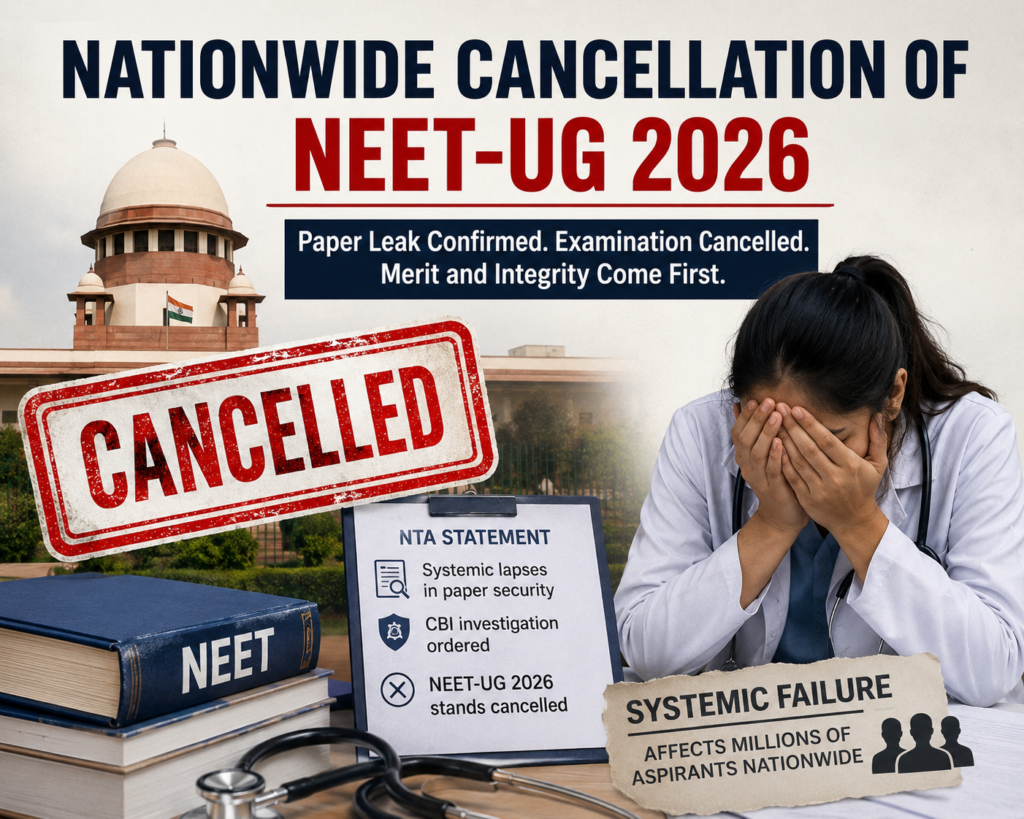
1. Nationwide Cancellation of NEET-UG 2026
Syllabus
- GS Paper II: Governance, Transparency, Accountability; Issues relating to the development and management of Social Sector/Services relating to Education.
- GS Paper II: Functions and responsibilities of the Union and the States, issues and challenges pertaining to the federal structure.
Context
- The Union Ministry of Education cancelled the NEET-UG 2026 examination following systemic paper leak confirmations.
- The CBI has taken over the investigation from state police forces to trace the interstate networks involved in the malpractice.
Main Body: Multi-Dimensional Analysis
- Institutional & Governance Dimension:
- Exposes critical vulnerabilities in the National Testing Agency’s (NTA) standard operating procedures (SOPs) regarding secure question paper transit.
- Highlights the danger of hyper-centralizing critical public examinations, creating a “single point of failure” for millions of aspirants.
- Raises questions about the regulatory oversight of outsourced private vendors used for logistics and digital monitoring at exam centers.
- Federal Dimension:
- Reignites the Centre-State debate over the Concurrent List status of Education.
- Vindicates states that have historically opposed NEET, arguing that centralized exams infringe on state autonomy in medical admissions and local healthcare planning.
- Socio-Economic & Equity Dimension:
- Disproportionately impacts marginalized and rural students who cannot afford the financial runway to drop another year for a re-examination.
- Reinforces the dominance of the unregulated “coaching mafia,” which exploits student anxieties and creates an unequal playing field favoring affluent candidates.
- Ethical & Psychological Dimension:
- Triggers immense psychological distress and loss of morale among honest aspirants.
- Erodes public trust in state institutions, compromising the foundational meritocracy required to build a competent medical workforce.
Positives, Negatives, and Government Schemes
| Dimension | Key Points (200 Words Summary) |
|---|---|
| Positives (of Cancellation) | • Restores the ultimate sanctity of merit by denying an unfair advantage to corrupt candidates. • Prevents unqualified individuals from entering the critical healthcare sector. • Acts as a catalyst for sweeping systemic overhauls and digital security upgrades in the NTA. |
| Negatives | • Massive financial and psychological burden on honest students. • Disrupts the national academic calendar, delaying the commencement of the first-year MBBS curriculum. • International embarrassment regarding India’s capacity to conduct fair assessments. |
| Govt. Schemes & Interventions | • Public Examinations (Prevention of Unfair Means) Act: Invoked to ensure non-bailable, stringent punishments. • Radhakrishnan Committee (2024): Recommendations being fast-tracked for NTA reform. • National Education Policy (NEP) 2020: Push for staggered, multiple-attempt assessment models. |
Examples
- Historical Parallel: The 2015 AIPMT cancellation by the Supreme Court over localized cheating devices, which originally led to the demand for a stricter NEET mechanism.
- State-Level Failures: The Vyapam Scam in Madhya Pradesh, demonstrating the long-term institutional damage of medical entrance fraud.
Way Forward
- Decentralized Diagnostic Testing: Transition from a high-stakes, single-day exam to a tiered “Student Success Journey” framework, utilizing continuous assessments rather than a make-or-break diagnostic test.
- Technological Fortification: Implement blockchain-encrypted question papers that only decrypt at the exam center 15 minutes prior, using biometric keys of center superintendents.
- Regulatory Crackdown: Formulate an autonomous statutory body specifically to regulate, audit, and tax the parallel coaching industry.
- Situational Crisis Management: Future administrators must apply a L.E.A.D.S. framework (Logical tracking, Ethical grounding, Actionable reform, Democratic federal consensus, Solution-oriented assessment) to resolve testing crises without alienating state governments.
Practice Mains Question
Critically evaluate the efficacy of the National Testing Agency (NTA) in maintaining the sanctity of public examinations. Should medical entrance tests be decentralized back to the states? Discuss. (250 words, 15 marks)
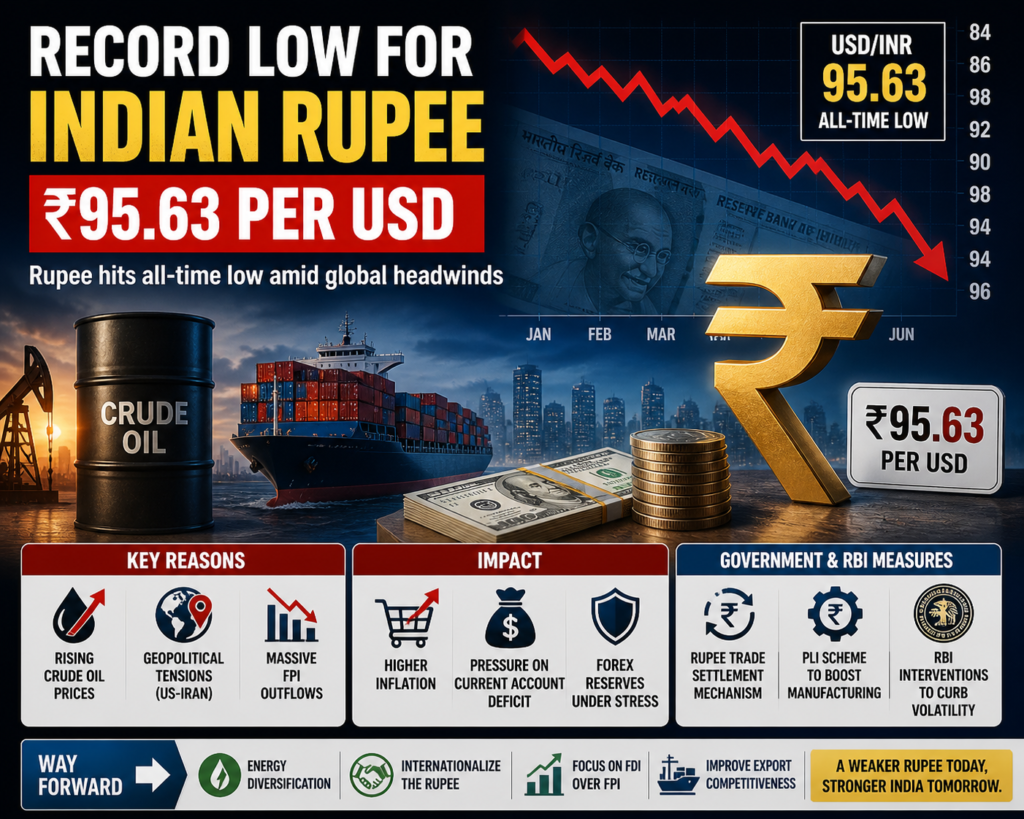
2. Record Low for Indian Rupee (₹95.63/$)
Syllabus
- GS Paper III: Indian Economy and issues relating to planning, mobilization, of resources, growth, development and employment.
- GS Paper III: Effects of liberalization on the economy, changes in industrial policy.
Context
- The Indian Rupee touched a historic low of ₹95.63 against the US Dollar.
- This depreciation is driven by a toxic combination of spiking Brent crude oil prices, escalating geopolitical tensions in the Middle East (US-Iran), and massive Foreign Portfolio Investment (FPI) outflows.
Main Body: Multi-Dimensional Analysis
- Macroeconomic Dimension:
- Imported Inflation: As India imports ~85% of its crude oil, a weaker rupee makes energy imports drastically more expensive, cascading into higher logistics and manufacturing costs.
- Current Account Deficit (CAD): The widening gap between the value of imports and exports will put structural pressure on the CAD, threatening macroeconomic stability.
- Forex Depletion: The RBI is forced to burn through its dollar reserves to defend the rupee from extreme volatility, limiting future buffers.
- Corporate & Sectoral Dimension:
- Importers suffer: Sectors reliant on imported raw materials (electronics, heavy machinery, pharmaceuticals/APIs) face severe margin compressions.
- Exporters gain (temporarily): IT services, textiles, and pharma exporters receive higher realizations in rupee terms, though global demand slowdowns may mute this benefit.
- External Commercial Borrowings (ECBs): Indian corporates with unhedged dollar-denominated debt face an immediate spike in their repayment burdens.
- Geopolitical & Strategic Dimension:
- Exposes India’s strategic vulnerability to Middle Eastern chokepoints (Strait of Hormuz) and petrodollar dominance.
- Accelerates the urgency to establish alternate payment systems bypassing the SWIFT network.
Positives, Negatives, and Government Schemes
| Dimension | Key Points (200 Words Summary) |
|---|---|
| Positives | • Makes Indian exports highly competitive in the global market. • Increases the domestic value of inward remittances from the Indian diaspora (crucial for states like Kerala). • Acts as a natural deterrent to non-essential imports, promoting domestic manufacturing. |
| Negatives | • Severe inflationary pressure, directly impacting the common man through fuel and food prices. • Flight of foreign capital out of Indian equity and debt markets. • Increases the fiscal deficit if the government absorbs fuel price hikes via excise duty cuts. |
| Govt. Schemes & Interventions | • Rupee Trade Settlement Mechanism: RBI’s push to settle international trade (especially with Russia/UAE) in INR via Vostro accounts. • PLI Scheme: To boost domestic manufacturing and reduce import dependence (e.g., electronics). • Forex Interventions: RBI’s dynamic selling of USD from its reserves to curb erratic volatility. |
Examples
- The 2013 “Taper Tantrum”: When the US Federal Reserve signaled a reduction in quantitative easing, causing the Rupee to crash nearly 20% in months, forcing emergency RBI rate hikes.
- Sri Lankan Crisis (Reference): How unchecked currency depreciation, combined with forex depletion, can lead to sovereign defaults.
Way Forward
- Energy Diversification: Aggressively accelerate the transition to renewables (National Green Hydrogen Mission) to structurally reduce the crude import bill.
- Internationalization of Rupee: Expand UPI-PayNow linkages and aggressively negotiate Free Trade Agreements (FTAs) that include INR settlement clauses.
- FDI over FPI: Shift policy focus from attracting volatile “hot money” (portfolio investments) to securing stable, long-term Foreign Direct Investment (FDI).
- Export Competitiveness: Move away from relying purely on currency depreciation for export growth; focus on improving logistics, reducing red tape, and moving up the global value chain.
Practice Mains Question
“A depreciating currency is a double-edged sword for a developing economy.” Analyze the impact of the falling Rupee on India’s macroeconomic stability and suggest measures to insulate the economy from global financial shocks. (250 words, 15 marks)
3. Launch of “One Case One Data” & “Su Sahay” AI
Syllabus
- GS Paper II: Structure, organization, and functioning of the Judiciary. E-governance applications, models, successes, limitations, and potential.
- GS Paper III: Awareness in the fields of IT, Computers, Robotics, and Artificial Intelligence.
Context
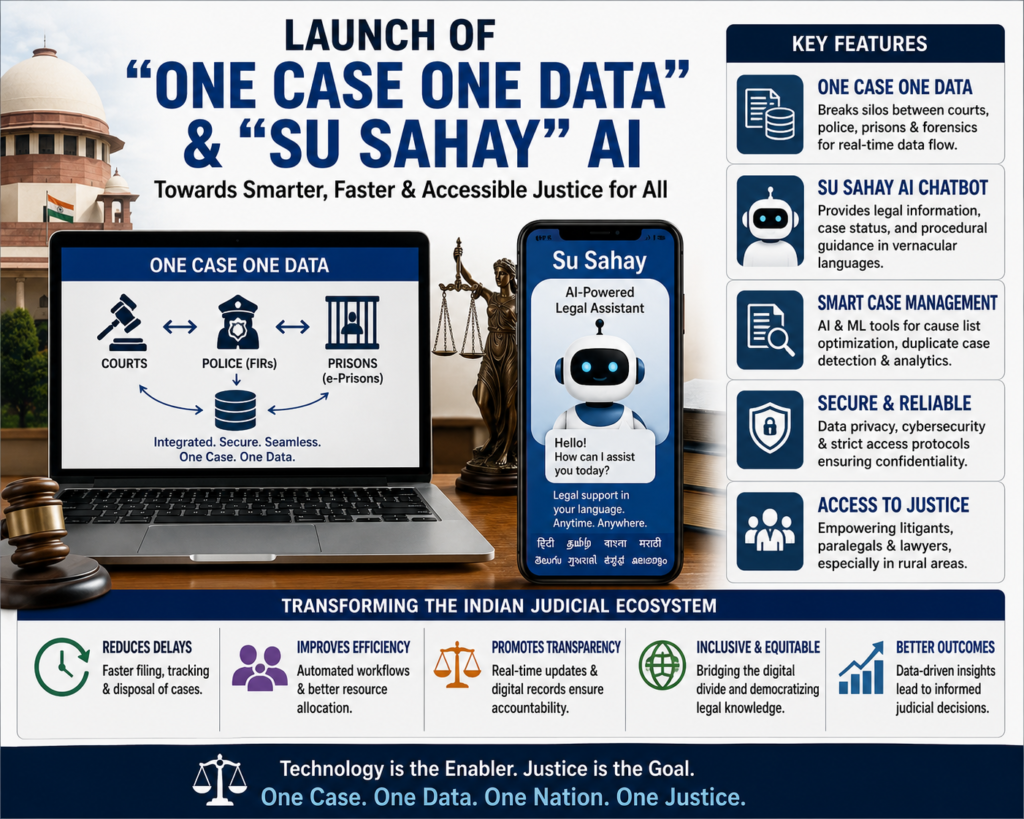
- The Chief Justice of India launched the “One Case One Data” initiative for national judicial integration.
- Simultaneously, “Su Sahay,” a natively developed AI-powered judicial assistance chatbot, was unveiled to aid litigants, paralegals, and judges.
Main Body: Multi-Dimensional Analysis
- Judicial Efficiency Dimension:
- Targets the colossal pendency of over 5 crore cases across Indian courts by automating administrative tracking and streamlining filing processes.
- “One Case One Data” breaks down departmental silos, allowing seamless data flow between police (FIRs), prisons (e-Prisons), and courts (e-Courts).
- Technological & AI Dimension:
- “Su Sahay” utilizes Natural Language Processing (NLP) to parse complex legal jargon into vernacular languages, democratizing legal access.
- Employs machine learning algorithms for predictive analysis on case scheduling, identifying duplicate litigations, and clustering similar cases for joint hearings.
- Ethical & Jurisprudential Dimension:
- Raises concerns about “algorithmic bias”—if the AI is trained on historical data containing systemic caste or gender biases, it may replicate them in bail predictions or sentencing recommendations.
- The “black box” nature of AI challenges the judicial principle that reasoning for a decision must be transparent and clearly articulated.
- Rights & Access Dimension:
- Bridges the digital divide for undertrials who lack the financial capacity to hire premium legal counsel for basic procedural queries.
- Poses a risk to data privacy, necessitating strict firewalls around sensitive case data involving juveniles or sexual assault survivors.
Positives, Negatives, and Government Schemes
| Dimension | Key Points (200 Words Summary) |
|---|---|
| Positives | • Drastic reduction in administrative delays and paperwork. • Empowers citizens with vernacular legal knowledge, reducing dependency on exploitative middlemen. • Improves Ease of Doing Business by speeding up commercial contract enforcement. |
| Negatives | • Risk of AI “hallucinations” providing incorrect legal precedents to litigants. • Severe cybersecurity vulnerabilities; judicial databases are prime targets for ransomware attacks. • Excludes the digitally illiterate population who lack smartphone access. |
| Govt. Schemes & Interventions | • Inter-operable Criminal Justice System (ICJS): Integrating courts, police, and forensics. • e-Courts Phase III: Funded with ₹7,000+ crores for cloud infrastructure and paperless courts. • SUVAS & SUPACE: Predecessor AI tools for translation and factual extraction in the Supreme Court. |
Examples
- Global Precedent: The use of AI in Colombia, where a judge controversially used ChatGPT to help structure a ruling on a child’s medical rights, sparking global debate on AI in jurisprudence.
- Domestic Use Case: The Punjab & Haryana High Court using AI (ChatGPT) in 2023 to seek a broader perspective on bail jurisprudence in an assault case.
Way Forward
- Human-in-the-Loop (HITL) Mandate: Ensure AI remains strictly an assistive technology (“Su Sahay”) for factual extraction, never replacing the human judge’s interpretative wisdom.
- Algorithmic Auditing: Establish an independent Judicial Technology Committee to regularly audit “Su Sahay” for inherent societal biases and accuracy.
- Digital Legal Literacy: Run grassroots campaigns alongside localized Common Service Centres (CSCs) to help marginalized groups utilize the AI chatbot.
- Strict Data Sovereignty: Enact judicial data protection guidelines ensuring “One Case One Data” servers are localized and immune to commercial AI scraping.
Practice Mains Question
Discuss the transformative potential of Artificial Intelligence in the Indian judicial system. What ethical and administrative safeguards are necessary to ensure that AI integration does not compromise the principles of natural justice? (250 words, 15 marks)
4. SEHAT Mission Launch (Science Excellence for Health through Agricultural Transformation)
Syllabus
- GS Paper II: Issues relating to poverty and hunger; Issues relating to the development and management of Social Sector/Services relating to Health.
- GS Paper III: Technology missions; e-technology in the aid of farmers; Food processing and related industries in India.
Context
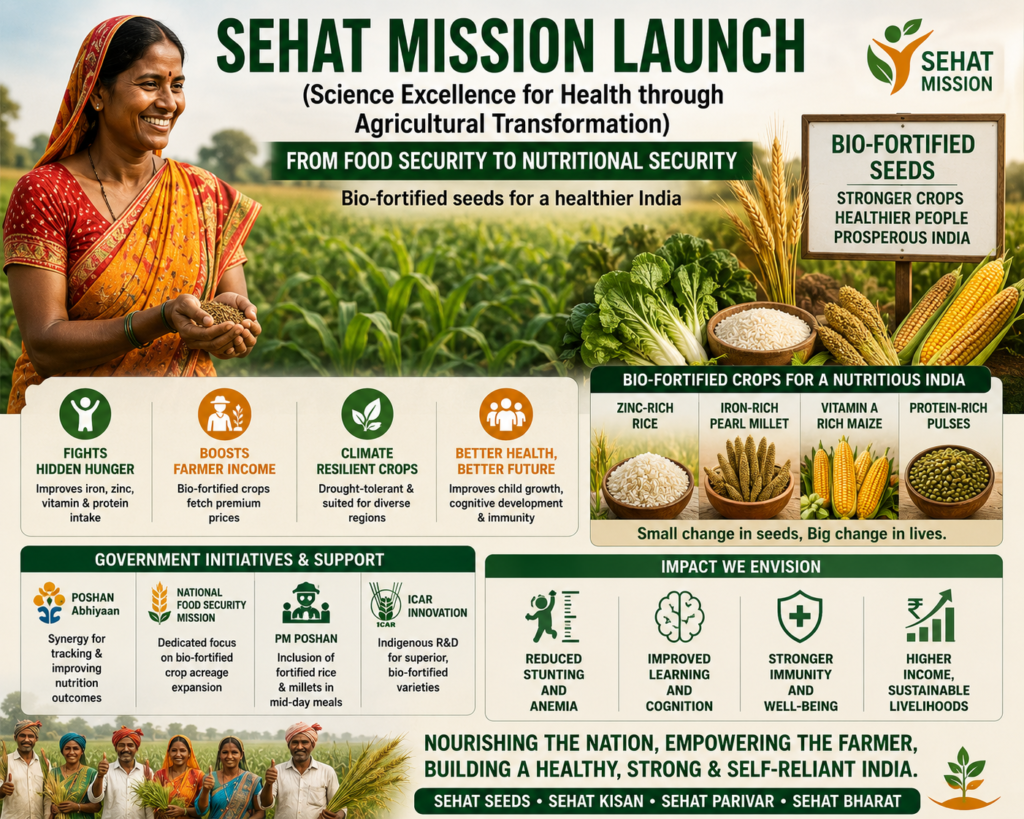
- The Union Ministries of Health and Agriculture jointly launched the SEHAT Mission.
- The initiative shifts the national focus from mere “food security” (caloric intake) to “nutritional security” by mass-distributing bio-fortified seeds to rural farmers.
Main Body: Multi-Dimensional Analysis
- Nutritional & Health Dimension: Addresses India’s silent epidemic of “hidden hunger” (micronutrient deficiencies like iron, zinc, and Vitamin A), which stunts cognitive development and exacerbates maternal mortality.
- Agrarian & Economic Dimension: Bio-fortified crops generally command a premium price in urban markets, potentially increasing farmer income while simultaneously improving their household consumption quality.
- Technological Dimension: Promotes indigenous agritech innovation by the Indian Council of Agricultural Research (ICAR), bypassing controversial Genetically Modified (GM) routes in favor of conventional breeding and advanced CRISPR gene-editing tools.
- Climate Resilience Dimension: Many bio-fortified variants (like zinc-rich millet) are inherently drought-resistant, aligning nutritional goals with climate-adaptive agriculture in rain-fed regions.
Positives, Negatives, and Government Schemes
| Dimension | Key Points (200 Words Summary) |
|---|---|
| Positives | • Cost-effective, long-term solution compared to medical supplementation (pills/syrups). • Leverages existing agricultural supply chains to reach remote tribal belts. • Dual benefit of improving soil health and human health through crop diversification. |
| Negatives | • Risk of corporate seed monopolies if private agritech firms dominate the patent landscape. • Potential initial resistance from farmers due to fears of lower crop yields compared to standard High-Yielding Varieties (HYVs). • Lack of consumer awareness regarding the visual or taste differences of fortified foods. |
| Govt. Schemes & Interventions | • Poshan Abhiyaan (National Nutrition Mission): Synergy with SEHAT to track stunting and wasting metrics. • National Food Security Mission (NFSM): Upgraded to include specific sub-targets for bio-fortified crop acreage. • PM-POSHAN: Incorporating fortified rice and millets into mid-day school meals. |
Examples
- ICAR Successes: The widespread adoption of “Madhuban Gajar” (bio-fortified carrot rich in B-carotene and iron) and “CR Dhan 310” (high-protein rice).
- Global Parallel: The HarvestPlus initiative in Sub-Saharan Africa, which successfully reduced zinc deficiency through fortified maize.
Way Forward
- PDS Integration: Mandate the procurement of bio-fortified crops at Minimum Support Price (MSP) for distribution through the Public Distribution System (PDS).
- Consumer Awareness Campaigns: Launch aggressive behavioral change campaigns to create urban market demand for fortified local produce.
- Seed Subsidies: Provide 100% subsidized bio-fortified seed kits to small and marginal farmers during the initial three-year transition period.
- L.E.A.D.S. Implementation: Utilize the L.E.A.D.S. framework (Logical mapping of nutrient deficient zones, Ethical seed pricing, Actionable extension services, Democratic farmer consultations, Sustainable yield tracking) for localized rollout.
Conclusion Transitioning from a calorie-centric agricultural model to a nutrition-centric one is vital for India’s demographic dividend. The SEHAT Mission represents a paradigm shift where agriculture becomes the primary preventative healthcare tool for the nation.
Practice Mains Question
“To eliminate hidden hunger, India must look beyond the pharmacy and into the farm.” Discuss the significance of bio-fortification in achieving nutritional security in India, highlighting the challenges in its large-scale adoption. (250 words, 15 marks)
5. Constitutional Crisis: Speaker’s Role & Floor Tests
Syllabus
- GS Paper II: Indian Constitution—historical underpinnings, evolution, features, amendments, significant provisions; State Legislatures—structure, functioning, conduct of business, powers & privileges.
- GS Paper II: Separation of powers between various organs, dispute redressal mechanisms.
Context
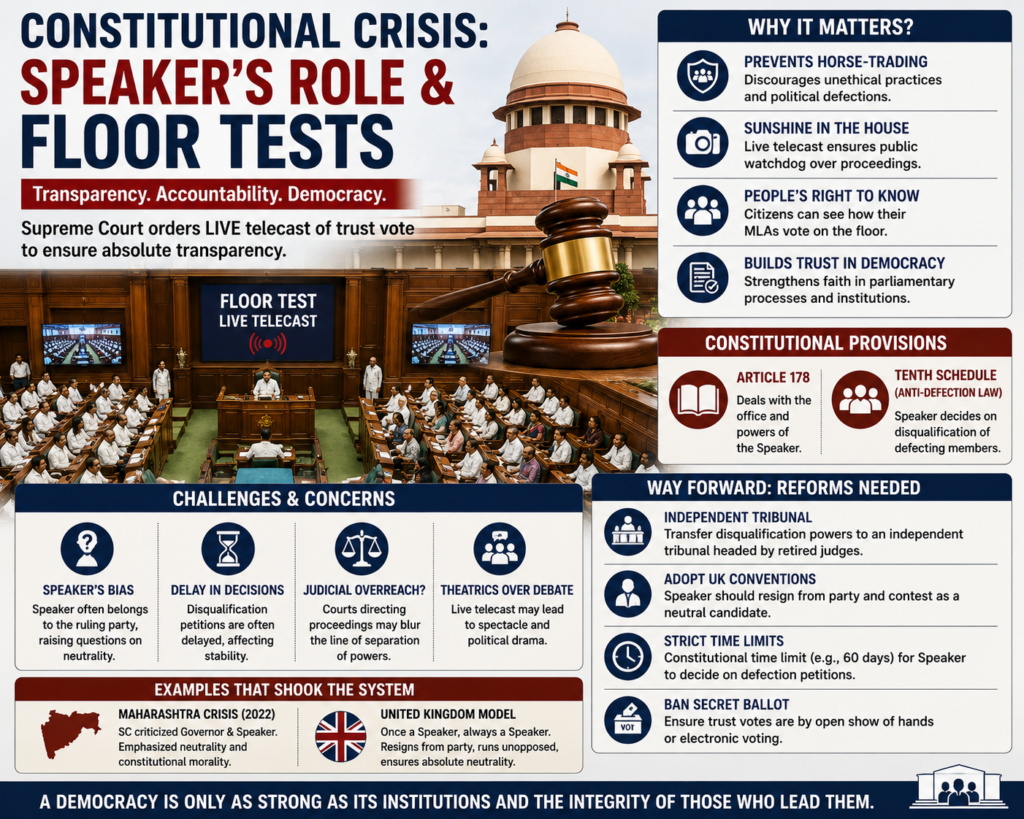
- A high-stakes floor test was mandated in the Tamil Nadu Assembly under the newly appointed Speaker.
- In a democratic first, the Supreme Court ordered the live telecast of the trust vote to ensure absolute transparency and curb allegations of partisan manipulation by the Speaker’s office.
Main Body: Multi-Dimensional Analysis
- Constitutional Dimension: Puts the spotlight on Article 178 (office of the Speaker) and the Tenth Schedule (Anti-Defection Law), where the Speaker acts as a tribunal, often accused of delaying disqualification petitions to favor the ruling party.
- Democratic Dimension: The live telecast acts as a digital sunshine law, exposing “resort politics” and horse-trading to the electorate, thereby enforcing direct democratic accountability.
- Judicial Dimension: Tests the limits of judicial review. While the Kihoto Hollohan judgment restricted court intervention prior to a Speaker’s decision, recent trends show the Supreme Court setting strict time limits on Speakers to prevent the subversion of constitutional mandates.
- Ethical Dimension: Highlights the conflict of interest inherent in the Indian system, where the Speaker rarely resigns from their primary political party, making absolute neutrality functionally impossible.
Positives, Negatives, and Government Schemes
| Dimension | Key Points (200 Words Summary) |
|---|---|
| Positives (of Live Telecast & Scrutiny) | • Eliminates physical coercion or fraudulent voice votes during the floor test. • Restores public faith in parliamentary procedures. • Creates historical, unalterable digital records of MLA voting patterns. |
| Negatives | • Judicial overreach into legislative domain breaches the separation of powers (Article 212). • Continuous live broadcasting might lead to grandstanding and theatrical behavior by politicians rather than serious debate. • Does not solve the root cause of defection via monetary inducements. |
| Govt. Schemes & Interventions | • Supreme Court Guidelines (Keisham Meghachandra Case): Mandating Speakers to decide disqualification pleas within three months. • National e-Vidhan Application (NeVA): Digitizing state assemblies for better record-keeping and public tracking. • ADR Electoral Reforms: Push for intra-party democracy and financial transparency. |
Examples
- Maharashtra Crisis (2022): The Supreme Court heavily criticized the Governor and the Speaker’s roles during the split in the Shiv Sena, emphasizing that the Speaker must not act as a political pawn.
- UK Parliamentary Convention: The tradition of “Once a Speaker, always a Speaker,” where the individual resigns from their party and runs unopposed in general elections to guarantee absolute neutrality.
Way Forward
- Independent Tribunal: Amend the Constitution to strip the Speaker of disqualification powers under the Tenth Schedule, transferring them to an independent tribunal headed by retired judges.
- Adopt UK Conventions: Establish a political consensus to adopt the British model, ensuring the Speaker formally severs all party ties upon election.
- Codified Timeframes: Insert explicit constitutional time limits (e.g., 60 days) for the Speaker to resolve defection petitions, after which automatic judicial review triggers.
- Secret Ballot Ban: Strictly prohibit secret ballots in trust votes to ensure constituents know exactly how their representative voted.
Conclusion The sanctity of a parliamentary democracy relies heavily on the impartial umpiring of the Speaker. Without structural reforms to insulate the office from partisan pressures, the anti-defection law will remain a tool of political convenience rather than constitutional morality.
Practice Mains Question
The office of the Speaker in India is characterized by a paradox of immense constitutional power and inherent political bias. Examine this statement in the context of recent floor tests and anti-defection controversies. Suggest systemic reforms. (250 words, 15 marks)
6. Inflation Impact on National Social Assistance Programme (NSAP)
Syllabus
- GS Paper II: Welfare schemes for vulnerable sections of the population by the Centre and States and the performance of these schemes.
- GS Paper III: Indian Economy and issues relating to planning, mobilization of resources, growth, development.
Context
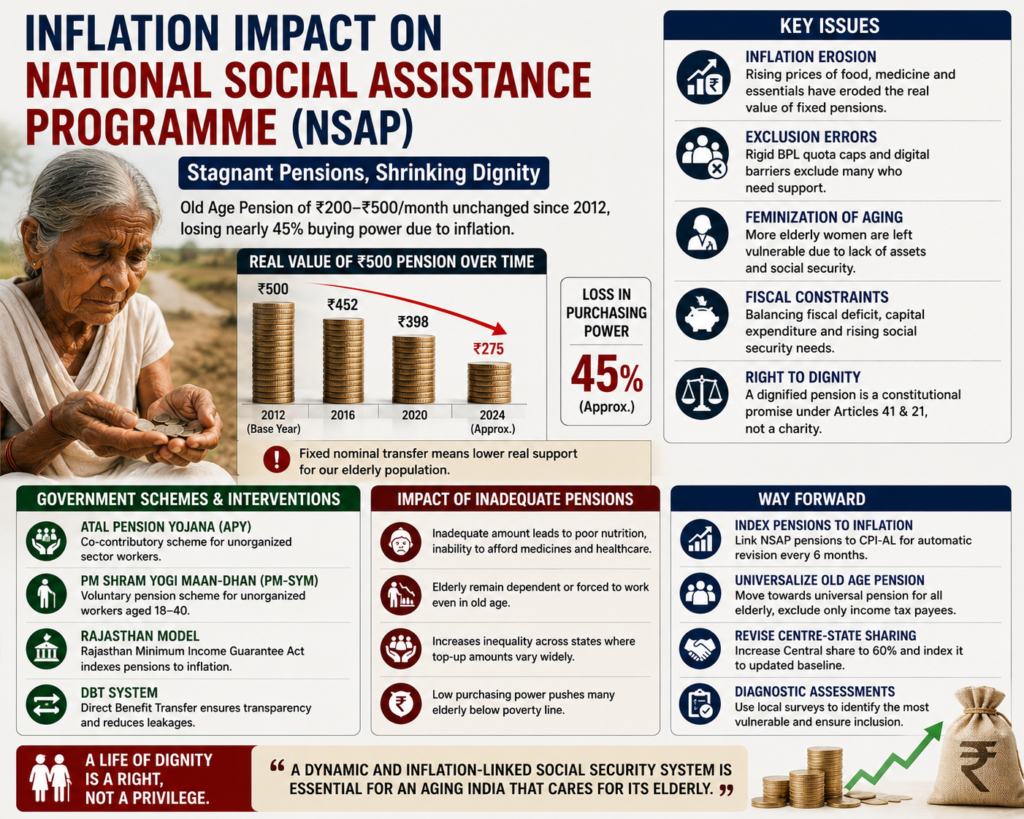
- A new parliamentary committee report revealed that the Centre’s Old Age Pension under the NSAP (stagnant at ₹200–₹500 per month since 2012) has lost nearly 45% of its purchasing power due to cumulative inflation.
- Advocacy groups are demanding an immediate linkage of social pensions to the Consumer Price Index (CPI).
Main Body: Multi-Dimensional Analysis
- Economic Dimension: Fixed nominal transfers suffer from “fiscal drag.” When inflation rises, the real value of the welfare net shrinks, effectively pushing vulnerable populations below the extreme poverty line despite government expenditure.
- Demographic Dimension: India is rapidly aging. With the breakdown of traditional joint family structures and the “feminization of aging” (women living longer but with fewer assets), state-sponsored old-age security is shifting from a moral obligation to a critical economic necessity.
- Fiscal vs. Welfare Dimension: The Finance Ministry faces the “trilemma” of maintaining fiscal deficit targets, expanding capital expenditure, and funding a ballooning social security bill. States currently bear the brunt of topping up the inadequate central contribution.
- Rights-Based Dimension: Under Article 41 (Directive Principles) and Article 21 (Right to Life), civil society argues that a dignified pension is an enforceable fundamental right, not a charitable dole.
Positives, Negatives, and Government Schemes
| Dimension | Key Points (200 Words Summary) |
|---|---|
| Positives (of current NSAP/DBT) | • Direct Benefit Transfer (DBT) has eliminated ghost beneficiaries and massive leakages. • Provides a guaranteed, albeit small, safety net for the poorest rural demographics. • Acts as a financial stimulus that is immediately injected back into the local rural economy. |
| Negatives | • The ₹200 monthly allocation is universally recognized as distressingly inadequate. • Severe exclusion errors due to rigid BPL (Below Poverty Line) quota caps imposed on states. • Heavy reliance on digital infrastructure marginalizes the elderly who lack biometric clarity or banking access. |
| Govt. Schemes & Interventions | • Atal Pension Yojana (APY): Co-contributory scheme targeting the unorganized sector to prevent future old-age poverty. • PM Shram Yogi Maan-dhan (PM-SYM): Voluntary pension scheme for unorganized workers. • Rajasthan Minimum Income Guarantee Act: A state-level model legally indexing pensions to inflation. |
Examples
- State Disparities: While the Centre provides ₹200, states like Andhra Pradesh and Haryana top it up to provide ₹3,000+ per month, creating a highly unequal welfare architecture across borders.
- Latin American Models: Brazil’s BPC program, which legally pegs the minimum social pension to the national minimum wage, preventing inflationary erosion.
Way Forward
- Dynamic Indexation: Immediately legally bind the core NSAP pension amount to the CPI for Agricultural Labourers (CPI-AL), ensuring automatic bi-annual revisions.
- Universalization over Targeting: Move away from flawed BPL lists towards a universal old-age pension system (excluding only income tax payees) to eliminate exclusion errors.
- Centre-State Funding Formula: Revise the fiscal burden-sharing model to a 60:40 ratio indexed to the updated baseline, rather than the static 2012 baseline.
- Diagnostic Assessment integration: Implement localized diagnostic surveys at the Panchayat level to prioritize widows, disabled elderly, and PVTGs for accelerated disbursement.
Conclusion Social security for the elderly must be viewed as deferred macroeconomic maintenance rather than a sunk cost. Failing to inflation-index the NSAP renders the welfare state hollow, undermining the very constitutional promise of a life with dignity.
Practice Mains Question
“A static welfare architecture in an inflationary economy is a regression of social justice.” Analyze the performance of the National Social Assistance Programme (NSAP) in providing a dignified life to the elderly. Should social pensions be universalized and indexed to inflation? (250 words, 15 marks)
7. India to Host Asian Weightlifting Championships
Syllabus
- GS Paper II: Issues relating to development and management of Social Sector/Services relating to Health, Education, Human Resources (Sports infrastructure).
- GS Paper II: Bilateral, regional and global groupings and agreements involving India and/or affecting India’s interests (Soft Power Diplomacy).
Context
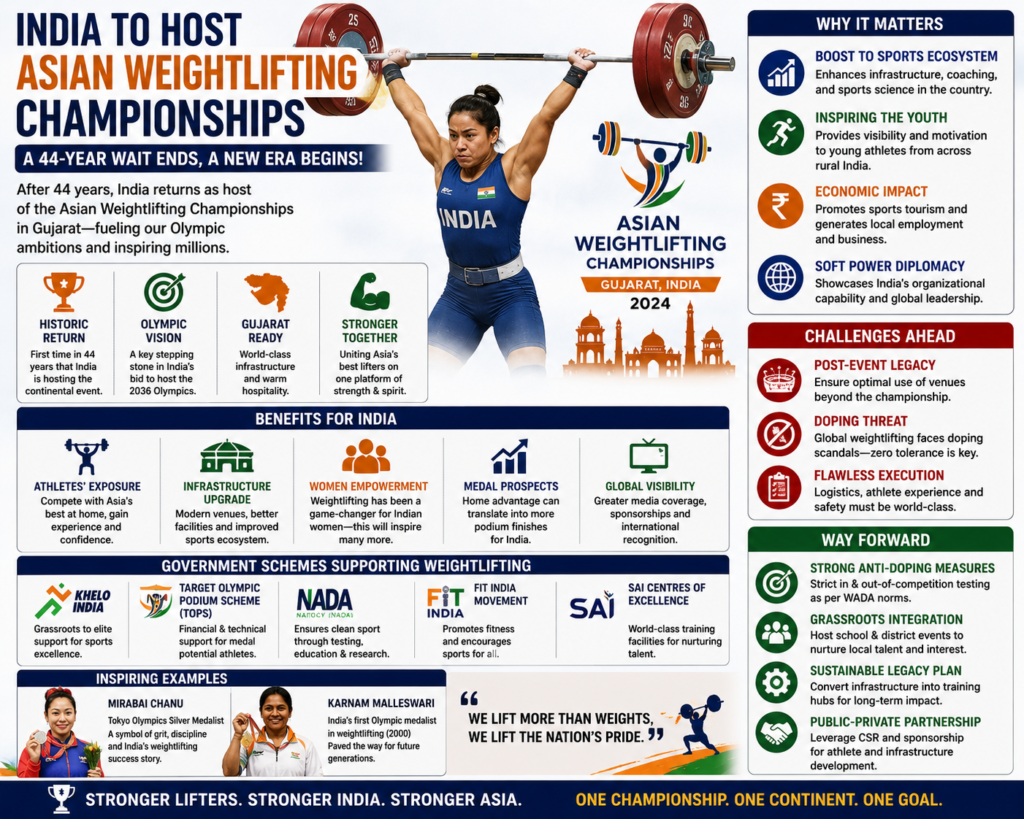
- India has been officially selected to host the Asian Weightlifting Championships in Gujarat.
- This marks a monumental return of the continental event to Indian soil after a 44-year hiatus, serving as a critical precursor to India’s aggressive bid for the 2036 Olympic Games.
Main Body: Multi-Dimensional Analysis
- Strategic Soft Power Dimension: * Hosting major sporting events is a classic tool of public diplomacy. It projects state capacity, administrative efficiency, and economic stability to the global community.
- It shifts India’s geopolitical narrative from a developing nation struggling with basic infrastructure to an emerging superpower capable of managing global spectacles.
- Sports Infrastructure & Ecosystem Dimension:
- Centralized events force the rapid modernization of tier-2 city infrastructure (stadiums, transit systems, hospitality). Gujarat is positioning itself as the undisputed sports capital of India.
- Exposes domestic athletes, coaches, and sports administrators to international standards of sports science, biomechanics, and physiotherapy right at home.
- Socio-Economic Dimension:
- Weightlifting in India has traditionally been a “way out of poverty” for rural and marginalized youth, particularly women (e.g., Mirabai Chanu, Karnam Malleswari).
- Bringing the championship home provides unprecedented visibility, potentially unlocking massive corporate sponsorships and CSR funding for grassroots academies that struggle with basic equipment costs.
- Ethical & Regulatory Dimension (Anti-Doping):
- Weightlifting globally is plagued by systemic doping scandals, repeatedly threatening its Olympic status. India’s own National Anti-Doping Agency (NADA) faces severe scrutiny. Hosting the event places India’s testing protocols and WADA compliance under the international microscope.
Positives, Negatives, and Government Schemes
| Dimension | Key Points (200 Words Summary) |
|---|---|
| Positives | • Massive boost to localized sports tourism and hospitality sectors. • Inspires a new generation of grassroots athletes by providing access to international role models. • Strengthens India’s logistical and administrative dossier for the 2036 Ahmedabad Olympic bid. |
| Negatives | • Risk of creating “White Elephants”—expensive stadiums that fall into disrepair post-event due to lack of community use. • High vulnerability to international embarrassment if structural failures, logistical bottlenecks, or major doping violations occur on home soil. |
| Govt. Schemes & Interventions | • Target Olympic Podium Scheme (TOPS): Specialized funding for elite athletes. • Khelo India Centres of Excellence: Decentralizing sports science and training infrastructure. • National Anti-Doping Act, 2022: Providing statutory backing to NADA for independent search and seizure. |
Examples
- The Odisha Model: How Odisha sponsored the Indian Hockey team and hosted successive World Cups, transforming the state into a global hockey hub and reviving the national sport.
- Legacy Management: The contrast between the utilized legacy of the 1982 Asian Games in Delhi versus the deeply criticized, abandoned infrastructure of the 2010 Commonwealth Games.
Way Forward
- Situational Legacy Planning: Implement a “Situational Action Plan” where post-event stadium utility is mathematically mapped out before construction begins, ensuring venues are handed over to local state associations or universities.
- Stringent Doping Surveillance: NADA must initiate targeted out-of-competition testing six months prior to the event, utilizing biological passports to ensure a zero-tolerance environment.
- Grassroots Integration: Run parallel inter-school competitions in the host city leading up to the main event, converting spectator interest into active academy enrollments.
- Corporate Tax Incentives: Broaden Section 80G of the Income Tax Act to explicitly cover corporate donations made directly to Olympic-discipline sporting federations.
Conclusion Transitioning from a ‘sports-loving’ nation (cricket viewership) to a ‘sports-playing’ nation requires the catalytic energy of international events. If executed flawlessly, the Asian Weightlifting Championships will serve as the perfect diagnostic test for India’s 2036 Olympic ambitions.
Practice Mains Question
“Hosting international sporting events is less about the sport itself and more about projecting a nation’s soft power and administrative capability.” Analyze this statement in light of India’s recent infrastructural push to host major global tournaments. (250 words, 15 marks)
8. PMGSY-IV Road Approvals & PM-JANMAN
Syllabus
- GS Paper II: Welfare schemes for vulnerable sections of the population (PVTGs) by the Centre and States.
- GS Paper III: Infrastructure: Energy, Ports, Roads, Airports, Railways etc.; Linkages between development and spread of extremism.
Context
- The Union Ministry approved the construction of 973 roads spanning 2,117 km in Madhya Pradesh under the Pradhan Mantri Gram Sadak Yojana (PMGSY)-IV.
- Crucially, this includes ₹261 crore earmarked explicitly under the PM-JANMAN initiative to provide all-weather connectivity to Particularly Vulnerable Tribal Groups (PVTGs).
Main Body: Multi-Dimensional Analysis
- Inclusive Infrastructure Dimension:
- Geographic isolation is the primary driver of socio-economic exclusion for PVTGs. All-weather roads act as the fundamental artery for the delivery of all other welfare schemes (PDS rations, mobile medical units, and election booths).
- PM-JANMAN corrects historical blind spots by lowering the population threshold required to sanction a road in tribal hamlets, a critical diagnostic policy shift.
- Economic Multiplier Dimension:
- Rural roads seamlessly integrate isolated forest economies with peri-urban markets. It reduces transit time for Non-Timber Forest Produce (NTFP), dramatically curbing the distress sale of goods to exploitative middlemen.
- Stimulates the localized gig economy and allows daily wage laborers to commute to nearby towns rather than permanently migrating.
- Internal Security & Governance Dimension:
- In regions affected by Left Wing Extremism (LWE), lack of roads allows insurgents to operate parallel shadow governments. Road construction disrupts Maoist mobility, facilitates rapid deployment of central forces, and most importantly, brings the “visible state” (teachers, doctors, block officers) to the people.
- Ecological Conflict Dimension:
- Road construction in deep tribal belts often clashes with the Forest Conservation Act and the Forest Rights Act (FRA) of 2006. Heavy machinery disrupts wildlife corridors, increases the risk of illegal logging, and can lead to the non-consensual displacement of indigenous populations.
Positives, Negatives, and Government Schemes
| Dimension | Key Points (200 Words Summary) |
|---|---|
| Positives | • Drastic reduction in Maternal Mortality Rates (MMR) as institutional deliveries become physically accessible via ambulances. • Higher school retention rates, especially for adolescent tribal girls. • Direct integration of PVTG products into the e-NAM and TRIFED networks. |
| Negatives | • Paved roads often bring unwanted external elements into protected tribal reserves, diluting indigenous culture and exposing them to external diseases. • Poor long-term maintenance by State PWDs leads to roads washing away in the first monsoon cycle. • Deforestation and habitat fragmentation. |
| Govt. Schemes & Interventions | • PM-JANMAN: An ₹24,000 crore mega-scheme strictly targeting 75 PVTG communities across 18 states. • Vibrant Villages Programme: Border village connectivity to prevent out-migration. • Road Connectivity Project for Left Wing Extremism Affected Areas (RCPLWEA): Strategic security infrastructure. |
Examples
- The Bastar Transformation: How concerted road building by the Border Roads Organisation (BRO) and state agencies in Chhattisgarh’s Sukma and Dantewada districts shrank the Maoist corridor and increased voter turnout.
- Healthcare Impact: Studies show that villages connected by PMGSY see a 30% increase in the frequency of visits by Auxiliary Nurse Midwives (ANMs).
Way Forward
- Green Road Technologies: Mandate the use of localized, sustainable materials (like cold mix technology, waste plastic, and fly ash) to reduce the carbon footprint of road construction in ecologically sensitive zones.
- FRA Harmonization: Ensure that District Collectors clear all Gram Sabha resolutions under the Forest Rights Act before issuing tenders, preventing protracted legal battles with tribal activists.
- Community Ownership: Train local tribal youth in basic civil maintenance and allocate a dedicated 5-year post-construction maintenance fund directly to the Gram Panchayats.
- L.E.A.D.S. Integration Framework: Apply a logical mapping of PVTG settlements, ensure ethical land acquisition, prioritize actionable health corridors, secure democratic consent from Gram Sabhas, and deploy sustainable engineering practices.
Conclusion While roads are undeniably the engines of economic assimilation, building them through PVTG territories requires a delicate balance. The state must ensure that PM-JANMAN acts as a bridge for empowerment, rather than a highway for exploitation and cultural erosion.
Practice Mains Question
“For Particularly Vulnerable Tribal Groups (PVTGs), physical isolation translates to systemic marginalization.” Discuss how targeted infrastructure initiatives like PM-JANMAN and PMGSY-IV can mainstream these communities without destroying their socio-ecological fabric. (250 words, 15 marks)
