
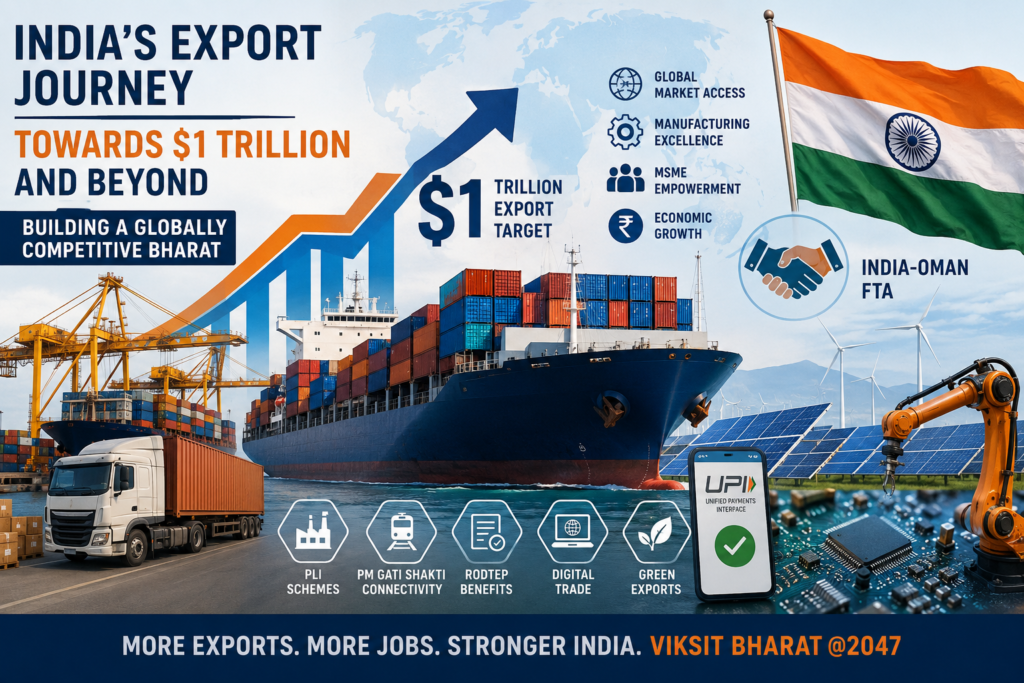
1. Enhancing India’s Export Capacity: The $1 Trillion Target
Syllabus
- GS Paper III (Economy): Indian Economy and issues relating to planning, mobilization of resources, growth, development and employment. Effects of liberalization on the economy, changes in industrial policy and their effects on industrial growth.
- GS Paper II (International Relations): Bilateral, regional and global groupings and agreements involving India and/or affecting India’s interests.
Context
The Union Minister of Commerce and Industry recently announced an aggressive $1 trillion export target for the current fiscal year, alongside a broader vision of $2 trillion within five years. Concurrently, the operationalization of the India-Oman Free Trade Agreement (FTA) on June 1 emphasizes the strategic pivot toward expanding market access for Indian manufacturing and MSMEs.
Main Body: Multi-Dimensional Analysis
Economic Dimension: Structural Transformation
- MSME Integration: Achieving the trillion-dollar mark necessitates moving Micro, Small, and Medium Enterprises (MSMEs) from domestic suppliers to global value chain participants.
- Manufacturing Output Overhaul: Requires scaling up output under the PLI (Production Linked Incentive) schemes across critical sectors like electronics, pharmaceuticals, and automobiles.
- Service Sector Dominance: While merchandise exports face global headwinds, IT services, digital infrastructure, and global capability centers (GCCs) remain the strongest pillars supporting the total export volume.
- Current Account Deficit (CAD) Management: Higher export revenues are crucial to offsetting India’s structural import dependence, particularly concerning crude oil and gold, thereby stabilizing the rupee.
Geopolitical & Strategic Dimension: Diversification
- China-Plus-One Strategy: India is aggressively positioning itself as a reliable alternative manufacturing hub amid Western de-risking from China.
- FTAs and Market Access: The incoming India-Oman FTA and ongoing negotiations with the UK and EU are critical to securing preferential tariff regimes, enabling Indian products to compete on price.
- Global South Leadership: Exporting indigenous public digital infrastructure (like UPI and ONDC) establishes strategic economic leverage and soft power across developing nations.
Administrative & Infrastructure Dimension
- Logistics Cost Reduction: The National Logistics Policy aims to reduce logistics costs from 13-14% of GDP to global benchmarks (around 8%), a non-negotiable prerequisite for export competitiveness.
- Port Modernization: Expanding turnaround times and container handling capacity at major ports (Sagarmala project) is vital for volume scaling.
- Customs Streamlining: Digitalization of customs and easing compliance burdens through the “Turant Customs” program ensures faster clearance.
Technological Dimension: Industry 4.0
- Quality Standardisation: Moving beyond low-cost labor, exports must meet stringent international quality, phytosanitary, and ESG (Environmental, Social, and Governance) standards using AI and IoT in manufacturing.
- Green Exports: Adapting to mechanisms like the EU’s Carbon Border Adjustment Mechanism (CBAM) by shifting towards green manufacturing and exporting renewable energy components (solar modules, green hydrogen).
Positives, Negatives, and Government Schemes
| Dimension | Details |
| Positives | Drives massive employment generation, particularly in labor-intensive sectors (textiles, leather).Catalyzes foreign direct investment (FDI) and technology transfer.Strengthens forex reserves and macroeconomic stability. |
| Negatives/Challenges | Global economic slowdown and geopolitical conflicts (Red Sea crisis) threaten demand.Protectionist policies and non-tariff barriers by Western nations (e.g., CBAM).Domestic infrastructural bottlenecks and high energy costs for manufacturers. |
| Government Schemes | RoDTEP (Remission of Duties and Taxes on Exported Products).PLI (Production Linked Incentive) Scheme across 14 sectors.Districts as Export Hubs (DEH) initiative to decentralize export origination.NIRYAT Portal for unified foreign trade data access. |
Examples
- Electronics: Apple contract manufacturers (Foxconn, Wistron) scaling up iPhone exports from India, showcasing the success of the PLI scheme.
- Defense: India’s export of BrahMos missiles to the Philippines, marking a shift from a net importer to an exporter of advanced defense hardware.
Way Forward
- De-bottleneck Logistics: Expedite the implementation of the PM Gati Shakti National Master Plan to ensure seamless multi-modal connectivity from factory gates to ports.
- Focus on R&D and Quality: Incentivize private sector R&D to shift the export basket from primary/low-value goods to complex, high-value, and high-tech manufactured products.
- Proactive Trade Diplomacy: Leverage geopolitical goodwill to finalize comprehensive FTAs with the EU and UK, while actively addressing non-tariff barriers and sanitary/phytosanitary issues through the WTO.
- Credit Accessibility: Ensure MSMEs have access to low-interest, collateral-free export credit guarantees to manage cash flow delays inherent in international trade.
Conclusion
The $1 trillion export target is not merely an economic metric but a milestone in India’s journey toward becoming a developed nation by 2047 (Viksit Bharat). While domestic policy momentum is strong, navigating global fragmentation, enhancing logistical efficiency, and ensuring stringent quality compliance will dictate the pace at which this ambition is realized.
Practice Mains Question
Evaluate the feasibility of India’s $1 trillion export target in the context of the current global economic slowdown and rising protectionism. How can schemes like PLI and PM Gati Shakti address structural bottlenecks in India’s export sector? (250 words)
2. PFRDA Relaxes NPS Annuity Exit Rules: Strengthening Social Security
Syllabus
- GS Paper II (Social Justice): Welfare schemes for vulnerable sections of the population by the Centre and States and the performance of these schemes; mechanisms, laws, institutions and Bodies constituted for the protection and betterment of these vulnerable sections.
- GS Paper III (Economy): Mobilization of resources, inclusive growth and issues arising from it.
Context
The Pension Fund Regulatory and Development Authority (PFRDA) has amended regulations to permit National Pension System (NPS) subscribers to surrender their annuity policies under exceptional circumstances, specifically for critical illnesses. This applies to policies issued before October 2024 that contain explicit surrender clauses.

Main Body: Multi-Dimensional Analysis
Social & Welfare Dimension: Safety Net Flexibility
- Addressing Life Contingencies: Pension structures are traditionally rigid to prevent premature depletion. However, medical emergencies often require massive immediate liquidity that monthly annuities cannot satisfy.
- Elderly Healthcare Security: With rising out-of-pocket health expenditures and limited insurance penetration among the elderly, access to one’s own corpus becomes a vital lifeline for critical care.
- Dignity in Old Age: Prevents subscribers from falling into debt traps or relying on informal, high-interest loans during severe health crises.
Economic & Financial Dimension: Asset Liquidity
- Balancing Longevity Risk vs. Liquidity: The core dilemma in pension economics. Annuities protect against outliving savings (longevity risk), but the relaxation prioritizes immediate liquidity for survival over long-term income streams.
- Market Confidence: Increased flexibility makes the NPS more attractive to young investors who previously feared locking up their capital permanently, potentially increasing overall systemic enrollment.
- Impact on Pension Funds: Insurers and pension fund managers will need to recalibrate their actuarial models and asset liability management to account for premature withdrawals, though the “critical illness” filter limits systemic shocks.
Regulatory & Administrative Dimension
- Defining Critical Illness: The success of this policy depends on clear, unambiguous, and medically updated definitions of “critical illness” to prevent misuse while ensuring genuine beneficiaries are not entangled in bureaucratic red tape.
- Retrospective Clause Execution: Applying this to policies pre-dating October 2024 requires seamless coordination between PFRDA, Annuity Service Providers (ASPs), and the medical certification boards.
- Grievance Redressal: A robust framework is required to handle disputes between subscribers and insurance providers regarding the validity of surrender claims.
Behavioral Economics Dimension
- Myopic Withdrawals: Regulators must ensure this relaxation does not trigger behavioral biases where subscribers prematurely liquidate retirement funds for manageable issues, leaving them destitute in later years.
- Financial Literacy: Requires extensive awareness campaigns so subscribers understand that surrendering an annuity permanently terminates their future monthly income.
Positives, Negatives, and Government Schemes
| Dimension | Details |
| Positives | Provides life-saving liquidity during catastrophic health events.Increases the attractiveness of NPS compared to other savings instruments.Reduces reliance on exploitative private credit during emergencies. |
| Negatives/Challenges | Defeats the primary purpose of pensions: ensuring a steady post-retirement income.Risk of complex claims processes leading to delays when funds are needed most.Potential for misuse or misinterpretation of “critical illness” guidelines. |
| Government Schemes | National Pension System (NPS) (The core framework being modified).Atal Pension Yojana (APY) (For unorganized sector, highlights the push for universal coverage).Ayushman Bharat PM-JAY (Complementary scheme reducing the need to liquidate pensions for health crises). |
Examples
- A retired teacher diagnosed with advanced-stage cancer requires an immediate ₹15 lakh for immunotherapy not fully covered by insurance. Under the new rules, surrendering the NPS annuity provides direct access to their accumulated corpus rather than waiting for monthly payouts of ₹20,000.
Way Forward
- Standardized Medical Protocols: Establish a fast-track, centralized medical board to verify critical illness claims swiftly, ensuring disbursements happen within a strictly mandated timeframe.
- Partial Surrender Options: Explore allowing partial commutation (e.g., 50%) for medical emergencies so that a foundational monthly income stream is preserved.
- Integration with Health Insurance: Promote the bundling of NPS with comprehensive senior-citizen health insurance to mitigate the need for corpus liquidation in the first place.
- Financial Counseling: Mandate impartial financial counseling for subscribers before they finalize an annuity surrender, clearly detailing the long-term income loss.
Conclusion
The PFRDA’s move represents a pragmatic shift from paternalistic financial regulation to a compassionate, subscriber-centric approach. While it introduces the risk of depleted retirement income, the policy acknowledges that financial security in old age is meaningless if a subscriber cannot survive a present medical crisis. Effective implementation will hinge on swift claims processing and preventing policy misuse.
Practice Mains Question
Discuss the rationale behind the PFRDA’s decision to allow the surrender of NPS annuities for critical illnesses. How does this policy attempt to balance the conflicting goals of ensuring lifelong income security and providing emergency liquidity? (250 words)
3. Nationwide Public Advisory on Heat Stress: Climate-Health Nexus
Syllabus
- GS Paper III (Disaster Management & Environment): Disaster and disaster management. Conservation, environmental pollution and degradation.
- GS Paper II (Health): Issues relating to development and management of Social Sector/Services relating to Health, Education, Human Resources.
Context
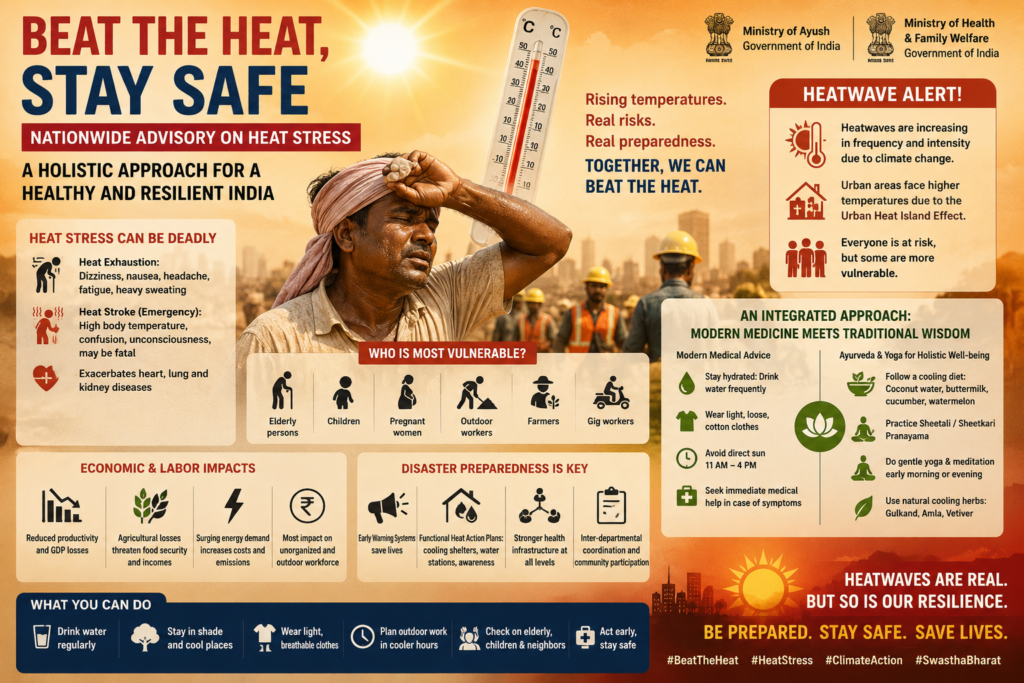
Driven by escalating temperatures, the Ministries of Ayush and Health have issued a joint nationwide advisory on managing heat stress. The guidelines uniquely integrate modern medical advice with traditional Ayurvedic practices and Yoga (such as Sheetali Pranayama), reflecting a holistic approach to a severe, recurring climate-induced disaster.
Main Body: Multi-Dimensional Analysis
Climate Change & Environmental Dimension
- Increasing Frequency and Intensity: Heatwaves are no longer anomalies; they are recurring, protracted extreme weather events directly linked to anthropogenic climate change and global warming trends.
- Urban Heat Island (UHI) Effect: Rapid, unplanned urbanization, concretization, and loss of green cover exacerbate temperatures in metropolitan areas (like Delhi, Chennai) significantly beyond surrounding rural areas.
- Changing Definitions: The geographic spread of heatwaves is expanding beyond the traditional “heat core zone” of central and northwest India to coastal and southern states.
Public Health Dimension: A Silent Disaster
- Morbidity and Mortality: Heat stress leads to severe conditions ranging from heat exhaustion to fatal heatstrokes, exacerbating underlying cardiovascular and respiratory diseases.
- Vulnerable Populations: Disproportionately impacts the elderly, children, pregnant women, and particularly outdoor manual laborers (construction workers, farmers, gig economy workers).
- Holistic Health Integration: The integration of AYUSH (traditional cooling diets, specific hydration techniques) alongside allopathic protocols represents a culturally resonant, preventive healthcare strategy.
Economic & Labor Dimension
- Productivity Loss: Extreme heat drastically reduces labor productivity. The ILO estimates significant GDP losses for India due to heat stress, heavily impacting the unorganized, outdoor workforce.
- Agricultural Impact: Heatwaves during crucial crop cycles (e.g., wheat terminal heat stress) threaten food security and rural incomes, leading to broader agrarian distress.
- Energy Burden: Surging demand for cooling drives power grids to the brink, necessitating costly energy imports and increasing greenhouse gas emissions.
Disaster Management & Governance Dimension
- Early Warning Systems (EWS): The IMD’s color-coded alerts have improved, but translating these warnings into actionable, localized ground-level interventions remains a challenge.
- Heat Action Plans (HAPs): While several states and cities have adopted HAPs, implementation suffers from lack of dedicated funding, legal backing, and inter-departmental coordination.
- Infrastructure Adaptation: Building codes need urgent revision to mandate passive cooling, cool roofs, and adequate ventilation.
Positives, Negatives, and Government Schemes
| Dimension | Details |
| Positives | Integrates culturally accessible AYUSH practices for mass adoption.Proactive issuance builds awareness before peak casualties occur.Encourages inter-ministerial coordination (Health, Ayush, NDMA). |
| Negatives/Challenges | Advisories are often impractical for daily-wage laborers who cannot afford to “stay indoors.”Chronic lack of funding for local municipalities to implement Heat Action Plans (cooling shelters, water stations).Inadequate rural health infrastructure to treat severe heatstrokes. |
| Government Schemes | National Disaster Management Authority (NDMA) Guidelines on Heatwave.India Cooling Action Plan (ICAP) (Addressing cooling needs across sectors).National Action Plan on Climate Change (NAPCC) (Overarching climate resilience framework). |
Examples
- Ahmedabad Heat Action Plan: A pioneering model that utilized early warning systems, mobilized healthcare workers, and implemented “cool roofs” to drastically reduce heat-related mortality.
- Gig Workers: Delivery drivers facing heat exhaustion highlight the clash between algorithmic work targets and extreme weather survival, necessitating specific labor protections.
Way Forward
- Legal Framework for Heatwaves: Officially notify heatwaves as a national disaster under the Disaster Management Act, 2005, to unlock dedicated relief funds (SDRF/NDRF) for mitigation and compensation.
- Labor Protections: Enforce mandatory paid rest breaks, altered working hours, and worksite hydration mandates for outdoor workers and gig economy participants during red alerts.
- Urban Redesign: Mandate green-blue infrastructure in city planning—expanding tree canopies, reviving water bodies, and enforcing “cool roof” policies to mitigate the Urban Heat Island effect.
- Strengthen Health Infrastructure: Equip Primary Health Centres (PHCs) with adequate ice packs, IV fluids, and specific heat-stroke management training to prevent mortalities at the grassroots level.
Conclusion
Heatwaves represent a formidable intersection of climate change, public health, and labor economics. While advisories combining modern and traditional practices are vital for public awareness, they must be backed by structural interventions—such as legally binding Heat Action Plans and robust labor protections—to protect India’s most vulnerable populations from this escalating “silent disaster.”
Practice Mains Question
Examine the socioeconomic and public health impacts of recurring heatwaves in India. How effective are the current municipal Heat Action Plans (HAPs), and what structural changes are needed to protect vulnerable outdoor workforces? (250 words)
4. Internationalization of GIFT City: ICICI-Visa USD Debit Card for NRIs
Syllabus
- GS Paper III (Economy): Indian Economy and issues relating to planning, mobilization of resources, growth, development and employment. Banking and financial institutions, effects of liberalization.
Context
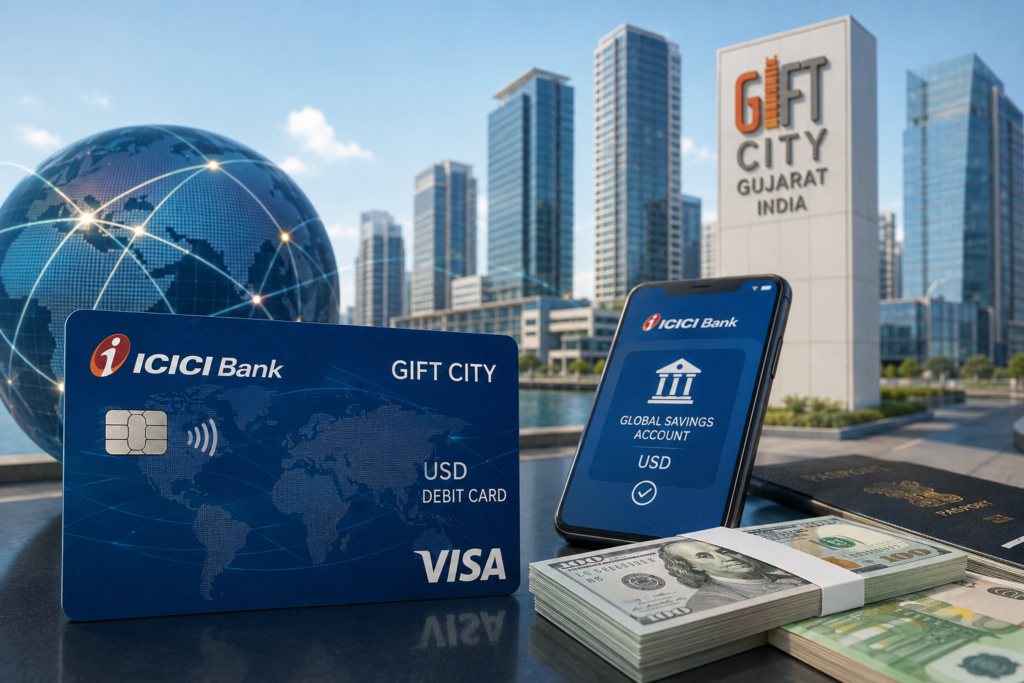
- ICICI Bank, in collaboration with Visa, has launched USD-denominated debit cards for Non-Resident Indians (NRIs) holding Global Savings Accounts at its International Banking Unit (IBU) in GIFT City, Gujarat.
- This feature completely eliminates the standard 3.5% foreign exchange markup and associated GST, allowing NRIs to transact globally while buffering their capital against Indian Rupee (INR) depreciation.
Main Body: Multi-Dimensional Analysis
Economic & Financial Dimension: Capital Mobilization
- Forex Inflow Stabilization: Simplifies the process for the Indian diaspora to park foreign currency directly within Indian jurisdictions, stabilizing long-term capital inflows.
- Currency Risk Mitigation: By keeping accounts denominated in USD, NRIs avoid the standard exchange-rate conversion losses during global transactions, increasing the stickiness of these deposits.
- Integration with Global Markets: Bridges the gap between domestic banking protocols and international financial standards, making offshore banking seamless.
Strategic Dimension: Positioning GIFT-IFSC
- Competing with Global Hubs: Directly challenges established financial ecosystems like Dubai (DIFC), Singapore, and London by offering lower transactional costs and tax incentives.
- Financial Sovereignty: Ensures that wealth generated by the Indian diaspora is cycled through an Indian-regulated special economic zone rather than foreign offshore centers.
- Avenue for De-dollarization Deflection: While the account uses USD, it roots the transactional infrastructure within India, preparing domestic banks to handle complex international multi-currency products.
Regulatory & Legal Dimension
- IFSCA Oversight Efficiency: Demonstrates the agility of the International Financial Services Centres Authority (IFSCA) in approving progressive retail financial products.
- Compliance and AML Standards: Requires strict adherence to Know Your Customer (KYC) and Anti-Money Laundering (AML) laws across multiple international jurisdictions to maintain financial credibility.
- Tax Neutrality Framework: Capitalizes on the zero-GST and relaxed tax compliance structures mandated inside the IFSC zone to incentivize retail consumer adoption.
Technological & FinTech Dimension
- Cross-Border Payment Rail Optimization: Leverages Visa’s global processing networks to ensure near-zero latency for retail transactions initiated out of a specialized Indian economic zone.
- Digital Banking Scale: Paves the way for fully automated, paperless onboarding for global citizens, setting a standard for domestic public and private sector banks.
Positives, Negatives, and Government Schemes
| Dimension | Details |
| Positives | Eliminates the financial friction of a 3.5% forex markup and GST for non-resident depositors.Deepens liquidity within GIFT City’s retail banking ecosystem.Empowers Indian banks to capture global premium retail banking market share. |
| Negatives/Challenges | Risk of capital flight from domestic Indian banking units to offshore IBUs within the same country.Complex regulatory coordination required when dealing with tax laws of various NRI home countries.High reliance on Western payment rails (Visa) rather than indigenous alternatives like RuPay Global. |
| Government Schemes | IFSCA Retail Banking Regulations (Enabling framework for offshore retail banking).GIFT City SEZ Tax Incentives (100% tax exemption for 10 consecutive years out of 15).Liberalized Remittance Scheme (LRS) (Intersects with resident Indians investing through IFSC). |
Examples
- DIFC Model: Dubai International Financial Centre successfully utilized similar zero-markup, multi-currency debit and credit models to attract global expat wealth over the last two decades.
- Global Indian Professionals: A software engineer based in the US can maintain a USD account in Gujarat to pay for global subscriptions or families traveling abroad without conversion penalties.
Way Forward
- Indigenize Payment Rails: Actively encourage the National Payments Corporation of India (NPCI) to launch a RuPay-backed multi-currency international card out of GIFT City to reduce reliance on Visa/Mastercard.
- Expand Currency Portfolios: Gradually expand the product line from pure USD to include Euros, British Pounds, and UAE Dirhams to cater to diverse diaspora clusters.
- Harmonize Domestic-Offshore Rules: Create seamless corridors for NRIs to transition funds between domestic Non-Resident External (NRE) accounts and GIFT City IBU accounts without bureaucratic lag.
- Targeted Marketing Campaigns: Leverage Indian embassies and global financial forums to actively project GIFT City as a premier, secure, and cost-effective wealth management destination.
Conclusion
- The launch of the USD debit card marks a maturity milestone for GIFT City, shifting its focus from purely corporate institutional finance to high-value retail banking.
- By lowering transaction costs and protecting against currency shocks, India is effectively utilizing its vast diaspora to build a resilient, globally competitive offshore financial ecosystem.
Practice Mains Question
The evolution of GIFT City from an institutional financial hub to a retail-centric offshore banking destination is critical for India’s global financial ambitions. Evaluate this statement in light of recent regulatory relaxations and product launches like offshore multi-currency retail banking. (250 words)
5. Indian Railways Modernization: Bullet Train Corridors & Interstate Connectivity
Syllabus
- GS Paper III (Infrastructure): Railways, multi-modal connectivity, industrial corridors, growth and development planning.
Context
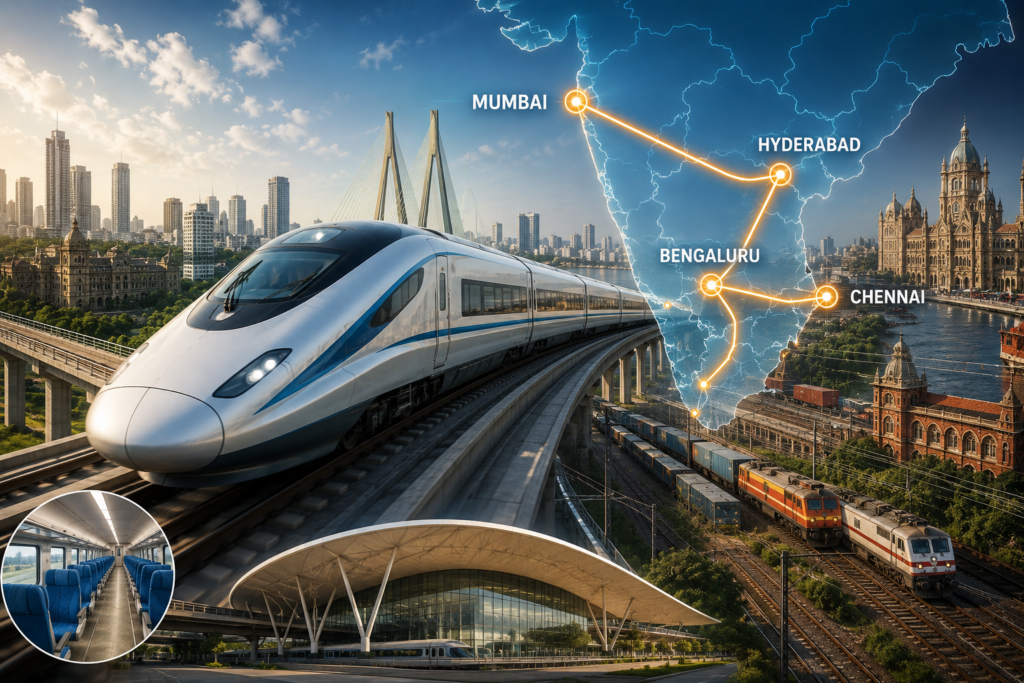
- The Ministry of Railways officially flagged off the Bengaluru-Mumbai Express to dramatically reduce transit times between the two economic powerhouses.
- Concurrently, the Union Cabinet approved new high-speed bullet train corridors connecting Bengaluru to Hyderabad and Chennai, accelerating India’s transition toward hyper-connected regional economies.
Main Body: Multi-Dimensional Analysis
Economic & Industrial Dimension: Mega-Corridor Effects
- Agglomeration Economies: Connecting the tech and industrial capitals of the South and West (Bengaluru, Chennai, Hyderabad, Mumbai) creates dense economic corridors, stimulating real estate, manufacturing, and tech-cluster integration.
- Logistics Efficiency Enhancement: Shifting high-value passenger traffic to high-speed rail frees up capacity on traditional saturated tracks for freight trains, directly lowering national logistics costs.
- Employment Generation Matrix: The construction, operationalization, and maintenance phases of high-speed rail networks generate massive direct and indirect employment opportunities for skilled engineers and laborers.
Environmental & Climate Dimension: Carbon Footprint Reduction
- Modal Shift from Aviation: High-speed rail serves as a direct, cleaner alternative to short-haul domestic flights (e.g., Bengaluru-Chennai), significantly lowering carbon emissions per passenger-kilometer.
- Energy Efficiency Optimization: Modern electric bullet trains utilize regenerative braking systems, pumping energy back into the grid and reducing the net carbon intensity of transit.
- Mitigating Highway Congestion: Discourages long-distance interstate road travel, reducing vehicular emissions and oil import bills.
Socio-Spatial & Urbanization Dimension
- Transit-Oriented Development (TOD): Smaller tier-2 and tier-3 towns along the bullet train corridors will evolve into economic satellite hubs, decentralizing the intense population pressure on tier-1 megacities.
- Enhanced Labor Mobility: Allows professionals to commute long distances seamlessly, effectively transforming distinct cities into single, functional mega-labor markets.
Technological & Geopolitical Dimension
- Technology Transfer and Indigenization: Moving beyond full import models to domestic manufacturing via joint ventures, boosting India’s capability to export high-speed rail tech to the Global South later.
- Engineering Capability Scaling: Mastering complex construction challenges such as ballastless tracks, undersea/underground tunnels, and advanced signaling (ETCS Level-2) upskills the domestic civil engineering workforce.
Positives, Negatives, and Government Schemes
| Dimension | Details |
| Positives | Drastically reduces transit times between major state GDP contributors.Spurs industrial investments via the Transit-Oriented Development model.Enhances passenger safety and comfort through advanced crashproof technologies. |
| Negatives/Challenges | Astronomical capital expenditure requirements, risking fiscal deficit strain.Massive land acquisition hurdles, leading to project delays and social rehabilitation friction.High ticket pricing could exclude low-income demographics, raising equity concerns. |
| Government Schemes | National Rail Plan (NRP) 2030 (Framework to build a future-ready railway system).PM Gati Shakti National Master Plan (Multi-modal infrastructure synchronization).National High-Speed Rail Corporation Limited (NHSRCL) (Special purpose vehicle executing bullet projects). |
Examples
- Shinkansen Impact: Japan’s Tokaido Shinkansen line completely transformed the Tokyo-Nagoya-Osaka corridor into a unified economic engine, paying off its initial high capital costs through exponential productivity gains.
- Vande Bharat Upgrades: The rapid domestic scaling of Vande Bharat trains showcases India’s readiness to adopt and maintain high-speed semi-ballast ecosystems.
Way Forward
- Innovative Financing Mechanisms: Utilize Land Value Capture (LVC) models around high-speed rail stations to monetize surrounding real estate and cross-subsidize construction costs.
- Streamline Land Acquisition: Establish dedicated state-level fast-track land clearance cells with transparent, market-linked compensation and ready-to-move rehabilitation packages.
- Ensure Multi-Modal Integration: Design bullet train terminals to directly plug into existing city metro networks, bus rapid transits (BRT), and airports to prevent last-mile bottlenecks.
- Phased Indigenization: Enforce strict domestic sourcing clauses for components like steel tracks, signaling systems, and rolling stock to maximize the “Make in India” dividend.
Conclusion
- High-speed rail corridors are not luxury transport projects; they are transformative economic corridors vital for a multi-trillion-dollar economy.
- While financing and land acquisition remain structural hurdles, the integration of southern and western economic centers via bullet train networks will fundamentally redefine India’s urban and industrial layout for the next century.
Practice Mains Question
High-speed rail corridors in India are often criticized as capital-intensive projects with long gestation periods. Critically analyze how these corridors act as catalysts for regional economic integration and urban decentralization. (250 words)
6. Strategic India-Sweden Ties: Conferring the Royal Order of the Polar Star
Syllabus
- GS Paper II (International Relations): Bilateral, regional and global groupings and agreements involving India and/or affecting India’s interests. Effect of policies and politics of developed and developing countries on India’s interests.
Context
- Prime Minister Narendra Modi was conferred with the Royal Order of the Polar Star, Sweden’s highest honor for foreign heads of government, during his bilateral visit to Stockholm.
- This diplomatic milestone cements deepening strategic ties between India and the Nordic region, focusing sharply on green transitions, defense co-production, and multilateral cooperation in the Arctic.

Main Body: Multi-Dimensional Analysis
Strategic & Geopolitical Dimension: The Nordic Pivot
- Arctic Council Synergy: As climate change thaws Arctic shipping routes, strong ties with Sweden (an Arctic Council member) bolster India’s scientific, economic, and strategic interests in the polar region.
- Multilateral Alignment: Sweden’s recent entry into NATO and its shifting security posture align with India’s quest for reliable, democratic partners to maintain a rules-based global order.
- Countering Hegemony: Deepening engagement in Northern Europe forms part of India’s broader strategy to diversify its European alliances beyond the traditional France-Germany axis.
Technology & Green Diplomacy Dimension
- LeadIT Leadership: The India-Sweden co-founded Leadership Group for Industry Transition (LeadIT) drives global efforts to decarbonize heavy, hard-to-abate sectors like steel, cement, and aviation.
- Joint Innovation Ecosystems: Facilitates institutional collaboration in deep-tech, artificial intelligence, quantum computing, and smart city waste management technologies where Sweden leads globally.
- Circular Economy Integration: Enables the transfer of advanced Swedish recycling and bio-energy models to tackle urban waste crises across major Indian municipalities.
Defense & Security Dimension
- Make in India Co-Production: Shifts the defense relationship from a buyer-seller dynamic to co-development, exemplified by Swedish defense major Saab establishing 100% FDI manufacturing for the Carl-Gustaf weapon system in India.
- Maritime Domain Awareness: Enhances intelligence sharing regarding underwater technologies, submarine detection, and secure maritime communication networks in the Indo-Pacific.
Economic & Trade Dimension
- EFTA Momentum: Capitalizes on the recent India-EFTA trade deal to accelerate Swedish private investments into India’s infrastructure, clean energy, and healthcare sectors.
- Sovereign Wealth Flows: Attracts long-term capital from Nordic pension funds into green bonds and renewable energy assets across India.
Positives, Negatives, and Government Schemes
| Dimension | Details |
| Positives | Secures cutting-edge green and defense technologies through co-development models.Elevates India’s diplomatic leverage in the strategic Arctic and Nordic-Baltic regions.Boosts domestic manufacturing capabilities via 100% defense FDI pathfinders. |
| Negatives/Challenges | Historically low trade volumes compared to India’s trade with major global powers like the US or China.Divergent views on global trade regulations, intellectual property rights, and data localization.Geopolitical friction risks if European conflicts distract Nordic partners from Indo-Pacific commitments. |
| Government Schemes | LeadIT Initiative (Joint global climate action leadership platform).India-Sweden Innovation Partnership (Funded institutional research and development).Strategic Partnership Model in Defense (Framework enabling deep private co-production). |
Examples
- Saab India Facility: Saab becoming the first foreign defense company to secure 100% FDI approval to manufacture military hardware in India, setting a precedent for global defense firms.
- Green Steel: Swedish company SSAB’s breakthrough “HYBRIT” technology (using green hydrogen instead of coking coal for steel) serves as a direct blueprint for India’s National Green Hydrogen Mission goals.
Way Forward
- Institutionalize Arctic Research: Establish a joint India-Sweden Polar and Climate Research Centre to study the teleconnections between Arctic ice-melt and the Indian monsoon.
- Scale Up LeadIT Commitments: Actively deploy Swedish technical expertise to set up commercial-scale green hydrogen and low-carbon cement demonstration plants across Indian industrial zones.
- Fast-Track SME Tie-ups: Create an exclusive corridor for Swedish green-tech start-ups to pitch localized solutions directly to Indian municipal corporations for waste and water treatment.
- Strengthen Academic Exchange: Launch targeted, fully funded STEM fellowship programs between premium institutions like India’s IITs and Sweden’s KTH/Karolinska Institute to build a future-ready workforce.
Conclusion
- Conferring the Royal Order of the Polar Star on Prime Minister Modi signals that India is now viewed as an indispensable partner in Northern Europe’s strategic and environmental calculus.
- By combining Sweden’s technological supremacy with India’s massive manufacturing scale, this relationship serves as a template for successful climate-conscious, high-tech global partnerships.
Practice Mains Question
Evaluate the strategic significance of the India-Nordic partnership, with specific reference to defense co-production and global climate leadership through industrial transition initiatives. (250 words)
7. Strengthening Digital Governance: Appointment of New UIDAI CEO
Syllabus
- GS Paper II (Governance): Important aspects of governance, transparency and accountability, e-governance- applications, models, successes, limitations, and potential; citizens charters, transparency & accountability and institutional and other measures.
Context
- Saurabh Vijay, a 1998-batch IAS officer from the Maharashtra cadre, has assumed charge as the Chief Executive Officer (CEO) of the Unique Identification Authority of India (UIDAI).
- This transition arrives at a critical juncture when UIDAI is scaling up Aadhaar-enabled governance frameworks, rolling out next-generation biometric architectures, and addressing intensifying global data privacy and cyber security protocols.

Main Body: Multi-Dimensional Analysis
Governance & Administrative Dimension: Digital Welfare Delivery
- Targeted Benefit Subsidies: The primary administrative challenge remains minimizing leakages in the Direct Benefit Transfer (DBT) ecosystem, which relies entirely on the Aadhaar Payment Bridge System (APBS).
- De-duplication & Inclusion: Balancing the removal of ghost beneficiaries with the constitutional mandate to ensure no genuine citizen is denied critical food, health, or labor rations due to fingerprint authentication failures.
- Cadre Competency Utilization: Appointing senior administrators with strong financial and expenditure portfolios (such as managing state expenditure) brings necessary financial auditing discipline to massive state-led technological architectures.
Data Privacy & Legal Dimension
- DPDP Act Compliance: UIDAI must strictly align its extensive data collection, storage, and sharing protocols with the mandates of the Digital Personal Data Protection (DPDP) Act.
- The Right to Privacy Directive: Maintaining the equilibrium between state-driven surveillance anxieties and citizen welfare security as outlined in the landmark K.S. Puttaswamy judgment.
- Consent Framework Standardization: Formalizing zero-trust architectures where individual data fields cannot be accessed by third-party private verification platforms without explicit, revocable user permission.
Technological & Cyber Security Dimension
- Advanced Biometric Vulnerabilities: Countering the emergence of AI-generated deepfakes and advanced silicone fingerprint spoofing requires migrating to multi-modal biometric authentication (incorporating facial recognition, iris scans, and live-detection tech).
- Quantum-Safe Encryption: Upgrading central databases to post-quantum cryptography standards to protect identity profiles against state-backed cyber-espionage and data mining threats.
- Cloud Decentralization: Exploring secure, localized data infrastructure partitions to prevent single-point-of-failure risks in the centralized Aadhaar Data Vaults.
Geopolitical & Soft Power Dimension
- Exporting Digital Public Infrastructure (DPI): Projecting India’s Aadhaar architecture as a cost-effective blueprint for foundational identity networks across developing economies in Africa and Southeast Asia.
- Global Standard Setting: Actively representing India in international biometric and digital identity standard-setting bodies to counter monopolistic Western or Chinese digital governance templates.
Positives, Negatives, and Government Schemes
| Dimension | Details |
|---|---|
| Positives | Saves billions of dollars for the exchequer annually by eradicating systemic middlemen and leakages.Acts as the foundational architecture for financial inclusion through the Jan Dhan-Aadhaar-Mobile (JAM) trinity.Simplifies civic identification for marginalized, migrant, and unorganized-sector workers. |
| Negatives/Challenges | Persistent rural connectivity deficits and manual labor fingerprint wear lead to authentication exclusion.Centralized data repositories present high-value targets for international cyber-attacks and ransomware.Risks of function creep where private entities pressure citizens to use an optional card as a mandatory permit. |
| Government Schemes | Aadhaar Enabled Payment System (AePS) (Enabling branchless micro-banking).Direct Benefit Transfer (DBT) (Universal subsidy welfare transport architecture).Digital India Mission (Overarching framework for tech-enabled citizen empowerment). |
Examples
- Face Auth App: The deployment of the UIDAI Face Authentication mobile application, which uses live facial imagery to let senior citizens verify their life certificates from home without physical biometric sensors.
- DPI Abroad: Nations like the Philippines (PhilSys) and Morocco designing their national identity architectures modeled directly on India’s open-source modular DPI approach.
Way Forward
- Mandate Offline Verification Alternatives: Establish mandatory, legally binding offline backup validation systems (such as secure QR codes or interactive voice systems) to ensure zero welfare exclusion during network outages.
- Enforce Strict Data Audits: Conduct comprehensive, periodic security audits of all third-party sub-AUAs (Authentication User Agencies) to proactively detect and penalize external security vulnerabilities.
- Upgrade Grassroots Technology: Subsidize the deployment of advanced, multi-spectral biometric scanners at local Fair Price Shops (Ration shops) to significantly lower false rejection rates among manual laborers.
- Strengthen Grievance Redressal: Institutionalize an automated, fast-track compensation mechanism for citizens who suffer monetary losses due to identity theft or unauthorized Aadhaar linked bank-account redirections.
Conclusion
- The transition in UIDAI leadership comes at a time when identity networks are changing from simple storage systems into active transactional tools.
- The long-term success of India’s foundational DPI will depend on transitioning from a pure focus on system efficiency to an architecture that prioritizes strict data security and citizen protection, ensuring tech serves as a tool for empowerment rather than exclusion.
Practice Mains Question
Digital Public Infrastructure (DPI) has revolutionized welfare delivery in India, yet concerns regarding algorithmic exclusion and data vulnerability persist. Critically analyze the role of UIDAI in balancing national data security with inclusive citizen service delivery. (250 words)
8. Strategic Global Defense: Russia’s Successful RS-28 Sarmat ICBM Test
Syllabus
- GS Paper II (International Relations): Bilateral, regional and global groupings and agreements involving India and/or affecting India’s interests. Effect of policies and politics of developed and developing countries on India’s interests.
- GS Paper III (Security): Science and Technology- developments and their applications and effects in everyday life. Security challenges and their management.
Context
- Russia successfully conducted a comprehensive test launch of its RS-28 Sarmat Intercontinental Ballistic Missile (ICBM), colloquially designated as “Satan-II.”
- This strategic defense development underscores a severe shift in international deterrence architecture, introducing complex challenges for global arms control treaties, missile defense grids, and India’s multi-aligned geopolitical balancing act.

Main Body: Multi-Dimensional Analysis
Geopolitical & Deterrence Dimension: Strategic Re-balancing
- Erosion of Non-Proliferation Treaties: The operational deployment of hyper-advanced ICBMs signals the functional breakdown of traditional arms-limitation pacts like the New START treaty, reigniting a dangerous global arms race.
- Asymmetric Deterrence Overhaul: Designed specifically to defeat advanced Western missile defense shields (like the US Aegis and THAAD systems) using fractional orbital bombardment pathways.
- Multi-Polar Polarization: Heightens structural defense anxieties across the Euro-Atlantic theatre, forcing middle powers to re-evaluate their reliance on extended nuclear umbrellas and increase individual defense budgets.
Technological & Defense Dimension: Hypersonic Integration
- Hypersonic Glide Vehicle (HGV) Payload: The Sarmat is designed to carry Avangard hypersonic glide vehicles, which can alter course mid-flight at speeds exceeding Mach 20, making traditional trajectory tracking useless.
- Liquid-Propelled Heavy Throw-Weight: Uses advanced liquid-propellant rocket engines to carry up to 10 tons of payload, enabling multiple independently targetable reentry vehicles (MIRVs) to strike distinct targets simultaneously.
- Short Boost-Phase Profiles: Engineered with shortened engine burn phases to blind space-based infrared detection satellites before the missile reaches stable thin-atmosphere altitudes.
Strategic Implications for India
- The Technology Transfer Dynamic: India’s long-standing defense technology reliance on Moscow (e.g., BrahMos, nuclear submarine leasing) means changes in Russian missile science eventually influence India’s domestic tech base.
- The Two-Front Deterrence Calculus: Advancements in Russian rocketry indirectly influence the defense postures of China and Pakistan, forcing New Delhi to upgrade its own long-range MIRV architectures (like Agni-V).
- Diplomatic Tightrope Balancing: Puts pressure on India’s strategic autonomy doctrine, as Western nations step up sanctions and demand stronger condemnation of aggressive strategic weapon displays.
Positives, Negatives, and Government Schemes
| Dimension | Details |
|---|---|
| Positives | For Russia, it solidifies absolute strategic deterrence against preemptive international intervention.Drives technological innovations in high-temperature metallurgy and space-launch delivery systems.Reinforces the argument for multi-polar strategic balance over unipolar military dominance. |
| Negatives/Challenges | Triggers a massive, expensive round of global defense spending on counter-missile systems.Significantly lowers the threshold for strategic miscalculation during active regional conflicts.Diverts vital international capital away from global climate transitions into military-industrial supply complexes. |
| Government Schemes / Frameworks | Integrated Guided Missile Development Programme (IGMDP) (India’s historical foundation for missile autonomy).Strategic Forces Command (SFC) (India’s operational command managing nuclear deterrence assets).No-First-Use (NFU) Policy (India’s defensive, stabilizing nuclear governance doctrine). |
Examples
- Agni-V MIRV Test: India’s successful testing of the Agni-V missile with Multiple Independently Targetable Reentry Vehicle (MIRV) technology under Mission Divyastra showcases India adopting similar modern deterrence mechanisms.
- The Cuban Missile Precedent: Historical precedents demonstrate that unmonitored escalation in heavy ICBM technology without diplomatic backchannels increases the risk of global security failures.
Way Forward
- Revitalize Pluri-lateral Arms Controls: Initiate new-age strategic dialogue formats involving the US, Russia, and China to establish transparency agreements for hypersonic and heavy ICBM testing.
- Accelerate Indigenous BMD Systems: Enhance the deployment of India’s indigenous Phase-II Ballistic Missile Defence (BMD) shields capable of intercepting high-altitude, high-velocity target profiles.
- Strengthen Space-Based Early Warnings: Expand India’s network of dedicated military reconnaissance satellites (like the RISAT series) to ensure persistent, high-resolution surveillance of global regional launch pads.
- Deepen Strategic Non-Alignment: Maintain clear open-ended diplomacy with all major power blocs, ensuring India’s defense procurement lines remain decoupled from external geopolitical disputes.
Conclusion
- The successful test of the RS-28 Sarmat is a stark reminder that hard military deterrence remains the ultimate foundation of global power politics.
- For India, navigating this period of intense international defense polarization requires upgrading its own technology and expanding its defense manufacturing base, while using steady diplomacy to prevent global tensions from disrupting regional stability.
Practice Mains Question
The collapse of bilateral arms control treaties between global superpowers has led to a dangerous escalation in hypersonic and intercontinental ballistic missile technology. Assess the implications of this trend on India’s national security and its long-term strategy of maintaining credible minimum deterrence. (250 words)
