
Topic 1: Foundation Laid for the Fifth-Generation AMCA Programme Facility
Syllabus
- GS Paper 3 (National Security & Defence): Indigenization of technology and developing new technology; Security forces and agencies.
Context
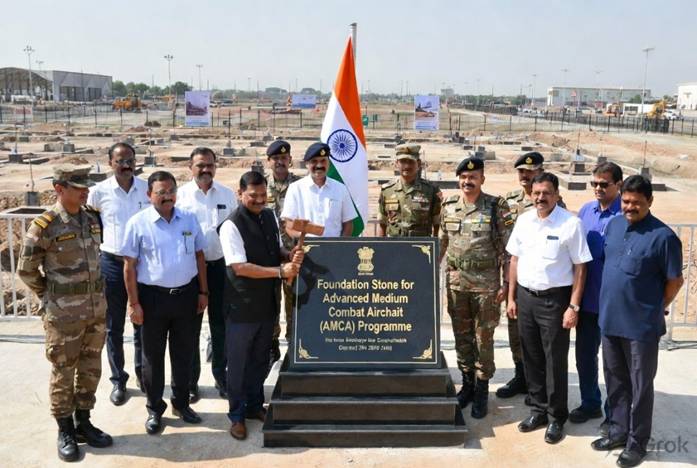
In a historic push for defense indigenization, the Union Minister of Defence, alongside the Chief Minister of Andhra Pradesh, laid the foundation stone for a ₹15,000 crore Advanced Medium Combat Aircraft (AMCA) programme facility in Puttaparthi, Andhra Pradesh.
Main Body: Multi-Dimensional Analysis
- Strategic Technological Leap: The facility will spearhead the development and manufacturing of India’s indigenous 5th-generation stealth fighter jet, the AMCA. This places India in an elite club of nations capable of manufacturing advanced stealth platforms.
- Core Integration & Flight Testing Centre: A vital component of this layout is a dedicated ₹2,000 crore flight testing and system integration facility established concurrently to fast-track test airframes and minimize the typical induction gestation period.
- Private Sector Synergy: Alongside the state infrastructure, private major Bharat Forge (via its subsidiary Agneyastra Energetics) announced a ₹1,500 crore Defence Energetics Facility, highlighting a growing public-private partnership model in producing specialized military hardware.
- Reducing Foreign Strategic Dependence: Moving toward domestic 5th-generation manufacturing structurally minimizes prolonged dependencies on geopolitical suppliers for stealth technology, securing localized sovereign supply chains.
Positives, Negatives, & Government Schemes
| Dimension | Details |
| Positives | Drastically enhances deep-strike air dominance; accelerates indigenous R&D; creates high-skill aerospace jobs in Southern India. |
| Negatives | Massive capital-intensive investment with long development horizons; strict vulnerability to project delays common in advanced aerospace projects. |
| Associated Schemes | Atmanirbhar Bharat in Defence, Defence Acquisition Procedure (DAP), Innovations for Defence Excellence (iDEX). |
Examples
The development follows a multi-tiered indigenization ecosystem layout, mirroring the domestic infrastructure model used to successfully transition the LCA Tejas program from laboratory prototypes into active service squadrons.
Way Forward
- Establish an independent fast-track project management board directly answering to the PMO to avoid bureaucratic bottlenecks.
- Build deep institutional ties with academic powerhouses like IIT Madras and IISc for raw materials R&D, specifically radar-absorbing composites.
- Ensure synchronous development of the domestic Kaveri engine variant to avoid running stealth frames on foreign power plants permanently.
Conclusion
The initiation of the physical manufacturing footprint for the AMCA transforms India’s defense narrative from a buyer state to a primary innovator, anchoring internal defense capabilities deep within national bounds.
Practice Mains Question
Critically analyze how the development of the 5th-generation Advanced Medium Combat Aircraft (AMCA) platform helps India mitigate emerging air-space vulnerabilities in the Indo-Pacific region. (250 words)
Topic 2: Strategic Outcomes of the 3rd India-Nordic Summit
Syllabus
- GS Paper 2 (International Relations): Bilateral, regional, and global groupings involving India; Effect of policies of countries on India’s interests.
Context
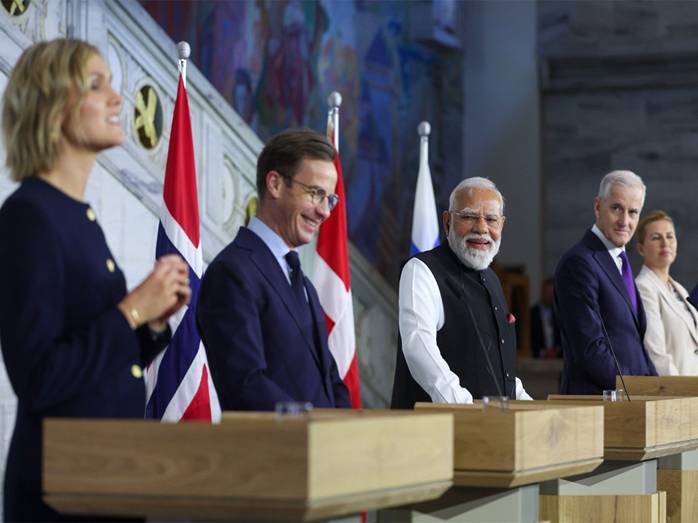
The Prime Minister of India concluded his participation in the 3rd India-Nordic Summit alongside leaders from Denmark, Finland, Iceland, Norway, and Sweden, unveiling an 8-point strategic roadmap focusing on green technologies and Arctic governance.
Main Body: Multi-Dimensional Analysis
- Green Strategic Partnerships: The focal outcome involved moving bilateral architectures toward a collective “Green Strategic Partnership,” focusing explicitly on the circular economy, blue economy resources, and hydrogen energy ecosystems.
- The Arctic Frontier: India secure critical cooperation avenues for deep-sea Arctic research, which holds vital scientific insights regarding global monsoon variations directly impacting Indian agriculture.
- Supply Chain Interoperability: Amid acute global volatility, the Nordic economies committed to transferring key green manufacturing supply lines to India, looking to establish trusted production nodes.
- Maritime Safety & Digitization: Joint working agendas were signed off on secure digital infrastructures, marine pollution containment measures, and smart port operations.
Positives, Negatives, & Government Schemes
| Dimension | Details |
| Positives | Diversifies tech investments; opens advanced clean technology conduits; anchors India’s presence in strategic Arctic councils. |
| Negatives | Executing carbon-neutral transfers requires heavy structural restructuring in India’s highly price-sensitive energy sectors. |
| Associated Initiatives | National Green Hydrogen Mission, Indo-Nordic Green Innovation Partnership, Deep Ocean Mission. |
Examples
The model replicates and expands upon India’s pre-existing individual bilateral agreements with Denmark, using them as a baseline framework to execute multi-country clean tech infrastructure models.
Way Forward
- Establish an institutional India-Nordic Green Fund to directly subsidize incoming clean technology pilot projects.
- Scale up academic cross-exchange fellowships specifically targeting polar climate modeling research.
- Align domestic coastal management policies directly with Nordic smart-port models to improve blue economy efficiencies.
Conclusion
The 3rd India-Nordic Summit effectively shifts international collaboration away from traditional security-only paradigms toward critical resource preservation, aligning climate goals with national strategic interests.
Practice Mains Question
Examine the economic and environmental imperatives that make the India-Nordic collaboration a cornerstone for India’s transition toward a sustainable blue economy. (250 words)
Topic 3: US Approves $428 Million Sustainment Packages for Indian Military Platforms
Syllabus
- GS Paper 2 & 3: International Relations; Bilateral ties; Technology transfers & Defense trade.
Context
The United States Department of State approved two Foreign Military Sales (FMS) sustainment packages valued at $428.2 million for India, ensuring long-term operational readiness for front-line attack and artillery systems.
Main Body: Multi-Dimensional Analysis
- Platform Continuity: The defense support injects $198.2 million directly into support engineering and maintenance logistics for India’s fleet of AH-64E Apache attack helicopters.
- Artillery Operational Baseline: The secondary tranche allocating $230 million guarantees long-term product support, spare assemblies, and repair metrics for the M777A2 ultra-light howitzers deployed along high-altitude mountain borders.

- Geopolitical Realignment: The approvals signal deep tactical alignment in the Indo-Pacific, demonstrating that despite defense indigenization drives, foreign maintenance ecosystems remain critical to immediate combat readiness.
- Interoperability and Readiness: Prolonged military hardware operations depend on immediate access to global spare components, highlighting how such packages sustain strategic weapon systems in active defense zones.
Positives, Negatives, & Government Schemes
| Dimension | Details |
| Positives | Secures immediate operational status of crucial mountain artillery; maintains peak utility of modern aerial attack assets. |
| Negatives | Underscores a continuing fiscal drain to foreign OEMs for basic support infrastructure; exposes vulnerabilities if supply lines face political blocks. |
| Associated Frameworks | Foreign Military Sales (FMS), India-US Strategic Partnership, LEMOA (Logistics Exchange Memorandum of Agreement). |
Examples
The maintenance matrices match similar life-cycle enhancement protocols executed globally across major platforms, acting as an essential bridge until domestic equivalent assemblies achieve regulatory clearances.
Way Forward
- Fast-track public-private offset ventures to gradually build component repair capability inside Indian defense labs.
- Mandate partial indigenization of high-wear spare parts via domestic additive manufacturing (3D printing) networks.
- Negotiate long-term transfer-of-technology (ToT) clauses for support systems during initial procurement phases of future foreign platforms.
Conclusion
While India’s long-term objective remains absolute defense indigenization, specialized strategic maintenance agreements act as a pragmatic bridge to maintain external defense security along volatile border sectors.
Practice Mains Question
“While indigenous manufacturing is India’s ultimate defense objective, foreign technical sustainment contracts remain critical to near-term tactical readiness.” Evaluate this statement with reference to recent international defense acquisitions. (250 words)
Topic 4: Tamil Nadu Reaffirms Two-Language Policy Amid Federal PM-SHRI Push
Syllabus
- Polity & Governance (GS Paper 2): Issues and challenges pertaining to the federal structure; Education policies; Government interventions.
Context
Following reminders from the Union Ministry of Education regarding the nationwide implementation of the PM SHRI school modernization scheme, the Tamil Nadu State Administration officially reiterated its unwavering commitment to its long-standing Two-Language Policy.
Main Body: Multi-Dimensional Analysis
- Federal Friction over Language: The friction centers around conditions within federal education programs like PM SHRI, which encourage aligning state structures with the National Education Policy (NEP) three-language framework.
- Preserving Regional Linguistic Identity: The state administration emphasizes that the Two-Language formula—comprising Tamil and English—has been the cornerstone of social justice and global employability in Tamil Nadu for decades.

- Financing School Infrastructure: The bottleneck threatens federal funding flows for updating infrastructure in state-run schools, testing the financial mechanisms of cooperative federalism.
- Sovereignty over State Curriculums: The debate underscores a larger constitutional issue: education sits on the Concurrent List, making consensus mandatory rather than central directives.
Positives, Negatives, & Government Schemes
| Dimension | Details |
| Positives | Preserves state linguistic autonomy; protects cultural heritage; avoids overloading primary students with multiple scripts. |
| Negatives | Potential disruption in accessing central infrastructure development funds under modern educational schemes. |
| Associated Policies | PM SHRI Scheme, National Education Policy (NEP), State Education Policy (SEP) Committee of Tamil Nadu. |
Examples
The historical context dates back to the Official Languages Act agitations, which codified the legal right of states to select their localized language frameworks to prevent linguistic hegemony.
Way Forward
- Create bilateral state-centre dialogue panels to separate general infrastructure funding from language selection clauses.
- Strengthen state-level school upgrading initiatives using localized capital allocations to avoid infrastructure gaps.
- Formulate clear guidelines to ensure regional texts are translated into international mediums, protecting student career options.
Conclusion
The ongoing stance of Tamil Nadu highlights that structural development in a diverse federation cannot be executed uniformly; it must adjust to regional identities and historic social agreements.
Practice Mains Question
Examine the constitutional and political challenges that emerge when national education initiatives intersect with regional linguistic policies within India’s federal layout. (250 words)
Topic 5: Tax-Free Sovereign Status Afforded to Indian Cloud Data Infrastructure
Syllabus
- Indian Economy (GS Paper 3): Growth, development, and infrastructure; IT and digital resources.
Context
Speaking at the National Business Reform Summit, the Union Commerce and Industry Minister made a major policy announcement: all cloud services provided globally from Indian data centers are granted 100% tax-free status until 2047.
Main Body: Multi-Dimensional Analysis
- Hyper-Scaling Digital Infrastructure: The policy aims to turn India into the data storage capital of the developing world by providing long-term fiscal certainty to multinational infrastructure firms.
- Expanding Global Capability Centres (GCCs): With around 1,800 GCCs operating domestically and supporting nearly 2 million direct jobs, this tax waiver directly lowers operations costs for high-value tech infrastructure.

- Securing Digital Sovereignty: Incentivizing data center construction within physical borders simplifies local data localization requirements, ensuring Indian citizen data remains under domestic judicial reach.
- Spurring Secondary Industrial Demand: Data centers are massive power and real estate consumers. This status accelerates green energy setups and boosts construction and advanced hardware manufacturing sectors.
Positives, Negatives, & Government Schemes
| Dimension | Details |
| Positives | Attracts massive Foreign Direct Investment (FDI); establishes India as a global data hub; drives high-end tech employment. |
| Negatives | Long-term direct tax revenue foregone; massive sudden burden on the regional power grid and water cooling resources. |
| Associated Initiatives | Digital India Mission, National Data Centre Policy, Production Linked Incentive (PLI) for IT Hardware. |
Examples
This policy builds on the structural success of the IT-BPM tax exemptions of the late 1990s, which originally enabled the explosive growth of the Indian software services sector.
Way Forward
- Mandate that all incoming data centers run at least 80% on captive renewable energy plants to protect local grids.
- Draft explicit safety and environmental laws for data center disposal networks and waste handling.
- Formulate localized data protection monitoring boards to oversee security practices across these massive tax-free hubs.
Conclusion
Giving long-term fiscal tax exemptions to data infrastructure represents a clear transition from traditional manufacturing incentives to securing dominant positions in the global knowledge economy.
Practice Mains Question
Assess the macroeconomic impacts of providing long-term tax waivers to global cloud data centers in India. How does this policy affect the nation’s digital sovereignty? (250 words)
Topic 6: Strategic Vulnerabilities at Global Maritime Chokepoints
Syllabus
- GS Paper 2 (International and Regional Geography/Relations): Important International institutions, agencies, and fora; Strategic maritime geography.
Context
Geopolitical escalations in West Asia have focused international attention on global maritime chokepoints—specifically the Strait of Hormuz, Bab-el-Mandeb, and the Malacca Strait—sparking emergency maritime trade reviews within India’s commerce ministries.
Main Body: Multi-Dimensional Analysis
- The Vulnerability of Energy Hubs: The Strait of Hormuz handles nearly 20-25% of global petroleum trade. Any conflict there directly threatens India’s domestic fuel security, causing immediate price inflation.
- The Shipping Route Trap: The Bab-el-Mandeb Strait handles almost 10% of global seaborne oil and critical container traffic moving to Europe via the Suez Canal. Disruptions here force ships to circumnavigate Africa, spiking freight costs.
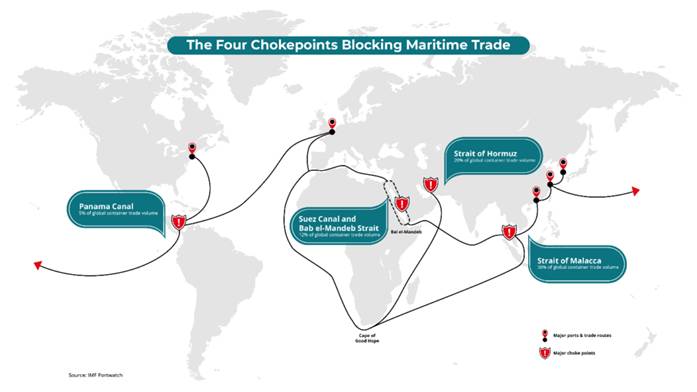
- The Malacca Dilemma: To the east, the Malacca Strait forms India’s primary export channel to East Asia. Securing this chokepoint is vital to keeping regional trade moving freely.
- Naval Escort Imperatives: The vulnerability forces the Indian Navy to dedicate active destroyer groups to continuous escort operations, shifting defense focus toward open-ocean policing.
Positives, Negatives, & Government Schemes
| Dimension | Details |
| Positives | Drives structural changes toward creating strategic domestic fuel reserves; highlights the value of the Indian Navy as a regional security provider. |
| Negatives | Immediate inflationary pressure on the Rupee; major supply chain disruptions for export items; surging maritime insurance premiums. |
| Associated Frameworks | Sagarmala Project, Indian Ocean Rim Association (IORA), Security and Growth for All in the Region (SAGAR). |
Examples
Recent trade re-routing patterns around the Cape of Good Hope during localized Red Sea flashpoints serve as an active example of how quickly chokepoint vulnerabilities impact inflation.
Way Forward
- Rapidly double the capacity of India’s Strategic Petroleum Reserves (SPR) to insulate the economy against supply shocks.
- Deepen trilateral maritime patrol structures with like-minded regional partners around critical strait openings.
- Expand alternative international land-rail transport corridors, such as the International North-South Transport Corridor (INSTC), to bypass vulnerable waters.
Conclusion
Maritime chokepoint instability underscores that economic security cannot be isolated from oceanic geography, requiring a strong blue-water naval presence to safeguard trade lines.
Practice Mains Question
Analyze the strategic economic vulnerabilities India faces due to rising security threats across global maritime chokepoints, and outline the naval counter-strategies required. (250 words)
Topic 7: The Rupee Depreciates Amid Geopolitical Stress
Syllabus
- Indian Economy (GS Paper 3): Indian Economy and issues relating to planning, mobilization of resources, growth, and development.
Context
The Indian Rupee hit a historic low, opening at 96.89 and slipping further to 96.90 against the US Dollar during early interbank foreign exchange trade, marking its eighth consecutive losing session due to ongoing global market corrections.
Main Body: Multi-Dimensional Analysis
- The Geopolitical Flight to Safety: Escalating global flashpoints have driven international funds out of emerging markets and into safe-haven assets, boosting the US Dollar index.
- Import-Export Disparity: A weaker Rupee makes essential imports—especially crude oil, electronic systems, and defense components—substantially more expensive, driving imported inflation.

- Export Competitiveness Realities: While a falling currency theoretically boosts export profitability (e.g., IT services and textiles), concurrent global demand slowdowns limit these gains.
- Central Bank Intervention Dilemmas: The Reserve Bank of India (RBI) faces a tough balance: spending foreign exchange reserves to defend the currency versus letting market forces settle to preserve import cover.
Positives, Negatives, & Government Schemes
| Dimension | Details |
| Positives | Improves local currency earnings for software, pharmaceutical, and textile exporters; naturally discourages non-essential imports. |
| Negatives | Expands the current account deficit (CAD); raises domestic retail fuel prices; increases external commercial borrowing repayment costs for local firms. |
| Associated Concepts | Liberalized Remittance Scheme (LRS), Foreign Exchange Management Act (FEMA), RBI Open Market Operations. |
Examples
The current drop mirrors previous global economic shocks, where systemic risk aversion instantly triggers defensive capital reallocations away from developing markets regardless of solid domestic growth indicators.
Way Forward
- Set up rupee-denominated trade accounts with major export hubs to reduce direct operational reliance on the US Dollar.
- Utilize targeted interest rate tools to prevent short-term speculative currency trading without harming domestic industrial growth.
- Provide tailored export credit incentives to high-value manufacturing units to capitalize on the lower exchange rate.
Conclusion
The Rupee’s dip reflects global financial shifts rather than internal economic weakness, calling for steady monetary guardrails to navigate international market volatility.
Practice Mains Question
Examine the domestic macroeconomic consequences of rapid currency depreciation on India’s Current Account Deficit (CAD) amid volatile international trade scenarios. (250 words)
Topic 8: The “Coffee of Nagaland” Mission Launched to Boost Rural Livelihoods
Syllabus
- GS Paper 3 (Agriculture & Economic Development): Issues related to direct and indirect farm subsidies and minimum support prices; Promoting agricultural growth.
Context
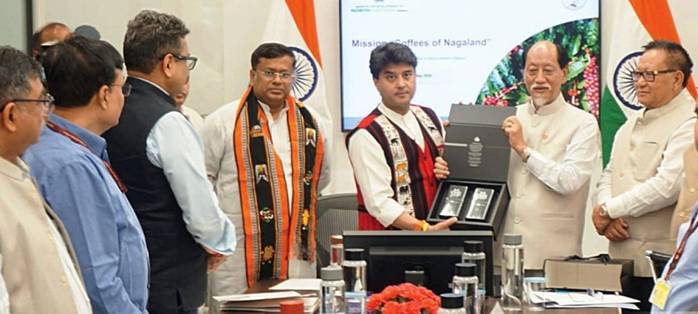
The Ministry of Development of North Eastern Region (MDoNER) launched the ₹175 crore “Coffee of Nagaland” mission, a dedicated initiative designed to convert regional agricultural practices into high-yield premium agri-business models.
Main Body: Multi-Dimensional Analysis
- Cluster-Based Agricultural Development: The mission deploys a targeted cluster format, identifying Tuophema village for high-value Arabica coffee and Ghotovi village for robust Robusta coffee cultivation.
- Sustainable Livelihood Diversification: The program offers hill farmers an alternative to traditional Jhum (slash-and-burn) cultivation, reducing soil erosion while establishing structured income streams.
- Agri-Logistics Enhancement: A significant portion of the ₹175 crore budget is directed toward building regional processing mills and sorting facilities to ensure products meet export standards.
- Global Brand Integration: By marketing Nagaland’s unique high-altitude microclimates, the initiative looks to connect local cooperatives directly with organic global specialty coffee markets.
Positives, Negatives, & Government Schemes
| Dimension | Details |
| Positives | Reduces eco-damaging slash-and-burn farming; triples average local household farm income; creates a premium global brand for Northeast exports. |
| Negatives | Long harvest gestation periods (3-4 years for initial yields); sensitive to sudden climate shifts and localized pest challenges. |
| Associated Initiatives | Mission Organic Value Chain Development for Northeastern Region (MOVCDNER), Coffee Board of India Support, PM-DevINE. |
Examples
The cluster format adapts successful organic farming models from Araku Valley in Andhra Pradesh, where tribal cooperatives achieved premium global brand status through structured organic cultivation.
Way Forward
- Provide direct interest-free transition loans to farmers to cover income gaps during the initial non-bearing crop years.
- Integrate international organic standard certifications directly at the village cooperative level to ease export access.
- Formulate robust eco-tourism tracks around the coffee clusters to create secondary service-sector jobs for local youth.
Conclusion
The “Coffee of Nagaland” mission represents a clear transition in development strategies for the Northeast—shifting from general subsidies to building specialized, high-value agricultural assets that protect the local ecosystem.
Practice Mains Question
“Cluster-based agricultural initiatives can simultaneously resolve ecological degradation and rural poverty in hilly terrains.” Evaluate this statement using the newly launched “Coffee of Nagaland” mission as a baseline. (250 words)
