
Today’s snapshot
1. USTR Names India Among 14 Economies in Section 301 Excess-Capacity Determinations (GS 2 & 3)
2. ECI Directs Form 8 Corrections to SSR Rolls Using SIR Data (GS 2)
3. Supreme Court Lets CBSE Students Continue with Three Languages (GS 2)
4. Cabinet Approves Rs 11,000 Crore Construction and Infrastructure Equipment Scheme (GS 3)
5. Bangladesh Raises Garment Minimum Wage 36 Per Cent After Weeks of Protests (GS 2 & 3)
6. Australia’s Digital Duty of Care Becomes Law (GS 3)
7. Australia Signs Security Treaty with Solomon Islands (GS 2)
8. Constitution Day 2026: Why November 26 Is Samvidhan Divas (GS 1 & 2)
Topic 1: USTR Names India Among 14 Economies in Section 301 Excess-Capacity Determinations
Subject: International Relations and Economy – Trade Policy and India-US Relations
Paper: GS Paper 2: effect of policies and politics of developed and developing countries on India’s interests; GS Paper 3: Indian economy, trade and manufacturing policy
UPSC Relevance: The determinations test India’s manufacturing-first economic strategy against its largest export market, and they show how unilateral trade law is displacing multilateral dispute settlement, a recurring GS 2 and GS 3 theme.
Why in News
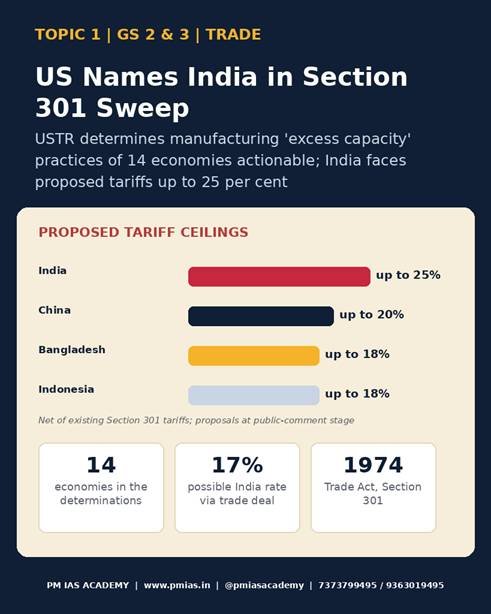
On 25 November 2026, United States Trade Representative Jamieson Greer determined under Section 301 of the Trade Act of 1974 that the acts, policies and practices of 14 economies relating to structural excess capacity and production in manufacturing sectors are unreasonable and burden or restrict United States commerce, and are therefore actionable under Section 301(b).
The 14 economies are China, the European Union, Singapore, Switzerland, Indonesia, Malaysia, Cambodia, Thailand, Korea, Vietnam, Taiwan, Bangladesh, Japan and India; the Trade Representative made no determinations on Mexico or Norway at this time, and proposed responsive tariffs for public comment.
Background: Section 301 and the Excess-Capacity Turn
Section 301 of the United States Trade Act of 1974 authorises the US Trade Representative to investigate foreign practices it considers unreasonable or discriminatory and to impose responsive measures, including tariffs, after a public-comment process; it was the legal basis of the China tariffs from 2018 onward.
The new investigations extend the tool from its traditional focus on specific unfair practices to a broader theory of structural excess capacity, which Ambassador Greer described as industrial strategies built on manufacturing targeting, wage and labour suppression, financial support and other market-distorting practices that tilt trade balances.
Against India specifically, the USTR listed industrial plans to expand manufacturing, inadequate labour protections, financial repression policies, sustained market access barriers and failure to address global excess capacity, naming pharmaceuticals and medical devices, steel, solar and ICT as especially affected sectors.
Key Dimensions
1. The proposed India tariff: The USTR proposed tariffs of up to 25 per cent on all goods of India, net of existing Section 301 tariffs, with exemptions for certain goods, and signalled the rate could be adjusted to 17 per cent were India to conclude an Agreement on Reciprocal Trade responsive to the investigation, making the tariff a negotiating lever rather than a finished decision.
2. Differentiated rates: The proposals differentiate by partner: up to 18 per cent for Bangladesh, Cambodia and Indonesia, up to 20 per cent for China layered on the forced-labour investigation, and up to 25 per cent for India, a spread candidates should map rather than memorise as a single figure.
3. The negotiating off-ramp: Each proposal is expressly conditioned on ongoing consultations and existing reciprocal trade agreements, and the India text explicitly contemplates a lower rate if a bilateral agreement addresses the findings, so the action functions as coercive diplomacy.
4. Unilateral versus multilateral: The determinations bypass the WTO dispute system entirely; the USTR argues that statements at the G7, G20 and WTO have not produced change, a justification India and others contest because unilateral retaliation sits uneasily with WTO obligations.
5. Excess capacity as theory: The investigations treat manufacturing support itself, not only dumping or subsidies to specific products, as actionable, which would subject industrial policy as such, including production-linked incentives, to trade challenge.
6. The labour dimension: Nine of the fourteen determinations, including India’s, cite inadequate labour protections, folding workers’ rights into a market-access argument and blurring the line between trade enforcement and social regulation.
7. China’s separate lane: China faces the longest charge sheet, nine categories including forced technology transfer and intellectual property theft, and a proposed structure referencing the Kuala Lumpur Joint Arrangement of 30 October 2025, showing the India action is part of a global sweep, not an India-specific rupture.
8. Commerce Ministry response: India’s Commerce Ministry has batted for resolution within the bilateral trade deal framework, as reported in news coverage, signalling that New Delhi reads the proposal as a negotiating position to be settled through the pending trade talks rather than through retaliation.
9. Public-comment stage: The proposals are not yet law: the USTR published pre-publication Federal Register notices inviting comment, so the operative status is proposed action, a distinction Prelims questions may test.
10. Sector exposure for India: The named Indian sectors, pharmaceuticals and medical devices, steel, solar and ICT, cover some of India’s strongest export lines to the United States, so even a proposed tariff can move investment and order-book decisions before any final rate.
11. Alliance awkwardness: The sweep covers treaty allies and partners, Japan, Korea, the EU, Taiwan, alongside rivals, demonstrating that the instrument is economic-nationalist rather than geopolitical, which complicates India’s reading of strategic partnership guarantees.
12. Precedent risk: If excess capacity becomes settled grounds for Section 301 action, every economy with active industrial policy, including India’s PLI architecture, carries standing exposure to US unilateral measures.
Significance
1. Trade talks leverage: The proposed rates frame the ongoing India-US trade negotiations: the 25 per cent ceiling and the 17 per cent contingent rate define the zone of a possible bargain.
2. Manufacturing strategy stress-test: India’s PLI-driven manufacturing push is now explicitly named in a US trade-remedy document, forcing a policy conversation on how industrial support is designed and defended.
3. WTO at the margin: The episode deepens the shift from rule-based dispute settlement to power-based bilateral bargaining, a structural change in the trading system India has relied upon.
4. Exam hook: The item links trade law, industrial policy, labour standards and bilateral diplomacy, and it demands precise status language: determination made, tariffs proposed, nothing final.
Challenges
1. Export exposure: The United States is among India’s largest goods export destinations, so a blanket tariff of even the lower contingent rate would hit pharmaceuticals, engineering goods and electronics simultaneously.
2. Retaliation dilemma: Counter-tariffs risk escalation with a partner India needs on technology and defence, while acquiescence invites wider demands on labour, currency and industrial policy.
3. Policy chill: Investors pricing Section 301 risk may defer India-linked capacity decisions in the named sectors even before any final action, a cost that arrives ahead of the legal fact.
4. Narrative asymmetry: The charge of inadequate labour protections lands on a country whose recent labour codes are still being operationalised, letting trade pressure shape a domestic reform agenda from outside.
Way Forward
1. Negotiate the off-ramp: Prioritise concluding a reciprocal trade agreement that addresses the listed practices on India’s terms, since the USTR text itself maps a 17 per cent pathway.
2. Defend industrial policy design: Document that PLI and allied schemes are production-neutral, WTO-consistent supports, building the legal record before any final US action.
3. Diversify markets and products: Accelerate trade agreements with the EU, UK and Gulf partners so that sector exposure to a single market falls over the medium term.
4. Use the comment window: File substantive submissions in the Federal Register process through industry bodies, since the proposals remain at the public-comment stage.
Prelims Value Addition
- Section 301 of the Trade Act of 1974 empowers the USTR to act against unreasonable foreign practices; on 25 November 2026 determinations covered 14 economies including India; no determination was made on Mexico or Norway.
- Proposed tariffs: India up to 25 per cent (17 per cent contingent on a reciprocal trade agreement); Bangladesh, Cambodia and Indonesia up to 18 per cent; China up to 20 per cent; proposals are at the public-comment stage.
- India’s cited sectors: pharmaceuticals and medical devices, steel, solar and ICT; India’s cited practices include industrial plans, labour protections, financial repression and market access barriers.
- USTR: Jamieson Greer; the China proposal references the Kuala Lumpur Joint Arrangement of 30 October 2025.
Mains Value Addition
- GS 2: ‘Section 301 has evolved from a remedy against specific unfair practices into an instrument against industrial policy itself.’ Examine with reference to the November 2026 excess-capacity determinations and their implications for India.
- GS 3: Discuss how India should defend its manufacturing-support programmes in an era of unilateral trade actions, while keeping the India-US economic relationship on track.
Topic 2: ECI Directs Form 8 Corrections to SSR Rolls Using SIR Data
Subject: Polity – Election Commission and Electoral Rolls
Paper: GS Paper 2: salient features of the Representation of the People Act; constitutional bodies and their powers; electoral processes and reforms
UPSC Relevance: The directive shows how the ECI sequences its two revision instruments, the Special Intensive Revision and the Special Summary Revision, and how it balances data-driven flagging with the legal requirement that every correction pass through the elector’s own signed application.
Why in News
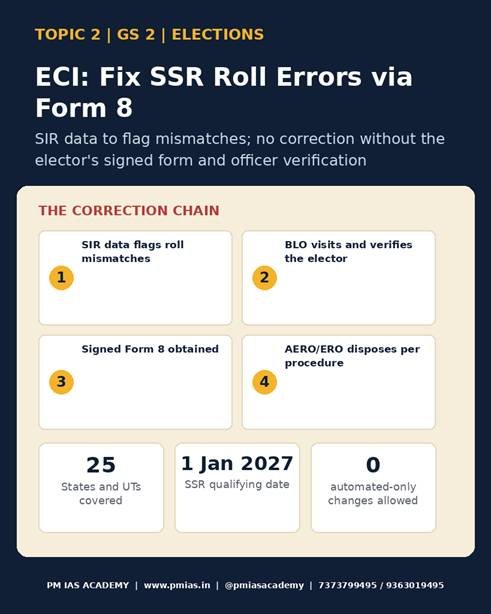
On 25 November 2026, the Election Commission of India directed Chief Electoral Officers of 25 States and Union Territories that incorrect or erroneous entries flagged in electoral rolls during the ongoing Special Summary Revision be corrected through Form 8, after comparing entries with the corresponding information collected during the Special Intensive Revision.
The move follows complaints of incorrect entries in several cases in the final published SIR lists, and the Commission made clear that no change will rest on automated matching alone.
Background: Forms, Revisions and the Roll
The electoral roll is prepared under the Representation of the People Act, 1950, and corrected through prescribed forms: Form 6 for new enrolment, Form 7 for objection or deletion, and Form 8, the application for correction of particulars such as name, relation name or type, date of birth, mobile number and photograph.
The Special Intensive Revision is a house-to-house enumeration the ECI has used to rebuild rolls de novo in selected States, while the Special Summary Revision is the periodic update run with reference to a qualifying date, here 1 January 2027, ordered through letters on 15 October, 4 November and 11 November.
The directive covers the 25 States and UTs where the SIR has been completed and the SSR is on, including Bihar, Tamil Nadu, West Bengal, Uttar Pradesh, Kerala, Assam, Gujarat and others listed in the Commission’s letter.
Key Dimensions
1. The correction mechanics: Where a mismatch is noticed between the existing roll and the SIR data, the entry is flagged for verification; booth-level officers visit the concerned electors during the SSR and obtain a duly filled and signed Form 8 wherever correction is needed.
2. No automation shortcut: The Commission ordered that though the exercise runs on the BLO, AERO and ERO modules of the ECINet portal, no changes shall be made solely on the basis of automated identification, and all corrections require the elector’s signed Form 8 plus prescribed verification and approval by the competent authority.
3. Disposal chain: Assistant Electoral Registration Officers and Electoral Registration Officers examine and dispose of the applications in accordance with the prescribed procedure, keeping the statutory officer, not the software, as the decision point.
4. Who can flag: As reported in news coverage, incorrect entries in the roll published after the SIR may be flagged by electors themselves, booth-level agents or any other person, widening the error-detection net beyond the machinery.
5. The qualifying date frame: The SSR proceeds with 1 January 2027 as the qualifying date, the reference point against which additions, deletions and corrections in this cycle are measured.
6. Why the SIR comparison helps: The SIR generated a fresh, field-verified dataset; comparing it against the existing roll lets the ECI find errors the elector never reported, converting one exercise’s output into the other’s quality check.
7. Accountability design: By insisting on the signed Form 8, the ECI preserves an auditable paper trail for every change, a safeguard against silent algorithmic edits to the franchise roll.
8. Sequencing lesson: The directive illustrates administrative sequencing: enumerate intensively first, then use the summary revision’s public-facing machinery to fix what the intensive round exposed.
9. Coverage breadth: The order runs to 25 States and UTs at once, making it one of the widest simultaneous roll-correction operations the Commission has directed in recent years.
10. Electoral integrity context: Erroneous entries, wrong names, photographs or dates of birth, disenfranchise in practice even without deletion, because identity mismatches at the booth can block voting; correction is therefore participation protection, not clerical tidying.
11. Institutional signalling: The public directive, issued the same day complaints were reported, signals responsiveness and pre-empts the charge that SIR errors were baked into the published roll.
12. Limits of the fix: Corrections depend on BLO field visits within the SSR window and on electors signing forms, so coverage will turn on the same ground-level capacity constraints that produced some errors in the first place.
Significance
1. Franchise accuracy: Accurate rolls are the administrative foundation of free elections; a correction channel that pairs data matching with elector consent strengthens both inclusion and integrity.
2. Checks on automation: The explicit bar on automated-only changes is a noteworthy governance norm for an era of digitised administration, relevant well beyond elections.
3. Federal execution: The directive runs through State CEOs, BLOs, AEROs and EROs, a live example of how a constitutional body implements through a field hierarchy.
4. Exam hook: The item lets candidates distinguish Form 6, 7 and 8, SSR from SIR, and the ECINet modules, while discussing consent-based correction as an administrative-law principle.
Challenges
1. Field capacity: BLO visits for every flagged entry within the SSR timetable strain the same frontline machinery that conducts the revision itself.
2. Voter awareness: Electors who do not know their entries are wrong may miss the window, since the process still depends on contact and signature.
3. Error asymmetry: A wrongly deleted or mismatched elector bears the burden of discovery and correction, even though the error originated in the official exercise.
4. Data protection: Large-scale comparison of demographic particulars raises confidentiality obligations the directive addresses only procedurally.
Way Forward
1. Publish flag statistics: Release State-wise counts of flagged and corrected entries after the SSR closes, so the exercise’s scale and quality are publicly auditable.
2. Notify affected electors: Use SMS and voter helplines to inform electors whose entries were flagged, rather than waiting for them to discover errors.
3. Train and staff BLOs: Provide temporary field support and clear scripts for the correction visits, since BLO capacity determines the directive’s real reach.
4. Institutionalise the cross-check: Make SIR-to-roll comparison a standing step in every future revision cycle, with the signed Form 8 safeguard retained.
Prelims Value Addition
- Form 8 corrects elector particulars; Form 6 is new enrolment; Form 7 is objection or deletion; electoral rolls are prepared under the Representation of the People Act, 1950.
- The 25 November 2026 ECI directive covers 25 States and UTs where SIR is complete and SSR is on; the SSR qualifying date is 1 January 2027.
- No correction can rest on automated identification alone: BLO verification, the elector’s signed Form 8, and AERO/ERO disposal are required; the exercise runs on the ECINet portal.
- The SSR was ordered through letters dated 15 October, 4 November and 11 November 2026.
Mains Value Addition
- GS 2: ‘The integrity of the electoral roll is the administrative foundation of universal franchise.’ Discuss in the light of the ECI’s directive on correcting erroneous entries through Form 8.
- GS 2: Examine the safeguards needed when data-matching is used to correct statutory registers, with reference to the ECI’s bar on automated-only changes to electoral rolls.
Topic 3: Supreme Court Lets CBSE Students Continue with Three Languages
Subject: Polity and Education – Judiciary, Language Policy and NEP Implementation
Paper: GS Paper 2: structure, organisation and functioning of the judiciary; issues relating to development and management of the social sector relating to education
UPSC Relevance: The case sits at the junction of judicial oversight of education policy, the three-language formula inherited from the National Education Policy 2020, and cooperative transitions: how courts phase in mandates without springing surprises on current students.
Why in News
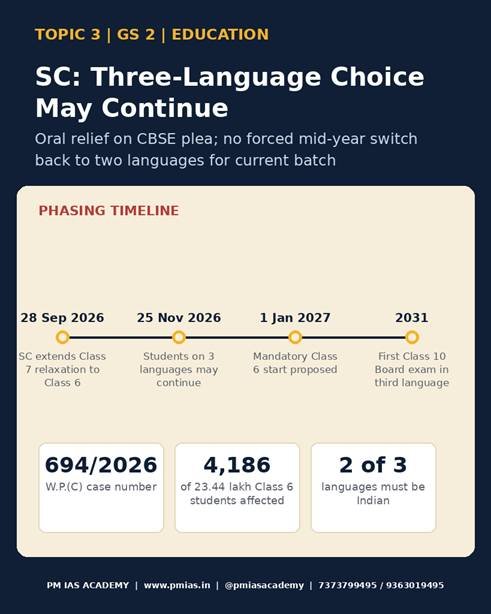
On 25 November 2026, the Supreme Court orally observed that CBSE students who have already opted for three languages for the current academic year may continue with that option and need not compulsorily switch back to two languages.
The remarks came on a CBSE plea seeking modification of the Court’s 28 September order that had extended to Class 6 the transitional relaxation available to Class 7 on evaluation of the third language, in the matter Yashica Bhandari Jain and Others versus Union of India and Others, W.P. (C) No. 694 of 2026 and connected matters.
Background: The Three-Language Mandate and Its Phasing
The three-language formula, reaffirmed in the National Education Policy 2020, asks school students to learn three languages, at least two of them Indian; CBSE’s R3 rule requires three languages in Classes 6 to 9 with at least two Indian languages, as described in coverage of the case.
In earlier hearings before the 28 September order, the Court had proposed making the scheme mandatory for Class 6 only from 1 January 2027, saying the government should not spring a surprise on the current Class 6 batch with hardly a few months left for the academic year, and suggesting the time be used to develop incentives for children to embrace a third language.
Under the transitional arrangement, Class 7 students, along with Classes 8 and 9, were granted relaxation from the CBSE Board examination in the third language when they reach Class 10; the third language is assessed only through internal school-based evaluation and has no bearing on final Board results.
Key Dimensions
1. What the Court clarified: Students who already chose three languages may continue; those currently on two languages may also continue this year and pick up the third language next year, so no student is forced to switch mid-year in either direction.
2. The CBSE’s arithmetic: CBSE told the Court the September relief would help only about 4,186 of roughly 23.44 lakh Class 6 students and could disrupt school timetables, as reported in coverage of the hearing, a numbers argument for modifying the order.
3. Bench’s practical lens: Chief Justice Kant’s bench had earlier pressed on implementation readiness, asking about teacher and textbook availability and the classification of English, signalling that the Court’s concern is administrability, not the policy’s merit.
4. Oral observation, not final word: The 25 November remarks are oral observations on a modification plea, and the Court left CBSE free to return if implementation problems continue; the status is interim guidance, not a settled judgment on the three-language formula.
5. Transitional design: The structure exempts Classes 6 to 9 from a Class 10 Board exam in the third language for current cohorts, while the present Class 6 batch had been slated for full implementation, including a mandatory Class 10 Board exam in the third language by 2031, a long glide path by design.
6. Judicial method: The case shows the Court managing policy transition through prospective phasing and incentive-building suggestions rather than striking down or staying the mandate, an example of dialogic review in education policy.
7. Federal language context: The three-language question carries special weight in States with strong two-language traditions, though this case is confined to CBSE schools, which follow the national board’s curriculum across States.
8. NEP implementation marker: The litigation is a checkpoint in NEP 2020’s rollout: curriculum mandates meet classroom capacity, and the Court is effectively supervising the pace of alignment.
9. Equity of transition: The Court’s no-surprise principle protects students who made subject choices on the rules as they stood, a fairness norm that recurs in service and examination jurisprudence.
10. Incentives over compulsion: The suggestion that government build incentives for third-language study reads compulsion as a weak instrument for language learning, an idea candidates can weigh against the constitutional commitment to multilingualism.
11. Data in judicial reasoning: The CBSE’s specific figure, 4,186 affected students among 23.44 lakh, shows how granular enrolment data now shapes interim relief in education litigation.
12. Standing of the parties: The case arises from writ petitions by students and parents against the Union and CBSE, the standard channel through which examination policy reaches constitutional courts under Article 32.
Significance
1. Education governance: The orders illustrate how judicial review now accompanies large curriculum transitions, setting pace and process without displacing the policymaker.
2. Multilingualism debate: The case keeps the three-language formula in public view, balancing the NEP’s multilingual vision against classroom capacity and student burden.
3. Precedent for phasing: The no-surprise, incentive-first approach is a transferable template for implementing mandates that affect enrolled cohorts.
4. Exam hook: Candidates can link Article 350A and the Eighth Schedule’s spirit, NEP 2020, and judicial phasing techniques in one answer, with precise case identification.
Challenges
1. Capacity gaps: Teacher and textbook readiness for a third language varies sharply across CBSE’s network, so uniform timelines risk formal compliance without real learning.
2. Classification disputes: Questions such as whether English counts among the three languages remain live, and unresolved classification can reopen litigation.
3. Interim uncertainty: Oral observations guide but do not finally settle the scheme’s validity, leaving schools to plan under continuing case risk.
4. State-board divergence: Relief confined to CBSE leaves State boards on their own timelines, fragmenting the national picture the formula was meant to unify.
Way Forward
1. Publish readiness audits: CBSE should map teacher and textbook availability school-wise before each phase-in date, so extensions rest on evidence rather than plea.
2. Build incentive pathways: Act on the Court’s suggestion: scholarships, certificate recognition and credit frameworks that make a third language attractive rather than merely mandatory.
3. Codify transition rules: Write prospective-application norms into the scheme itself, so enrolled cohorts are protected without needing courtroom clarification.
4. Settle classification early: Resolve the status of English and other ambiguities through clear CBSE notification, reducing the scope for renewed challenge.
Prelims Value Addition
- Case: Yashica Bhandari Jain and Others v. Union of India and Others, W.P. (C) No. 694/2026; oral observations of 25 November 2026; CBSE’s R3 rule requires three languages in Classes 6-9 with at least two Indian languages.
- The Supreme Court’s 28 September order extended Class 7’s transitional relaxation to Class 6; the Court earlier proposed mandatory application for Class 6 only from 1 January 2027.
- CBSE’s modification plea cited 4,186 affected students out of roughly 23.44 lakh in Class 6; third language for current cohorts is assessed internally, with no Class 10 Board exam bearing.
- The three-language formula is reaffirmed in the National Education Policy 2020; full implementation for the present Class 6 batch had been slated with a mandatory Class 10 Board exam in the third language by 2031.
Mains Value Addition
- GS 2: ‘Courts increasingly supervise the pace, not merely the validity, of policy transitions.’ Discuss with reference to the Supreme Court’s handling of the CBSE three-language mandate.
- GS 2: Examine the three-language formula as an instrument of national integration, and the administrative preconditions for its fair implementation in school education.
Topic 4: Cabinet Approves Rs 11,000 Crore Construction and Infrastructure Equipment Scheme
Subject: Economy – Industrial Policy and Capital Goods Manufacturing
Paper: GS Paper 3: Indian economy, industrial growth, infrastructure investment models; effects of liberalisation; government budgeting
UPSC Relevance: The scheme is the largest of the Cabinet’s 25 November package and extends the incentive-plus-testing-facility template to capital goods, the sector that determines whether India’s infrastructure build-out runs on domestic or imported machinery.
Why in News
The Union Cabinet, chaired by the Prime Minister, on 25 November 2026 approved the Scheme for Enhancement of Construction and Infrastructure Equipment (CIE) Manufacturing Ecosystem with a financial outlay of Rs 11,000 crore, to be implemented by the Ministry of Heavy Industries.
The decision was one of five approvals totalling Rs 19,934 crore announced the same day, alongside the Kamarajar Port second container terminal (Rs 4,288.26 crore), the Doloo greenfield airport at Silchar (Rs 2,014 crore) and two Department of Posts schemes (Rs 1,141 crore and Rs 1,491 crore), per the official cabinet briefing.
Background: India’s CIE Industry
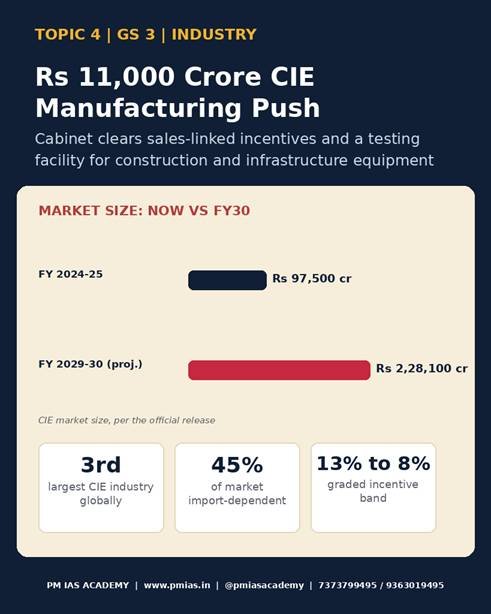
India’s CIE industry is the world’s third largest after China and the United States, with a market size of around Rs 97,500 crore in FY 2024-25, yet about 45 per cent of it depends on imports, per the official release.
Driven by growth in roads, ports and housing, the industry is projected to more than double to around Rs 2,28,100 crore by FY 2029-30, which is the demand window the scheme is designed to capture domestically.
The scheme targets technologically advanced equipment such as Ship-to-Shore cranes, Tunnel Boring Machines, hydraulic excavators and off-highway trucks, categories where import dependence is most strategic, and provides for a dedicated state-of-the-art CIE testing facility in the country.
Key Dimensions
1. Scheme architecture: Eight-year duration from FY 2026-27: a two-year gestation period (FY 2026-27 to FY 2027-28) for setting up manufacturing facilities, a five-year incentive disbursement period (FY 2028-29 to FY 2032-33), and a final settlement year (FY 2033-34) for incentives on incremental sales of FY 2032-33.
2. Sales-linked incentive: Component one pays incentives on the incremental sales value of eligible equipment and components to approved OEMs and component manufacturers across two categories, with graded rates declining from 13 per cent to 8 per cent over five years, rewarding scale-up rather than incumbency.
3. Testing facility grant: Component two offers a grant of up to Rs 375 crore as viability gap funding for a dedicated CIE testing facility, addressing the certification bottleneck that forces Indian makers to validate equipment abroad.
4. Import-substitution logic: With about 45 per cent of the market import-dependent, the scheme aims at the high-technology end where imports concentrate, not at the commoditised equipment India already makes competitively.
5. Incremental-sales design: Incentives attach to incremental sales value, so support follows realised market performance; the design is deliberately output-based rather than input-subsidised, in line with the PLI family of schemes.
6. Employment and supply chains: The official release projects supply chain security and employment opportunities as intended effects, consistent with component manufacturing’s higher labour intensity than assembly.
7. Atmanirbhar framing: The scheme is presented under the Atmanirbhar Bharat Abhiyan and the Viksit Bharat @2047 vision, situating capital goods within the self-reliance agenda that earlier covered electronics and automobiles.
8. Package context: Within the day’s Rs 19,934 crore Cabinet package, the CIE scheme is the largest item, signalling that industrial policy, not only infrastructure construction, is the current capex emphasis.
9. Gestation realism: The two-year no-incentive gestation acknowledges that heavy equipment plants take time to build, a design correction against schemes that pay out before capacity exists.
10. Testing as public good: A domestic testing facility lowers entry costs for smaller manufacturers who cannot afford foreign certification, making the ecosystem less concentrated than incentives alone would produce.
11. Global market ambition: The release explicitly aims to position India as a key player in the global CIE market, moving the sector’s goal from import substitution toward export competitiveness.
12. Fiscal profile: The Rs 11,000 crore outlay is spread over eight years with back-loaded disbursement, so the near-term fiscal cost is modest relative to the headline figure.
Significance
1. Capital goods self-reliance: Infrastructure spending multiplies through the economy only if the equipment is available; domestic CIE capacity keeps more of the public capex multiplier at home.
2. Template extension: The scheme extends the PLI-style graded, incremental-sales incentive to heavy capital goods, testing the model’s portability beyond electronics.
3. Strategic sectors: Tunnel boring and port equipment are dual-use capabilities for strategic infrastructure, where import dependence carries supply-security risk.
4. Exam hook: The item lets candidates discuss industrial policy design (output-based incentives, gestation periods, viability gap funding) with exact, current figures.
Challenges
1. Technology gap: Advanced CIE requires hydraulics, powertrains and control systems where Indian capability is thin; incentives alone cannot conjure the knowledge base.
2. Import entrenched advantage: Established foreign OEMs offer financing, service networks and proven reliability that new domestic entrants must match, not merely underprice.
3. Disbursement discipline: Back-loaded payouts depend on verification of incremental sales, an administrative burden that has slowed other incentive schemes.
4. Demand cyclicality: The scheme bets on the infrastructure boom holding through FY 2033-34; a capex downturn would leave subsidised capacity underused.
Way Forward
1. Pair incentives with technology partnerships: Encourage joint ventures and licensing that transfer hydraulic and control-system capability, so domestic content rises with output.
2. Fast-track the testing facility: Sequence the Rs 375 crore grant early, since certification capacity gates every manufacturer’s product cycle.
3. Anchor demand through procurement: Use public infrastructure tenders to create assured initial demand for domestically made equipment meeting quality standards.
4. Publish annual progress dashboards: Report incremental sales, incentives disbursed and import share annually, so the scheme’s trajectory is visible and correctable.
Prelims Value Addition
- Cabinet approved the CIE Manufacturing Ecosystem scheme on 25 November 2026: Rs 11,000 crore outlay, Ministry of Heavy Industries, eight years from FY 2026-27, graded sales-linked incentives of 13 to 8 per cent, and up to Rs 375 crore viability gap funding for a testing facility.
- India’s CIE market: about Rs 97,500 crore in FY 2024-25, world’s third largest after China and the US, about 45 per cent import-dependent, projected at about Rs 2,28,100 crore by FY 2029-30.
- Target equipment includes Ship-to-Shore cranes, Tunnel Boring Machines, hydraulic excavators and off-highway trucks.
- The same Cabinet cleared five decisions worth Rs 19,934 crore: CIE scheme Rs 11,000 crore, Kamarajar Port second container terminal Rs 4,288 crore, Doloo greenfield airport Rs 2,014 crore, Postal Operations Scheme Rs 1,141 crore and Estates Management Scheme Rs 1,491 crore.
Mains Value Addition
- GS 3: ‘Infrastructure-led growth is sustainable only when the capital goods behind it are made at home.’ Evaluate the CIE Manufacturing Ecosystem scheme against this claim.
- GS 3: Discuss the design features, incremental-sales incentives, gestation periods and viability gap funding, that distinguish India’s current industrial support schemes, using the CIE scheme as illustration.
Topic 5: Bangladesh Raises Garment Minimum Wage 36 Per Cent After Weeks of Protests
Subject: International Relations and Economy – Labour, Trade and the Neighbourhood
Paper: GS Paper 2: India and its neighbourhood; effect of policies of developing countries on India’s interests; GS Paper 3: labour, employment and inclusive growth
UPSC Relevance: Bangladesh’s wage settlement reshapes the economics of the world’s second-largest garment exporter, a sector India watches both as competitor in textile exports and as neighbour whose industrial stability carries regional spillovers.
Why in News
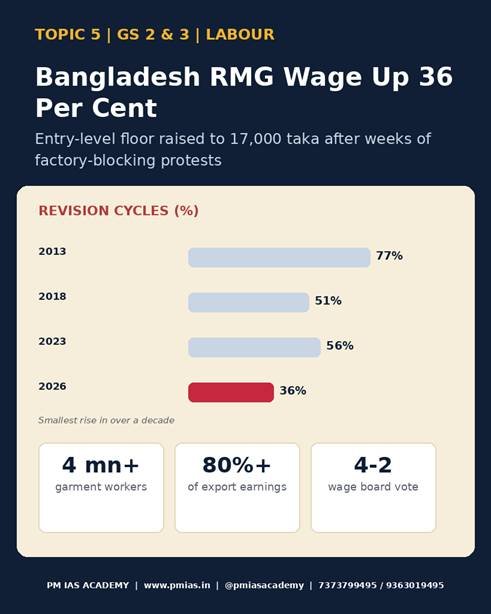
Bangladesh on 25 November 2026 raised the minimum monthly wage for entry-level garment workers by 36 per cent, from 12,500 taka to 17,000 taka (about $136-139), after weeks of protests that closed factories, blocked highways and disrupted production, as reported by AP, CNA and Bangladeshi media.
The government-appointed wage board approved the new structure around 2 am after nearly 12 hours of talks, in a 4-2 vote of its six members, with the two worker representatives backing an 18,000 taka minimum instead, according to worker representative Babul Akhter as reported.
Background: The RMG Sector and Its Wage Cycle
The ready-made garment sector is Bangladesh’s export engine: it employs more than four million workers, many of them women from rural areas, supplies retailers including H&M, Zara, Walmart, Target and Gap, and generates more than 80 per cent of the country’s export earnings, roughly $38 billion a year per the central bank as cited in coverage.
The new four-grade structure pays 17,000 taka monthly at Grade 4 up to 21,500 taka at Grade 1; the increase is the smallest in more than a decade, following rises of 56 per cent in 2023, 51 per cent in 2018 and 77 per cent in 2013, and takes effect on 1 December with revised pay from January.
Workers initially sought 32,000 taka before lowering their demand to 18,000 taka in negotiations, while factory owners opened at 15,000 taka before rising to 17,000; the BGMEA estimated 317 factories lost about $428 million in production over 18 days of disruption and buyers shifted about $254 million in orders to other countries, as reported.
Key Dimensions
1. The settlement’s arithmetic: A 36 per cent nominal rise against an initial demand for more than double shows both sides moved: workers dropped from 32,000 to 18,000 taka, owners rose from 15,000 to 17,000, and the board split 4-2 along representative lines.
2. Vote anatomy: The 4-2 board vote, with worker representatives dissenting for 18,000 taka, means the settlement carries formal legitimacy but incomplete consent, which is why labour leaders simultaneously accepted and criticised it.
3. Disruption economics: Reported losses of about $428 million in production and $254 million in shifted orders during 18 days quantify how quickly labour unrest converts into trade diversion in a buyer-driven industry.
4. Competitiveness tension: Factory owners warn further increases raise costs and weaken competitiveness, while labour groups argue living-standard pay underwrites long-term stability; both claims concern the same variable, the sector’s thin margin model.
5. Decelerating revisions: Each successive revision cycle has delivered a smaller percentage rise, 77, 56, 51 and now 36 per cent, even as inflation compounds, a trend workers read as falling behind and owners as converging on sustainability.
6. Fast-fashion structure: The sector’s prices are set by global buyers with alternative sourcing options, so wage costs cannot simply be passed through; the structural question is who in the value chain absorbs the increase.
7. Gender dimension: With much of the workforce made up of women from rural areas, the wage floor is also a gender equity instrument, affecting household bargaining power and rural-urban migration decisions.
8. The no-work-no-pay lever: The BGMEA reported 397 factories unable to operate on one day and 84 closed under the labour law’s ‘no work, no pay’ provision, showing employers using statutory closures as counter-pressure.
9. Regional read-across: Buyers diversifying orders during the unrest looked to alternative suppliers including India and Vietnam; Bangladesh’s instability is India’s opportunity only if Indian units can meet compliance and scale expectations.
10. Tripartite mechanism: The wage board model, government-appointed with worker and employer representatives, is the ILO-consistent tripartite form, and its 4-2 outcome tests whether form can deliver legitimacy when votes split on representation lines.
11. Compliance linkage: Minimum wage levels interact with international buyer codes and trade-preference reviews; labour standards in export sectors are increasingly market-access conditions, not only domestic policy.
12. Post-settlement risk: Coverage notes the relatively modest hike may not fully quell unrest, since the gap between the 18,000 taka fallback demand and the 17,000 taka award leaves the core grievance partly open.
Significance
1. Neighbourhood stability: Industrial peace in Bangladesh matters to India through trade, connectivity and migration channels; prolonged RMG unrest would have regional spillovers.
2. Textile competition: India’s own textile-export ambitions are benchmarked against Bangladesh’s costs; a 36 per cent wage floor rise narrows the cost gap Indian exporters compete against.
3. Labour-rights norm: The episode is a live case of how wage floors in global value chains get set, relevant to India’s own pending labour-code implementation debates.
4. Exam hook: The item combines wage boards, tripartism, export economics and neighbourhood policy with precise, datable figures.
Challenges
1. Living-cost gap: Even the raised floor trails the inflation workers cite, so purchasing-power peace may prove temporary.
2. Order diversion: Buyers who shifted orders during the disruption may not fully return, converting a temporary stoppage into a permanent share loss.
3. Enforcement capacity: A higher floor helps only where it is paid; Bangladesh’s inspection machinery has historically struggled with coverage and follow-through.
4. Political economy: The interim political context in Dhaka makes every economic settlement also a test of governmental authority, complicating purely technocratic resolution.
Way Forward
1. Index future revisions: Tie the wage floor to a published inflation index with scheduled reviews, replacing protest-driven bargaining with predictable adjustment.
2. Share costs up the chain: Press global buyers, through sourcing-country coordination, to absorb part of wage increases in contract prices.
3. Strengthen inspection: Fund independent factory-level wage compliance audits, so the new floor is real in payslips, not only in gazettes.
4. Protect competitiveness jointly: Pair wage rises with productivity investment, training and automation support, so unit costs rise slower than nominal wages.
Prelims Value Addition
- Bangladesh’s garment minimum wage rose 36 per cent on 25 November 2026: 12,500 to 17,000 taka (about $136-139), effective 1 December, paid from January; four-grade structure up to 21,500 taka at Grade 1.
- The sector employs over four million workers, supplies H&M, Zara, Walmart, Target and Gap, and earns more than 80 per cent of Bangladesh’s export earnings, roughly $38 billion a year.
- The wage board voted 4-2; worker representatives sought 18,000 taka; earlier revisions were 56 per cent (2023), 51 per cent (2018) and 77 per cent (2013).
- Reported disruption costs: about $428 million in lost production over 18 days and about $254 million in orders shifted abroad, per the BGMEA as reported.
Mains Value Addition
- GS 2/3: ‘Wage floors in export industries are set as much by global buyers as by domestic boards.’ Discuss with reference to the 2026 Bangladesh garment wage settlement.
- GS 2: Examine the significance of Bangladesh’s garment sector stability for India’s economic and neighbourhood interests.
Topic 6: Australia’s Digital Duty of Care Becomes Law
Subject: Science and Technology – Platform Regulation and Online Safety
Paper: GS Paper 3: science and technology, developments and their applications and effects in everyday life; GS Paper 2: government policies and interventions; comparison with India’s regulatory debates
UPSC Relevance: Australia’s law is the most assertive common-law-country move yet toward proactive platform liability, and it supplies a working model, and a cautionary debate, for India’s own online-safety and Digital India Act discussions.
Why in News
Australia’s Parliament passed the Digital Duty of Care on 25 November 2026, requiring online services such as games, apps, social media platforms and AI chatbots to protect users from seriously harmful material and conduct and to ensure their features and tools do not cause harm, per the Australian government’s release.
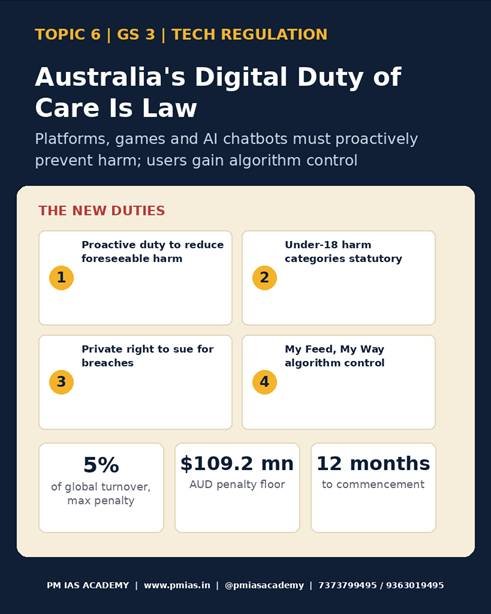
Breaches attract penalties of up to 5 per cent of the offending company’s global turnover or $109.2 million Australian, whichever is greater, and the law creates a private right of action letting individuals or groups sue providers for losses caused by breaches; it comes into effect in 12 months.
Background: From Notice-and-Takedown to Duty of Care
Traditional platform regulation worldwide rested on notice-and-takedown: platforms respond to flagged content; a duty-of-care model instead obliges services to anticipate and reduce foreseeable harm by design, the shift the Australian government describes as applying basic safety standards to online services as to every other industry.
The law includes an Australian-first ‘My Feed, My Way’ initiative giving users control over their social media algorithms, expanded eSafety Commissioner powers to remove nudify apps and websites, faster responses to cyber-bullying, and a rule-making power for an external dispute-resolution pathway.
Specific protections target under-18s against material, conduct and features harmful to them, including content that glorifies crime or life-endangering stunts, causes serious mental distress, encourages eating disorders or promotes hostile attitudes towards women.
Key Dimensions
1. Proactive obligation: The core shift is from reactive removal to proactive risk reduction: platforms must assess and mitigate harms before they occur, with the duty attaching to design choices and features, not only to content.
2. Penalty architecture: The greater-of formula, 5 per cent of global turnover or $109.2 million Australian, scales deterrence to the largest platforms while retaining a meaningful floor for smaller services.
3. Private right of action: Individuals or groups can sue providers for breaches that caused them loss or damage, decentralising enforcement beyond the regulator and importing tort logic into platform governance.
4. Algorithmic agency: My Feed, My Way gives users control over recommender algorithms, treating ranking systems themselves as a harm vector, a regulatory first the government claims for Australia.
5. Regulator tooling: The eSafety Commissioner gains expanded takedown powers over nudify apps and websites and faster cyber-abuse response, plus rule-making for external dispute resolution, combining command and adjudication tools.
6. Child-specific duties: Named harm categories for under-18s, crime glorification, dangerous stunts, serious mental distress, eating-disorder content, gendered hostility, convert child-safety principles into statutory categories.
7. AI chatbots included: Listing AI chatbots among covered services brings generative systems inside the safety perimeter, an early statutory treatment of conversational AI as a harm-capable service.
8. Free-speech contest: The United States and the Australian opposition warned the law could push platforms to censor lawful speech; the US ambassador to Australia publicly cautioned against disproportionate burdens on American companies, as reported, so the law opens a trade-and-rights debate alongside the safety one.
9. Implementation runway: A 12-month commencement delay gives services time to build compliance systems, but also means every obligation now passes through rule-making where scope fights will be refought.
10. Global regulatory convergence: The law joins the EU’s Digital Services Act and the UK’s Online Safety Act in the risk-based family, strengthening the template and isolating the US model of platform immunity.
11. Enforcement realism: Turnover-based fines and private actions are only as strong as eSafety’s capacity and courts’ willingness to quantify harm; the first cases will define the law more than its text.
12. India read-across: India’s intermediary rules still rest on takedown and grievance-officer mechanics; Australia’s statute offers Indian policymakers a drafted example of proactive duty, including its speech-cost objections.
Significance
1. Regulatory model export: If the Australian model survives implementation, duty-of-care becomes the democratic default for platform regulation, shaping debates in India and elsewhere.
2. Child online safety: The statutory under-18 categories mark the shift from voluntary platform pledges to enforceable child-protection standards.
3. Speech-balance precedent: How Australian courts handle the first over-removal challenges will calibrate the global balance between safety duties and lawful expression.
4. Exam hook: The item lets candidates compare regulatory models, notice-and-takedown versus duty of care, with concrete instruments: turnover-based fines, private action, algorithmic choice.
Challenges
1. Over-removal incentive: Faced with large fines, platforms may delete borderline lawful content, the censorship-by-compliance risk critics named.
2. Compliance asymmetry: Global giants can fund compliance teams that smaller Australian services cannot, potentially entrenching the very platforms the law targets.
3. Extraterritorial friction: The US government’s public objection signals coming trade and diplomatic friction over rules applied to American firms.
4. Definition disputes: Terms like seriously harmful and foreseeable risk will be litigated category by category, delaying settled enforcement.
Way Forward
1. Publish harm-taxonomy guidance: eSafety should issue detailed, consultative category guidance before commencement, so duties are predictable and over-removal is bounded.
2. Build the dispute pathway early: Stand up the external dispute-resolution mechanism with published timelines, giving users a fast alternative to courts.
3. Measure speech effects: Commit to independent review of removal decisions and lawful-speech impacts after the first year, with statutory reporting.
4. Coordinate with peers: Align standards with the EU and UK regimes where possible, reducing fragmentation costs and forum shopping by platforms.
Prelims Value Addition
- Australia’s Digital Duty of Care passed Parliament on 25 November 2026; it covers games, apps, social media and AI chatbots; it commences in 12 months.
- Penalties: up to 5 per cent of global turnover or $109.2 million Australian, whichever is greater; a private right of action lets affected individuals or groups sue.
- ‘My Feed, My Way’ is an Australian-first initiative giving users control over social media algorithms; the eSafety Commissioner gains expanded powers, including against nudify apps.
- Under-18 protections name content that glorifies crime or dangerous stunts, causes serious mental distress, encourages eating disorders or promotes hostile attitudes towards women; the US ambassador warned of disproportionate burdens on American companies, as reported.
Mains Value Addition
- GS 3: ‘A duty of care converts platform safety from content moderation into product design.’ Discuss with reference to Australia’s Digital Duty of Care law and its lessons for India.
- GS 2: Examine the tension between proactive online-safety regulation and freedom of expression, and how India’s framework compares with the emerging risk-based model.
Topic 7: Australia Signs Security Treaty with Solomon Islands
Subject: International Relations – Indo-Pacific and Regional Security Architecture
Paper: GS Paper 2: India and its neighbourhood; bilateral, regional and global groupings; effect of policies of developed and developing countries; Indo-Pacific strategic competition
UPSC Relevance: The treaty redraws the Southwest Pacific’s security map at China’s expense, and it matters to India as part of the wider Indo-Pacific balance that underpins its own maritime strategy and Quad diplomacy.
Why in News
Australia and Solomon Islands signed a landmark security treaty in Canberra on 25 November 2026, with Prime Minister Anthony Albanese and Solomon Islands Prime Minister Matthew Wale both hailing it as historic, as reported by the ABC.
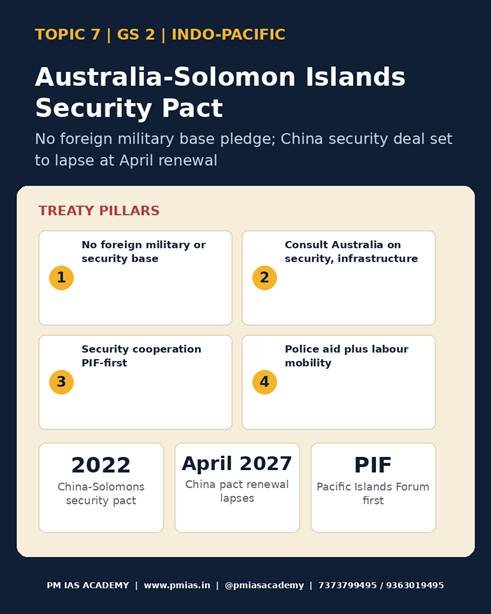
The treaty followed the revelation that Solomon Islands would not renew its 2022 security pact with China when it comes up in April next year, though Mr Wale declined to confirm scrapping that pact, citing a non-disclosure clause in the China agreements.
Background: The 2022 China Pact and Its Reversal
Solomon Islands signed a security pact with China in 2022 under the Sogavare government, alarming Australia, New Zealand and the United States because it opened the possibility of a Chinese security presence in the Southwest Pacific.
The ABC confirmed the Wale government had quietly informed Beijing it would let the contentious security agreement phase out at renewal in April next year; Mr Wale said of the previous government’s era that Solomon Islands had been ‘a source of uncertainty and doubt in the region’, adding ‘those days are done, gone’.
The new treaty requires Solomon Islands to consult Australia on national security and sensitive infrastructure, commits it to keeping critical infrastructure free from ‘militarisation and unauthorised access’, and to never permitting a foreign military base on its soil.
Key Dimensions
1. Core commitments: Solomon Islands has committed that its sensitive infrastructure ‘shall remain free from militarisation, any form of foreign interference or unauthorised access’ and that it will not ‘permit its territory to be used for any foreign military or security base’, per the reported treaty text.
2. PIF-first security: The treaty does not explicitly ban security partnerships with outside players such as China, but requires that Solomon Islands ‘ensure security cooperation comes from Pacific Islands Forum members’ and safeguard regional security if it forms partnerships for needs PIF members cannot meet, a regional-first rule rather than an exclusion clause.
3. Development sweeteners: Australia will help strengthen the Solomon Islands police force and create opportunities for its citizens to work in aged care and childcare in Australia, pairing security terms with labour mobility and capacity building.
4. Consultation duty: The obligation to consult Australia on national security and sensitive infrastructure gives Canberra structured visibility into future deals, the practical core of the treaty.
5. China pact ambiguity: Mr Wale declined to confirm scrapping the 2022 China pact, citing a non-disclosure clause covering the security pact and policing agreement; the phase-out is reported by the ABC, not announced by Honiara, a distinction answers should preserve.
6. Geographic weight: Solomon Islands sits astride sea lanes northeast of Australia; its orientation was contested terrain during the Second World War (Guadalcanal), and its alignment remains strategically consequential for the Coral Sea approaches.
7. Regional norm-setting: Channelling security cooperation through the Pacific Islands Forum elevates the PIF as the gatekeeper of Pacific security, consistent with the ‘Pacific family’ framing Australia and New Zealand promote.
8. Domestic politics: The signing was watched by a large contingent of Solomon Islands ministers and MPs, signalling cross-party cover at home, though the non-disclosure posture shows the China relationship remains politically delicate.
9. China’s position: Beijing loses its only formal security foothold in the Pacific islands’ southern arc, but the treaty’s silence on an explicit China ban leaves it room to pursue economic and policing engagement short of basing.
10. US and allied read: The treaty consolidates the US-Australia-New Zealand position in the island chain without a direct US signature, showing alliance management proceeding through regional partners.
11. Model character: Labour mobility plus policing support plus consultation rights is Australia’s standard Pacific statecraft template, previously seen in agreements with Papua New Guinea and Tuvalu’s Falepili Union.
12. India connection: India’s Indo-Pacific interests run through a stable, rules-based Pacific; the treaty aligns with the Quad’s public goods framing and with India’s own Pacific islands outreach through the FIPIC summit mechanism.
Significance
1. Strategic denial: The no-foreign-base commitment achieves Australia’s central aim, keeping hostile military infrastructure out of its northern approaches, through consent rather than confrontation.
2. China setback, not exclusion: The treaty marks a reputational and positional setback for China’s Pacific push while leaving economic engagement channels open, a nuanced rather than total reversal.
3. Forum centrality: The PIF-first clause strengthens regional multilateralism as the legitimate venue for Pacific security choices.
4. Exam hook: The item links treaty design, strategic geography and Indo-Pacific competition, and rewards precise reading: consultation duty, infrastructure clause, PIF-first rule, no explicit China ban.
Challenges
1. Durability: Pacific island agreements often shift with electoral cycles; a future Honiara government could reinterpret or exit, as the 2022 pact’s fate itself demonstrates.
2. Non-disclosure asymmetry: Unpublished China agreements leave outside powers guessing about residual obligations, complicating verification of the phase-out.
3. Capacity dependence: Australia’s policing and labour promises require sustained delivery; unmet expectations have historically reopened doors to other suitors.
4. China’s economic card: Beijing retains trade, infrastructure and finance instruments that do not breach the treaty’s letter, so competition continues on the economic field.
Way Forward
1. Deliver visibly and fast: Front-load policing support, infrastructure and labour-mobility places so the treaty’s benefits are felt before the next election cycle in Honiara.
2. Multilateralise the gain: Embed the PIF-first principle in a wider Pacific declaration, converting a bilateral win into a regional norm harder for any one government to reverse.
3. Keep channels to Beijing: Australia and its partners should signal that normal economic ties with China are compatible with the treaty, lowering the incentive for covert security workarounds.
4. For India: deepen FIPIC: Sustain India’s own Pacific islands engagement through the Forum for India-Pacific Islands Cooperation, complementing rather than duplicating Australia’s role.
Prelims Value Addition
- Australia-Solomon Islands security treaty signed in Canberra on 25 November 2026 by PMs Albanese and Wale; Solomon Islands commits to no foreign military base and infrastructure free from ‘militarisation and unauthorised access’.
- Security cooperation is to come from Pacific Islands Forum members first; Solomon Islands must consult Australia on national security and sensitive infrastructure.
- The 2022 China-Solomon Islands security pact will reportedly be allowed to lapse at its April renewal, per the ABC; Mr Wale cited a non-disclosure clause and did not confirm termination.
- Australia will strengthen the Solomon Islands police force and open aged-care and childcare work opportunities for its citizens.
Mains Value Addition
- GS 2: ‘Small island states have become the arbiters of Indo-Pacific alignment.’ Discuss with reference to the 2026 Australia-Solomon Islands treaty and the fate of the 2022 China pact.
- GS 2: Examine the design of Australia’s Pacific engagement, security consultation, labour mobility and forum-first rules, as a model of middle-power statecraft, and its implications for India’s Indo-Pacific policy.
Topic 8: Constitution Day 2026: Why November 26 Is Samvidhan Divas
Subject: Polity – The Constitution: Making, Preamble and Constitutional Culture
Paper: GS Paper 1: modern Indian history, the national movement; GS Paper 2: Indian Constitution, historical underpinnings, evolution, features, Preamble
UPSC Relevance: Constitution Day is the annual hook for the Constituent Assembly’s history, the Preamble’s drafting, and the living debate on constitutional values, all core Prelims and Mains territory.
Why in News
India observed Constitution Day (Samvidhan Divas) on 26 November 2026, commemorating the adoption of the Constitution by the Constituent Assembly on 26 November 1949.
The day carries fresh official emphasis each year: the Prime Minister called for strengthening constitutional values and placing India First in national endeavours, as reported, and The Hindu’s explainer revisited why the adoption date, rather than the enforcement date, anchors the commemoration.
Background: From National Law Day to Constitution Day
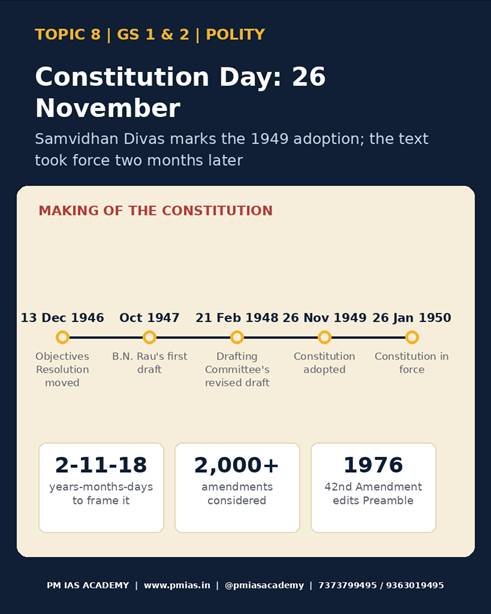
The Constitution was adopted on 26 November 1949 and came into force on 26 January 1950, making India a republic; November 26 marks the moment the text was formally adopted for ‘We, the People of India’, while January 26 marks its operation, commemorated as Republic Day.
The observance is young: Prime Minister Narendra Modi announced Constitution Day in October 2015 while laying the foundation stone for the Dr B.R. Ambedkar Memorial in Mumbai; before that, the date was marked as National Law Day, first initiated by former Supreme Court Bar Association president Laxmi Mall Singhvi in 1979.
The Constituent Assembly took two years, eleven months and eighteen days to frame the Constitution; Constitutional Adviser B.N. Rau prepared the first draft by October 1947, Dr Ambedkar’s Drafting Committee revised it and submitted the Draft Constitution on 21 February 1948, and the Assembly considered more than 2,000 amendments before adopting the final text.
Key Dimensions
1. Adoption versus enforcement: The two-date structure, adoption on 26 November 1949 and enforcement on 26 January 1950, is a standard Prelims distinction; the interim allowed transition arrangements and the choice of 26 January honoured Poorna Swaraj Day.
2. The physical text: The Constitution was handwritten in both English and Hindi, with artwork by Nandalal Bose of Santiniketan, and was signed by Assembly members on 24 January 1950, when Dr Rajendra Prasad was elected unopposed as India’s first President.
3. Preamble’s evolution: Dr Ambedkar drafted a Preamble in 1948 drawing on the December 1946 Objectives Resolution moved by Jawaharlal Nehru; the Preamble’s final wording, sovereign, democratic, republic, justice, liberty, equality, fraternity, predates later amendments.
4. The 42nd Amendment marker: The words socialist and secular, and the phrase integrity of the nation, entered the Preamble through the 42nd Amendment of 1976, the only amendment the Preamble has received, a standard Prelims fact.
5. Drafting machinery: Thirteen major committees did the Assembly’s work, with the Drafting Committee under Dr Ambedkar (seven members) converting resolutions into text; B.N. Rau’s advisory role preceded and informed the committee stage.
6. Time and scale: The Assembly sat for 2 years, 11 months and 18 days, held 11 sessions and 165 sitting days, and produced the world’s longest national constitution of its time, figures that anchor scale questions.
7. Borrowed features: The charter drew the parliamentary system from Britain, federalism with a strong centre from Canada, the Directive Principles from Ireland, Fundamental Rights from the United States and the amendment blend from South Africa, the standard ‘sources’ grid.
8. Constitutional morality: The day’s official rhetoric centres on duties alongside rights; Ambedkar’s own warning that constitutional morality must be cultivated because it is not a natural sentiment is the analytical anchor for Mains.
9. From Law Day to Constitution Day: The 2015 renaming shifted emphasis from the legal profession’s commemoration to a civic-national one tied to Ambedkar’s memory and the 125th birth anniversary cycle, an institutional-history point worth a line.
10. Living constitution: The document has been amended over a hundred times, yet the basic structure doctrine, from Kesavananda Bharati (1973), limits amendability, the tension between flexibility and endurance that defines Indian constitutionalism.
11. Civic function of the day: Preamble readings in schools and offices make the day performative citizenship education, turning a legal text into public ritual, an aspect governance answers can use.
12. Federal and rights frame: Constitution Day answers should hold the document’s dual character: a rights charter (Part III) enforceable by courts, and a governance frame (Parts V-XI) distributing power between Union and States.
Significance
1. Constitutional literacy: The day sustains public familiarity with the Preamble and Fundamental Duties, the vocabulary of civic argument.
2. Ambedkar’s centring: The commemoration institutionalises the Drafting Committee chairman’s place in national memory alongside the text itself.
3. Rights-duties balance: Official emphasis on duties recalls Article 51A, added by the 42nd Amendment, and the Swaran Singh Committee’s recommendations.
4. Exam hook: Adoption and enforcement dates, the 2015 naming, 1979 Law Day origin, 42nd Amendment changes, and committee structure are evergreen Prelims facts refreshed by this day.
Challenges
1. Ceremony versus practice: Annual ritual can coexist with weak everyday constitutionalism; the day’s value depends on whether values survive beyond it.
2. Historical flattening: Popular retellings compress a contested drafting process into a single heroic narrative, obscuring dissents and exclusions in the Assembly.
3. Rights-duties imbalance: Overweighting duties rhetoric risks reading the Constitution as discipline rather than as a charter of enforceable rights.
4. Awareness gaps: Surveys routinely show thin public knowledge of basic constitutional provisions, limiting the day’s educational reach.
Way Forward
1. Teach the document, not only the date: Use the day for substantive engagement, reading actual Articles, in schools and civil services, rather than ceremonial recitation alone.
2. Open the archives: Digitise and popularise Constituent Assembly Debates so citizens can read how provisions were argued, not merely what they say.
3. Link duties to rights: Frame Article 51A duties as corollaries of rights enjoyment by others, keeping the civic message balanced.
4. Institutional self-audit: Let legislatures and courts mark the day by reporting on constitutional compliance, pending rights litigation and legislative scrutiny standards.
Prelims Value Addition
- Constitution adopted 26 November 1949; in force 26 January 1950; Constitution Day announced October 2015 at the Dr B.R. Ambedkar Memorial foundation in Mumbai; earlier National Law Day, initiated 1979 by Laxmi Mall Singhvi.
- The text was handwritten in English and Hindi with artwork by Nandalal Bose; members signed on 24 January 1950; Dr Rajendra Prasad elected first President that day; B.N. Rau was Constitutional Advisor.
- The Assembly sat 2 years, 11 months and 18 days (11 sessions, 165 sitting days) and considered over 2,000 amendments; the Drafting Committee chaired by Dr B.R. Ambedkar had seven members.
- The Preamble was amended once, by the 42nd Amendment Act 1976 (socialist, secular, integrity); it derives from the Objectives Resolution of December 1946.
Mains Value Addition
- GS 2: ‘A constitution is measured not by its text but by the constitutional morality of those who work it.’ Discuss Ambedkar’s caution in the context of Constitution Day commemorations.
- GS 1/2: Trace the making of the Indian Constitution from the Objectives Resolution to adoption, highlighting the roles of B.N. Rau, the Drafting Committee and the Constituent Assembly’s deliberative method.
Quick Bits: Revise for Prelims
Schemes and the economy
- The Union Cabinet approved continuation of the Postal Operations scheme with an outlay of Rs 1,141 crore for the 16th Finance Commission cycle, FY 2026-27 to FY 2030-31, to modernise the postal network, parcel and mail operations and e-commerce logistics.
- The Cabinet also approved continuation of the Estates Management Scheme of the Department of Posts with an outlay of Rs 1,491 crore over the same five-year cycle, covering construction, renovation, branding and preservation of heritage postal buildings.
- The Cabinet Committee on Economic Affairs approved a new greenfield airport at Doloo, Silchar, Assam, at an estimated cost of Rs 2,014 crore; the Airports Authority of India will build a 12,351 sqm terminal handling 800 peak-hour passengers, easing the constraints of the defence-landlocked existing civil enclave.
- The PLI scheme for automobiles and auto components recorded Rs 4,385.28 crore of incentive disbursement in FY 2026-27 against a total approved outlay of Rs 25,938 crore, the Ministry of Heavy Industries said after a review meeting.
Polity and governance
- The Supreme Court deferred the bail pleas of Umar Khalid and Sharjeel Imam in the UAPA case pending a larger bench ruling on the statutory curbs on bail under the Act.
- A central committee has suggested a three-year roadmap to phase out unsustainable sand mining from active river channels, as reported in news coverage.
Practice MCQs
Q1. With reference to the USTR’s Section 301 determinations of 25 November 2026, consider the following: 1. The determinations cover manufacturing ‘excess capacity’ practices of 14 economies. 2. For India, tariffs of up to 25 per cent have been proposed, net of existing Section 301 tariffs. 3. A 17 per cent rate is proposed for India unconditionally. Which is/are correct?
(a) 1 and 2 only
(b) 1 and 3 only
(c) 2 and 3 only
(d) 1, 2 and 3
Answer: (a). The 17 per cent rate is contingent on India reaching a reciprocal trade agreement responsive to the determinations, so statement 3 is wrong.
Q2. Under the Election Commission’s directions on the Special Summary Revision, consider the following: 1. The qualifying date is 1 January 2027. 2. Corrections flagged through SIR data still require the elector’s signed Form 8. 3. AEROs may make automated-only changes without verification. Which is/are correct?
(a) 1 and 2 only
(b) 2 and 3 only
(c) 1 only
(d) 1, 2 and 3
Answer: (a). The ECI bars automated-only corrections: a BLO visit, a signed Form 8 and disposal by the AERO/ERO are required.
Q3. In the Supreme Court proceedings on the CBSE three-language formula (Yashica Bhandari Jain v. Union of India), consider the following: 1. The Court orally indicated that students already studying three languages may continue. 2. About 4,186 of 23.44 lakh Class 6 students study a third language. 3. The Board proposed a mandatory third language from Class 6 starting 1 January 2027. Which is/are correct?
(a) 1 and 2 only
(b) 2 and 3 only
(c) 1 and 3 only
(d) 1, 2 and 3
Answer: (d). All three statements match the report of the 25 November hearing in W.P.(C) 694/2026.
Q4. With reference to the Scheme for Enhancement of Construction and Infrastructure Equipment (CIE) Manufacturing Ecosystem, consider the following: 1. The outlay is Rs 11,000 crore, implemented by the Ministry of Heavy Industries. 2. Incentives are graded from 13 per cent down to 8 per cent. 3. It includes a dedicated CIE testing facility supported through viability gap funding of Rs 375 crore. Which is/are correct?
(a) 1 and 2 only
(b) 1 and 3 only
(c) 2 and 3 only
(d) 1, 2 and 3
Answer: (d). All three features appear in the official release; India’s CIE industry is the world’s third largest and about 45 per cent import-dependent.
Q5. Consider the following pairs from the 25 November 2026 Cabinet decisions: 1. Postal Operations continuation: Rs 1,141 crore. 2. Estates Management Scheme: Rs 1,491 crore. 3. Doloo greenfield airport, Silchar: Rs 2,014 crore. Which pairs are correctly matched?
(a) 1 and 2 only
(b) 2 and 3 only
(c) 1 and 3 only
(d) 1, 2 and 3
Answer: (d). All three figures match the PIB releases; the postal schemes run through the 16th Finance Commission cycle, FY 2026-27 to FY 2030-31.
Q6. Under Australia’s Digital Duty of Care law, consider the following: 1. Maximum penalties can reach 5 per cent of global turnover or A$109.2 million. 2. The eSafety Commissioner administers the regime. 3. The law takes effect immediately on assent. Which is/are correct?
(a) 1 and 2 only
(b) 1 and 3 only
(c) 2 only
(d) 1, 2 and 3
Answer: (a). The law commences 12 months after assent, so statement 3 is wrong; users also gain ‘My Feed, My Way’ algorithm control.
Mains Practice Set
Q1. The USTR’s ‘excess capacity’ determinations under Section 301 mark a shift from rules-based trade remedy to unilateral economic statecraft. Examine the options before India. (250 words)
Q2. Australia’s Digital Duty of Care moves beyond notice-and-takedown to a proactive duty to prevent harm. Assess what this model offers for reforming India’s intermediary liability framework. (250 words)
Q3. The Australia-Solomon Islands pact puts Pacific Islands Forum centrality ahead of bilateral security deals. Discuss the lessons for India’s approach to strategic competition in its own neighbourhood. (250 words)
