
Concerns Over Increasing weaponization of Trade
Syllabus: GS2/ International Relations
Context
- The External Affairs Minister of India, S. Jaishankar highlighted that rising globalization along with trade weaponization has resulted in job losses and dissatisfaction in many societies.
What is trade weaponization?
- Trade weaponization refers to the strategic use of trade policies and economic measures by countries to exert political or economic pressure on others.
- Instead of trade being purely an economic activity aimed at mutual benefit, it becomes a tool of influence, coercion, or retaliation.
Tools of trade weaponization
- Tariffs and Sanctions: Countries impose tariffs or sanctions on imports from a particular country to hurt its economy.
- Example: US-China trade war
- Export Controls: Restrictions on exports of critical technologies or materials to a nation.
- In 2020, the US government started imposing stricter export controls on China to limit its access to advanced semiconductor technology.
- Supply Chain Disruptions: Manipulating supply chains for critical goods, like rare earth metals or energy resources, to gain leverage in political disputes.
- Currency Manipulation: It boosts a nation’s export competitiveness while hurting the importing country’s economy.
Challenges of trade weaponization
- Increased Uncertainty: The imposition of tariffs and sanctions creates uncertainty in international markets, making it difficult for businesses to plan for the future.
- Loss of Export Markets: Retaliatory tariffs restrict access to key export markets, negatively affecting domestic industries that rely on international sales.
- Strained Diplomatic Relations: Trade weaponization leads to heightened tensions between nations, complicating diplomatic relations.
- Erosion of Multilateralism: The rise of unilateral trade measures undermines established international trade norms and institutions, such as the World Trade Organization (WTO), leading to a fragmented global trading system.
- Disproportionate Effects: Protectionist measures disproportionately affect low-income workers and communities, leading to job losses in industries exposed to international competition.
Steps taken against trade weaponization
- Regional Trade Agreements: Countries are forming or revitalizing regional trade agreements (RTAs) to enhance cooperation and reduce reliance on major economies.
- Comprehensive and Progressive Agreement for Trans-Pacific Partnership (CPTPP),
- Regional Comprehensive Economic Partnership (RCEP) etc.
- Mineral Security Partnership (MSP) to diversify and stabilize global supply chains of Critical Minerals.
- Reform of the WTO: Ongoing discussions to reform the World Trade Organization (WTO) aim to enhance its dispute resolution mechanisms and address the challenges posed by unilateral trade actions.
- Indo-Pacific Economic Framework (IPEF): It serves as a countermeasure to economic coercion by countries that use trade as a tool of influence, promoting a more equitable and rules-based trading system.
Concluding remarks
- The challenges arising from the weaponization of trade are complex and multifaceted, affecting not only national economies but also the global trading system and international relations.
- There is further need for encouraging transparency, enhanced communication, and conflict resolution mechanisms to promote a stable and equitable international trading system.
World Mental Health Day
Syllabus: GS2/ Health
Context
- World Mental Health Day is observed annually on October 10.
- It was first initiated in 1992 by the World Federation for Mental Health (WFMH).
- This global observance aims to raise awareness about mental health issues and mobilize efforts in support of mental health care worldwide.
About
- India is currently witnessing a surge in mental health disorders.
- According to The Lancet Psychiatry Commission, over 197 million people suffer from conditions such as depression, anxiety and substance abuse.
- Economic growth has created new opportunities, but it has also intensified societal pressures and personal expectations.
- As India’s developmental aspirations rise, mental well-being is often overlooked, fuelling a crisis driven by materialism and a growing disconnect from community and self-awareness.
Causes of Mental Illness
- Exposure to unfavorable social, economic, geopolitical and environmental circumstances – including poverty, violence, inequality and environmental deprivation.
- Over the past few years, the pandemic-led lockdowns and the uncertainties associated with them have had a detrimental effect on mental well-being
- Early adverse life experiences, such as trauma or a history of abuse (for example, child abuse, sexual assault, witnessing violence, etc.)
- Use of alcohol or drugs, having feelings of loneliness or isolation, etc.
- Family Dynamics: Dysfunctional family relationships and lack of support systems can negatively impact mental health.
- The growing focus on consumerism, particularly in urban areas, has fostered a culture where luxury and conspicuous goods define status. This leads to feelings of inadequacy, stress and social comparison.
- The endless quest for affluence disconnects individuals from the essential elements of a meaningful life trapping them in a cycle of dissatisfaction.
Issue of Lack of Psychiatrists in India
- The World Health Organization’s guidelines state that there should be at least three practising psychiatrists per one lakh population.
- As per the latest National Mental Health Survey (NMHS), which was conducted between 2015 and 2016, India has only 0.75 psychiatrists per 1 lakh population.
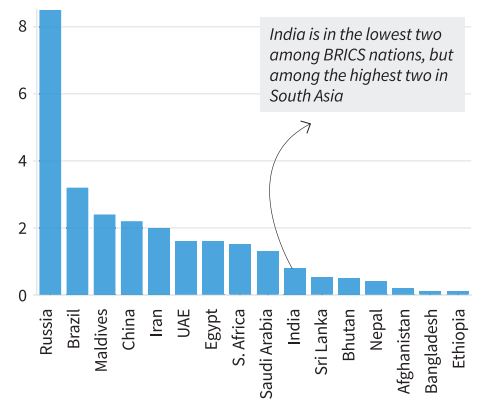
- Among the BRICS nations, India is one of the two countries with the lowest number of psychiatrists per capita; the other is Ethiopia.
- Keeping aside factors such as attrition and unemployment, it would take India about 27 years to meet the WHO-recommended goal.
- If India wants to achieve this mark earlier, it requires policy intervention with adequate incentives to increase supply.
Government of India Initiatives
- National Mental Health Programme (NMHP): Launched in 1982, this program aims to improve mental health services through community-based approaches, enhance mental health care at primary, secondary, and tertiary levels, and raise awareness.
- Mental Healthcare Act, 2017: The act decriminalised suicide attempts in India and also included WHO guidelines in the categorisation of mental illnesses.
- The most significant provision in the act was “advanced directives”, which allowed individuals with mental illnesses to decide the course of their treatment.
- It also restricted the use of electro-convulsive therapy (ECT), and banned its use on minors, finally introducing measures to tackle stigma in Indian society.
- Rights of Persons with Disabilities Act, 2017: The Act acknowledges mental illness as a disability and seeks to enhance the Rights and Entitlements of the Disabled.
- Manodarpan Initiative: An initiative under Atmanirbhar Bharat Abhiyan, aims to provide psycho-social support to students for their mental health and well-being.
- Kiran Helpline: The helpline is a step towards suicide prevention, and can help with support and crisis management.
- National Tele-Mental Health Programme: Launched in 2022, this initiative aims to provide mental health services through telemedicine, expanding access to care, especially in underserved and remote areas.
- For the first time ever, the Economic Survey 2023-24 talked about mental health, its significance and implications on policy recommendations.
- It emphasizes the need for effective implementation to accelerate progress in mental healthcare, addressing existing gaps to ensure maximum impact.
Way Forward
- There is a need for an urgent and well-resourced whole-of-society approach to protect, promote and care for the mental health of people.
- Killing the deep stigma surrounding mental health issues which prevents patients from seeking timely treatment.
- Making mental health an integral part of the public health programme to help screen and identify high-risk groups and strengthen mental health interventions like counselling services.
- Special emphasis on schools: Pay special attention to groups that are highly vulnerable to mental health issues such as children facing domestic or sexual violence.
- Collective action, community as solutions: To address this crisis, we must shift focus from individual success to collective well-being.
- Addressing India’s mental health crisis requires rethinking what it means to live a good life.
- We must challenge the materialistic notion of success and refocus on mental, emotional, and social well-being.
Need of Battery Storage for a Renewables-Heavy Electricity Grid
Syllabus: GS3/ Energy and Infrastructure
Context
- According to a report by the Central Electricity Authority (CEA), around 34 gigawatts (GW) or 136 gigawatts per hour (GWh) of battery energy storage systems is expected to be installed in India by 2030.
Background
- India is targeting to have half of its electric power capacity come from renewables by 2030 and energy storage is key in maintaining grid flexibility during surplus and deficit power generation.
- Traditional energy sources offer consistent output, but renewable energy’s variability can cause a 3-5% error in dispatches.
- For India’s planned 500 GW capacity by 2030, a 3% error could cut 15 GW, destabilizing the grid.
Ancillary Services
- In absence of infrastructure that can store electricity in large amounts, it must be produced and used simultaneously.
- Ancillary services provide quick, real-time adjustments to balance supply and demand of power. There are three kinds of ancillary services;
- Primary services respond to fluctuations in real-time (less than a second), making them most relevant in addressing imbalances in renewables-heavy grids. They can only be provided via hydroelectricity, and battery storage (more on that later).
- Secondary services respond to fluctuations within 10-15 minutes. These comprise gas-based capacities.
- Tertiary services take about 20-30 minutes to respond, and comprise thermal power plants, including the coal-fired plants that remain in use in India.
Need for Battery Storage
- Renewables make up roughly 10% of India’s energy portfolio at the moment. As India’s grid becomes more renewables-heavy, deployment of Battery Energy Storage Systems (BESS) is necessary.
- BESS is the fastest in responding to grid contingencies, and can transition from standby to full power in under a second.
- It can provide essential services such as frequency control, voltage regulation, congestion relief, peak shaving, power smoothing, and peak capacity support, making it an invaluable asset in the modern grid.
Challenges
- Raw Material Scarcity: India lacks sufficient reserves of critical materials like lithium, cobalt, and nickel, essential for battery manufacturing.
- Energy Density and Lifespan: Current battery technologies may not meet the energy density requirements for long-term storage or withstand prolonged cycling without significant degradation, impacting overall efficiency.
- Regulatory Hurdles: Lack of clear regulatory frameworks and incentives for BESS deployment slows down its adoption, making it harder to integrate into the existing grid.
Way Ahead
- The government announced a Viability Gap Funding scheme, allocating INR 3,760 crore to develop 4,000 MWh of battery storage systems.
- Partnering with industry leaders and start-ups to co-develop and commercialize advanced energy storage technologies will be key to driving innovation and scaling solutions.
- Also developing efficient and scalable battery recycling facilities will help recover valuable materials and reduce the environmental impact of battery waste, supporting a circular economy
Global wildlife population fell 73% : Living Planet Report
Syllabus : GS3/Environment
In News
- The World Wildlife Fund’s (WWF) Living Planet Report 2024 reveals a catastrophic 73% decline in monitored wildlife populations over the past 50 years (1970-2020)
The Living Planet Report
- WWF’s flagship publication, released every two years
- It is a comprehensive study of trends in global biodiversity and the health of the planet.
Key Findings
- The Living Planet Index (LPI) tracks trends in nearly 35,000 populations of 5,495 species.
- Freshwater populations experienced the steepest decline at 85%, followed by terrestrial (69%) and marine (56%).
- Regions wise : It highlights significant declines in monitored wildlife populations across different regions:
- Latin America and the Caribbean: 95% decline
- Africa: 76% decline
- Asia-Pacific: 60% decline
- North America: 39% decline
- Europe and Central Asia: 35% decline
- Some populations have stabilized or increased due to conservation efforts, such as:
- Mountain gorillas increased by about 3% per year in East Africa (2010-2016).
- Bison populations rose from 0 to 6,800 in central Europe (1970-2020).
- Primary Threats: The main threats to wildlife include:
- Habitat loss and degradation
- Overharvesting (mainly from the global food system)
- Invasive species
- Disease
- Climate change
Impact
- Significant drops in wildlife threaten ecosystem health and can lead to irreversible changes, pushing nature towards dangerous tipping points (e.g., decimated forests, destroyed rainforests, and coral reefs).
- Declines in wildlife populations signal increased extinction risks and ecosystem health issues.
Recommendations:
- WWF leaders emphasize the need for immediate action to prevent further declines, highlighting that compromised nature is more vulnerable to climate change.
- Develop and implement ambitious national nature and climate plans.
- Reduce overconsumption of food and energy equitably.
- Increase public and private investments aligned with sustainability goals.
- Eliminate activities negatively impacting biodiversity and redirect funding toward positive initiatives.
The Nobel Prizes for 2024 in Chemistry
Syllabus: GS3/Science
Context
- The Nobel Prizes for 2024 in Chemistry was awarded to David Baker “for computational protein design” along with Demis Hassabis and John M. Jumper “for protein structure prediction”.
About
- Proteins are large, complex molecules that play many critical roles in the body.
- They are made up of smaller units called amino acids, which are linked together in long chains.
- There are 20 different types of amino acids, and the specific sequence in which they are arranged determines the protein’s structure and function.
- In 2003, David Baker, a professor at the University of Washington, succeeded in using these blocks to design a new protein that was unlike any other protein.
- Since then, his research group has produced one imaginative protein creation after another.
- In 2020, Demis Hassabis and John Jumper developed an AI model called AlphaFold2, as part of Google’s DeepMind project, that was able to predict the structure of virtually all the 200 million proteins that researchers have identified.
- Significance: It allows us to better understand how life functions, including why some diseases develop, how antibiotic resistance occurs or why some microbes can decompose plastic.
| About Nobel Prize – Since 1901, the Nobel Prize has been awarded in the fields of physics, chemistry, physiology or medicine, literature and peace, while a memorial prize in economic sciences was added in 1968. a. In 1895 Alfred Nobel gave the largest share of his fortune to a series of the Nobel Prizes. – From Stockholm, the Royal Swedish Academy of Sciences confers the prizes for physics, chemistry, and economics, the Karolinska Institute confers the prize for physiology or medicine, and the Swedish Academy confers the prize for literature. – The Norwegian Nobel Committee based in Oslo confers the prize for peace. – The Nobel Foundation is the legal owner and functional administrator of the funds and serves as the joint administrative body of the prize-awarding institutions, but it is not concerned with the prize deliberations or decisions, which rest exclusively with the four institutions. |
