
Union Cabinet Approves Continuation Fortified Rice
Syllabus: GS2/ Governance
Context
- The Union Cabinet extends the rice fortification initiative across welfare schemes until 2028 to combat anemia and nutritional deficiencies.
Background
- The rice fortification would continue as a central sector initiative with 100% funding by the Centre in order to ensure inclusive nutritional security in the country.
- The free fortified rice will be provided under programmes such as Targeted Public Distribution System, Integrated Child Development Service, PM POSHAN, in all the States and Union Territories.
- FSSAI (Food Safety and Standards Authority of India) has established Food Fortification Resource Centre (FFRC) as a resource center to promote large-scale fortification of food
What is food fortification?
- According to WHO, fortification is the practice of deliberately increasing the content of one or more micronutrients (i.e., vitamins and minerals) in a food or condiment.
- This is done to improve the nutritional quality of the food and provide a public health benefit with minimal risk to health.
Food Fortification in India
- Rice fortification involves the addition of fortified rice kernels enriched with micronutrients (Iron, Folic Acid, Vitamin B 12) as per standards prescribed by FSSAI to regular rice.
- Milk is fortified with vitamins A and D, which helps in combating deficiencies linked to these vitamins.
- Salt fortified with iodine (iodized salt) to prevent iodine deficiency disorders.
Advantages of fortification in India
- Addressing Nutritional Deficiencies: India faces significant issues related to hidden hunger, where micronutrient deficiencies exist even if calorie intake is adequate.
- Fortification tackles deficiencies like anemia (iron), rickets (vitamin D), and blindness (vitamin A).
- Cost-Effective: Fortification is an inexpensive way to improve the nutritional value of foods without requiring people to change their eating habits.
- Improved Public Health: By preventing conditions like anemia, iodine deficiency etc. Fortification leads to better results in cases of maternal and infant mortality.
- According to the National Family Health Survey (NFHS-5), anemia remains a widespread issue in India, affecting children, women, and men across various age groups and income levels.
- The Copenhagen Consensus estimates that every 1 Rupee spent on fortification results in 9 Rupees in benefits to the economy.
Concerns of food fortification
- Absorption: The added nutrients are not always fully absorbed by the body due to factors like cooking methods and the presence of inhibitors in food.
- Example: Phytates in cereals that hinder iron absorption.
- Regulatory Oversight: Without strict regulatory oversight, there is a risk of inadequate or excessive fortification, which could undermine the health benefits.
- Limited Access: Fortified food products fail to reach the poorest segments of society (Low Purchasing Power), who are among the worst section affected with nutritional deficiencies.
Government Measures
- The ‘F+’ logo is an initiative by the FSSAI to standardize and indicate fortified foods.
- The Milk Fortification Project is a major initiative by the National Dairy Development Board (NDDB), undertaken in collaboration with the World Bank. The project’s goal is to fortify milk with vitamins A and D.
Way Ahead
- Food fortification offers a powerful tool for addressing India’s significant malnutrition and micronutrient deficiency challenges.
- While it is not a panacea, when combined with other nutritional strategies and strong governmental support, it can help improve public health and contribute to the nation’s sustainable development goals.
| Food Safety and Standards Authority of India (FSSAI) – Established under Food Safety and Standards, 2006, the Food Safety and Standards Authority of India (FSSAI) handles food-related issues including ensuring the safe availability of food for human consumption. – It is an autonomous body under the Ministry of Health and Family Welfare that is responsible for promoting and protecting public health through various regulations and supervisions of food safety. |
21st ASEAN-India Summit
Syllabus: GS2/ International Relations
Context
- The Prime Minister and ASEAN leaders reviewed how the ASEAN-India Comprehensive Strategic Partnership has progressed so far and discussed plans for future cooperation in Vientiane, Lao PDR.
Key Highlights
- PM announced a 10-point plan which includes:
- Celebrating the year 2025 as ASEAN-India Year of Tourism,
- To celebrate a decade of Act East Policy,
- Review of ASEAN-India Trade in Goods Agreement by 2025 etc.
- The leaders declared that they would explore collaboration of cross-border linkages between payment systems in ASEAN and India through digital solutions.
- India will share its knowledge and experiences in using digital public infrastructure (DPI) such as Aadhaar and Unified Payments Interface (UPI) with the ASEAN nations.
- The leaders agreed to create a new ASEAN-India Plan of Action (2026-2030) and adopted Two Joint Statements;
- Joint Statement on Strengthening ASEAN-India Comprehensive Strategic Partnership for Peace, Stability and Prosperity in the Region in the context of the ASEAN Outlook on the Indo-Pacific (AOIP) with the Support of India’s Act East Policy (AEP),
- Joint Statement on Advancing Digital Transformation.
- Leaders welcomed the launch of the ASEAN-India Fund for Digital Future to support joint activities.
- The PM of India emphasized the need to complete the review of ASEAN-India FTA (AITIGA) in a time bound manner.
| ASEAN India Trade in Goods Agreement (AITGA) – India signed an FTA in goods with ASEAN in 2009, which came into force in 2010. a. A separate FTA in services was signed in 2014. – The FTA between India and ASEAN is also known as the ASEAN India Trade in Goods Agreement (AITGA). – The pact resulted in disproportionate benefits for ASEAN. |
Significance of ASEAN for India
- Counter China’s Influence: ASEAN’s strategic location makes it a critical partner for balancing China’s growing influence in the region.
- Trade and Investment: In 2021-2022, trade between India and ASEAN stood at around $110 billion. ASEAN countries are also a significant destination for Indian investments.
- Indo-Pacific Region: ASEAN is central to India’s Indo-Pacific strategy, which seeks to promote a free, open, and rules-based order in the region.
- India’s Act East Policy places ASEAN at its core to enhance connectivity, maritime cooperation, and economic engagement.
- Counter-Terrorism: India collaborates with ASEAN on counter-terrorism, transnational crime, and cybersecurity initiatives. These efforts are crucial in maintaining regional security.
- Connectivity and Infrastructure: Initiatives such as the India -Myanmar-Thailand Trilateral Highway and the Kaladan Multimodal Transit Transport Project aim to improve physical connectivity between India and ASEAN, promoting trade and economic integration.
- ASEAN-led Mechanisms: India is part of key ASEAN-led platforms like the;
- East Asia Summit (EAS),
- ASEAN Regional Forum (ARF), and
- ASEAN Defense Ministers’ Meeting-Plus (ADMM-Plus), which are vital for fostering regional dialogue on strategic issues.
| Association of Southeast Asian Nations (ASEAN) – About: It is a political and economic organization aimed primarily at promoting economic growth and regional stability among its members. – Members: Brunei, Cambodia, Indonesia, Laos, Malaysia, Myanmar, the Philippines, Singapore, Thailand and Vietnam. – History: It was established in 1967 in Bangkok, Thailand, with the signing of the ASEAN Declaration (Bangkok Declaration) by the Founding Fathers of ASEAN: Indonesia, Malaysia, Philippines, Singapore and Thailand. a. Brunei Darussalam joined ASEAN in 1984, followed by Vietnam in 1995, Lao PDR and Myanmar in 1997, and Cambodia in 1999. – ASEAN Summit: It is the highest policy-making body in ASEAN comprising the Head of States or Government of ASEAN Member States.Summit is held twice annually. a. The First ASEAN Summit was held in Bali, Indonesia in 1976. |
Way Ahead
- The Summit represents a milestone in ASEAN-India relations, with both sides reaffirming their strategic and economic importance to one another.
- India’s sustained engagement with ASEAN, through its Act East Policy, will continue to shape the regional architecture in the Indo-Pacific, aligning with ASEAN’s Outlook and the broader goals of regional stability and prosperity.
Road Safety in Southeast Asia
Syllabus: GS2/Governance
Context
- A deadly fire accident on a Thai school bus has reignited a debate about road safety in Southeast Asia.
Road Accidents in Southeast Asia
- The Region has 11 Member States: Bangladesh, Bhutan, Democratic People’s Republic of Korea, India, Indonesia, Maldives, Myanmar, Nepal, Sri Lanka, Thailand and Timor-Leste.
- Southeast Asia accounted for 3,30,223 of the 1.19 million estimated global road traffic deaths in 2021, accounting for 28% of the global burden.
- Vulnerable road users, including pedestrians, bicyclists, and two or three-wheelers constitute 66% of all reported road traffic deaths in the southeast Asia region.
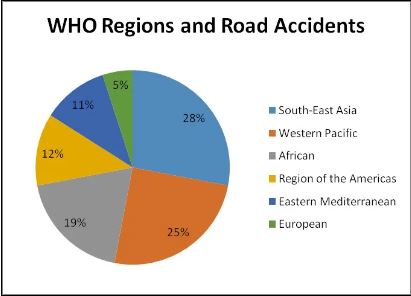
- Challenges: A high prevalence of motorised two and three-wheelers, inadequate traffic injury data, poor pedestrian and cyclist infrastructure, and limited emergency services.
Road Accidents in India
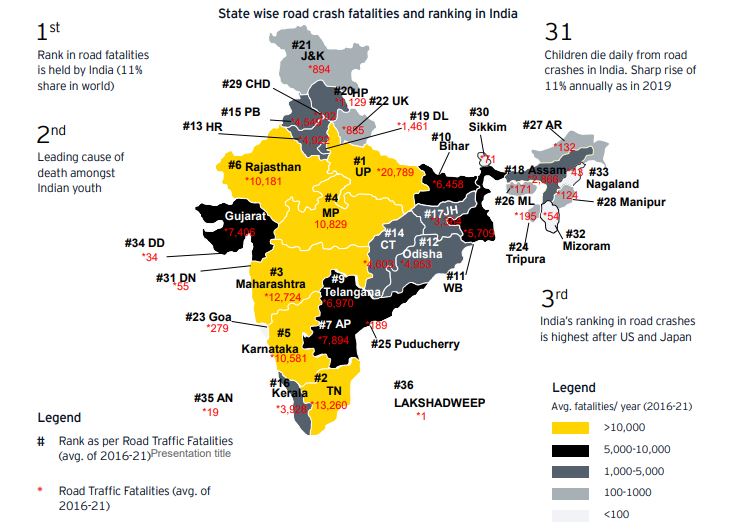
- According to the Ministry of Road Transport and Highways (MoRTH), 153,972 persons were killed in road crashes in the year 2021. This corresponds to 11.3 deaths per 100,000 population.
- With 11% share in total fatalities due to road crashes, India ranks 3rd globally for road crashes.
- Data indicates that traffic violations is the cause of road crashes in 90% of incidents in India. Of these, speeding accounts for 70% of the cases.
- Over the last decade (2009-2019) road traffic crashes have been the 13th largest contributor to health burden in India.
| Do you know? – In September 2020, the UN General Assembly launched the Decade of Action for Road Safety 2021-2030 which aims to reduce road traffic deaths and injuries by at least 50 per cent by 2030. – The 2nd Global High-Level Conference on Road Safety was held in Brazil, that declared 2011-2020 as the 1st decade of action for Road Safety. a. In the Brasillia Declaration, the participating countries set targets under the Sustainable Development Goals and pledged to reduce road crash fatalities by 50% in the next 5 years. |
Government Initiatives
- National Road Safety Policy India, 2010: It emphasized the need for better road infrastructure, stricter enforcement of traffic rules, enhanced emergency medical services, public awareness campaigns, and improved post-crash care.
- Supreme Court Committee on Road Safety (SCCoRS): It was established In 2014 to address the issue, guide and monitor all states and Union Territories to bring down crash fatalities in the country.
- India signed Brasilia Declaration: India was one amongst the initial 100+ countries to have signed the Brasilia Declaration in 2015 committing to achieve the Sustainable Development Goal 3.6 i.e.to half the number of global deaths and injuries from road traffic crashes by 2030.
- Motor Vehicles Amendment Act, 2019: The act brought about higher penalties for traffic violations, including speeding, drunk driving, and not wearing helmets or seat belts.
- It introduced stricter provisions for driving licenses and imposed stricter penalties for offenses by juveniles.
- A steering committee formed in 2023 to work on e-enforcement uniformity across India Under the directions of SCCoRS.
- It will prepare a concept plan for implementation of a nation-wide roll out of effective e-enforcement.
Way Ahead
- Global best practices show that countries that adopted a Systems Approach have been able to achieve their targets of 50% reduction in fatalities or are close to achieving it.
- Countries like Australia and Sweden have gone beyond the UN Sustainable Development Goals (SDG) 3.6 and dug deep into the issue. India can, therefore, learn from these global best practices.
- India has done substantial research on road safety through premiere institutions like Indian Institute of Technology (IITs) and Central Road Research Institute (CRRI).
- The government can collaborate with these institutes to improve policies and action plans.
- The researchers are working on developing models that can help government make quick data based decisions customized for different road stretches.
- The corporate sector can play a role in helping strengthen road safety by funding research, spreading awareness, making strict health policies for drivers, or provide roadside infrastructure for resting.
Escaping the Middle-Income Trap
Syllabus :GS 3/Economy
In News
- The World Development Report 2024 calls attention to the phenomenon of the “middle-income” trap, or the slowing down of growth rates as incomes increase.
| Do you know ? – The “middle-income trap” describes a situation where countries struggle to attain high-income status. – The concept introduced by Indermit Gill and Homi Kharas in 2007, highlights the challenges faced by countries transitioning from low to middle-income levels. |
About the report
- It was authored by the World Bank and it estimates a stagnation of income per capita when economies reach a level of per capita incomes 11% of that of the U.S., hindering their journey to high-income status.
- It details the policies and strategies necessary to break out of the trap based on the development experiences of those countries that did manage the transition.
Key Findings
- Global export growth has slowed, and many countries face protectionism.
- Premature deindustrialization is affecting the manufacturing sector, diminishing its role in growth.
- Over the last 34 years, only 34 middle-income economies — defined as economies with per capita incomes between $1,136 and $13,845 — have transitioned to higher income levels.
- Many successful countries were part of the European Union, benefiting from free capital and labor mobility.
- Successful cases like South Korea and Chile illustrate the role of state intervention.
- South Korea’s government directed private sector activities towards an export-driven growth model, rewarding successful companies with support while allowing underperformers to fail.
- Similarly, Chile’s targeted interventions bolstered its natural resource sectors.
Economic Challenges for India
- Scenario in India : The influence of billionaires close to the state has hindered domestic capital investment.
- Stagnation in manufacturing and a shift back to low-productive jobs in agriculture post-pandemic.
- Real GDP growth is not translating to wage growth, leading to low consumption demand.
- Nominal wage increases have lagged behind inflation, resulting in minimal real wage growth.
- According to the PLFS, nominal wages for regular wage workers at the all-India level between April and June 2023-24 has only grown at around 5%, and that of casual workers at roughly 7%.
- Insufficient worker participation in economic growth risks perpetuating the middle-income trap.
Suggestions
- The recent report highlights the importance of the “3i” approach: investment, infusion, and innovation.
- Economies must invest, ensure the infusion of new global technologies, and develop an environment conducive to domestic innovation.
- This is no easy task and requires nimble and responsive state policy.
- In the modern economy, there are plenty of headwinds that India must overcome to successfully navigate the middle-income trap.
- Powerful business entities can drive growth through investment and innovation.
- Historical examples from South Korea and Chile demonstrate that authoritarian regimes can achieve rapid growth, but at a cost to democracy.
- Therefore there is a need for Balancing effective state intervention with democratic principles is crucial for India to navigate the middle-income trap.
Synthetic Medical Images
Syllabus :GS 3/Science and Tech
In News
- The rise of AI-generated synthetic medical images has been observed.
About Synthetic medical images
- They are generated by AI or computer algorithms without being captured by traditional imaging devices such as MRI, CT scans, or X-rays.
- These images are entirely constructed using mathematical models or AI techniques like generative adversarial networks (GANs), diffusion models, and autoencoders.
- GANs involve a generator creating images and a discriminator assessing their authenticity, improving through competition.
- VAEs compress images into latent spaces and reconstruct them.
- Diffusion models transform random noise into realistic images step-by-step.
Advantages:
- It allows intra- and inter-modality translation, helping generate missing scans from available data.
- Intramodality Translation: Generates synthetic images within the same imaging modality (e.g., reconstructing MRI scans).
- Inter-Modality Translation: Creates synthetic images by converting data between different modalities (e.g., generating CT scans from MRI data).
- It is generated without real patient data, reducing privacy concerns and facilitating data sharing.
- It addresses the time and expense associated with collecting real medical images.
Challenges:
- Risk of creating deepfakes that could impersonate patients, leading to incorrect diagnoses and fraudulent claims.
- Synthetic images may not capture the subtle nuances of real-world medical data, risking the accuracy of AI diagnoses.
- Over-reliance on synthetic images could blur the lines between reality and fabrication, potentially leading to diagnostic models that misalign with actual patient cases.
Solutions:
- While synthetic medical images offer innovation opportunities, reliance on them poses regulatory and ethical challenges. Human oversight is crucial to maintain the integrity of healthcare decisions.
- Collaboration between clinicians and AI engineers is essential to enhance the quality of synthetic images and ensure they reflect real-world medical complexities.
- The use of synthetic images should be approached with optimism and caution to maximize benefits without undermining real-world healthcare understanding.
