
Topic 1: Supreme Court Judge Strength Expansion
Syllabus
- GS Paper 2: Structure, organization, and functioning of the Executive and the Judiciary; Issues and challenges pertaining to the federal structure.
Context
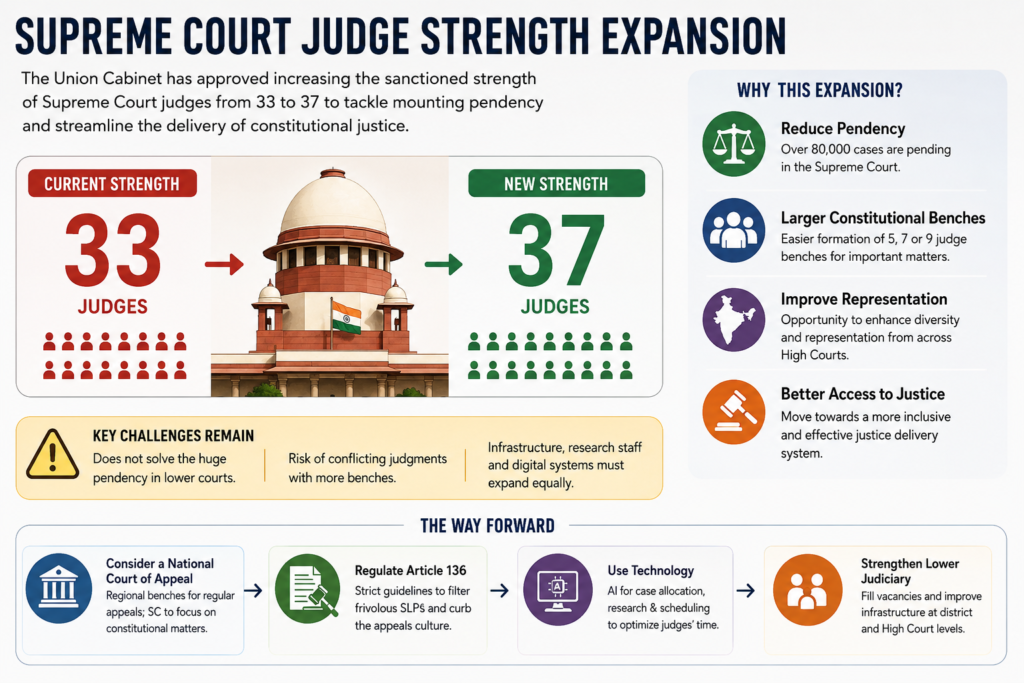
- The Union Cabinet has granted approval to increase the sanctioned strength of Supreme Court judges from 33 to 37, aiming to tackle mounting judicial pendency and streamline the delivery of constitutional justice.
Main Body: Multi-Dimensional Analysis
- Constitutional & Legal Dimension:
- Article 124(1): The Constitution leaves the strength of the Supreme Court to the discretion of the Parliament. It began with 8 judges in 1950 and has been periodically amended (most recently in 2019 to 33+1).
- Special Leave Petitions (SLPs): Originally intended as an exceptional remedy under Article 136, SLPs now constitute an overwhelming majority of the SC’s docket, transforming it into a regular court of appeal rather than a constitutional court.
- Institutional & Structural Dimension:
- Pendency Crisis: With over 80,000 cases pending at the apex level, the sheer volume dilutes the court’s primary mandate of interpreting constitutional law.
- Bench Fragmentation: A higher strength allows for the formation of larger Constitutional Benches (5, 7, or 9 judges) which are currently difficult to convene without halting regular appellate work.
- Federalism & Demographic Dimension:
- Geographical Disconnect: The concentration of the Supreme Court in New Delhi makes access to justice prohibitively expensive for litigants from Southern, North-Eastern, and Western India.
- Diversity & Representation: An expanded bench provides an opportunity to address the chronic under-representation of women, marginalized communities, and diverse High Courts at the apex level.
- Administrative & Systemic Dimension:
- The “Trickle-Down” Fallacy: Expanding the top tier does not alleviate the foundational bottlenecks in the subordinate judiciary (over 4 crore pending cases) and High Courts.
- Infrastructure Deficit: Merely adding judges without proportional expansion in digital infrastructure, research staff, and courtroom space creates administrative gridlock.
Positives, Negatives, and Government Initiatives
| Parameter | Details |
| Positives | • Faster disposal of long-pending constitutional matters. • Ability to maintain permanent specialized benches (e.g., commercial, tax). • Improved Judge-to-Population ratio at the apex tier. |
| Negatives | • Risk of conflicting judgments due to too many division benches (two-judge benches). • Does not address the root cause of the “appeals culture” in India. • Administrative strain on the Collegium to find suitable candidates. |
| Govt. Schemes / Initiatives | • e-Courts Mission Mode Project: Digitization of records and virtual hearings. • National Judicial Data Grid (NJDG): Real-time tracking of pendency. • SUVAS (AI Tool): Supreme Court Vidhik Anuvaad Software for translating judgments. |
Examples
- The delay in hearing vital constitutional matters, such as the electoral bonds scheme or the abrogation of Article 370, highlights how the lack of available judges for large benches impacts the timely delivery of justice on issues of national importance.
Way Forward
- Establish a National Court of Appeal: Split the Supreme Court’s functions by creating regional Courts of Appeal (North, South, East, West) to handle regular civil/criminal appeals, leaving the SC exclusively for constitutional matters.
- Regulate Article 136: Institute strict, objective guidelines to filter and penalize frivolous Special Leave Petitions to prevent the apex court from being treated as a routine appellate forum.
- Modernize Judicial Infrastructure: Expand the use of Artificial Intelligence for case allocation, preliminary research, and scheduling to optimize the time of the newly added judges.
- Strengthen Subordinate Judiciary: Shift focus to filling the massive vacancies in district courts, as a robust lower judiciary reduces the volume of appeals reaching the Supreme Court.
Conclusion
While expanding the Supreme Court’s numerical strength is a necessary administrative adjustment, it is not a standalone panacea. Without structural reforms—such as curtailing the deluge of regular appeals and regionalizing appellate justice—the apex court will continue to struggle under the weight of its own docket, compromising its role as the ultimate sentinel of the Constitution.
Practice Mains Question
Mere expansion of the judicial strength at the apex level cannot be a panacea for the chronic judicial pendency in India. Analyze this statement in light of the recent cabinet decision to increase the Supreme Court’s judge strength. (250 words, 15 Marks)
Topic 2: Mission for Cotton Productivity
Syllabus
- GS Paper 3: Major crops – cropping patterns in various parts of the country; e-technology in the aid of farmers; Issues related to direct and indirect farm subsidies.
Context
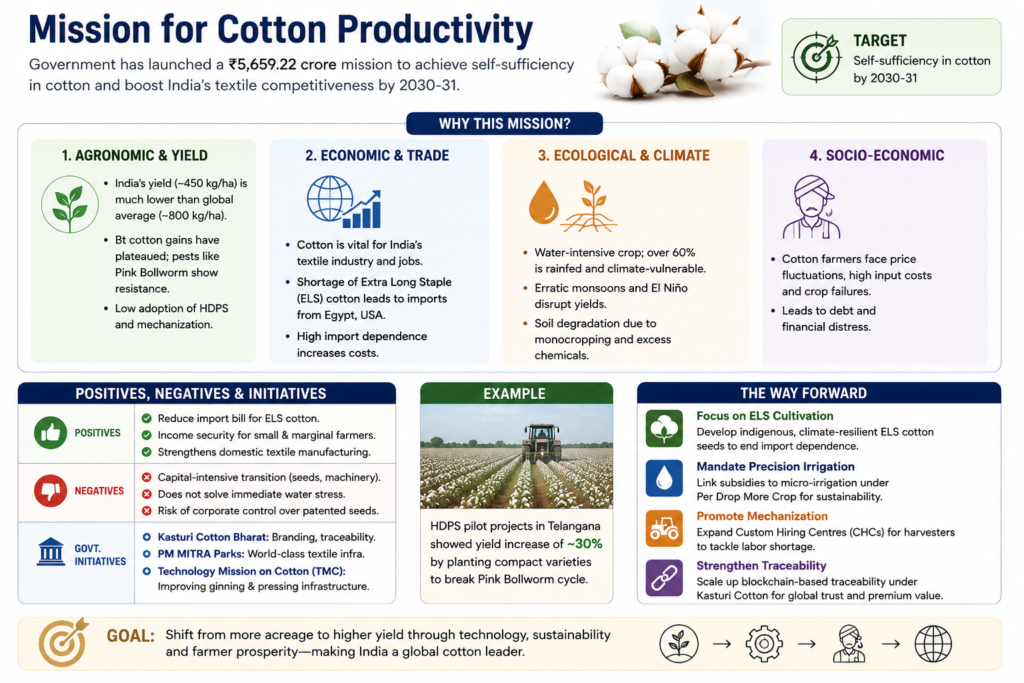
- The government has launched a ₹5,659.22 crore Mission for Cotton Productivity, aiming to achieve complete self-sufficiency in cotton and bolster India’s textile export competitiveness by the 2030-31 financial year.
Main Body: Multi-Dimensional Analysis
- Agronomic & Yield Dimension:
- Stagnant Productivity: Despite having the largest area under cotton cultivation globally, India’s yield (approx. 450 kg/hectare) is significantly lower than the global average (800 kg/hectare).
- Bt Cotton Fatigue: The initial yield explosion brought by Bt cotton in the early 2000s has plateaued. Pests, particularly the Pink Bollworm, have developed widespread resistance.
- Technology Deficit: Slow adoption of High-Density Planting Systems (HDPS) and mechanical harvesting keeps labor costs high and yields suboptimal.
- Economic & Trade Dimension:
- Textile Sector Backbone: Cotton is the lifeline of India’s textile industry, which contributes heavily to GDP and industrial employment.
- Import Dependency: India faces a severe shortage of Extra Long Staple (ELS) cotton, forcing reliance on imports from Egypt and the USA to cater to premium textile manufacturing.
- Ecological & Climate Dimension:
- Water Intensity: Cotton is highly water-intensive. Over 60% of India’s cotton is rainfed (grown in areas like Vidarbha and Saurashtra), making the crop highly vulnerable to erratic monsoons and El Niño disruptions.
- Soil Degradation: Intensive monocropping and overuse of chemical pesticides have degraded soil health in traditional cotton belts.
- Socio-Economic Dimension:
- Farmer Distress: Fluctuating global market prices, coupled with high input costs (seeds and pesticides) and crop failures, have historically made cotton farmers highly susceptible to debt traps.
Positives, Negatives, and Government Initiatives
| Parameter | Details |
| Positives | • Will reduce the import bill for ELS cotton. • Promises income security for millions of small and marginal farmers. • Strengthens backward linkages for the domestic textile manufacturing sector. |
| Negatives | • Capital-intensive transition (requires new seeds, machinery). • Does not address the immediate water-stress in rainfed regions. • Risk of corporate monopoly over new patented seed technologies. |
| Govt. Schemes / Initiatives | • Kasturi Cotton Bharat: Branding, traceability, and certification initiative. • PM MITRA Parks: To create world-class textile infrastructure. • Technology Mission on Cotton (TMC): Earlier framework focused on improving ginning and pressing infrastructure. |
Examples
- The success of High-Density Planting Systems (HDPS) pilot projects in Telangana has demonstrated that planting compact varieties closer together can bypass the Pink Bollworm cycle and increase per-acre yields by 30%.
Way Forward
- Focus on ELS Cultivation: Incentivize agricultural universities to develop indigenous, climate-resilient Extra Long Staple cotton seeds to eliminate import dependency.
- Mandate Precision Irrigation: Link the mission’s subsidies to the mandatory adoption of micro-irrigation (drip systems) under the Per Drop More Crop framework to ensure ecological sustainability.
- Promote Mechanization: Facilitate custom hiring centers (CHCs) for cotton harvesters to solve the chronic labor shortage faced by farmers during the picking season.
- Strengthen Traceability: Expand blockchain-based traceability under the Kasturi Cotton initiative to assure global buyers of the ethical and organic standards of Indian cotton.
Conclusion
The Mission for Cotton Productivity represents a critical shift from expanding acreage to maximizing yield. For India to reclaim its historical dominance in global textiles, the mission must rigorously integrate climate-smart agriculture with cutting-edge seed technology, ensuring that the prosperity reaches the primary producer—the farmer.
Practice Mains Question
Evaluate the agronomic and economic bottlenecks ailing the Indian cotton sector. How can the newly proposed Mission for Cotton Productivity ensure sustainable self-reliance by 2030? (250 words, 15 Marks)
Topic 3: Sovereign Transit Rules in the Strait of Hormuz
Syllabus
- GS Paper 2: Effect of policies and politics of developed and developing countries on India’s interests; Important International institutions, agencies, and fora.
Context
- In response to escalating regional tensions, Iran has mandated that all commercial vessels passing through the Strait of Hormuz must obtain prior transit permits, establishing a new “sovereign governance system” over the global energy chokepoint.
Main Body: Multi-Dimensional Analysis
- Geopolitical & Strategic Dimension:
- Chokepoint Weaponization: The Strait of Hormuz is the world’s most critical oil transit chokepoint (handling roughly 20% of global oil consumption). Iran is leveraging geography as an asymmetric weapon against Western sanctions.
- Regional Hegemony: This move is a projection of power in the broader Middle East matrix, signaling to the US, Israel, and Gulf neighbors that Iran holds the “off switch” to the global economy.
- International Law Dimension (UNCLOS):
- Transit Passage vs. Innocent Passage: Under the UN Convention on the Law of the Sea (UNCLOS), ships enjoy the right of “transit passage” through international straits, which cannot be suspended.
- Iran’s Legal Loophole: Iran signed but never ratified UNCLOS. It argues it is only bound by the 1958 Geneva Conventions, claiming the right to regulate “innocent passage” based on its national security parameters.
- Economic & Global Supply Chain Dimension:
- Inflationary Pressures: Any disruption or delay in the Strait instantly spikes global crude oil prices, translating directly to imported inflation for energy-dependent nations.
- Insurance and Logistics Costs: Mandated permits and the threat of seizure drastically increase marine insurance premiums and freight rates, disrupting post-pandemic supply chain recovery.
- Impact on India’s Interests:
- Energy Security: India imports nearly 60% of its crude oil from the Middle East, much of which transits through Hormuz.
- Diaspora & Remittances: Over 8 million Indians live and work in the Gulf; conflict in this waterway threatens regional stability, jobs, and vital remittance inflows.
Positives, Negatives, and Government Initiatives
| Parameter | Details |
| Positives | • (From Iran’s perspective) Establishes strategic deterrence and forces diplomatic engagement. • Accelerates global shifts toward renewable energy due to fossil fuel supply anxiety. |
| Negatives | • Triggers immediate spikes in global fuel and commodity prices. • High risk of naval miscalculation leading to a hot war involving superpowers. • Undermines the foundational principle of “Freedom of Navigation”. |
| Govt. Schemes / Initiatives (India) | • Operation Sankalp: Indian Navy’s deployment in the Gulf to ensure the safe passage of Indian-flagged merchant vessels. • Strategic Petroleum Reserves (SPR): Building buffers in Mangaluru, Padur, and Visakhapatnam. • Chabahar Port Development: To secure alternative trade routes to Central Asia bypassing specific vulnerabilities. |
Examples
- The cascading effects of chokepoint vulnerability are already evident in the Red Sea/Bab-el-Mandeb Strait, where Houthi militant attacks have forced global shipping companies to reroute around the Cape of Good Hope, adding weeks to transit times and doubling freight costs.
Way Forward
- Accelerate Energy Diversification: India must aggressively diversify its crude import basket by deepening energy ties with Latin America, Africa, and the US, while rapidly expanding domestic Strategic Petroleum Reserves (SPRs).
- Naval Diplomacy and Escorts: Enhance the operational scope of the Indian Navy’s Operation Sankalp through joint patrols and intelligence-sharing with international maritime coalitions to secure Indian-flagged vessels.
- Diplomatic De-escalation: Leverage India’s unique strategic autonomy and good relations with both Iran and Arab nations to act as a mediating voice for maintaining the freedom of navigation.
- Alternative Trade Corridors: Fast-track investments in multi-modal transport networks like the India-Middle East-Europe Economic Corridor (IMEC) and the International North-South Transport Corridor (INSTC) to reduce reliance on single maritime routes.
Conclusion
Iran’s regulatory overreach in the Strait of Hormuz underscores the fragility of a global economy reliant on narrow maritime corridors. For nations like India, ensuring energy security requires moving beyond passive diplomacy to active naval capability enhancement and aggressive diversification of energy supply chains.
Practice Mains Question
The strategic weaponization of maritime chokepoints in West Asia poses a severe threat to India’s energy and economic security. Discuss, highlighting the international legal frameworks governing such straits and the counter-measures India must adopt. (250 words, 15 Marks)
Topic 4: Indigenous Cell Broadcast System (CBS) Launch
Syllabus
- GS Paper 3: Disaster and disaster management; Science and Technology- developments and their applications and effects in everyday life; Indigenization of technology.
Context
- The Ministry of Communications has successfully deployed a fully indigenous Cell Broadcast System (CBS) designed to push real-time, location-based emergency alerts to mobile devices during natural disasters or security threats.
Main Body: Multi-Dimensional Analysis
- Technological Dimension:
- Broadcast vs. Unicast: Unlike SMS, which relies on point-to-point network transmission and is highly susceptible to congestion during emergencies, CBS functions like a radio broadcast. A single cell tower sends a message to all devices within its radius simultaneously.
- Device Agnostic Reach: It overrides silent or “Do Not Disturb” (DND) modes, triggering a distinct auditory alarm and pop-up notification on all active handsets, regardless of the telecom service provider.
- Disaster Management & Governance Dimension:
- The “Golden Hour” Paradigm: Shifts disaster management from a reactive rescue model to a proactive early-warning model. Timely evacuation alerts for flash floods, cyclones, or tsunamis drastically reduce the loss of life.
- Geo-Targeting Precision: Authorities can draw a digital geofence around a specific vulnerable area (e.g., a coastal district facing a cyclone) and alert only the population within that precise zone, preventing mass panic.
- Strategic & Security Dimension:
- Indigenization through C-DOT: Developed by the Centre for Development of Telematics (C-DOT), this ensures India is not reliant on foreign vendors for critical national security infrastructure, safeguarding against external surveillance or sabotage.
- Law and Order Applications: Beyond natural disasters, the system can be utilized for crowd control during stampedes, localized industrial chemical leaks, or active security threats.
- Socio-Economic Dimension:
- Overcoming Language Barriers: The system supports multi-lingual broadcasts, ensuring that localized alerts are understood by regional populations and migrant workers alike.
Positives, Negatives, and Government Initiatives
| Parameter | Details |
| Positives | • Immune to telecom network congestion during crises. • Requires no subscription or app download from the user. • Highly localized, reducing unnecessary panic in safe zones. |
| Negatives | • Relies on intact cell tower infrastructure, which can be destroyed in severe cyclones or earthquakes. • Older, legacy “feature phones” may lack the firmware to receive advanced CBS alerts. • Potential for “alert fatigue” if overused for non-critical issues. |
| Govt. Schemes / Initiatives | • Common Alerting Protocol (CAP): The integrated platform used by NDMA to trigger these alerts. • Aapda Mitra Scheme: Community volunteer training that synergizes with early warnings. • e-Raksha: Broad framework for digital disaster resilience. |
Examples
- The necessity of CBS was highlighted during Cyclone Biparjoy, where SMS-based warnings faced severe delivery lags. Conversely, countries like Japan utilize a similar J-Alert system that gives citizens a crucial 10-15 second head-start before earthquake tremors hit, saving thousands of lives.
Way Forward
- Satellite Integration: Integrate the CBS with India’s NavIC satellite system to push alerts directly to devices in remote areas where terrestrial cell towers have collapsed or do not exist.
- Feature Phone Compatibility: Mandate telecom operators and manufacturers to update the firmware of legacy 2G/3G feature phones via Over-The-Air (OTA) updates to ensure the poorest demographics are not excluded.
- Multi-Modal Redundancy: Combine CBS with localized automatic triggers for television and FM radio broadcasts to create a foolproof, multi-layered warning ecosystem.
- Standard Operating Procedures (SOPs): Establish strict statutory guidelines on what qualifies as a “Tier-1 Emergency” to prevent the misuse of the system and avoid public desensitization.
Conclusion
The indigenous Cell Broadcast System is a watershed moment for India’s disaster resilience architecture. By marrying cutting-edge, homegrown telecommunication technology with administrative agility, India has fortified its capacity to protect the lives of its citizens at the critical juncture of the “golden hour.”
Practice Mains Question
Evaluate the technological superiority of the Cell Broadcast System over traditional warning mechanisms. How does its indigenous development bolster India’s national security and disaster preparedness? (250 words, 15 Marks)
Topic 5: Unification via the Swasth Bharat Portal
Syllabus
- GS Paper 2: Issues relating to development and management of Social Sector/Services relating to Health, Education, Human Resources; e-governance applications, models, successes, limitations, and potential.
Context
- Unveiled by the Ministry of Health and Family Welfare, the Swasth Bharat digital platform aims to consolidate fragmented regional health systems and siloed data pools to accelerate India’s national digital health infrastructure.
Main Body: Multi-Dimensional Analysis
- Governance & Administrative Dimension:
- Breaking Data Silos: Historically, health data in India has been fragmented across state-level databases, private hospitals, and disparate central schemes. The portal acts as a master interoperability layer.
- Resource Optimization: Real-time dashboards allow policymakers to track epidemiological trends, predict localized disease outbreaks, and allocate medicines and frontline workers efficiently.
- Health Equity & Access Dimension:
- Longitudinal Patient History: Through the integration of the Ayushman Bharat Health Account (ABHA), patients are freed from carrying physical files. A doctor in a metropolitan hospital can instantly access the diagnostic history of a migrant worker from a rural district.
- Telemedicine Amplification: The portal provides a unified backend for tele-consultations, effectively bridging the severe doctor-to-patient ratio deficit in Tier-3 and Tier-4 geographies.
- Economic & Out-of-Pocket Dimension:
- Reducing Redundancy: By maintaining verifiable Electronic Health Records (EHR), the portal prevents patients from having to undergo duplicate, expensive diagnostic tests when switching healthcare providers.
- Fraud Detection: Unified tracking of health insurance claims (like PM-JAY) drastically reduces leakages, ghost billing, and institutional corruption.
- Data Privacy & Ethical Dimension:
- Consent Architecture: The system hinges on a federated digital architecture where data resides at the source (the hospital) and is shared only via explicit, revocable patient consent.
- Cybersecurity Vulnerabilities: Centralizing access to the biometric and clinical profiles of a billion citizens makes the portal a prime target for state-sponsored cyberattacks and ransomware.
Positives, Negatives, and Government Initiatives
| Parameter | Details |
| Positives | • Enables data-driven, precision public health policymaking. • Drastically reduces Out-of-Pocket Expenditure (OOPE) on redundant diagnostics. • Portability of health benefits across state borders. |
| Negatives | • Severe digital divide; rural populations lack smartphone literacy to manage digital consent. • Hesitancy from private hospitals (which control 70% of healthcare) to share proprietary patient data. • Catastrophic risks associated with medical data breaches. |
| Govt. Schemes / Initiatives | • Ayushman Bharat Digital Mission (ABDM): The foundational pillar generating ABHA IDs. • e-Sanjeevani: The national telemedicine network being integrated into the portal. • Digital Personal Data Protection (DPDP) Act: The legal framework securing this health data. |
Examples
- The foundational blueprint for this unification comes from the success of the CoWIN platform during the COVID-19 pandemic, which managed the logistics and verifiable records of over 2 billion vaccine doses seamlessly. Internationally, Estonia’s e-Health system serves as a benchmark for 100% digitized health records.
Way Forward
- Incentivize Private Sector Onboarding: The government must transition from voluntary to mandatory compliance for clinical establishments to share anonymized data, perhaps linking it to the renewal of their operating licenses.
- Capacity Building at the Grassroots: Train ASHA and Anganwadi workers to act as “Digital Health Navigators,” assisting the digitally illiterate in creating ABHA IDs and accessing the portal.
- Robust Cybersecurity Frameworks: Institute mandatory, periodic third-party cybersecurity audits and establish a dedicated health-sector Computer Emergency Response Team (Health-CERT).
- Enforce the DPDP Act: Ensure that the stringent penal provisions of the Data Protection Act are operationalized to build public trust in the state’s ability to protect sensitive medical histories.
Conclusion
The Swasth Bharat Portal is not merely an IT project; it is the digital spine of Universal Health Coverage in India. However, its success hinges on bridging the rural digital divide and ensuring that the pursuit of data interoperability does not come at the cost of individual medical privacy.
Practice Mains Question
Examine the role of the Swasth Bharat Portal in democratizing healthcare access in India. What are the critical data privacy and implementation hurdles that must be overcome to realize its full potential? (250 words, 15 Marks)
Topic 6: Expansion of the India Semiconductor Mission
Syllabus
- GS Paper 3: Indian Economy and issues relating to planning, mobilization, of resources, growth, development and employment; Effects of liberalization on the economy, changes in industrial policy; Indigenization of technology.
Context
- The Union Cabinet has cleared the establishment of two additional semiconductor manufacturing units with a cumulative investment of over ₹3,900 crore under the India Semiconductor Mission (ISM), aiming to strengthen domestic supply chains.
Main Body: Multi-Dimensional Analysis
- Geopolitical & Strategic Dimension:
- The “Chip War” Context: Semiconductors are the “new oil,” driving everything from smartphones to hypersonic missiles. Heavy reliance on Taiwan (which produces over 60% of global chips) exposes India to severe supply chain shocks amidst rising US-China tensions.
- Strategic Autonomy: Domestic fabrication is no longer just an economic goal but a critical national security imperative to prevent foreign espionage via compromised hardware backdoors.
- Economic & Industrial Dimension:
- Import Substitution: India’s electronics import bill is the second largest after crude oil. Domestic fabrication will drastically narrow the current account deficit over the next decade.
- The Multiplier Effect: A single mega-fab creates a massive downstream industrial ecosystem, stimulating the automotive, white goods, and consumer electronics sectors, while creating thousands of highly specialized jobs.
- Technological & Ecosystem Dimension:
- Moving up the Value Chain: India already has a strong base in semiconductor design (housing 20% of the world’s VLSI design engineers). The ISM aims to bridge the gap by establishing capabilities in actual manufacturing (Fabs) and Assembly, Testing, Marking, and Packaging (ATMP).
- Focus on Legacy Nodes: Initial investments are wisely targeting 28nm and 40nm nodes (used in autos and appliances) rather than highly complex, cutting-edge sub-5nm nodes (used in AI and smartphones), ensuring quicker operationalization.
- Infrastructural & Environmental Dimension:
- Resource Intensity: Semiconductor fabs run continuously (24/7/365). They require highly stable, fluctuation-free power grids and millions of liters of ultra-pure water daily.
- Environmental Footprint: The processing of silicon wafers utilizes highly toxic perfluorocarbons (PFCs) and creates significant industrial wastewater, posing local ecological challenges.
Positives, Negatives, and Government Initiatives
| Parameter | Details |
| Positives | • Positions India as a reliable “China+1” destination for global tech giants. • Bridges the gap between India’s design prowess and manufacturing deficit. • Catalyzes deep-tech R&D within Indian universities. |
| Negatives | • Exceptionally high capital expenditure with long gestation periods (3-5 years to build a fab). • Vulnerable to chronic infrastructural deficits (power/water) in industrial clusters. • Lack of a mature domestic ancillary industry (chemicals, specialty gases). |
| Govt. Schemes / Initiatives | • Design Linked Incentive (DLI) Scheme: Financial incentives for domestic chip design. • PLI for IT Hardware: Encouraging local manufacturing of laptops and servers. • SPECS: Scheme for Promotion of Manufacturing of Electronic Components and Semiconductors. |
Examples
- The recent joint ventures, such as the Tata-PSMC mega-fab in Dholera, Gujarat, and the Micron ATMP facility, demonstrate the initial success of the ISM in attracting global tech majors by offsetting up to 50% of the project costs through central subsidies.
Way Forward
- Guarantee Resource Infrastructure: State governments must create dedicated, ring-fenced infrastructure corridors guaranteeing zero-downtime electricity and sustainable ultra-pure water recycling systems for these fabs.
- Develop the Ancillary Ecosystem: Subsidies must also be extended to companies manufacturing the specialized raw materials required for chipmaking (e.g., photoresists, specialty gases, etching chemicals).
- Academic-Industry Linkages: Overhaul engineering curricula and fund specialized VLSI and nanotechnology labs in IITs and NITs to create a battle-ready workforce for the incoming fabs.
- Long-term Policy Stability: Semiconductor investments require a 10-15 year horizon. The government must ensure bipartisan policy continuity so that financial incentives are not abruptly withdrawn.
Conclusion
The expansion of the India Semiconductor Mission marks a decisive leap from being a consumer of technology to a creator of it. While the path from design to fabrication is fraught with infrastructural and capital challenges, establishing a sovereign semiconductor ecosystem is the non-negotiable bedrock for India’s economic and strategic ascendance in the 21st century.
Practice Mains Question
Semiconductors have emerged as the foundational battleground of modern geopolitics. In this context, evaluate the potential of the expanded India Semiconductor Mission in transforming India into a global electronics manufacturing hub. (250 words, 15 Marks)
Here are the final 2 Current Affairs topics (Topics 7 and 8) generated in the deep-dive, multi-dimensional framework to complete your requested set of 8 topics for May 6, 2026.
Topic 7: Emergency Credit Line Guarantee Scheme (ECLGS) 5.0
Syllabus
- GS Paper 3: Indian Economy and issues relating to planning, mobilization, of resources, growth, development and employment; Inclusive growth and issues arising from it.
Context
- The government has officially approved the fifth iteration of the Emergency Credit Line Guarantee Scheme (ECLGS 5.0) to ensure continued collateral-free credit flow and essential liquidity support to Micro, Small, and Medium Enterprises (MSMEs) and other stressed economic sectors.
Main Body: Multi-Dimensional Analysis
- Economic & Liquidity Dimension:
- Bridging the Credit Gap: The MSME sector in India faces a chronic, structural credit gap estimated at over ₹25 lakh crore. ECLGS acts as a sovereign backstop, encouraging risk-averse banks and NBFCs to lend by assuming 100% guarantee coverage for the sanctioned credit limits.
- Working Capital vs. Capex: While earlier iterations were strictly for survival and working capital, ECLGS 5.0 incorporates provisions allowing MSMEs to utilize funds for technology upgrades and minor capital expenditure, signaling a shift from “survival” to “growth.”
- Systemic Risk & NPA Dimension:
- Preventing Mass Defaults: By injecting liquidity at critical junctures, the scheme prevents a cascading effect of defaults. If MSMEs fail to pay vendors, it triggers a chain reaction that ultimately swells the Non-Performing Assets (NPAs) on bank balance sheets.
- The “Evergreening” Threat: A persistent economic critique is that blanket guarantees might lead to the “evergreening” of bad loans—where unviable, “zombie” firms are kept alive artificially through debt, merely delaying an inevitable collapse rather than solving fundamental uncompetitiveness.
- Employment & Social Dimension:
- Protecting the Job Engine: MSMEs are the second-largest employment generator after agriculture, employing over 11 crore people. Liquidity support directly translates to payroll protection, preventing massive job losses among semi-skilled and unskilled labor demographics.
- Informal Sector Exclusion: A glaring gap remains: ECLGS requires firms to have existing credit facilities and GST registration. Millions of micro and informal enterprises (which operate strictly in cash) remain entirely outside the protective net of this scheme.
- Operational & Implementation Dimension:
- Transmission Bottlenecks: Despite sovereign guarantees, on-ground disbursement often faces hurdles. Branch-level bank managers frequently delay approvals due to a fear of vigilance inquiries if loans turn bad, demanding extensive, redundant paperwork.
Positives, Negatives, and Government Initiatives
| Parameter | Details |
| Positives | • Sovereign guarantee removes the need for collateral, the biggest hurdle for MSMEs. • Highly automated, pre-approved loan structure ensures rapid disbursement. • Protects massive downstream employment in labor-intensive sectors. |
| Negatives | • Pushes highly leveraged MSMEs deeper into a debt trap instead of offering equity support. • Solves the “supply side” (liquidity) but cannot fix “demand side” (lack of consumer spending). • Excludes unregistered, informal micro-enterprises. |
| Govt. Schemes / Initiatives | • CGTMSE: Credit Guarantee Fund Trust for Micro and Small Enterprises. • RAMP Program: Raising and Accelerating MSME Performance (World Bank assisted). • Udyam Registration Portal: To formalize micro-units to enable credit access. |
Examples
- The impact of targeted ECLGS extensions was prominently visible in the Hospitality and Civil Aviation sectors post-2021. Targeted liquidity buffers prevented the total collapse of thousands of budget hotels and regional travel operators during prolonged demand slumps.
Way Forward
- Shift from Debt to Equity: Future MSME interventions must pivot towards equity infusion models (like the Self-Reliant India Fund) rather than just piling on more debt, which severely impacts a firm’s long-term profitability.
- Alternative Data Underwriting: Mandate banks to integrate digital footprints, GST returns, and digital payment histories (UPI data) for credit appraisal to bypass the need for traditional collateral.
- Formalization Drives: Accelerate grassroots campaigns linking PM SVANidhi beneficiaries and unregistered artisans to the Udyam portal to bring them into the formal credit fold.
- Capacity Building: Couple credit schemes with mandatory financial literacy and digital marketing training to ensure MSMEs use the injected capital efficiently rather than burning it on outdated operational models.
Conclusion
ECLGS 5.0 remains a vital macroeconomic shock absorber. However, liquidity is a painkiller, not a cure. To secure the long-term viability of India’s MSMEs, structural reforms focusing on technology adoption, equity financing, and formalization must rapidly outpace emergency credit measures.
Practice Mains Question
While the Emergency Credit Line Guarantee Scheme (ECLGS) has shielded the MSME sector from systemic collapse, it cannot be a substitute for deep structural reforms. Analyze. (250 words, 15 Marks)
Topic 8: National Festival for Pastoral Cultures
Syllabus
- GS Paper 1: Indian culture will cover the salient aspects of Art Forms, literature and Architecture from ancient to modern times; Salient features of Indian Society.
- GS Paper 3: Conservation, environmental pollution and degradation.
Context
- The Centre for Pastoralism is organizing the ‘Sanjha Bazaar’ festival in Pune, serving as an economic and cultural platform to preserve the oral traditions, artisanal crafts, and sustainable livelihoods of India’s arid-land pastoral communities.
Main Body: Multi-Dimensional Analysis
- Cultural & Heritage Dimension:
- Living Repositories of Knowledge: Pastoralists possess deep, inter-generational ethno-veterinary knowledge, an understanding of complex arid ecologies, and unique oral traditions, folk music, and weaving techniques that are rapidly fading.
- Stigma and Marginalization: Historically classified under colonial “Criminal Tribes” acts and persistently viewed through a modernist lens as “backward” or “unproductive,” their unique way of life faces severe cultural erosion and assimilation pressures.
- Ecological & Climate Dimension:
- Climate-Resilient Agriculture: Mobile pastoralism is inherently adapted to climate variability. By moving herds based on rainfall, they prevent overgrazing in fragile ecosystems (like the Thar desert or the Himalayas), naturally fertilizing lands along their migratory routes.
- Conservation Conflicts: The exclusionary model of wildlife conservation (creating fenced national parks and tiger reserves) often criminalizes traditional grazing rights, displacing pastoralists from their ancestral lands without viable alternatives.
- Economic & Livelihood Dimension:
- Unrecognized Economic Contribution: Pastoral systems contribute significantly to the national agrarian economy through the production of meat, milk, wool, and leather, yet they receive a fraction of the institutional support or subsidies given to settled agriculture.
- Exploitative Value Chains: Without decentralized processing units or cold storage, pastoralists are forced to sell premium products (like camel milk or pure Deccani wool) at distress prices to exploitative middlemen.
- Legal & Governance Dimension:
- Implementation of FRA, 2006: The Scheduled Tribes and Other Traditional Forest Dwellers (Recognition of Forest Rights) Act explicitly recognizes community rights to seasonal grazing access. However, bureaucratic inertia prevents the actual mapping and granting of these rights on the ground.
Positives, Negatives, and Government Initiatives
| Parameter | Details |
| Positives | • Festivals provide direct-to-consumer market linkages, eliminating middlemen. • Validates and celebrates indigenous identity, fighting socio-cultural stigma. • Promotes sustainable, cruelty-free, and organic animal products. |
| Negatives | • Niche urban markets do not solve the macro-issue of shrinking grazing lands. • Heavy out-migration of pastoral youth seeking formal, settled jobs. • Commercialization risks diluting authentic cultural practices for urban consumption. |
| Govt. Schemes / Initiatives | • National Livestock Mission: Sub-mission on breed development of livestock. • Forest Rights Act (FRA), 2006: Legal mandate for grazing rights. • Geographical Indication (GI) Tags: Utilized for specific pastoral crafts (e.g., Kachchhi Shawls). |
Examples
- The Raikas of Rajasthan (camel herders), the Bakarwals of Jammu & Kashmir, and the Maldharis of the Banni grasslands in Gujarat are prime examples of communities whose deeply sustainable lifestyles are threatened by rapid industrialization and the spread of invasive species like Prosopis juliflora.
Way Forward
- Secure Land and Grazing Rights: State governments must expedite the recognition of Community Forest Resource (CFR) rights under the FRA, 2006, ensuring uninterrupted access to traditional migratory corridors.
- Decentralized Processing Infrastructure: Set up micro-processing units (for wool carding, milk chilling, and cheese making) along traditional migratory routes to help pastoralists capture more value from their produce.
- Premium Branding & Certification: Facilitate organic and “cruelty-free/free-range” certifications for pastoral products to command premium prices in domestic and international markets, utilizing e-commerce platforms.
- Curriculum Integration: Integrate the ecological and cultural significance of pastoralism into school curriculums to alter the societal perception of these communities from “nomadic wanderers” to ecological stewards.
Conclusion
Pastoralism is not an anachronism to be erased by modernity; it is a highly evolved, climate-resilient economic model. Protecting pastoral cultures through economic integration and legal rights is not just an act of cultural preservation, but a critical imperative for ecological sustainability in India’s arid and semi-arid zones.
Practice Mains Question
Discuss the socio-economic and ecological significance of pastoral communities in India. How can the friction between traditional pastoralism and modern conservation policies be harmonized? (250 words, 15 Marks)
