
Topic 1: India-Italy Elevate Ties to “Special Strategic Partnership”
Syllabus
- GS Paper II: Bilateral, regional and global groupings and agreements involving India and/or affecting India’s interests.
Context
- During a bilateral visit to Rome on May 21, 2026, Indian Prime Minister Narendra Modi and Italian Prime Minister Giorgia Meloni formally upgraded bilateral relations to a “Special Strategic Partnership,” anchoring ties in defense co-production, energy transition, and secure supply chains.

Main Body: Multi-Dimensional Analysis
- Geopolitical Alignment in the Indo-Pacific: Italy’s growing footprint in the Indo-Pacific matches India’s maritime security needs. By joining the Indo-Pacific Oceans Initiative (IPOI), Rome anchors its broader European Union (EU) strategy within India’s maritime security matrix.
- Defense Industrial Co-production Pivot: Shifting from a buyer-seller dynamic to joint development under Atmanirbhar Bharat. The new defense industrial roadmap prioritizes the co-development of naval propulsion systems, underwater defense technologies, and military aviation components.
- Economic & Trade Integration: Bilateral trade aims to scale to €20 billion by 2029. Cooperation focuses on integrating India’s Digital Public Infrastructure (DPI) with European payment gateways and establishing resilient semiconductor supply chains to bypass traditional single-source dependencies.
- Connectivity & IMEC Vitality: Italy remains a crucial terminal node for the India-Middle East-Europe Economic Corridor (IMEC). Despite Middle Eastern geopolitical friction, both nations are advancing technical feasibility studies for data cables and green hydrogen pipelines.
- Strategic Autonomy & Multilateral Reform: Both nations advocate for a reformed multilateral order. Italy serves as a bridge for India within the G7, while India champions Global South perspectives, allowing both to balance volatile US-China dynamics.
Key Matrix: Impacts & Institutional Frameworks
| Positives | Negatives | Relevant Government Schemes |
| • Boosts India’s domestic defense manufacturing ecosystem via critical European technology transfers. • Secure alternative supply chains for critical minerals and semiconductors. • Enhanced migration and mobility partnerships to formalize Indian skilled labor entry into Europe. | • Past institutional baggage (e.g., the Enrica Lexie/Italian Marines case) leaves lingering bureaucratic hesitation. • Diverging views on the Russia-Ukraine conflict occasionally strain joint diplomatic communiqués. • High EU regulatory barriers (like CBAM) create trade friction. | • Make in India / Defense PLI: Incentivizes joint ventures. • National Semiconductor Mission: Aligns with Italian tech firms. • Global Biofuels Alliance: Co-founded with Italian backing. |
Examples
- Fincantieri-Cochin Shipyard Collaboration: Joint design and manufacturing initiatives focusing on advanced naval vessels and automation.
- The Migration and Mobility Partnership Agreement (MMPA): A structured framework managing the flow of students, researchers, and professionals, curbing illegal migration while filling Italy’s labor deficits.
Way Forward
- Fast-Track IMEC Infrastructure: Prioritize the digital and clean energy components of the corridor to maintain momentum while terrestrial routes stabilize.
- Establish a Joint Defense R&D Fund: Allocate dedicated state capital to co-develop emerging technologies like quantum computing and AI-driven maritime surveillance.
- Resolve Regulatory Impediments: Create a fast-track bilateral mechanism to assist Indian exporters in navigating the EU’s Carbon Border Adjustment Mechanism (CBAM).
- Deepen Space Cooperation: Leverage ISRO and the Italian Space Agency (ASI) for joint climate monitoring and commercial satellite launch agreements.
Conclusion
The transition to a “Special Strategic Partnership” marks a mature phase in India-Italy relations, shifting away from historical friction toward pragmatic, technology-driven convergence. This alliance reinforces India’s multi-aligned foreign policy and strengthens its economic and strategic position across the Eurasian corridor.
Practice Mains Question
Q. “The elevation of India-Italy relations to a ‘Special Strategic Partnership’ reflects a shared imperative to secure global supply chains and maritime corridors.” Critical analyze the strategic and economic dimensions of this relationship in the context of changing geopolitical dynamics in the Indo-Pacific. (15 Marks, 250 Words)
Topic 2: Supreme Court on Caste Census and Welfare Distribution
Syllabus
- GS Paper I: Salient features of Indian Society, Diversity of India.
- GS Paper II: Welfare schemes for vulnerable sections of the population by the Centre and States and the performance of these schemes.
Context
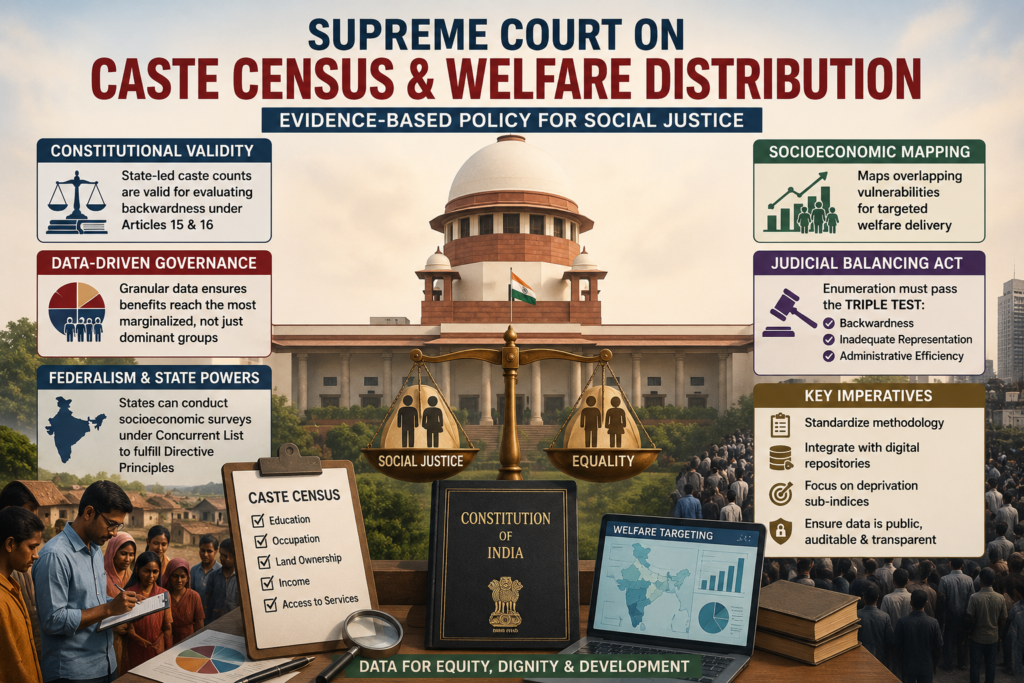
- On May 21, 2026, a three-judge bench of the Supreme Court, led by Chief Justice Surya Kant, affirmed that state-led caste counts are constitutionally valid administrative exercises necessary for targeted welfare delivery and correcting historical socioeconomic imbalances.
Main Body: Multi-Dimensional Analysis
- Constitutional Validity & State Mandate: The apex court clarified that collecting quantifiable data does not violate the federal structure, provided it is used as a diagnostic tool to evaluate backwardness under Articles 15 and 16, rather than as a political tool.
- Data-Driven Governance vs. Policy Blindness: Modern affirmative action requires precise data. Without granular sub-caste enumeration, benefits are frequently monopolized by dominant groups within backward classes, leaving the most marginalized communities unrepresented.
- The Federalism Debate: Census operations fall under Union List Entry 69 (Census Act, 1948). However, the Court ruled that states are well within their rights to conduct socioeconomic “surveys” under Concurrent List powers to fulfill directive principles.
- Socioeconomic Mapping Beyond Politics: A scientific caste census maps overlapping vulnerabilities—including land ownership, educational attainment, and formal employment access—shifting public policy from broad assumptions to targeted intervention.
- The Judicial Balancing Act: The ruling emphasizes that while enumeration is legal, it must withstand the triple test criteria: demonstrating backwardness, proving inadequate representation, and ensuring overall administrative efficiency under Article 335.
Key Matrix: Impacts & Institutional Frameworks
| Positives | Negatives | Relevant Government Schemes |
| • Provides empirical data to defend reservation quotas from judicial strikes. • Exposes the “creamy layer” within backward classes to allow redistribution to poorer sub-castes. • Moves welfare delivery from universal subsidies to precise, means-tested targeting. | • Risks deepening caste identities, running counter to the constitutional goal of a casteless society. • May spark demands to breach the 50% reservation limit set by the Indra Sawhney judgment. • Potential for data manipulation for short-term political gain. | • Article 340 Framework: Appointment of commissions to investigate backward class conditions. • PM-DAKSH Yojana: Skill development targeted using state socioeconomic registries. • SECC Framework: Socio-Economic and Caste Census adaptation for welfare mapping. |
Examples
- The Rohini Commission Report: Highlighted that a tiny fraction of sub-castes cornered over 97% of central OBC reservation benefits, underscoring the urgent need for granular, sub-classified data.
- Bihar & Andhra Pradesh Caste Surveys: Practical state-level templates that utilized localized data collection to redesign educational scholarships and housing allocations.
Way Forward
- Standardize Methodology: Establish an independent, non-partisan expert body to design survey parameters, minimizing political bias and ensuring data integrity.
- Integrate with Digital Repositories: Link caste-survey indicators with existing socioeconomic registries like Aadhaar, Ration Cards, and the e-Shram portal to prevent data silos.
- Prioritize Deprivation Sub-Indices: Focus policy interventions on the lowest-performing sub-castes to ensure equitable distribution of welfare resources.
- Strengthen Judicial Safeguards: Ensure all collected state data is public, auditable, and capable of satisfying the Supreme Court’s stringent “quantifiable data” criteria.
Conclusion
The Supreme Court’s validation of state-led caste counts reinforces that timely, empirical data is essential for effective governance. To keep this exercise from deepening social divisions, policy makers must treat data collection strictly as a diagnostic tool for human development and equitable resource distribution.
Practice Mains Question
Q. “Evaluating backwardness without precise, granular data leads to the centralization of affirmative benefits among a privileged few.” In light of recent judicial pronouncements, critically evaluate the constitutional, administrative, and social implications of conducting state-level caste-based socioeconomic surveys. (15 Marks, 250 Words)
Topic 3: ₹15,000 Crore AMCA Defence Facility and India’s Flight to Indigenization
Syllabus
- GS Paper III: Indigenization of technology and developing new technology; Security challenges and their management.
Context
- The Ministry of Defence and the Government of Andhra Pradesh laid the foundation stone for a dedicated ₹15,000 crore manufacturing and testing facility for the Advanced Medium Combat Aircraft (AMCA) in Puttaparthi, marking India’s formal entry into 5th-generation fighter jet production.

Main Body: Multi-Dimensional Analysis
- Strategic Military Deterrence: India faces complex two-front security challenges. Securing a 5th-generation stealth fighter is essential to maintaining regional deterrence against advanced air defense systems and radar networks.
- Overcoming Critical Technology Deficits: The AMCA program focuses on mastering domestic production of critical technologies: internal weapon bays, radar-absorbent paint, serpentine air intakes, and advanced active electronically scanned array (AESA) radars.
- Transitioning the Aerospace Ecosystem: By integrating private defense firms as development cum production partners (SPVs), this facility shifts India away from its historical dependence on public sector monopolies like HAL toward a competitive private ecosystem.
- The Engine Indigenization Challenge: While early AMCA airframes will use imported GE-F414 engines, long-term strategic autonomy hinges on co-developing a 110 kN high-thrust engine with international partners (like Safran or Rolls-Royce) with complete intellectual property rights.
- Geopolitical Resilience: Relying on foreign platforms leaves India vulnerable to supply chain disruptions and political leverage during crises. Establishing this facility ensures independent lifecycle management and continuous upgrades for the Indian Air Force.
Key Matrix: Impacts & Institutional Frameworks
| Positives | Negatives | Relevant Government Schemes |
| • Dramatically lowers capital outflow on foreign defense acquisitions. • Creates a high-tech manufacturing cluster, generating skilled aerospace engineering jobs. • Enhances spin-off civilian technologies in metallurgy, composite materials, and radar systems. | • Historically, Indian aerospace projects face long timelines and cost overruns. • Private defense manufacturers encounter high initial capital costs and slow commercial returns. • Securing complete technology transfers for high-thrust jet engines remains difficult. | • Defense Production & Export Promotion Policy: Drives local defense output targets. • Innovations for Defence Excellence (iDEX): Engages startups for AMCA sub-component R&D. • Defence Industrial Corridors: Supports specialized aerospace zones. |
Examples
- The LCA Tejas Program: Served as the technological foundation for AMCA, teaching domestic industry how to handle composite structures, fly-by-wire systems, and glass cockpits.
- Tata-Airbus C-295 Project: An active example of private industry scaling up to lead military aircraft assembly within India.
Way Forward
- Enforce Strict Project Timelines: Adopt agile project management practices and hold public-private joint ventures accountable to strict delivery schedules.
- Lock In Joint Engine Ventures: Finalize the 110 kN engine co-development agreement immediately, ensuring India retains full intellectual property rights for the powerplant.
- Build Out the Local Component Supply Chain: Incentivize MSMEs within the defense corridors to supply lower-tier components, insulating the main assembly line from external import delays.
- Plan for Export Potential: Design the platform with modular configurations to attract friendly foreign nations, lowering per-unit costs through economies of scale.
Conclusion
The Puttaparthi AMCA facility represents a major leap forward for Indian aerospace manufacturing. Developing a 5th-generation fighter jet is technically demanding, but by bridging public R&D with private manufacturing capacity, India is building the self-reliance necessary to safeguard its long-term sovereign interests.
Practice Mains Question
Q. “Achieving true strategic autonomy requires moving past licensed assembly to mastering foundational defense technologies.” Analyze this statement in light of India’s newly launched Advanced Medium Combat Aircraft (AMCA) program and examine the challenges facing private sector participation in domestic aerospace manufacturing. (15 Marks, 250 Words)
Topic 4: PM Modi Honored with FAO’s “Agricola Medal”
Syllabus
- GS Paper II: Important International institutions, agencies, and fora – their structure, mandate.
- GS Paper III: Issues related to direct and indirect farm subsidies and minimum support prices; Public Distribution System – objectives, functioning, limitations, revamping; issues of buffer stocks and food security.
Context
- On May 21, 2026, the United Nations Food and Agriculture Organisation (FAO) conferred the prestigious “Agricola Medal” upon Prime Minister Narendra Modi in Rome, recognizing India’s pioneering advancements in universal food security, digital agricultural infrastructure, and sustainable farming models.

Main Body: Multi-Dimensional Analysis
- Global Recognition of Food Security Scale: The medal highlights India’s management of the world’s largest food safety net. Transitioning from a food-deficit nation to one providing highly subsidized rations to over 800 million citizens marks a historic shift in public resource distribution.
- Digital Agriculture Revolution (AgriStack): India’s deployment of Digital Public Infrastructure (DPI) in farming—integrating land records, digital crop identification, and real-time climate advisories—serves as a blueprint for smallholder farmers across the Global South to optimize inputs and reduce asset loss.
- Nutritional Security & Millet Diplomacy: A key pillar recognized by the FAO is India’s push from basic caloric sufficiency toward nutritional security. Elevating millets (Shree Anna) as a climate-resilient global staple addresses both dryland farming vulnerabilities and the global hidden hunger crisis.
- Climate-Smart Agriculture Scaling: Transitioning towards micro-irrigation, natural farming, and soil-health analytics. The award validates policies that aim to balance high crop yields with critical soil restoration and water conservation goals.
- Global South Collaboration & Agri-Export Power: India’s dual role as a major exporter of staples and a technology partner to African and Asian nations strengthens its position as an essential pillar of global agricultural supply chain resilience.
Key Matrix: Impacts & Institutional Frameworks
| Positives | Negatives | Relevant Government Schemes |
| • Enhances India’s soft power and diplomatic leadership across the Global South. • Validates India’s large-scale public grain management systems on the international stage. • Attracts global climate finance and technical collaboration for agritech innovations. | • Ongoing high rates of malnutrition, stunting, and wasting challenge complete food safety. • Intense groundwater depletion driven by heavily subsidized flood-irrigation techniques. • Vulnerability of smallholders to extreme weather variations and rising input costs. | • PM Garib Kalyan Anna Yojana (PMGKAY): World’s largest free food grain delivery network. • PM-KISAN: Direct digital income support bypasses intermediaries. • PM Krishi Sinchayee Yojana: Promotes efficient water management. |
Examples
- One Nation One Ration Card (ONORC): A portable digital system allowing internal migrant workers to seamlessly access food grain subsidies anywhere in India.
- Digital Soil Health Cards: Millions of farmers utilize customized, digital soil profiles to avoid excessive chemical fertilizer application, lowering input expenses while maintaining soil quality.
Way Forward
- Transition to Nutrition-Centric Welfare: Broaden the public distribution system beyond wheat and rice to include pulses, millets, and fortified staples to eliminate malnutrition and micronutrient deficiencies.
- Scale Up Precision and Micro-Irrigation: Implement strict policy measures and financial incentives to scale “per drop, more crop” micro-irrigation, specifically targetting water-stressed crop belts.
- Modernize Agri-Logistics and Storage: Build localized cold-chain networks to dramatically lower post-harvest losses, which currently impact a substantial percentage of perishable crops.
- Strengthen Agritech for Smallholders: Leverage AI-driven weather modeling and open-source regional digital tools to provide ultra-localized climate adaptation advice directly to farmers.
Conclusion
The FAO Agricola Medal reflects India’s remarkable evolution from structural food reliance to a model of scalable food security. By bridging digital public goods with targetted welfare, India provides a template for global agriculture, though long-term domestic resilience requires tackling deep-seated groundwater extraction and nutritional challenges.
Practice Mains Question
Q. “India’s journey from food scarcity to securing global recognition for food management highlights the efficacy of its large-scale welfare interventions, yet structural vulnerabilities in climate resilience and nutrition persist.” Dissect this statement in light of India’s recent international accolades in agriculture. (15 Marks, 250 Words)
Topic 5: Political Shift in Tamil Nadu and the Evolution of Coalition Era
Syllabus
- GS Paper II: Functions and responsibilities of the Union and the States, issues and challenges pertaining to the federal structure, devolution of powers and finances up to local levels and challenges therein. Salient features of the Representation of People’s Act.
Context
- On May 21, 2026, Tamil Nadu’s political landscape witnessed a significant shift as the newly emergent Tamilaga Vettri Kazhagam (TVK) invited major long-standing regional and national parties, including the Congress, VCK, and IUML, to form a joint coalition cabinet, breaking decades of single-party majority rule in the state.

Main Body: Multi-Dimensional Analysis
- Decline of Absolute Single-Party Dominance: This development signals a structural move away from the traditional duopoly of regional powerhouses that have alternated control of the state assembly for decades, introducing a more fragmented, multipolar legislative environment.
- Evolution of Cooperative Federalism: A broad-based coalition cabinet forces national and regional entities to negotiate policy priorities. This structural change requires the union government to adapt its center-state interactions to engage with a complex multi-party state executive.
- Sub-Regional Identity & Inclusive Bargaining: Smaller parties representing historically underrepresented or marginalized social groups gain direct executive leverage. Rather than acting as external support blocks, their presence in the cabinet ensures direct access to the policy-making table.
- Impact on Policy and Governance Stability: While coalition structures deepen political representation, they inherently complicate bureaucratic execution. Key infrastructure, land, and economic policies require broad ideological alignment, which can slow down rapid decision-making.
- Redefining National-Regional Political Equations: National parties participating as junior partners in a regionally led state cabinet shows a dynamic shift where localized interests dictate terms, altering strategic calculations for national parliamentary alliances.
Key Matrix: Impacts & Institutional Frameworks
| Positives | Negatives | Relevant Government Schemes/Laws |
| • Enhances democratic representation by reflecting a wider array of socio-political interests. • Institutions build internal checks and balances, limiting centralized executive overreach. • Encourages consensus-driven, inclusive social policies across distinct regions. | • Higher risk of policy gridlock or flip-flops if coalition partners disagree on major reforms. • Political instability can lower investor confidence regarding long-term mega infrastructure plans. • Administrative delays caused by managing competing party manifestos. | • Anti-Defection Law (10th Schedule): Regulates structural stability of legislative coalitions. • Article 163 & 164: Framework governing the formation and collective responsibility of state cabinets. • S.R. Bommai Case Guidelines: Governs floor tests and federal intervention parameters. |
Examples
- The Common Minimum Programme (CMP): A governance tool used by modern multi-party coalitions to align diverse political agendas into a unified legislative roadmap before taking office.
- Multi-Party Welfare Directives: Past instances where diverse coalitions successfully combined rural development demands from one partner with urban tech-corridor funding from another.
Way Forward
- Institutionalize a Standing Coalition Committee: Establish formal coordination committees to resolve policy frictions swiftly without stalling routine bureaucratic governance.
- Enforce Strict Fiscal Prudence: Ensure that competitive populism among coalition partners does not lead to unsustainable budget deficits that strain state finances.
- Prioritize Unified Infrastructure Goals: Separate core long-term industrial projects from daily political bargaining to maintain continuity for outside investors.
- Strengthen Grassroots Local Bodies: Devote fiscal power to Panchayats and Urban Local Bodies to insulate local governance from shifting dynamics at the state cabinet level.
Conclusion
The shift toward a coalition format in Tamil Nadu highlights the deepening of representative politics where single-party dominance gives way to negotiated consensus. While this ensures a wider spectrum of voices find a place in the state executive, the ultimate success of this model relies on building stable, rule-based coordination that prioritizes long-term economic growth over short-term political compromise.
Practice Mains Question
Q. “The transition from single-party hegemony to multi-party coalition cabinets in state governance deepens democratic representation but introduces distinct challenges for administrative continuity and fiscal discipline.” Critically examine this statement with reference to recent political developments in India. (15 Marks, 250 Words)
Topic 6: U.S. Approves $428 Million Defence Sustainment Package for India
Syllabus
- GS Paper II: Effect of policies and politics of developed and developing countries on India’s interests, Indian diaspora.
Context
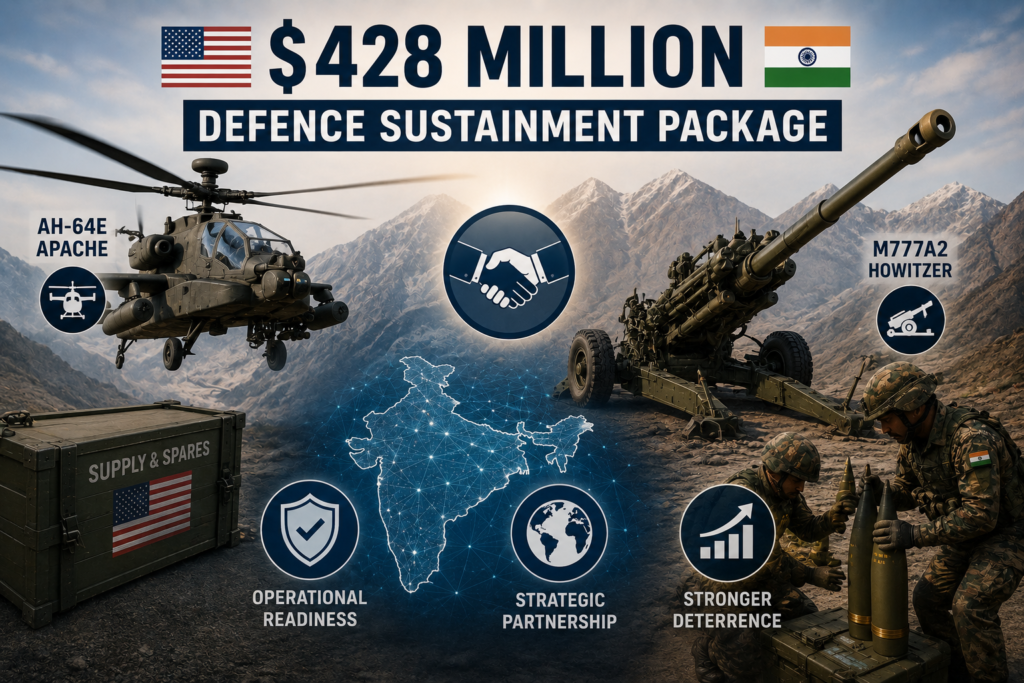
- On May 21, 2026, the U.S. State Department approved a $428.2 million Foreign Military Sales (FMS) package focused on providing vital engineering, logistics, and supply support for India’s fleet of AH-64E Apache attack helicopters and M777A2 ultra-light howitzers.
Main Body: Multi-Dimensional Analysis
- Operational Readiness along Mountain Borders: The M777 howitzers and Apache helicopters are critical assets deployed along India’s high-altitude northern and eastern frontiers. This sustainment package ensures high operational availability and constant mission readiness during long deployments.
- Strategic Interoperability and Trust: This transaction emphasizes the deep integration within the India-U.S. Major Defence Partner framework. Routine, large-scale support packages reinforce logistical interoperability between the two armed forces across the broader Indo-Pacific theater.
- Shifting Away from Legacy Monopolies: India’s deliberate moves to diversify its defense hardware inventory reduces its historic, overwhelming reliance on single-nation supply chains, particularly Russian spare parts, which have faced logistical delays due to ongoing European conflicts.
- The Foreign Military Sales (FMS) Mechanism: Utilizing the U.S. government-to-government FMS channel provides transparency, circumvents prolonged commercial contract litigation, guarantees stringent quality control, and ensures fixed timelines for critical spare deliveries.
- Geopolitical Signal to Regional Adversaries: The timing of this major approval serves as a clear signal of continued Western strategic alignment with New Delhi, reinforcing India’s regional deterrence capability amid fluid maritime and continental border security environments.
Key Matrix: Impacts & Institutional Frameworks
| Positives | Negatives | Relevant Strategic Pacts |
| • Guarantees long-term lifecycle support and electronic updates for critical frontline weapons. • Stabilizes defense equipment operational status during periods of regional border tension. • Strengthens technological linkages between Indian defense technicians and international OEMs. | • Creates a long-term operational dependency on U.S.-sourced components and certifications. • Significant capital outflows that do not directly translate into domestic manufacturing setups. • Susceptibility to strict U.S. export control laws and potential future policy realignments. | • LEMOA (Logistics Exchange Memorandum of Agreement): Eases reciprocal logistical support. • COMCASA: Allows secure communication equipment integration on aircraft. • DTTI (Defence Technology and Trade Initiative): Aimed at co-development. |
Examples
- M777 Heli-Lift Operations: Using IAF Chinook helicopters to rapidly transport U.S.-sourced M777 howitzers to inaccessible, high-altitude firing positions along the Line of Actual Control (LAC).
- COMCASA Implementation: The installation of secure, encrypted American data-links on Indian Apache fleets to allow real-time coordinate sharing with naval vessels and international partners.
Way Forward
- Negotiate Localized Maintenance Hubs: Push for the establishment of domestic Maintenance, Repair, and Overhaul (MRO) facilities within India for American platforms to reduce turnaround times.
- Incorporate Indigenous Spares: Collaborate with U.S. defense primes to certify Indian-manufactured sub-components and wear-and-tear parts for use on these imported weapon systems.
- Balance Multi-Alignment Options: Maintain a balanced defense procurement strategy that ensures hardware diversification does not lead to logistically complex or competing systems.
- Leverage Know-How for Local Design: Use the operational insights gained from maintaining world-class assets like the Apache to accelerate India’s own Light Combat Helicopter (LCH) Prachand scaling programs.
Conclusion
The $428 million sustainment package underscores the pragmatic, technology-backed nature of the contemporary India-U.S. strategic partnership. While these lifecycle agreements are vital for keeping frontline mountain-defense platforms operational, India’s ultimate goal must remain leveraging these technology partnerships to scale up its own domestic aerospace and artillery manufacturing ecosystems.
Practice Mains Question
Q. “While foreign defense sustainment packages are indispensable for maintaining immediate operational readiness along contested borders, they highlight the long-term challenge of systemic dependency.” Discuss this statement in the context of India’s recent military acquisitions and its stated goal of defense indigenization. (15 Marks, 250 Words)
Topic 7: Google and Blackstone’s $5 Billion AI Cloud Infrastructure Venture
Syllabus
- GS Paper III: Science and Technology- developments and their applications and effects in everyday life; Achievements of Indians in science & technology; indigenization of technology and developing new technology. Infrastructure: Energy, Ports, Roads, Airports, Railways etc.
Context
- On May 21, 2026, Google LLC and Blackstone Inc. announced a landmark $5 billion joint venture to establish state-of-the-art Artificial Intelligence (AI) cloud infrastructure. The collaboration aims to deploy Google’s latest Tensor Processing Units (TPUs) at a massive scale, targeting 500 megawatts (MW) of specialized computing capacity by 2027 to meet the explosive global demand for AI workloads.

Main Body: Multi-Dimensional Analysis
- The Scaling of Sovereign AI and Hyperscale Infrastructure: The transition from general-purpose cloud computing to specialized AI workloads requires unprecedented data center scale. This venture reflects a broader global shift where private equity capital merges with big-tech software to build heavy physical infrastructure for generative AI models.
- Energy Grid Demands and Sustainability Friction: AI data centers are incredibly energy-intensive. Deploying 500 MW of capacity by 2027 places severe pressure on regional electrical grids, necessitating a parallel shift toward renewable energy integration, matching power purchases with round-the-clock green energy solutions.
- Decoupling the AI Hardware Supply Chain: By focusing heavily on Google’s proprietary Tensor Processing Units (TPUs) as a compute-as-a-service model, this venture creates a vital alternative market ecosystem to Nvidia’s dominant Graphics Processing Units (GPUs), helping stabilize severe chip supply shortages.
- Geopolitical Data Localization and Sovereignty: As countries tighten regulations regarding data residency, hyperscale ventures must build localized digital infrastructure. This enables multinational companies and governments to train advanced AI models within local legal jurisdictions, preserving data privacy.
- Democratization of High-Performance Compute: Providing specialized TPUs through a flexible “compute-as-a-service” framework lowers the massive capital barriers for startups, research institutions, and mid-sized enterprises, allowing them to train and deploy advanced AI models without buying expensive hardware.
Key Matrix: Impacts & Institutional Frameworks
| Positives | Negatives | Relevant Government Initiatives/Regs |
| • Massively expands high-performance AI computing capacity for global markets. • Diversifies the hardware ecosystem away from single-source GPU monopolies. • Drives massive private infrastructure investment into data centers and renewable energy grids. | • Accelerates carbon footprints and tests electrical grid stability if powered by fossil fuels. • High risk of market concentration as big tech consolidates control over critical AI compute. • Creates localized water-cooling strain in data center hubs. | • National Programme on AI (IndiaAI): Drives domestic compute scaling. • Digital Personal Data Protection (DPDP) Act: Sets terms for localized cloud data storage. • Draft Data Centre Policy: Aims to simplify the setup of hyperscale zones. |
Examples
- Google’s TPU v5e & Trillium Deployments: Hardware engines specialized for training large language models (LLMs) and diffusion models with significantly better performance-per-dollar metrics than traditional chips.
- Blackstone’s QTS Data Centers: Practical application of real estate and private equity capital transforming traditional warehouses into high-density, liquid-cooled facilities purpose-built for AI workloads.
Way Forward
- Mandate Round-the-Clock (RTC) Green Energy: Tie all mega-scale AI data center expansions directly to newly built solar, wind, or nuclear power projects to ensure carbon-neutral operations.
- Advance Next-Generation Liquid Cooling: Invest heavily in closed-loop immersion cooling technologies to minimize the massive fresh-water consumption typical of traditional data center evaporative cooling systems.
- Promote Open Architecture Compute: Encourage cloud providers to ensure seamless interoperability between different hardware types (TPUs, GPUs, and ASICs) to prevent monopolistic vendor lock-in.
- Localize Compute for Public Goods: Allocate a dedicated percentage of hyperscale cloud infrastructure for public research, agriculture modeling, and healthcare startups at subsidized operational rates.
Conclusion
The Google-Blackstone venture represents a fundamental shift in how digital infrastructure is built, treating AI computing capacity as a core utility akin to electricity or water. While this massive injection of capital accelerates technological growth, balancing this buildout with green energy grids and open market competition remains essential for sustainable digital transformation.
Practice Mains Question
Q. “The transition toward specialized AI cloud infrastructure presents a unique intersection of heavy capital investment, technological evolution, and severe energy grid strain.” Evaluate the socio-economic and environmental implications of growing hyperscale AI data centers globally and in India. (15 Marks, 250 Words)
Topic 8: Supreme Court’s Final Deadline for Bengaluru Civic Polls
Syllabus
- GS Paper II: Devolution of powers and finances up to local levels and challenges therein. Salient features of the Representation of People’s Act. Important judicial pronouncements regarding federalism and local governance.
Context
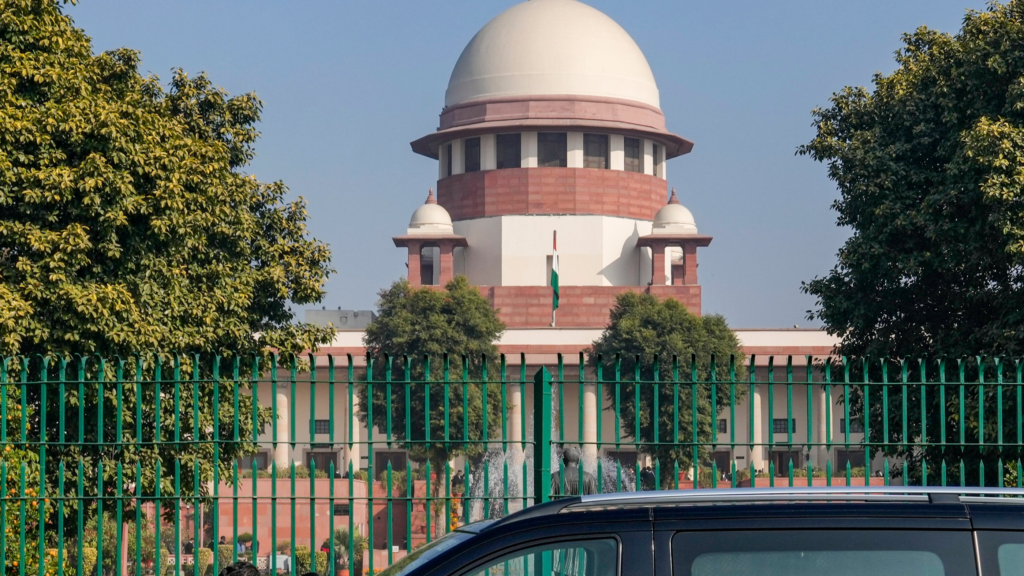
- On May 21, 2026, the Supreme Court issued a stern warning to the Karnataka government over continued delays in conducting elections for the Bruhat Bengaluru Mahanagara Palike (BBMP). Granting a final extension, a bench headed by Chief Justice Surya Kant fixed August 31, 2026, as the absolute deadline, emphasizing that bureaucratic delays cannot subvert constitutional local governance.
Main Body: Multi-Dimensional Analysis
- Constitutional Mandate vs. Executive Foot-Dragging: The 74th Constitutional Amendment Act explicitly mandates that municipal elections must occur every five years. The continuous use of delimitation updates and ward boundary restructuring as tools to delay local polls undermines constitutional democracy.
- Erosion of Urban Democratic Accountability: Operating a major metropolitan city through appointed state bureaucrats rather than elected municipal counselors detaches citizens from local governance. This creates a severe accountability deficit, leaving civic issues like flooding, waste management, and zoning poorly addressed.
- The Dilemma of Ward Delimitation: While updating ward boundaries to reflect changing urban populations is legitimate, using it as an excuse to stall elections politicizes local boundaries. This practice compromises the independent role of State Election Commissions.
- Financial Impact on Urban Local Bodies (ULBs): Delays in electing local councils often prevent cities from accessing central performance grants tied to the Central Finance Commission. This worsens the financial dependency of municipal corporations on state government handouts.
- Judicial Activism for Grassroots Democracy: The Supreme Court’s proactive enforcement of strict deadlines highlights its role as a safeguard for democratic institutions. It ensures that political calculations do not override the mandatory timelines of the third tier of Indian federalism.
Key Matrix: Impacts & Institutional Frameworks
| Positives | Negatives | Relevant Constitutional Laws |
| • Restores democratic accountability and representation to millions of urban citizens. • Unlocks vital central development funds linked to functional, elected local bodies. • Prevents state executives from centralizing metropolitan planning and finances. | • Rushed delimitation exercises can lead to uneven voter distribution across urban wards. • Intense political polarization can disrupt immediate municipal administration during transitions. • Temporary slowdown in infrastructure approvals due to the Model Code of Conduct. | • Article 243U: Mandates a strict five-year duration for municipalities. • Article 243ZA: Empowers the State Election Commission to superintend and conduct urban polls. • 74th Amendment Act, 1992: Foundation for empowering urban local self-governments. |
Examples
- Suresh Mahajan v. State of Madhya Pradesh (2022): The landmark Supreme Court ruling which established that the constitutional mandate to hold local body elections cannot be delayed or ignored due to incomplete delimitation or reservation updates.
- BBMP Administrator Rule: The multi-year absence of an elected council in Bengaluru, which saw citizen grievances rise significantly as bureaucrats managed a city of over 10 million people without direct public feedback.
Way Forward
- De-link Elections from Delimitation Clashes: Establish statutory rules that freeze delimitation exercises six months prior to scheduled terms, ensuring elections happen on time regardless of pending appeals.
- Empower State Election Commissions (SECs): Grant complete financial and administrative autonomy to SECs, bringing them on par with the Election Commission of India to shield them from state executive pressure.
- Automate Ward Adjustments via GIS: Use Geographic Information System (GIS) mapping and clear census data to make ward re-drawing an automatic, objective process free from political interference.
- Strengthen Citizen Ward Committees: Institutionalize active ward committees composed of local residents to maintain continuous civic oversight, keeping local governance functional even during delayed transitions.
Conclusion
The Supreme Court’s firm stance on the Bengaluru civic polls reinforces the principle that local self-government is a non-negotiable pillar of Indian democracy. True urban development cannot be achieved through centralized bureaucratic administration alone; it requires functional, regularly elected municipal councils to reflect public needs and ensure sustainable city growth.
Practice Mains Question
Q. “The deliberate postponement of municipal elections under the guise of administrative reorganization challenges the core spirit of the 74th Constitutional Amendment.” Analyze this statement in light of recent judicial interventions aimed at ensuring timely elections for Urban Local Bodies. (15 Marks, 250 Words)
