
Topic 1: State Visit of Cyprus President and Strategic Partnership Upgrade
Syllabus
- GS Paper 2: Bilateral, regional and global groupings and agreements involving India and/or affecting India’s interests.
Context
On May 22, 2026, the President of the Republic of Cyprus, Nikos Christodoulides, concluded his official state visit to India, culminating in the formal elevation of bilateral ties to a Strategic Partnership.
Main Body: Multi-Dimensional Analysis
- Diplomatic & Strategic Elevation: The upgrading of ties establishes a new Foreign Ministers-led mechanism to review strategic actions and introduces a formal Roadmap for Defence Cooperation spanning 2026–2031.
- Maritime & Regional Security Integration: Cyprus officially joined the Indo-Pacific Oceans Initiative (IPOI) under the “Trade, Connectivity and Maritime Transport” pillar, expanding India’s maritime diplomacy into the Eastern Mediterranean.
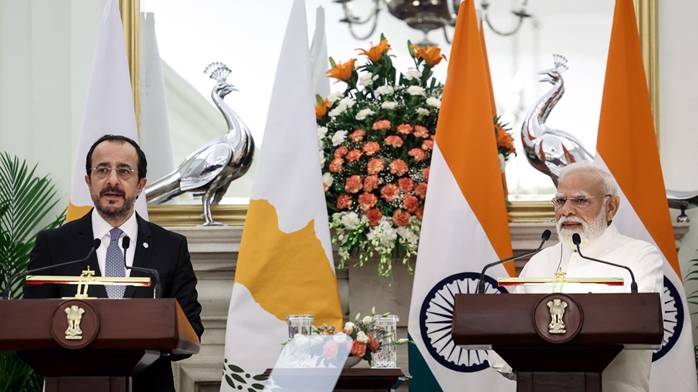
- Counter-Terrorism & Cyber Security: Both nations signed a crucial Memorandum of Understanding (MoU) to set up a Joint Working Group on counter-terrorism and launched an exclusive bilateral Cyber Security Dialogue.
- Technological & Educational Exchange: MoUs were finalized between India’s Ministry of Electronics and Information Technology (MeitY) and the Cypriot Deputy Ministry of Research on innovation, alongside academic collaborations for higher education and joint research.
- Humanitarian Diplomacy: India formally gifted its indigenously developed BHISM (Bharat Health Initiative for Sahyog Hita & Maitri) Cube—a portable emergency medical disaster block—to the Republic of Cyprus, demonstrating its medical manufacturing capabilities.
Positives, Negatives, & Government Schemes
| Dimension | Details |
| Positives | Positions India as a net security provider from the Indian Ocean to the Mediterranean; enhances market access for Indian IT professionals via the planned Cyprus Trade Center in Mumbai. |
| Negatives | Diplomatic friction could arise with Turkey due to India’s deepening strategic ties with Cyprus over the unresolved Cyprus dispute. |
| Associated Initiatives | Indo-Pacific Oceans Initiative (IPOI), BHISM Cube Project, Sushma Swaraj Institute of Foreign Service. |
Examples
The celebration of the first-ever India-Cyprus Space Day on May 18, 2026, serves as a concrete baseline for extending this strategic partnership into satellite-based earth observation and space technologies.
Way Forward
- Institutionalize the newly announced Consular Dialogue to streamline the mobility of skilled Indian professionals and students into the European Union via Cyprus.
- Leverage Cyprus’s shipping clout to secure collaborative logistical nodes for Indian commercial vessels traversing the Suez Canal route.
Conclusion
The India-Cyprus Strategic Partnership effectively expands India’s geopolitical footprints into the Mediterranean space, blending traditional defense diplomacy with cutting-edge digital cooperation to create a comprehensive trans-regional network.
Practice Mains Question
The elevation of India-Cyprus ties to a Strategic Partnership highlights India’s expanding maritime and diplomatic horizons beyond its traditional immediate neighborhood. Analyze the strategic and economic implications of this partnership for India’s European outreach. (250 words)
Topic 2: First-Ever Coalition Cabinet Expansion in Tamil Nadu
Syllabus
- GS Paper 2: Indian Constitution—historical underpinnings, evolution, features, amendments, significant provisions and basic structure; Functions and responsibilities of the Union and the States.
Context
On May 22, 2026, Tamil Nadu Chief Minister C. Joseph Vijay concluded a historic multi-phase expansion of his Cabinet, swearing in representatives from the Viduthalai Chiruthaigal Katchi (VCK) and the Indian Union Muslim League (IUML) at Lok Bhavan, Chennai, establishing the State’s first fully operational coalition government.
Main Body: Multi-Dimensional Analysis
- Constitutional Compliance on Cabinet Size: With the final induction of VCK MLA Vanni Arasu and IUML MLA A.M. Shahjahan, the total number of Ministers reached 35. This complies with the 91st Constitutional Amendment Act, 2003, which caps the council of ministers at 15% of the total assembly strength (35 out of 234).
- Break from Single-Party Hegemony: This marks a paradigm shift in Tamil Nadu’s political architecture, which has been dominated exclusively by single-party rule since 1967. The shift introduces a power-sharing model among alliance partners.
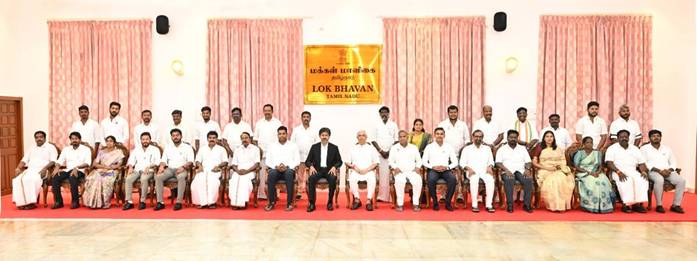
- Unprecedented Social Representation: The current Cabinet expansion achieves the highest-ever proportional representation for Scheduled Castes (SC) and minorities in Tamil Nadu’s history, significantly altering the executive’s demographic profile.
- Generational Shift in Executive Governance: With 22 out of 35 ministers currently aged below 50, the council represents a deliberate structural shift towards younger administrative leadership at the state level.
- Coalition Dynamics & Friction Management: The transition from a legislative alliance to an executive coalition forces the state to develop formal coordination mechanisms to balance distinct party manifestos within state policymaking.
Positives, Negatives, & Government Schemes
| Dimension | Details |
| Positives | Enhances grass-roots democratic representation in the executive; deepens federal inclusivity by involving regional minority blocks directly in governance. |
| Negatives | Potential policy paralysis if constituent parties diverge on critical economic development or industrial land acquisition policies. |
| Associated Laws | Article 164 of the Constitution (Appointment of Ministers), 91st Constitutional Amendment Act. |
Examples
The entry of the Congress party into the Tamil Nadu Cabinet on May 21, 2026, after a hiatus of 59 years, serves as a direct historical baseline for the state’s transition from external legislative support to direct administrative coalition.
Way Forward
- Formulate a “Minimum Common Programme” (MCP) signed by all coalition partners to ensure long-term policy continuity and predictability for investors.
- Set up a permanent State Coalition Coordination Committee to resolve ideological disputes outside of the formal Cabinet meetings.
Conclusion
Tamil Nadu’s transition into a coalition model signals a mature evolutionary step in regional governance, proving that absolute structural uniformity is no longer mandatory for achieving executive stability.
Practice Mains Question
“The emergence of coalition governance at the state level alters the traditional dynamics of regional political executives.” Critically analyze this statement in the context of the recent Cabinet expansion and structural shifts in Tamil Nadu. (250 words)
Topic 3: Launch of Multilateral Military Exercise PRAGATI 2026
Syllabus
- GS Paper 3: Security challenges and their management in border areas; linkages of organized crime with terrorism; Defence cooperation.
Context
The Indian Army officially commenced the mega multilateral military exercise PRAGATI 2026 at the Umroi Military Station in Meghalaya, featuring active combat contingents from 12 friendly nations across the Indian Ocean Region (IOR) and Southeast Asia.
Main Body: Multi-Dimensional Analysis
- Operationalizing the SAGAR Doctrine: The exercise serves as a direct vehicle for India’s SAGAR (Security and Growth for All in the Region) policy, building institutional trust and interoperability among littoral nations without forming formal military alliances.
- Geopolitical Counter-Balancing: By involving nations like Vietnam and the Philippines, which are active stakeholders in South China Sea maritime disputes, India is subtly reinforcing a rules-based international order and freedom of navigation.
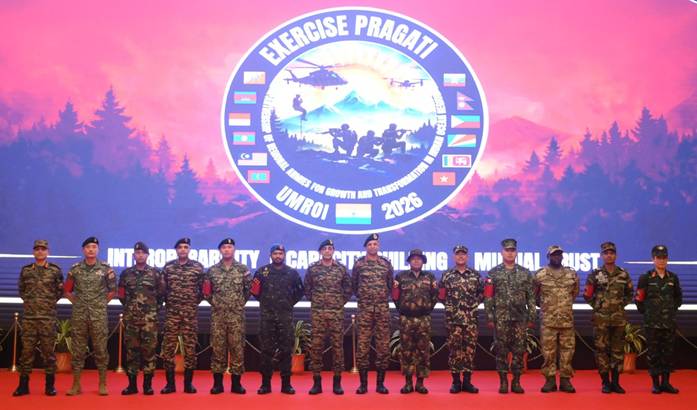
- Focus on Hybrid and Asymmetric Warfare: The tactical scope of PRAGATI 2026 moves beyond conventional combat, prioritizing multi-domain responses to drone swarms, cyber attacks, coordinated maritime piracy, and localized proxy militant networks.
- Showcasing Indigenous Defence Industrial Prowess: India is utilizing the exercise to showcase its indigenous defense hardware produced under the Atmanirbhar Bharat initiative, positioning itself as a reliable defense export hub for developing nations.
- Inter-Agency Coordination Protocols: The joint drills establish unified standard operating procedures (SOPs) for rapid humanitarian assistance and disaster relief (HADR) operations across the wider Indo-Pacific region.
Positives, Negatives, & Government Schemes
| Dimension | Details |
| Positives | Strengthens India’s position as a “Net Security Provider” in the IOR; builds defense export channels with Southeast Asian states. |
| Negatives | May escalate diplomatic anxieties with northern neighbors who view concentrated multinational drills near sensitive geographic corridors as encirclement tactics. |
| Associated Initiatives | SAGAR Doctrine, Atmanirbhar Bharat in Defence, Positive Indigenisation Lists, iDEX. |
Examples
The active tactical involvement of combat troops from non-aligned nations like Cambodia, Laos, and the Maldives demonstrates India’s unique capacity to foster defense diplomacy independent of the intensifying US-China power rivalry.
Way Forward
- Integrate the tactical lessons of Exercise PRAGATI 2026 directly into the institutional framework of regional groupings like BIMSTEC.
- Expand the scope of future editions to include joint coastal radar monitoring networks and real-time intelligence-sharing agreements.
Conclusion
Exercise PRAGATI 2026 successfully showcases India’s capability to orchestrate complex, multi-nation defense operations, asserting its strategic role as an anchor of peace, stability, and cooperative maritime security in the Indo-Pacific.
Practice Mains Question
Examine how multilateral military exercises like PRAGATI 2026 help India advance its strategic interests under the SAGAR doctrine while maintaining its traditional strategic autonomy. (250 words)
Topic 4: UNDESA Lowers India’s GDP Forecast to 6.4% for FY27
Syllabus
- GS Paper 3: Indian Economy and issues relating to planning, mobilization of resources, growth, development and employment.
Context
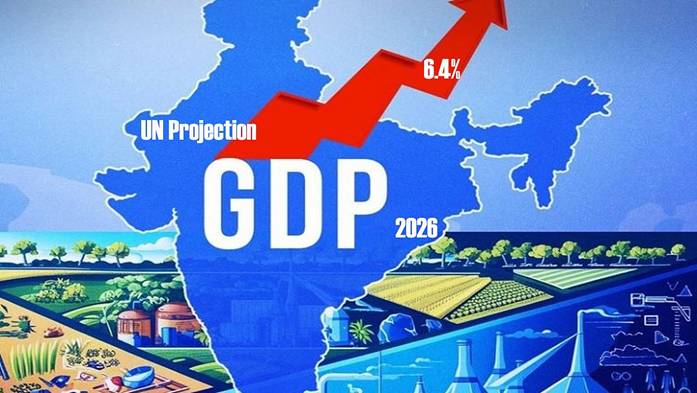
The United Nations Department of Economic and Social Affairs (UNDESA), in its updated mid-year release of the ‘World Economic Situation and Prospects 2026’ report, adjusted India’s Gross Domestic Product (GDP) growth projection for Financial Year 2026-27 downward to 6.4% from its previous estimation of 6.6%.
Main Body: Multi-Dimensional Analysis
- Global Macroeconomic Headwinds: The downward adjustment is largely attributed to slowing external demand in key export markets (US and EU), lingering geopolitical tensions impacting global supply chains, and volatile energy commodity baskets.
- Domestic Consumption Divergence: While urban consumption remains resilient, slow recovery in real rural wages has kept domestic rural demand soft, dragging down the overall pace of economic expansion.
- Monetary Policy Pass-Through: High interest rates sustained by the RBI over previous quarters to anchor sticky food inflation have increased borrowing costs for corporate capital expenditure (CapEx), moderating private investment velocity.
- Inflation Coherence: On a positive note, the UNDESA report projects India’s headline inflation to settle at 4.9% for FY27, confirming it will likely remain well within the RBI’s mandated flexible target comfort band of $4\% \pm 2\%$.
- Resilience Relative to Global Peers: Despite the downward revision, India continues to maintain its status as the fastest-growing major economy globally, outpacing China, the United States, and the Eurozone by significant margins.
Positives, Negatives, & Government Schemes
| Dimension | Details |
| Positives | Stable internal inflation at 4.9% minimizes the risk of sudden macro-destabilization; strong public capital expenditure shields the core economy. |
| Negatives | A lower growth rate of 6.4% may slow down the pace of employment generation required to absorb entering workforce demographics. |
| Associated Concepts | Flexible Inflation Targeting, Capital Expenditure (CapEx) Multiplier, Real vs Nominal GDP. |
Examples
The recent adjustment of India’s FY28 growth forecast to 6.6% by the same UN report highlights a sustained multi-year trend of moderate, stable growth rather than an abrupt or localized economic shock.
Way Forward
- Boost rural infrastructure spending to directly pump liquidity into the agricultural wage economy, reversing soft consumption trends.
- Conclude ongoing free trade agreement (FTA) negotiations with the UK and Oman to diversify export destinations and counter slowing Western demands.
Conclusion
The UNDESA growth downgrade serves as a reminder of India’s vulnerability to global economic integration, emphasizing the need to strengthen domestic engines of demand and expedite private capital investment cycles.
Practice Mains Question
Discuss the external and internal factors responsible for the recent downward revision of India’s GDP growth forecast by international agencies. What structural measures are required to insulate the domestic economy from global headwinds? (250 words)
Topic 5: Velimalai 1,100 MW Pumped Storage Hydropower Project Cleared
Syllabus
- GS Paper 3: Infrastructure: Energy, Ports, Roads, Airports, Railways etc; Conservation, environmental pollution and degradation.
Context
The Ministry of Environment, Forest and Climate Change (MoEFCC) has granted crucial Terms of Reference (ToR) clearance to the 1,100 MW Velimalai Pumped Storage Hydroelectric Project in Kanniyakumari district, making it Tamil Nadu’s first pumped-storage project to be executed under a Public-Private Partnership (PPP) framework.
Main Body: Multi-Dimensional Analysis
- Grid Stabilization for Renewable Energy: As Tamil Nadu scales up its solar and wind generation, it faces severe grid intermittency challenges. The 1,100 MW pumped storage system acts as a giant water battery, absorbing excess green energy during peak production and releasing it during peak grid demand.
- Innovative Closed-Loop Mechanism: The project utilizes an off-river, closed-loop design that recycles water between an upper and lower reservoir continuously. This significantly minimizes net water consumption and avoids disrupting natural riverine paths.
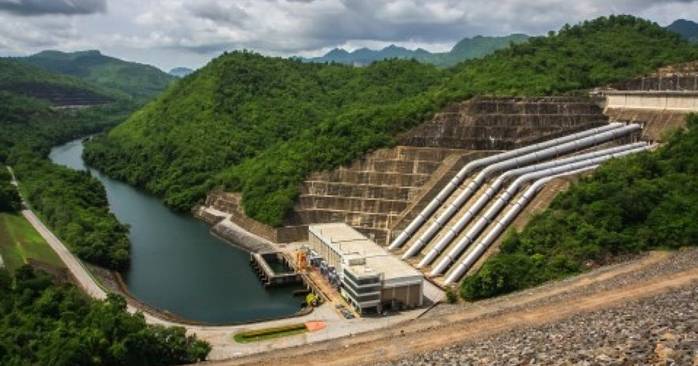
- Pioneering Regulatory Model: Implemented under Section 63 of the Electricity Act on a Build-Own-Operate-Transfer (BOOT) basis via competitive bidding, it creates a new regulatory blueprint for private sector investment in hydro-storage infrastructure.
- Reduction in Thermal Reliance: By providing 1,100 MW of rapid-response peaking power, the project reduces the state’s reliance on coal-fired thermal power plants, accelerating Tamil Nadu’s green transition goals.
- Environmental & Ecological Safeguards: Since the project is located near Kanniyakumari’s sensitive ecosystem, the ToR mandate requires comprehensive Environmental Impact Assessments (EIA), micro-climatic studies, and strict biodiversity mitigation plans.
Positives, Negatives, & Government Schemes
| Dimension | Details |
| Positives | Zero operational carbon emissions, enhances grid stability for wind energy, attracts private capital into clean-tech infrastructure. |
| Negatives | High initial capital cost; potential localized ecological disruption during the construction of upper dams and underground tunnels. |
| Associated Laws/Schemes | Electricity Act 2003, National Pumped Storage Hydro Policy, Environmental Impact Assessment (EIA) Notification. |
Examples
The successful deployment of similar closed-loop pumped storage systems across western India demonstrates how hydro-storage can effectively reduce grid curtailment losses for private renewable energy developers.
Way Forward
- Fast-track the comprehensive EIA report while ensuring absolute transparency and local community consultations to prevent legal bottlenecks.
- Establish a dedicated green energy transmission corridor to link the Velimalai storage unit directly with the high-capacity wind turbine zones of southern Tamil Nadu.
Conclusion
The clearance of the Velimalai Pumped Storage Project marks a significant step forward in clean energy storage infrastructure, proving that market-driven PPP models can successfully meet complex environmental and grid-balancing demands.
Practice Mains Question
“Pumped storage hydropower projects are indispensable for managing grid intermittency in an era of rapid renewable energy scaling.” Analyze this statement in light of the regulatory and ecological dimensions of the Velimalai project. (250 words)
Topic 6: Test Success of Indigenous ‘Suryastra’ Rocket System
Syllabus
- GS Paper 3: Indigenization of technology and developing new technology; Science and Technology- developments and their applications.
Context
India successfully conducted the developmental flight test of its first indigenous universal multi-calibre rocket launcher system, ‘Suryastra’, at the Integrated Test Range (ITR) in Chandipur, Odisha, marking a significant step forward in domestic artillery technology.
Main Body: Multi-Dimensional Analysis
- Universal Multi-Calibre Capabilities: Developed by private defense manufacturer NIBE Limited in technological collaboration with Elbit Systems, the Suryastra features interchangeable modular pods. This unique capability allows it to load, calibrate, and fire different calibres of munitions from a single platform.
- Precision Strike Architecture: Unlike legacy unguided artillery rockets, Suryastra is designed for highly precise strikes on high-value enemy assets, including localized radar installations, forward logistics hubs, and deeply fortified command centers.
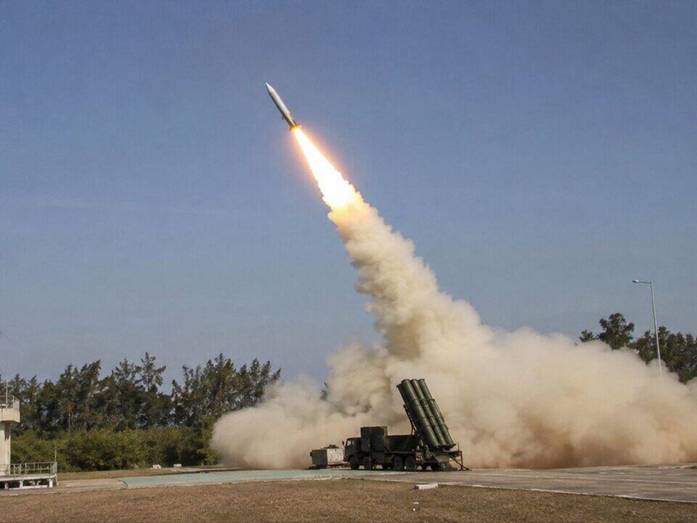
- Mobility & Survivability Optimization: The rocket system is mounted on a highly mobile, rugged 6×6 Tatra truck chassis, enabling rapid deployment across diverse terrain types and utilizing tactical “shoot-and-scoot” maneuvers to avoid counter-battery fire.
- Private Sector Integration Success: The development highlights a successful shift in India’s defense industrial complex, where private entities are moving from basic component manufacturing to designing and integrating advanced, complete weapon systems.
- Simultaneous Target Engagement: Armed with advanced state-of-the-art fire control computers, the system can calculate multiple ballistic trajectories simultaneously, allowing it to engage distinct targets across varying ranges in a single salvo.
Positives, Negatives, & Government Schemes
| Dimension | Details |
| Positives | Drastically reduces dependency on imported artillery systems; modular pod technology lowers the field maintenance footprint. |
| Negatives | Integrating diverse domestic multi-calibre ammunition types requires stringent quality control to prevent field loading failures. |
| Associated Frameworks | Defence Acquisition Procedure (DAP), Positive Indigenisation Lists, Strategic Partnership Model in Defence. |
Examples
The operational usage of multi-barrel rocket systems like the Pinaka during past border engagements demonstrates how high-mobility rocket artillery can decisively alter ground tactical balances.
Way Forward
- Conduct rigorous user trials across extreme climatic zones, including the high-altitude regions of Ladakh and the arid environments of Rajasthan, to secure full army induction.
- Market the Suryastra system to friendly foreign nations across Southeast Asia and Africa to boost India’s defense export revenues.
Conclusion
The successful testing of the Suryastra Rocket System showcases the increasing capabilities of India’s private defense sector, adding a versatile, high-precision artillery platform to the armed forces’ tactical arsenal.
Practice Mains Question
Assess the role of private sector defense manufacturing in achieving the goal of self-reliance in strategic weapon systems. Discuss with specific reference to the newly tested Suryastra Rocket System. (250 words)
Topic 7: Plant-OpenCRISPR1: World’s First AI-Designed Plant Genome Platform
Syllabus
- GS Paper 3: Awareness in the fields of Biotechnology; Scientific innovations and their daily life applications.
Context
Scientists at the ICAR-Central Rice Research Institute (CRRI), led by Dr. Kutubuddin Ali Molla, achieved a global breakthrough by developing and validating Plant-OpenCRISPR1 (POC1), the world’s first Artificial Intelligence (AI)-designed genome-editing platform specifically engineered for plant systems.
Main Body: Multi-Dimensional Analysis
- Departure from Microbial Systems: Traditional CRISPR systems rely on naturally occurring microbial proteins (like Cas9) to cut DNA. POC1 utilizes completely synthetic, non-natural enzymes designed from scratch by large language models (LLMs) trained on vast protein databases.
- Precision and Anti-Off-Target Efficacy: By leveraging AI-guided protein folding models, the platform minimizes “off-target mutations”—a major limitation of traditional gene editing where unintended parts of the plant genome are altered.
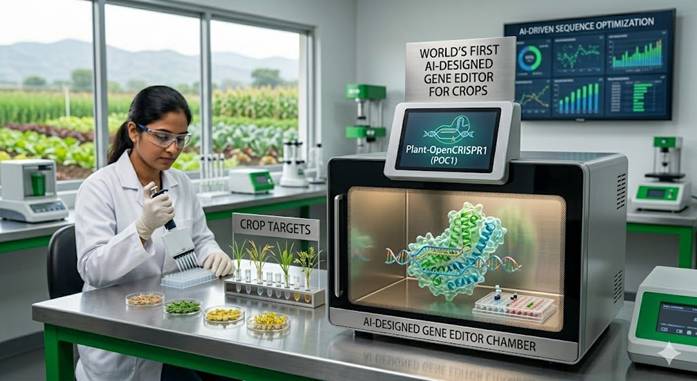
- Accelerating Climate-Resilient Agriculture: Using rice as a foundational model, the platform has shown it can reduce the timeline for developing crop variants that are highly resilient to drought, salinity, and localized pest pressures from years to weeks.
- Bypassing Geopolitical Patent Walls: Because POC1 is based on open-source, AI-generated nucleases, it allows Indian agricultural scientists to develop gene-edited crops free from commercial intellectual property restrictions owned by foreign biotechnology firms.
- Customized Bio-Engineering: The platform opens the door for custom-tailored biotechnology solutions, allowing researchers to tweak specific plant protein pathways to optimize photosynthetic efficiency and grain nutritional profiles.
Positives, Negatives, & Government Schemes
| Dimension | Details |
| Positives | Drastically shortens crop breeding cycles; eliminates reliance on foreign-patented gene-editing tools; improves safety profiles. |
| Negatives | Requires specialized high-performance computing labs; public resistance to gene-altered foods could slow down commercial deployment. |
| Associated Entities/Rules | Indian Council of Agricultural Research (ICAR), National Guidelines for Gene Editing in Plants, Department of Biotechnology (DBT). |
Examples
The successful publication of this validation study in the international peer-reviewed journal New Phytologist in May 2026 confirms the global scientific acceptance of India’s AI-driven agricultural biotechnology breakthrough.
Way Forward
- Expand the POC1 platform’s validation models from rice to crucial oilseeds and pulse crops to tackle India’s systemic import dependencies.
- Draft streamlined bio-safety regulatory clear paths specifically tailored for AI-designed crop varieties to ensure they reach fields safely and efficiently.
Conclusion
Plant-OpenCRISPR1 represents a milestone intersection of artificial intelligence and advanced biotechnology, placing India at the forefront of the next generation of global agricultural innovations and food security tools.
Practice Mains Question
“The integration of Artificial Intelligence with genome-editing tools holds the potential to revolutionize climate-resilient agriculture.” Discuss this statement in light of India’s development of the Plant-OpenCRISPR1 platform. (250 words)
Topic 8: Tonbo Imaging Secures Naval Contract for High Power Microwave System
Syllabus
- GS Paper 3: Security challenges and their management; Indigenization of technology; Science and Technology- developments.
Context
In a significant development for directed-energy warfare capabilities, domestic defense technology company Tonbo Imaging secured a prestigious contract from the Indian Navy under the ADITI 3.0 (Acing Development of Innovative Technologies with iDEX) framework to build and commission an indigenous High Power Microwave (HPM) system.
Main Body: Multi-Dimensional Analysis
- The Shift to Directed-Energy Weapons (DEWs): HPM systems represent a critical evolution in modern naval warfare, transitioning away from kinetic ammunition toward directed-energy systems that disable targets via electromagnetic bursts at the speed of light.
- Countering Swarm Drones & Unmanned Threats: The primary tactical role of the naval HPM system is to instantly fry the electronic circuitry, command links, and internal guidance systems of incoming asymmetric threats like aerial swarm drones and unmanned surface vessels.
- Unlimited Magazine Capability: Unlike missile defense systems that are physically limited by the number of interceptors stored in vertical launch cells, HPM systems offer a virtually unlimited magazine capacity, constrained only by the vessel’s internal electrical power output.

- Minimizing Collateral Damage: HPM waves target electrical infrastructure precisely. This allows naval commanders to neutralize hostile electronics on tracking vessels or pirate skiffs without detonating explosive warheads in contested international shipping lanes.
- Validation of the iDEX Ecosystem: Supported by the Innovations for Defence Excellence (iDEX) and the Defence Innovation Organisation (DIO), this contract demonstrates the government’s success in incubating advanced tech startups capable of delivering high-tier strategic systems.
Positives, Negatives, & Government Schemes
| Dimension | Details |
| Positives | Offers low cost-per-shot operational physics; provides instant neutralization of swarm drone threats; boosts self-reliance in futuristic DEW systems. |
| Negatives | High operational power demands require integration with vessels possessing advanced integrated electrical propulsion configurations. |
| Associated Frameworks | ADITI 3.0 Initiative, iDEX, Defence Innovation Organisation (DIO), Technology Development Fund (TDF). |
Examples
The increasing deployment of low-cost loitering munitions in contemporary maritime conflict corridors underscores the urgent requirement for navies to deploy non-kinetic HPM options to preserve expensive missile inventories.
Way Forward
- Design the modular HPM sub-systems to ensure they can be seamlessly retrofitted onto existing stealth frigates and destroyers during routine mid-life upgrades.
- Accelerate joint research between private innovators and the DRDO to develop compact, solid-state microwave generators to reduce the system’s physical footprint.
Conclusion
By funding the integration of High Power Microwave capabilities via the ADITI 3.0 framework, the Indian Navy is positioning itself to effectively counter emerging asymmetric digital threats, securing its operational edge in regional maritime domains.
Practice Mains Question
What are Directed-Energy Weapons (DEWs)? Discuss the strategic advantages of deploying High Power Microwave (HPM) systems on naval platforms to counter modern asymmetric maritime threats. (250 words)
