
Topic 1: State Visit of Cypriot President & Joint Defense Roadmap (2026–2031)
Syllabus
- GS Paper 2: India and its Neighborhood- Relations, Bilateral, Regional, and Global Groupings involving India.
Context
The state visit of Cyprus President Nikos Christodoulides to India from May 20 to May 23, 2026—the first by a Cypriot head of state in nine years—concluded with the signing of a sweeping bilateral Defense Cooperation Roadmap for 2026–2031 and Cyprus officially joining the Indo-Pacific Oceans Initiative (IPOI).
Main Body: Multi-Dimensional Analysis
- Geopolitical Alignment & IPOI: Cyprus joining the Indo-Pacific Oceans Initiative (IPOI) and co-chairing its Trade Connectivity and Maritime Transport pillar establishes a critical geopolitical bridge between the Eastern Mediterranean and the Indo-Pacific.
- Strategic Defense Partnerships: Concluding the 2026–2031 Bilateral Defense Cooperation Roadmap directly synchronizes with the broader India-EU Defense and Security Partnership framework signed earlier in January 2026.
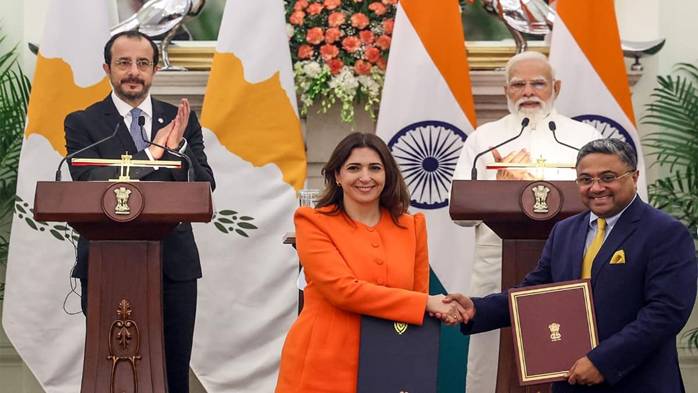
- Economic & Investment Deepening: As India’s ninth-largest source of cumulative Foreign Direct Investment ($16 billion since 2000), Cyprus expanded its economic footprint by setting up a dedicated Cyprus Trade Center in Mumbai.
- Cross-Border Fintech Integration: Bilateral negotiations finalized timelines for making India’s Unified Payments Interface (UPI) fully operational in Cyprus by next year, easing cross-border merchant transactions and tourism.
- Counter-Terrorism & Information Sharing: The establishment of a formalized Cybersecurity Dialogue and a Consular Dialogue underscores shared strategic concerns regarding transnational cyber threats, maritime security, and cross-border terrorism networks.
Positives, Negatives, & Government Schemes
| Dimension | Details |
| Positives | Boosts maritime security cooperation, accelerates digital infrastructure exports via UPI, and diversifies EU-centric capital inflows into India’s IT and pharmaceutical sectors. |
| Negatives | Deepening ties with Cyprus could complicate India’s delicate diplomatic balancing act with Turkey regarding the complex Eastern Mediterranean territorial disputes. |
| Associated Schemes | Indo-Pacific Oceans Initiative (IPOI), India-EU Strategic Partnership, Unified Payments Interface (UPI) Global Expansion Drive. |
Examples
Cyprus’s prompt declaration of support for India’s counter-terrorism resolutions on global platforms serves as a historic baseline for their shared geopolitical priorities.
Way Forward
- Leverage the newly established Cyprus Trade Center to channel Mediterranean clean-tech and maritime logistics technology into Indian port ecosystems.
- Utilize Cyprus as a soft-landing pad for Indian automotive and pharmaceutical exports seeking compliance-friendly pathways into the wider European Union market.
Conclusion
The strategic transformation of India-Cyprus ties from a traditional tax-haven narrative to a high-tech maritime and defense partnership enhances India’s strategic reach across the crucial maritime choke points of the Mediterranean.
Practice Mains Question
Assess the strategic significance of India’s deepening bilateral engagements in the Eastern Mediterranean with special reference to Cyprus joining the Indo-Pacific Oceans Initiative. (150 words)
Topic 2: Maiden Bilateral Visit of U.S. Secretary of State Marco Rubio to India
Syllabus
- GS Paper 2: Bilateral Groupings and Agreements involving India and/or affecting India’s interests.
Context
U.S. Secretary of State Marco Rubio arrived in New Delhi on May 23, 2026, for a maiden four-day state visit explicitly aimed at repairing critical bilateral policy strains that have accumulated since mid-2025.
Main Body: Multi-Dimensional Analysis
- Resetting Strained Bilateral Ties: The visit serves as a calculated diplomatic effort to reset deep political and trade friction between Washington and New Delhi that intensified over the past year.
- Quad Foreign Ministers Consensus: The state visit directly transitions into a high-level Quad Foreign Ministers meeting scheduled for May 26, where India, the U.S., Japan, and Australia aim to harmonize their maritime security protocols.
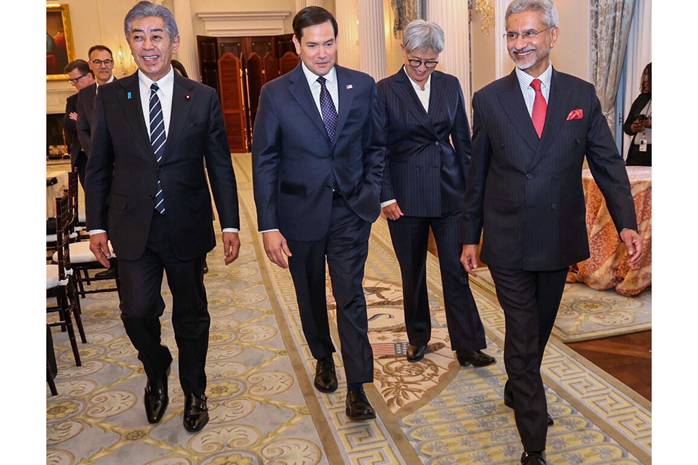
- Critical Energy Cooperation: Secretary Rubio opened discussions by identifying India as an indispensable long-term partner, proposing expanded bilateral partnerships in liquefied natural gas (LNG) supply chains and small modular nuclear reactors.
- Technology & Supply Chain Security: Deliberations focus on fortifying the Initiative on Critical and Emerging Technology (iCET), ensuring resilient semiconductor manufacturing corridors that bypass adversarial supply hubs.
- Defense Industrial Interoperability: Co-development of next-generation weapon systems, including loitering munitions and unmanned aerial vehicles, is being prioritized to reduce India’s legacy dependence on Russian defense networks.
Positives, Negatives, & Government Schemes
| Dimension | Details |
| Positives | Restores diplomatic momentum within the Quad framework, de-escalates bilateral trade friction, and unlocks high-technology defense transfers to India. |
| Negatives | Divergent diplomatic approaches toward secondary sanctions and regional trade protectionism continue to present structural policy challenges. |
| Associated Schemes | Initiative on Critical and Emerging Technology (iCET), Quad Maritime Domain Awareness (IPMDA), Make in India (Defense sector). |
Examples
The joint production agreement for GE-F414 jet engines in India highlights how technological trust can withstand passing diplomatic disagreements between the two nations.
Way Forward
- Establish a standing institutional mechanism under iCET to fast-track commercial export clearances for dual-use defense components.
- Harmonize cross-border data flow regulations to prevent legislative friction from stalling joint artificial intelligence research initiatives.
Conclusion
Secretary Rubio’s visit underscores that despite cyclical tactical friction, the structural convergences between India and the United States in the Indo-Pacific region remain fundamentally resilient.
Practice Mains Question
“Bilateral friction between India and the United States is often tactical, whereas their strategic convergences are structural.” Analyze this statement in the context of recent diplomatic visits. (150 words)
Topic 3: Supreme Court Refers UAPA Bail Restrictions to a Larger Bench
Syllabus
- GS Paper 2: Structure, Organization, and Functioning of the Judiciary; Fundamental Rights.
Context
The Supreme Court of India officially referred the highly controversial stringencies governing bail under the Unlawful Activities (Prevention) Act (UAPA)—specifically Section 43D(5)—to a larger, authoritative bench for comprehensive judicial review.
Main Body: Multi-Dimensional Analysis
- Constitutional Tensions Identified: The reference targets the structural conflict between the statutory embargo on bail under Section 43D(5) of the UAPA and Article 21 of the Constitution (Right to Life and Personal Liberty).
- Reassessing the Zahoor Watali Precedent: The larger bench will scrutinize the 2019 Zahoor Ahmad Shah Watali judgment, which bars courts from deeply examining prosecution evidence during bail hearings, making bail nearly impossible.

- The Burden of Prolonged Pre-Trial Detention: The judiciary is increasingly raising concern over situations where accused individuals undergo years of incarceration due to trial delays, effectively turning the detention into a pre-trial punishment.
- Harmonizing Fundamental Rights: The reference seeks to create an authoritative standard that balances the state’s legitimate national security concerns with an individual’s right to a speedy, fair trial.
- Impact on Special Courts: A definitive ruling by a larger bench will streamline lower family and sessions courts, reducing inconsistent interpretations of what constitutes a “prima facie true” prosecution case.
Positives, Negatives, & Government Schemes
| Dimension | Details |
| Positives | Strengthens constitutional protections against arbitrary detention and corrects systemic imbalances built into anti-terror laws. |
| Negatives | Concerns that relaxing bail provisions could inadvertently hinder state investigative agencies from securing high-risk terror suspects during ongoing trials. |
| Associated Concepts | Article 21 (Personal Liberty), Section 43D(5) of UAPA, Judicial Review, Doctrine of Proportionality. |
Examples
The Supreme Court’s prior intervention in the Union of India v. K.A. Najeeb case established that constitutional courts can grant bail if UAPA trials are excessively delayed, serving as the legal foundation for this reference.
Way Forward
- The larger bench should explicitly formulate a clear, objective criteria that allows lower courts to assess the reliability of evidence at the preliminary bail stage.
- Introduce statutory timelines for the collection of forensic and digital evidence under UAPA to avoid open-ended pre-trial detentions.
Conclusion
By submitting UAPA’s strict bail clauses to a higher judicial review, the Supreme Court reaffirms that state security laws cannot completely bypass the fundamental right to liberty.
Practice Mains Question
Discuss the constitutional challenges arising from the statutory restrictions on granting bail under the Unlawful Activities (Prevention) Act (UAPA). (150 words)
Topic 4: Launch of UMMID Phase-II for Rare Genetic Disorders
Syllabus
- GS Paper 2: Issues relating to the development and management of Social Sector/Services relating to Health.
- GS Paper 3: Science and Technology- developments and their applications in everyday life.
Context
The Ministry of Science and Technology officially launched Phase-II of the UMMID (Unique Methods of Management and Treatment of Inherited Disorders) programme to expand genomic screening and genetic counseling infrastructure across India.
Main Body: Multi-Dimensional Analysis
- Scaling Genomic Healthcare Access: Phase-II focuses on setting up NIDAN (National Inherited Diseases Administration) Kendras in government hospitals to democratize access to expensive genetic diagnostic tools.
- Combating the Rare Disease Burden: Rare Genetic Disorders (RGDs) impact an estimated 70-90 million individuals in India. This phase emphasizes early prenatal screening to significantly reduce the incidence of congenital anomalies.
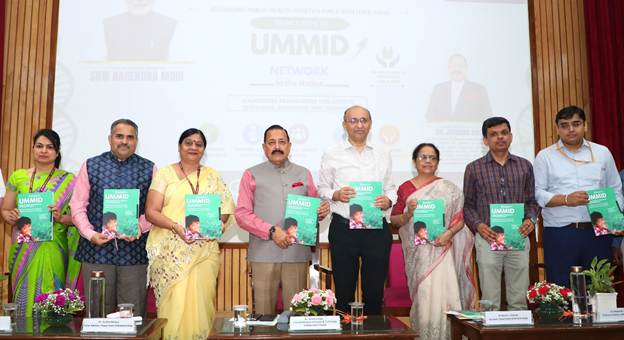
- Decentralizing Specialized Medical Infrastructure: By tying premier research hubs under the Department of Biotechnology (DBT) to district-level hospitals, the initiative shifts advanced medical diagnostics out of metropolitan areas.
- Genetic Counseling Ecosystem: The initiative supports training specialized medical clinicians and genetic counselors, addressing India’s severe human resource deficit in genomic medicine.
- Data-Driven Precision Medicine: Genomic data collected across diverse regional populations will enrich India’s indigenous genetic databases, supporting long-term research into tailored therapeutics.
Positives, Negatives, & Government Schemes
| Dimension | Details |
| Positives | Drastically lowers diagnostic costs for economically backward families and minimizes the long-term public health burden of inherited disorders. |
| Negatives | High initial setup costs for sequencing equipment and an acute shortage of trained bioinformaticians to interpret data in rural regions. |
| Associated Schemes | National Policy for Rare Diseases, UMMID Programme, Ayushman Bharat Digital Mission (ABDM). |
Examples
The successful establishment of early screening protocols for Beta-Thalassemia and Sickle Cell Anemia during UMMID Phase-I provides a clear operational template for Phase-II.
Way Forward
- Integrate NIDAN Kendra diagnostic data with the Ayushman Bharat digital health IDs to ensure seamless medical histories across primary and tertiary hospitals.
- Formulate public-private partnerships with domestic biotech startups to manufacture low-cost localized genetic testing kits.
Conclusion
UMMID Phase-II transitions India’s healthcare landscape from a purely reactive treatment model to a proactive, preventative genomic strategy, ensuring equitable access to advanced medical science.
Practice Mains Question
Evaluate how the expansion of the UMMID initiative can address the socio-economic and public health challenges posed by Rare Genetic Disorders in India. (150 words)
Topic 5: 68th APO Governing Body Meeting Concludes in New Delhi
Syllabus
- GS Paper 3: Indian Economy and issues relating to planning, mobilization of resources, growth, development, and employment.
Context
The 68th Session of the Governing Body Meeting of the Asian Productivity Organization (APO) concluded at Bharat Mandapam, New Delhi, focusing on driving productivity-led green growth transformations across the Asia-Pacific.
Main Body: Multi-Dimensional Analysis
- APO Vision 2030 Review: Senior policymakers and productivity experts evaluated mid-term progress under the APO Vision 2030 framework, prioritizing artificial intelligence integration into manufacturing workflows.
- India’s Leadership Trajectory: Hosting the apex governing body positions India as a central driver of high-efficiency manufacturing, agricultural modernization, and sustainable service-sector practices within the region.
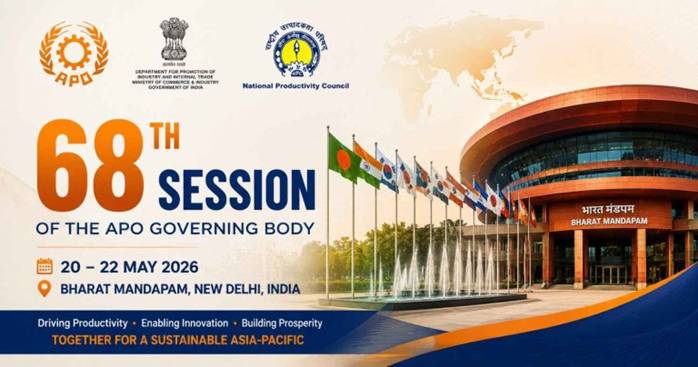
- Focus on Green Productivity: Debates focused on decoupling economic expansion from carbon intensity by formulating metrics that value energy efficiency and circular economy waste management frameworks.
- SME Digital Transformation: The meeting formalized actionable strategies to deploy digital twins and automated data analytics into small and medium enterprises (SMEs) to reduce resource waste.
- Multilateral Institutional Reforms: Member economies initiated administrative restructurings regarding the election protocols for the APO Secretary-General to improve institutional transparency.
Positives, Negatives, & Government Schemes
| Dimension | Details |
| Positives | Facilitates international technology transfers, aligns domestic manufacturing standards with global benchmarks, and opens up cross-border technical training. |
| Negatives | Translating high-level multilateral productivity frameworks into the unorganized sectors of developing economies faces deep execution gaps. |
| Associated Schemes | National Productivity Council (NPC) Initiatives, Make in India, Digital MSME Scheme. |
Examples
The adoption of lean manufacturing techniques across Indian automotive clusters, which led to an immediate reduction in material waste, illustrates the tangible benefits of APO-led knowledge sharing.
Way Forward
- Task the National Productivity Council with translating APO green-growth toolkits into accessible, regional-language instructional formats for local MSMEs.
- Launch cross-border institutional fellowships within the APO framework to train Indian agricultural experts in smart, climate-resilient farming techniques.
Conclusion
The outcomes of the 68th APO meeting highlight that India’s next phase of sustained economic growth will depend on shifting from low-cost labor advantages to high-value, technology-driven productivity paradigms.
Practice Mains Question
Analyze the role of institutional frameworks like the Asian Productivity Organization (APO) in advancing green productivity models within India’s MSME sector. (150 words)
Topic 6: Test-Firing of Vayu Astra-1 Loitering Munition
Syllabus
- GS Paper 3: Indigenization of Technology and Developing New Technology; Security Challenges.
Context
On May 23, 2026, India successfully carried out user-trials of the indigenously developed Vayu Astra-1 loitering munition, confirming a precise strike capability over an operational range of 100 kilometers.
Main Body: Multi-Dimensional Analysis
- Indigenization of Stand-off Weapons: The successful test marks a major technological step forward in reducing reliance on imported loitering weapon systems from foreign suppliers.
- Precision Strike Architecture: Vayu Astra-1 integrates advanced anti-jamming GPS navigation alongside homegrown electro-optical seekers, allowing it to loiter over targeted sectors before neutralizing high-value assets.
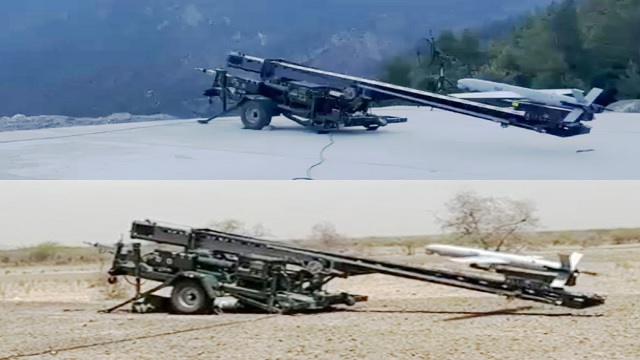
- Asymmetric Warfare Dynamics: Incorporating long-range loitering munitions into standard army units changes tactical planning, providing a cost-effective alternative to expensive cruise missiles for suppressing enemy air defenses.
- Boosting the Defense PLI Ecosystem: The domestic development and assembly of the munition’s carbon-composite airframe and seeker sub-assemblies validate the Production Linked Incentive (PLI) goals within defense manufacturing.
- Enhanced Operational Flexibility: Engineered with multi-platform launch options, the drone system can be deployed from mobile ground stations or forward infantry positions, improving tactical response speeds.
Positives, Negatives, & Government Schemes
| Dimension | Details |
| Positives | Significantly enhances forward tactical artillery range, decreases asset procurement costs, and builds deep domestic supply-chain resilience. |
| Negatives | Vulnerability to advanced multi-layered electronic warfare grids highlights the need for continuous software encryption updates. |
| Associated Initiatives | Defense Acquisition Procedure (DAP 2020), Innovations for Defense Excellence (iDEX), Make in India. |
Examples
The tactical integration of loitering munitions in recent global conflicts emphasizes how low-cost, smart aerial systems can counter traditional armored formations.
Way Forward
- Accelerate the deployment of swarm-networking algorithms to allow multiple Vayu Astra-1 units to coordinate strikes simultaneously.
- Establish dedicated assembly lines within private defense manufacturing clusters to prepare for large-scale induction into the armed forces.
Conclusion
The precision testing of Vayu Astra-1 confirms India’s growing ability to design and manufacture smart, autonomous weapon systems, strengthening forward operational deterrence.
Practice Mains Question
Examine how the indigenization of autonomous loitering munitions alters tactical doctrines and strengthens India’s internal and external security readiness. (150 words)
Topic 7: Third Domestic Fuel Price Revision & Macroeconomic Implications
Syllabus
- GS Paper 3: Economic Development- Inflation, Fiscal Policy, and Resource Mobilization.
Context
State-owned oil marketing companies (OMCs) enacted a third consecutive upward revision to petrol and diesel prices within an eight-day window on May 23, 2026, raising prices by an average of 90 paise per litre.
Main Body: Multi-Dimensional Analysis
- Cascading Inflationary Pressures: The continuous increase in diesel prices directly raises freight and logistics expenses, creating upward pressure on wholesale food and essential commodity inflation.
- Macroeconomic Margin Pressures: Rising fuel inputs compress margins across retail manufacturing and logistics networks, potentially slowing the pace of private sector capital expenditure.
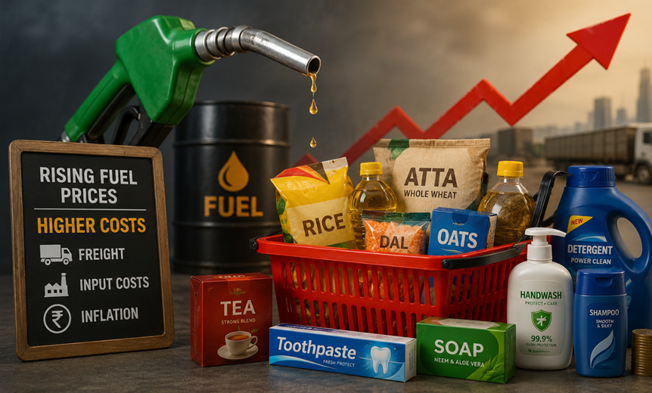
- OMC Under-Recovery Rebalancing: The price hikes represent a calculated effort by domestic OMCs to recover structural losses that built up over years of retail price freezes, repairing their balance sheets.
- Fiscal Trilemma for Government: The center faces complex policy tradeoffs between lowering central excise duties to protect consumer purchasing power or keeping revenues steady to meet capital expenditure commitments.
- Monetary Policy Adjustments: Persistent fuel-driven inflation threatens to delay anticipated interest rate cuts by the Reserve Bank of India (RBI) as the central bank prioritizes price stability.
Positives, Negatives, & Government Schemes
| Dimension | Details |
| Positives | Restores the financial viability of state-run oil marketing enterprises and encourages long-term shifts toward energy-efficient transport options. |
| Negatives | Reduces household disposable income, places an unfair financial burden on lower-income consumers, and complicates retail inflation management. |
| Associated Initiatives | Market-Determined Fuel Pricing Mechanism, National Logistics Policy (NLP), FAME Scheme. |
Examples
The swift retail price adjustments implemented during historic oil shocks underscore how volatile energy markets translate directly into broader consumer price index fluctuations.
Way Forward
- Accelerate the implementation of the National Logistics Policy to transition long-haul freight from road transportation to energy-efficient rail corridors.
- Introduce targeted fuel subsidies or transport tax relief for essential agricultural supply chains to protect food prices from volatility.
Conclusion
Managing recurring domestic fuel price adjustments requires a careful balance between ensuring the financial health of public oil marketing firms and shielding vulnerable consumer sectors from inflation.
Practice Mains Question
Analyze the macroeconomic consequences of recurring domestic fuel price adjustments on India’s retail inflation trajectory and overall post-pandemic growth. (150 words)
Topic 8: Long-Pending Demands of Tamil Nadu Government Doctors
Syllabus
- GS Paper 2: State Government Policies and Interventions; Issues relating to the management of Public Health.
Context
The Legal Coordination Committee for Government Doctors (LCC) in Tamil Nadu issued a formal representation on May 23, 2026, urging the newly formed state administration to address critical, long-standing demands regarding pay structures and systemic staff shortages.
Main Body: Multi-Dimensional Analysis
- The Government Order 354 Mandate: The primary point of friction remains the delayed implementation of Pay Band Four (PB-4) benefits after 12 years of service, as originally promised under G.O. 354 over a decade ago.
- Inter-State Salary Disparities: The committee presented detailed comparative metrics showing that Tamil Nadu’s public health specialists receive lower base salaries than counterparts in neighboring states, risking a brain drain from public service.
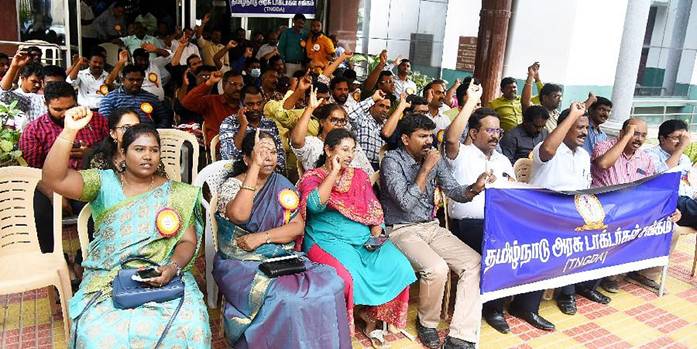
- Contractual Regularization Crisis: The petition calls for the immediate regularisation of over 400 dental surgeons who have worked on short-term contracts within rural Primary Health Centres (PHCs) for more than 15 years without promotions.
- Public Health Infrastructure Deficits: To maintain the state’s high performance in reducing Maternal Mortality Rates (MMR) and Infant Mortality Rates (IMR), the LCC demanded a doubling of doctor and nurse positions across district hospitals.
- Administrative Friction: The association called for the immediate withdrawal of pending disciplinary charge memos issued against medical union leaders during past demonstrations, highlighting ongoing labor relations issues.
Positives, Negatives, & Government Schemes
| Dimension | Details |
| Positives | Fulfilling these demands stabilizes the public healthcare workforce, improves rural retention of specialists, and secures the quality of grassroots care. |
| Negatives | Fully implementing PB-4 across the entire medical cadre introduces immediate fiscal strains on the state’s revenue deficit management. |
| Associated Policies | Tamil Nadu Government Order 354, National Health Mission (NHM) State Component, Makkalai Thedi Maruthuvam. |
Examples
The unresolved five-year delay in providing a compensatory government position to the family of a public doctor who died during active COVID-19 duties is highlighted by the LCC as an example of administrative delay.
Way Forward
- Formulate a transparent, phased fiscal roadmap to implement PB-4 benefits for senior medical specialists over a three-year window.
- Establish an institutionalized medical recruitment calendar under the State Medical Services Recruitment Board (MRB) to systematically fill vacancies before shortages impact care.
Conclusion
Maintaining Tamil Nadu’s position as a model state for public health requires addressing the long-standing financial and structural grievances of its frontline medical workforce.
Practice Mains Question
“Unresolved human resource grievances in public healthcare can undermine long-term state public health achievements.” Discuss in the context of recent representations by government doctors in Tamil Nadu. (150 words)
