
Topic 1: Bombay High Court Strikes Down One-Time Spectrum Charges (OTSC)
Syllabus
- GS Paper 2: Governance, Government Policies, Judicial Interventions, and Regulatory Oversight.
- GS Paper 3: Infrastructure (Telecom), Economic Development, and Ease of Doing Business.
Context
On June 9, 2026, the Bombay High Court delivered a landmark judgment striking down the Central Government’s retrospective One-Time Spectrum Charge (OTSC) demands imposed on major telecom service providers like Bharti Airtel and Vodafone Idea.
Main Body: Multi-Dimensional Analysis
- Judicial Check on Executive Overreach: The High Court ruled that the Department of Telecommunications (DoT) lacked the legal and statutory authority to retrospectively alter telecom license terms years after their issuance. It established that state contracts cannot be modified unilaterally to impose sudden fiscal burdens.
- Financial Lifeline for Telecom Sector: The quashing of the OTSC demands brings massive, immediate financial relief to an indebted sector. It eliminates an estimated liabilities burden of nearly ₹20,000 crore collectively—saving around ₹11,000 crore for Vodafone Idea and ₹9,000 crore for Bharti Airtel.

- Regulatory Stability & Investor Confidence: By stopping arbitrary, retroactive taxation, the judgment restores regulatory predictability. Predictable legal frameworks are crucial for attracting long-term foreign direct investment (FDI) into high-capital infrastructure sectors like telecommunications.
- Impact on the State Exchequer: The verdict leaves a substantial fiscal deficit in the non-tax revenue projections of the Union Government for FY27, forcing a recalibration of budgetary expectations from telecom spectrum earnings.
Positives, Negatives, & Government Schemes
| Dimension | Details |
| Positives | Prevents bankruptcy risks in the telecom duopoly/oligopoly market, protects consumer interests by preventing tariff hikes, and strengthens judicial enforcement of corporate contracts. |
| Negatives | Creates a unexpected multi-crore revenue shortfall for the central exchequer; delays the recovery of contested public dues from commercial enterprises. |
| Associated Concepts/Acts | Indian Telegraph Act 1885, National Digital Communications Policy (NDCP), Ease of Doing Business Framework, Retroactive Taxation Doctrine. |
Examples
The retrospective tax dispute involving Vodafone in 2012 serves as a historical baseline showing how retroactive state demands damage India’s global reputation for business friendliness until checked by judicial interventions.
Way Forward
- Formulate clear statutory guidelines that explicitly forbid departments from drafting retrospective financial clauses into active commercial licenses.
- Strengthen alternative dispute resolution (ADR) mechanisms within the Telecom Disputes Settlement and Appellate Tribunal (TDSAT) to settle revenue disagreements before they escalate to High Courts.
Conclusion
The High Court’s decision underscores that administrative enthusiasm for generating non-tax revenue must operate within constitutional limits, reinforcing trust-based governance necessary for a stable infrastructure economy.
Practice Mains Question
The regular occurrence of retrospective regulatory demands creates economic uncertainty and discourages long-term infrastructure investments. Critically analyze the Bombay High Court’s ruling on One-Time Spectrum Charges in this context. (250 words)
Topic 2: Historic Expansion of the Supreme Court of India via Presidential Ordinance
Syllabus
- GS Paper 2: Indian Constitution—Significant Provisions, Judicial Reforms, Executive-Judiciary Dynamics, and Separation of Powers.
Context
In a major constitutional development, the President of India promulgated an ordinance under Article 123 to temporarily expand the judge strength of the Supreme Court of India to handle the massive backlog of structural constitutional cases.
Main Body: Multi-Dimensional Analysis
- Constitutional Validity of Executive Ingress: The use of an Ordinance under Article 123 to modify the composition of the apex court raises questions about separation of powers, bypassing traditional parliamentary debates on judicial numbers.
- Clearing Judicial Bottlenecks: The expansion directly addresses structural delays. It creates dedicated constitutional benches to handle complex systemic matters without freezing routine appellate cases like bail and civil reviews.

- The Transition/Absorption Strategy: The expansion utilizes a phased absorption mechanism. As permanent sitting judges retire (e.g., Justice Pankaj Mithal and Justice J.K. Maheshwari later in June 2026), the newly added Ordinance judges will seamlessly transition into permanent, sanctioned seats.
- Impact on the Collegium System: The temporary nature of Ordinance seats creates administrative challenges for the Supreme Court Collegium, which must balance quick appointments with deep scrutiny under an evolving framework.
Positives, Negatives, & Government Schemes
| Dimension | Details |
| Positives | Accelerates the resolution of long-pending constitutional questions, increases the daily case disposal rate, and sets up continuous, uninterrupted multi-judge benches. |
| Negatives | Bypasses parliamentary debate, sets a precedent for executive management of judicial structures, and risks creating operational friction if the Ordinance faces delays in parliament. |
| Associated Laws/Articles | Article 123 (Ordinance Power), Article 124(1) (Composition of Supreme Court), Supreme Court (Number of Judges) Act, Basic Structure Doctrine. |
Examples
The historical expansion of judges from the original 8 in 1950 to 34 in 2019 shows how the court has structurally scaled up over time to keep pace with India’s growing population and litigation volume.
Way Forward
- Ensure the Ordinance is tabled for parliamentary debate immediately upon the next session to secure cross-party legislative backing.
- Establish a permanent National Judicial Appointments Commission or structured secretariat to streamline names transparently for newly added seats.
Conclusion
While expanding the judiciary addresses systemic delays, using emergency executive ordinances requires careful management to preserve the delicate balance between the executive and independent judiciary.
Practice Mains Question
Bypassing parliamentary debate via ordinances to alter the composition of the highest checking authority raises important constitutional questions. Examine the recent expansion of the Supreme Court’s judge strength under Article 123. (250 words)
Topic 3: Launch of the Land Port Management System (LPMS)
Syllabus
- GS Paper 2: Government Policies, Institutional Interventions, and Cross-Border Management.
- GS Paper 3: Internal Security, Border Area Infrastructure, and Technology application in Logistics.
Context
On June 9, 2026, the Union Home Minister officially launched the digital Land Port Management System (LPMS) in New Delhi to modernize cross-border movement, trade tracking, and real-time surveillance across all Integrated Check Posts (ICPs) in India.
Main Body: Multi-Dimensional Analysis
- Digital Transformation of Border Economy: LPMS transitions manual cargo clearing, immigration checks, and quarantine permissions into a unified, single-window software dashboard, drastically cutting down cargo turnaround times.
- Securing Cross-Border Trade Vectors: By introducing AI-enabled digital tracking, the system minimizes security vulnerabilities like smuggling, counterfeit currency insertion, and illegal border crossings along sensitive frontiers.
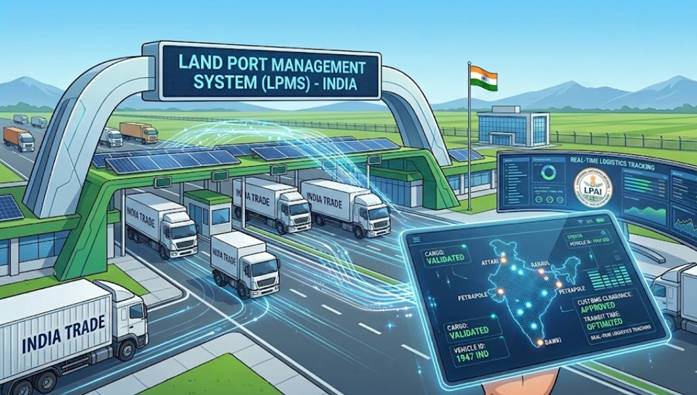
- Neighborhood First Policy Enabler: This platform facilitates trade along sub-continental pathways, primarily benefiting economic corridors connecting India with Bangladesh, Nepal, and Bhutan.
- Last-Mile Infrastructure Strains: While the centralized software architecture is advanced, its ultimate success depends heavily on the physical infrastructure at remote border outposts, which often face power outages and poor internet connectivity.
Positives, Negatives, & Government Schemes
| Dimension | Details |
| Positives | Minimizes logistical human error, cuts down tracking delays for traders, enhances security monitoring, and boosts regional trade volume. |
| Negatives | High initial deployment costs, vulnerability to targeted cross-border cyberattacks, and disruption for local manual shipping clearing agents. |
| Associated Schemes | Land Ports Authority of India (LPAI), Neighborhood First Policy, PM GatiShakti National Master Plan, Digital India. |
Examples
The successful operation of the Petrapole-Benapole integrated port with Bangladesh shows how automated tracking can prevent massive multi-day truck queues along borders.
Way Forward
- Deploy backup satellite communication links (like ISRO’s GSAT series) to keep remote land ports online during local fiber-optic internet disruptions.
- Organize regional training camps to help local trade helpers and truck operators adapt smoothly to the new digital platform.
Conclusion
The Land Port Management System transforms India’s border posts from slow, high-friction security barriers into fast-moving, digitally monitored economic gateways.
Practice Mains Question
“Effective border security must coexist with seamless trade facilitation.” Evaluate how the Land Port Management System (LPMS) addresses India’s border management challenges. (250 words)
Topic 4: Tax Exemptions on G-Secs to Boost Foreign Capital Inflows
Syllabus
- GS Paper 3: Indian Economy, Capital Markets, Mobilization of Resources, and Fiscal Policy.
Context
To stabilize volatile capital flows and expand the domestic sovereign debt framework, the Ministry of Finance introduced sweeping reforms on June 9, 2026, exempting Foreign Portfolio Investors (FPIs) from interest income and capital gains taxes on Government Securities (G-Secs).
Main Body: Multi-Dimensional Analysis
- Stabilizing the Balance of Payments (BoP): By completely removing short-term (STCG) and long-term capital gains (LTCG) taxes for FPIs investing in government bonds, India aims to attract stable global liquidity to counter persistent capital outflows from its equity markets.
- Financing the Fiscal Deficit: Increased foreign participation in the sovereign debt market helps the state fund its massive infrastructure projects without crowding out domestic private corporate borrowers from local banks.

- Currency Stabilization Against Global Headwinds: Rising global oil prices (~$110/barrel) put pressure on the Indian Rupee. Increased dollar inflows from foreign bond buyers create a vital protective cushion for the domestic currency.
- Vulnerability to Global Liquidity Shocks: While opening up the G-Sec market brings in quick capital, it also links India’s sovereign debt directly to foreign market shifts, exposing local bond yields to sudden policy changes by Western central banks.
Positives, Negatives, & Government Schemes
| Dimension | Details |
| Positives | Deepens the domestic bond market, lowers government borrowing costs, stabilizes the Rupee, and diversifies the public debt investor base. |
| Negatives | Results in a direct loss of tax revenues from foreign investments; exposes domestic interest rate cycles to external global market shocks. |
| Associated Concepts | Fully Accessible Route (FAR) for Bonds, JP Morgan Emerging Market Bond Index integration, FPI Regulations, Capital Account Convertibility. |
Examples
India’s recent inclusion in global bond indices like the JP Morgan Emerging Market index shows how removing structural and fiscal barriers can unlock billions of dollars in stable foreign investment.
Way Forward
- Set up dynamic caps on short-term foreign investments in public bonds to prevent sudden, disruptive mass pullouts of foreign capital during global crises.
- Encourage long-term sovereign wealth funds and global pension funds to utilize these tax benefits, securing stable, multi-year investments.
Conclusion
Removing capital taxes on G-Secs is a calculated strategic move that trades short-term tax revenue for long-term currency stability and robust infrastructure financing.
Practice Mains Question
Exempting Foreign Portfolio Investors (FPIs) from taxes on government securities is a double-edged sword for resource mobilization. Analyze its impact on fiscal autonomy and currency stability. (250 words)
Topic 5: Defense Ministry Approves First-of-its-Kind Large-Scale Solar-Plus-Storage Project
Syllabus
- GS Paper 3: Security Forces Infrastructure, Renewable Energy Initiatives, and Indigenization of Technology.
Context
On June 9, 2026, the Ministry of Defence (MoD) approved the setup of a 250 MW Solar Power Project equipped with an advanced Battery Energy Storage System (BESS) over 850 acres of vacant defense land in Sitapur, Uttar Pradesh.
Main Body: Multi-Dimensional Analysis
- Decarbonizing Military Infrastructure: This project marks a major shift by bringing renewable energy directly into the defense sector, reducing the carbon footprint of base camps, cantonments, and manufacturing workshops.
- Securing Strategic Energy Independence: By combining solar power with advanced battery storage (BESS), the military secures a self-sustaining power supply that keeps critical bases operational even during grid failures or external cyberattacks on civilian infrastructure.
- Fiscal Savings through Green Conversion: Transitioning away from expensive commercial grid electricity and backup diesel generators will save the defense exchequer considerable funds over the project’s life cycle.
- Alternative Land-Use Governance: Using vacant defense land for green energy projects sets a useful precedent for land management, showing how idle state resources can be repurposed to meet national clean energy targets.
Positives, Negatives, & Government Schemes
| Dimension | Details |
| Positives | Ensures 24/7 clean power for military setups, minimizes expenditure on fossil fuels, and advances India’s goal of reaching net-zero emissions. |
| Negatives | High upfront costs for large-scale battery storage installations; requires strict, round-the-clock physical security over extensive rural layouts. |
| Associated Organizations | NTPC Limited (Executing Agency), Directorate General Defense Estates (DGDE), National Solar Mission. |
Examples
The Indian Army’s deployment of micro-solar grids along remote, high-altitude posts in Ladakh serves as a successful proof-of-concept for integrating green energy into national security frameworks.
Way Forward
- Replicate the Sitapur solar-plus-storage model across other vacant, non-operational military land holdings in desert and arid border states.
- Collaborate with local domestic manufacturers to source the large-scale battery storage units, boosting the domestic clean technology supply chain.
Conclusion
Fusing large-scale clean energy generation with battery storage on defense land shows how national security installations can actively support the country’s environmental goals.
Practice Mains Question
“Modern military forces must balance operational readiness with environmental sustainability.” Discuss this statement in light of the Defence Ministry’s new large-scale solar-plus-storage project. (250 words)
Topic 6: SIPRI Report Reveals Expansion of India’s Nuclear Arsenal
Syllabus
- GS Paper 3: National Security, International Relations, Global Geopolitical Trends, and Nuclear Weapons Doctrines.
Context
The Stockholm International Peace Research Institute (SIPRI) released its annual global security yearbook, revealing that India expanded and modernized its operational nuclear arsenal over the past year in response to growing regional security pressures.
Main Body: Multi-Dimensional Analysis
- Deterrence in a Multi-Polar Region: The expansion highlights India’s focus on maintaining a credible minimum deterrence capability, especially given the rapid nuclear modernizations underway in its immediate neighborhood.
- Strengthening the Nuclear Triad: The report highlights India’s steady work in reinforcing its survivable nuclear triad, focusing on developing longer-range submarine-launched ballistic missiles (SLBMs) and road-mobile canisters.

- Adherence to a Strict No-First-Use Policy: Despite growing its stockpiles, India’s broader security strategy remains firmly anchored around its traditional No-First-Use (NFU) doctrine, positioning its arsenal as a purely defensive shield.
- Global Non-Proliferation Pressures: Periodic reports tracking nuclear stockpiles can lead to intense diplomatic pressure in international forums, requiring careful foreign policy handling to protect national defense choices.
Positives, Negatives, & Government Schemes
| Dimension | Details |
| Positives | Strengthens national defense against multi-front threats, enhances regional strategic balance, and reinforces India’s technological standing. |
| Negatives | Accelerates regional arms competition and increases security spending, diverting resources from critical social sector development. |
| Associated Concepts | Credible Minimum Deterrence, Strategic Forces Command (SFC), No-First-Use Doctrine, Wassenaar Arrangement. |
Examples
The successful testing of the Agni-V missile with Multiple Independently Targetable Re-entry Vehicle (MIRV) technology serves as a clear example of India’s focus on modernizing its strategic defensive capabilities.
Way Forward
- Continue expanding automated early warning radar networks like Project NETRA to protect command infrastructures from accidental or surprise threats.
- Maintain open, structured channels for strategic dialogue with regional neighbors to establish clear confidence-building measures (CBMs) and prevent miscalculations.
Conclusion
The measured growth of India’s strategic deterrent reflects its complex geopolitical reality, ensuring national sovereignty while maintaining a responsible global nuclear posture.
Practice Mains Question
Evaluate how regional security dynamics shape India’s nuclear deterrence strategy, while keeping its commitment to a responsible No-First-Use framework. (250 words)
Topic 7: Digitization of Wildlife Offence Management via the HAWK System
Syllabus
- GS Paper 3: Conservation, Environmental Degradation, Wildlife Protection, and Cyber-Governance applications.
Context
The Forest Department launched the Hostile Activity Watch Kernel (HAWK) system, marking the full operationalization of the state’s first completely digitized, judiciary-integrated wildlife offense management framework.
Main Body: Multi-Dimensional Analysis
- Modernizing Wildlife Law Enforcement: HAWK replaces slow, paper-based reporting with a secure digital network, allowing forest rangers to log poaching incidents, register forest offenses, and track contraband seizures in real-time.

- Judiciary Integration for Faster Convictions: By linking forest department logs directly with local judicial databases, the system ensures that digital evidence, wildlife forensic reports, and charge sheets are transmitted quickly, improving low conviction rates for environmental crimes.
- Preventing Transnational Poaching Networks: The platform uses predictive analytics to map poaching hotspots and animal migration routes, enabling wildlife wardens to deploy anti-poaching patrols more effectively.
- Addressing the Digital Divide in Forest Staff: Implementing complex digital systems requires continuous technical training for frontline forest guards, who often operate in remote areas without stable connectivity.
Positives, Negatives, & Government Schemes
| Dimension | Details |
| Positives | Eliminates manual file delays, secures field evidence against tampering, speeds up legal trials, and deters organized wildlife syndicates. |
| Negatives | Risks systemic vulnerabilities from field data entry errors; highly dependent on digital literacy among ground-level forest staff. |
| Associated Laws | Wildlife (Protection) Act 1972, Forest Conservation Act, Digital India Mission, Wildlife Crime Control Bureau (WCCB). |
Examples
The previous success of the M-STrIPES digital monitoring tool in tiger reserves shows how tech-driven tracking can significantly reduce poaching risks and improve forest management.
Way Forward
- Equip field patrolling teams with rugged, offline-capable handheld gadgets that can sync local offense data automatically once they return to base camps.
- Integrate the HAWK architecture with national databases like the Wildlife Crime Control Bureau (WCCB) to easily track inter-state smuggling networks.
Conclusion
By connecting forest field reports directly with the judicial system, the HAWK platform introduces accountability and speed to environmental protection efforts.
Practice Mains Question
“Technology-driven surveillance and seamless judicial integration are vital to ending organized wildlife crime.” Discuss this with reference to the newly introduced HAWK system. (250 words)
Topic 8: Ministry of Defence Reviews Scrutiny of Tejas Light Combat Aircraft Delays
Syllabus
- GS Paper 3: Indigenization of Technology, Defence Procurement, and Challenges in Domestic Aerospace Manufacturing.
Context
On June 9, 2026, the Ministry of Defence launched a high-level performance review focusing on Hindustan Aeronautics Limited (HAL) to address critical production delays affecting the delivery of the indigenous Tejas Light Combat Aircraft (LCA MK1A) to the Indian Air Force.
Main Body: Multi-Dimensional Analysis
- Impact on Air Force Squadron Strength: Delays in delivering the Tejas fighters directly affect the Indian Air Force’s operational capabilities as it works to maintain its sanctioned squadron strength amidst the phased retirement of older fighter jets.
- Challenges in the Global Component Supply Chain: The review highlighted how vulnerabilities in global supply networks—particularly delays in importing vital foreign sub-systems like jet engines—can stall domestic assembly lines.

- Testing Domestic Manufacturing Limits: This situation underscores the gap between designing advanced defense platforms and mass-producing them efficiently within tight delivery schedules.
- Implications for Defense Export Ambitions: Production delays at home can weaken India’s position in competitive global defense markets, where the country is pitching the Tejas aircraft to friendly foreign nations.
Positives, Negatives, & Government Schemes
| Dimension | Details |
| Positives | Increases accountability for public sector defense units, drives structural reforms in production lines, and encourages wider private sector involvement. |
| Negatives | Creates temporary gaps in air defense readiness and increases project costs due to prolonged production timelines. |
| Associated Schemes | Atmanirbhar Bharat in Defence, Defence Acquisition Procedure (DAP), Make in India Initiative. |
Examples
The historical development journey of the Advanced Light Helicopter (Dhruv) shows how initial production bottlenecks can be resolved to create a highly successful, mass-produced domestic platform.
Way Forward
- Encourage deeper partnerships between HAL and private aerospace firms to outsource the manufacturing of structural components, speed up final assembly, and reduce bottlenecks.
- Set up a dedicated joint task force within the Ministry of Defence to build local component alternatives, reducing dependence on erratic global supply chains.
Conclusion
Addressing production bottlenecks at HAL is critical to ensuring that India’s push for self-reliance in defense translates into reliable, on-time equipment deliveries for its armed forces.
Practice Mains Question
“While designing indigenous defense platforms is a significant technological milestone, mass-producing them on time presents unique industrial challenges.” Analyze this statement in light of the production review of the Tejas LCA project. (250 words)
