
Topic 1: America on Hold: FAA Grounds All Departing Flights After Communications Outage
File image: passengers at an airport terminal (photo: DD News).
Subject: Infrastructure and Internal Security – Aviation Safety
Paper: GS Paper 3: Infrastructure; disaster and emergency management; internal security
UPSC Relevance: The US Federal Aviation Administration ordered a nationwide ground stop on all departing flights on 13 November 2026 after a major communications outage – only the second such alert in US airspace since 9/11. The Hindu reported it on 14 November 2026.
Why in News
All departing flights across the United States were grounded on Friday, 13 November 2026, after what government officials described as a major communications outage, with authorities insisting it was not the result of any “nefarious attack”.
The FAA ordered the nationwide ground stop “due to extraordinary circumstances and for reasons of safety”, leaving tens of thousands of passengers stranded; some were pulled off aircraft moments before departure by airline staff who appeared unaware of the unfolding events.
The incident marked only the second time such an alert has been given in US airspace since the 9/11 attacks; the FAA later allowed departures to resume and lifted the ground stop the same day, AP reported.
Background
A ground stop is the most drastic traffic-management tool in aviation: an order halting departures so that airborne congestion and uncertainty do not migrate into the sky. In the US, the FAA’s authority flows from its mandate over the National Airspace System, one of the world’s busiest.
The first post-9/11 precedent was the January 2023 outage of the FAA’s Notice to Air Missions (NOTAM) system, which halted departures nationwide and exposed how a single corrupted database can paralyse a continental network.
Modern aviation runs on layered digital links – radar feeds, flight-plan filing, airline operations centres and controller-pilot data links; the outage hit the communications layer that binds them, which is why authorities grounded departures even though aircraft themselves were unaffected.
Key Dimensions
1. The resilience question: A communications failure, not a mechanical one, stopped a superpower’s skies: critical infrastructure is now only as strong as its least redundant data link, and aviation authorities worldwide audit against precisely this failure mode.
2. The attribution discipline: Officials moved early to rule out a “nefarious attack” – in an era of state-sponsored cyber operations, the first hours of any infrastructure outage are now also an information-management exercise to prevent panic and market contagion.
3. The cascade effect: Tens of thousands of passengers stranded within hours shows how tightly coupled US aviation is: aircraft, crew and gate slots are all repositioned wrong within a single morning, and recovery takes days even after the stop lifts.
4. The Indian mirror: India’s own skies are regulated by the DGCA and its navigation services by the Airports Authority of India; Indian carriers with US-bound operations felt the disruption’s edges, a reminder that aviation risk is networked across jurisdictions.
Significance
1. Critical-infrastructure protection is now a core GS3 theme: power grids, payment systems and air navigation share the same single-point-of-failure logic.
2. The episode will feed global debate on redundancy mandates for air-navigation service providers and on cyber-hardening of aviation communication protocols.
3. For India, with passenger traffic projected at 430 million in FY26 (CareEdge), resilience of navigation and communication systems is an economic issue, not only a safety one.
Challenges
1. Restoring full schedules after a nationwide stop takes days of aircraft and crew rebalancing, stranding passengers well beyond the outage window.
2. Communicating clearly during a security-ambiguous outage without triggering panic or conspiracy narratives is a recurring governance challenge.
3. Upgrading legacy aviation communication systems without grounding the network they serve is slow, capital-heavy work.
Way Forward
1. Watch the FAA’s technical post-mortem and any congressional hearings into the outage’s root cause.
2. Track new redundancy or cyber requirements imposed on US air-navigation infrastructure.
3. Note any DGCA or AAI advisories reviewing India’s own contingency procedures in response.
Prelims Value Addition
- ‘The FAA grounded all departing US flights on 13 November 2026, citing extraordinary circumstances and safety after a communications outage.’
- ‘It was only the second such nationwide alert in US airspace since the 9/11 attacks; the first was the January 2023 NOTAM system outage.’
- ‘The FAA – Federal Aviation Administration – regulates civil aviation in the United States; India’s regulator is the DGCA, with navigation services from the Airports Authority of India.’
- ‘AP reported the ground stop was lifted and departures resumed later on 13 November 2026.’
Mains Value Addition
- “Digital infrastructure failure is the new natural disaster.” Discuss with reference to the November 2026 FAA ground stop.
- Examine the safeguards India needs for its aviation communication and navigation systems as passenger traffic scales toward half a billion a year.
Topic 2: When the Cloud Went Quiet: The Microsoft Outage Reaches India

File image: Microsoft signage (photo: DD News).
Subject: Science and Technology – Digital Infrastructure
Paper: GS Paper 3: Science and technology – IT; cyber security; economic impact of digital dependence
UPSC Relevance: A global disruption of multiple Microsoft services that began on 12 November 2026 continued into 13 November, hitting businesses and public services worldwide, including Indian firms from startups to multinationals. The Hindu and New Indian Express reported it on 13 November 2026.
Why in News
The global disruption of multiple Microsoft services began on Thursday, 12 November 2026 and continued late into Friday, affecting email access and workplace applications in businesses, public services and other organisations across the globe.
In India, the disruptions affected businesses from startups to multinational corporations, hitting internal communications and customer-facing operations; Microsoft said on Friday it was making progress in fixing the outage.
The New Indian Express reported Microsoft restored parts of its India and Asia-Pacific infrastructure after the disruption; the BBC catalogued effects on courts, MPs and institutions worldwide.
Background
Microsoft 365 – Outlook, Teams, Exchange and linked workplace tools – functions as the operating layer for a large share of the world’s offices; a cloud outage there is not an app failure but a workplace failure across continents at once.
This is the second mega-outage era in two years: the July 2024 CrowdStrike-triggered Windows disruption grounded airlines and banks globally and made “concentration risk” in enterprise IT a board-level term.
India’s services economy – IT, banking, aviation, retail and government portals – layers its own systems on a handful of global cloud and productivity providers, importing their failure modes along with their efficiencies.
Key Dimensions
1. The concentration problem: When one vendor’s identity and email stack fails, the failure is correlated worldwide: redundancy inside a single provider’s cloud does not protect against the provider itself failing.
2. The productivity tax: Indian firms from startups to MNCs lost internal communication and customer-facing operations simultaneously – the outage measured in missed SLA deadlines and stalled citizen services, not just inconvenience.
3. The sovereignty undertone: Dependence on foreign hyperscalers for mail, identity and collaboration tools raises data-sovereignty and continuity questions for public services, reviving interest in sovereign cloud and fallback infrastructure.
4. The transparency deficit: Enterprises and governments typically learn outage causes at the vendor’s pace; mandatory incident-reporting regimes – like CERT-In’s six-hour reporting rule in India – are the policy answer still maturing.
Significance
1. Cloud concentration risk is now a financial-stability and public-service-continuity question, not merely an IT procurement detail.
2. The outage strengthens the case for multi-vendor fallbacks, offline-capable critical workflows and tested business-continuity plans in both firms and government.
3. For UPSC, it links cyber security, digital public infrastructure and economic resilience in one live case study.
Challenges
1. Building genuine redundancy across providers is costly and operationally complex for most organisations.
2. Public services with statutory timelines – courts, hospitals, utilities – cannot simply pause when collaboration tools fail.
3. Attribution and post-mortem disclosure by global vendors remains voluntary in most jurisdictions.
Way Forward
1. Watch Microsoft’s root-cause analysis and any regulatory demands for disclosure in the US, EU and India.
2. Track whether CERT-In or sectoral regulators issue continuity advisories for critical sectors.
3. Note enterprise moves toward multi-cloud and sovereign-cloud arrangements in India.
Prelims Value Addition
- ‘A global Microsoft services outage beginning 12 November 2026 disrupted email and workplace applications worldwide, with Indian businesses affected.’
- ‘CERT-In is India’s national nodal agency for responding to cyber-security incidents, under the IT Act, 2000.’
- ‘The July 2024 global Windows outage was triggered by a faulty CrowdStrike update – a benchmark event for IT concentration risk.’
- ‘Cloud service models: IaaS, PaaS, SaaS; productivity suites like Microsoft 365 are delivered as SaaS.’
Mains Value Addition
- “Concentration in cloud infrastructure is a systemic risk to the digital economy.” Discuss in the Indian context.
- Examine the regulatory instruments India needs to ensure continuity of essential services dependent on foreign cloud providers.
Topic 3: The Comparative-Advantage Assurance: India-US Trade Deal Nears the Tape
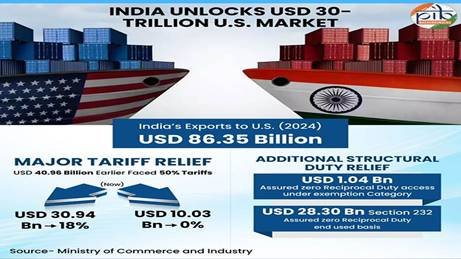
DD News infographic on the India-US trade agreement.
Subject: International Relations and Economy – Trade Policy
Paper: GS Paper 2: India-US relations; GS Paper 3: Indian economy – trade, tariffs and exports
UPSC Relevance: The US has assured India of a comparative tariff advantage over competitors once its tariff structure is finalised, a senior Commerce Ministry official said on 13 November 2026, with both sides working to conclude the interim trade deal by the end of the current financial year.
Why in News
In a significant breakthrough toward the India-US interim trade deal, the US has assured India of a comparative advantage over its competitors once it finalises its tariff structure, a senior official in the Ministry of Commerce and Industry said.
Both sides are working to complete the deal by the end of the current financial year; Indian officials had repeatedly said India would move ahead only if the US assured comparative advantage, as agreed in the February 2026 Modi-Trump joint statement.
Commerce Minister Piyush Goyal has said the finalised deal gives India “most preferred market access” to the US in areas of India’s interest vis-a-vis competitors, and that India safeguarded agriculture and dairy in the agreement; DD News described it as unlocking preferential access to the USD 30-trillion US market.
Background
The interim deal traces to the February 2026 joint statement between Prime Minister Narendra Modi and President Donald Trump, which set the comparative-advantage principle – that India’s tariffs relative to competitor economies should not leave Indian exports worse off.
Tariff uncertainty has shadowed the negotiations: The Hindu BusinessLine reported that US mid-term results were unlikely to speed up the deal, with tariff questions persisting through the year.
Agriculture and dairy are India’s traditional red lines in every trade negotiation – from the WTO to bilateral pacts – because of the livelihood exposure of smallholder farmers; Goyal’s statement that these were safeguarded addresses the deal’s most sensitive domestic flank.
Key Dimensions
1. The relative-tariff logic: In a world of differential US tariffs, absolute rates matter less than the gap with competitors: a comparative-advantage assurance converts market access from a number into a position.
2. The sequencing choice: Concluding by the end of the financial year lets both governments align the deal with domestic economic calendars – India’s budget cycle and Washington’s post-midterm agenda.
3. The defensive flank: Safeguarding agriculture and dairy preserves India’s negotiating template: open where competitive, protect where livelihoods concentrate – the same architecture seen in India’s FTAs with the UAE, Australia and EFTA.
4. The strategic frame: The deal sits atop a wider technology-and-defence relationship; trade closure removes an irritant that has periodically crowded the partnership’s strategic agenda.
Significance
1. A concluded interim deal would be India’s most consequential trade pact of the decade, anchoring access to its largest export market.
2. It tests whether tariff-era trade diplomacy can still produce rules-based outcomes between strategic partners.
3. For GS3, it is a live study in how relative – not absolute – tariffs shape competitiveness.
Challenges
1. Final tariff schedules and rules-of-origin details remain the hardest technical mile of any trade pact.
2. Domestic lobbies on both sides – US farm groups, Indian industry wary of import surges – can still narrow the deal’s ambition.
3. US tariff policy has been volatile; an assurance must survive translation into a binding schedule.
Way Forward
1. Watch for the joint announcement and the published text of the interim agreement.
2. Track the treatment of agriculture, dairy and government procurement in the final schedules.
3. Note how the comparative-advantage clause is drafted – as a binding commitment or a best-endeavours assurance.
Prelims Value Addition
- ‘The US assured India of comparative tariff advantage over competitors in the interim trade deal, targeted for completion by the end of the current financial year.’
- ‘The assurance was first agreed in the February 2026 joint statement between PM Modi and President Trump.’
- ‘Piyush Goyal: the deal gives India most-preferred market access in areas of interest and safeguards agriculture and dairy.’
- ‘The United States is India’s largest export market; bilateral trade frameworks include the Trade Policy Forum.’
Mains Value Addition
- “In an era of differential tariffs, relative advantage matters more than absolute access.” Discuss with reference to the India-US interim trade deal.
- Examine India’s approach to protecting agriculture and dairy in bilateral trade agreements.
Topic 4: Capping the Margin: NPPA’s 30% Ceiling on 137 Anti-Cancer Drugs

Representative image: a doctor with a patient (photo: DD News).
Subject: Health and Governance – Drug Price Regulation
Paper: GS Paper 2: Health; GS Paper 3: Economy – regulation and consumer welfare
UPSC Relevance: The National Pharmaceutical Pricing Authority has warned of penal action against those failing to comply with revised prices of 137 non-scheduled anti-cancer drugs, with a 30% trade-margin cap effective 9 November 2026, The Hindu reported on 14 November 2026.
Why in News
The NPPA has warned of penal action against those failing to comply with the revised prices of 137 non-scheduled anti-cancer drugs, asking State Drug Controllers to strictly monitor prices and submit action-taken reports by 16 November.
The revised prices came into effect on 9 November 2026, following a gazette order issued on 17 October 2026; the order capped the trade margin on these medicines at 30%.
The NPPA functions under the Department of Pharmaceuticals, Ministry of Chemicals and Fertilisers; DD News reported the margin cap as a patient-welfare measure on high-cost cancer therapies.
Background
The NPPA, established in 1997, administers the Drugs (Prices Control) Order issued under the Essential Commodities Act, 1955; the current DPCO 2013 lets it fix ceiling prices of scheduled formulations and monitor non-scheduled ones.
Scheduled drugs follow cost-based ceiling pricing linked to the National List of Essential Medicines; non-scheduled drugs are normally policed by an annual price-increase cap – which is why a direct trade-margin cap on 137 cancer drugs is an exceptional instrument.
Trade margin – the gap between the price to the stockist and the maximum retail price – is where much of a drug’s final cost accumulates; capping it at 30% attacks the distribution markup rather than the manufacturer’s price, an approach NPPA first used for select cancer drugs in 2019.
Key Dimensions
1. The affordability stakes: Cancer treatment is among the largest drivers of out-of-pocket health spending and medical impoverishment in India; a 30% margin cap directly compresses the retail price patients pay for 137 therapies.
2. The regulatory innovation: Margin capping bypasses the scheduled/non-scheduled boundary: instead of reclassifying drugs, the regulator compresses the distribution chain’s take – a surgical use of the DPCO toolkit.
3. The enforcement chain: NPPA fixes, but State Drug Controllers enforce; the 16 November deadline for action-taken reports shows the Centre-State relay that drug-price regulation actually runs on.
4. The industry balance: Manufacturers and distributors argue margin caps squeeze availability in remote markets; the regulator’s counter is that oncology margins were outliers in an essential-commodity framework.
Significance
1. Access to affordable cancer care is a stated national priority under the National Health Policy; price regulation is its sharpest immediate lever.
2. The order tests whether margin-based regulation can scale beyond pilot categories to a broad therapeutic class.
3. For GS2/GS3 it links the Essential Commodities Act, pharmaceutical policy and health equity.
Challenges
1. Ensuring compliance across a long distribution chain – stockists, retailers, hospital pharmacies – within days.
2. Guarding against supply distortion: withdrawal of capped brands or substitution toward uncapped alternatives.
3. Coordinating Central price fixation with State-level enforcement capacity.
Way Forward
1. Watch the State Drug Controllers’ action-taken reports after the 16 November deadline.
2. Track MRP changes on the notified cancer formulations and any industry litigation.
3. Note whether the margin-cap model extends to other therapeutic areas.
Prelims Value Addition
- ‘NPPA capped trade margins at 30% on 137 non-scheduled anti-cancer drugs; revised prices effective 9 November 2026.’
- ‘NPPA works under the Department of Pharmaceuticals and administers the DPCO under the Essential Commodities Act, 1955.’
- ‘Scheduled drugs have ceiling prices; non-scheduled drugs face monitoring and an annual price-increase cap.’
- ‘The National List of Essential Medicines guides which formulations fall under price control.’
Mains Value Addition
- “Drug price regulation in India must balance affordability with availability.” Discuss with reference to the NPPA’s margin-cap approach.
- Examine the role of the Essential Commodities Act in healthcare governance.
Topic 5: Cyclone Watch: The Bay System Builds Toward November 16
Representative image: heavy monsoon rain (photo: DD News), not of the current weather system.
Subject: Geography and Disaster Management – Tropical Cyclones
Paper: GS Paper 1: Geography – weather systems; GS Paper 3: Disaster management
UPSC Relevance: The IMD says the low-pressure area over the southeast Bay of Bengal, formed on 13 November 2026, is likely to intensify into a cyclonic storm over the central Bay of Bengal around the evening of 16 November, with Odisha and Tamil Nadu activating precautions.
Why in News
A low-pressure area formed over the southeast Bay of Bengal on 13 November 2026 under the influence of an upper-air cyclonic circulation over the central Andaman Sea; it is likely to become a well-marked low on 14 November and a depression around the morning of 15 November.
The system is expected to move north-northwestwards and intensify into a cyclonic storm over the central Bay of Bengal by the evening of 16 November, the IMD and the Cyclone Warning Centre, Visakhapatnam said.
Odisha alerted collectors of coastal and southern districts and issued yellow alerts for heavy rain on 18-20 November, advising fishermen off the south Odisha coast on 17 November; Tamil Nadu grounded thousands of fishing boats and banned fishing in Tuticorin.
Background
The Bay of Bengal is one of the world’s most cyclone-prone basins: warm sea-surface temperatures, a funnel-shaped coastline and post-monsoon instability make October-November its secondary cyclone season after April-May.
The IMD’s intensity ladder runs from low-pressure area through well-marked low, depression (17-27 knots), deep depression (28-33) and cyclonic storm (34-47) – the stage at which the system receives a name from the WMO/ESCAP panel list; this system has not yet been named.
The Cyclone Warning Centre at Visakhapatnam covers the Bay; forecasts now combine satellite scatterometry, buoy networks and numerical models, a system credited with cutting cyclone mortality from lakhs in the 20th century to tens in recent storms.
Key Dimensions
1. The forecast logic: Each intensification step carries a lead time that converts into administrative action: depression forecasts ground boats, cyclonic-storm forecasts move relief columns; the 16 November window is the planning horizon.
2. The two-state geometry: A north-northwest track places Odisha’s southern districts and the Tamil Nadu-Andhra coast inside the cone of uncertainty, which is why two state machineries activated on the same bulletin.
3. The livelihood exposure: Grounding thousands of fishing boats is the costliest daily decision in cyclone governance: every precautionary day is lost income for coastal families, which makes relief design as important as warning accuracy.
4. The memory of Murasu: The system builds weeks after Cyclone Murasu, in which nine fishermen from Chennai’s Kasimedu died when their boat capsized (PTI) – a reminder that even modest systems kill at sea.
Significance
1. Cyclone forecasting is India’s most mature disaster-governance success; each event tests its last-mile link to fishermen and district collectors.
2. The event is a live GS1/GS3 bridge: monsoon withdrawal dynamics, sea-surface warming and disaster administration in one system.
3. Post-Murasu scrutiny of vessel tracking and communication equipment will shape this response.
Challenges
1. Track and landfall uncertainty remains highest before depression stage; over-warning erodes credibility, under-warning costs lives.
2. Enforcing fishing curbs across hundreds of landing centres with limited marine police capacity.
3. Protecting standing samba paddy in the Cauvery delta if heavy rain bands cross the coast.
Way Forward
1. Watch IMD bulletins for depression formation around 15 November morning and naming at cyclonic-storm stage.
2. Track Odisha’s district-level preparedness reviews and any NDRF pre-positioning.
3. Note Tamil Nadu’s decisions on extending fishing curbs and on relief for grounded fishing days.
Prelims Value Addition
- ‘IMD: the Bay of Bengal low-pressure area (13 November 2026) may become a cyclonic storm over the central Bay around 16 November evening.’
- ‘IMD wind scale: depression 17-27 knots; deep depression 28-33; cyclonic storm 34-47 (naming stage).’
- ‘Cyclone names come from the WMO/ESCAP panel list; the Cyclone Warning Centre for the Bay of Bengal is at Visakhapatnam.’
- ‘The October-November window is the post-monsoon or retreating-monsoon cyclone season in the North Indian Ocean.’
Mains Value Addition
- “Early warning has converted cyclones from mass-casualty events into managed emergencies in India.” Discuss.
- Examine the role of state-level disaster machinery in translating IMD forecasts into action, with reference to the November 2026 Bay system.
Topic 6: The Consular Track: India and Bangladesh Keep Talking
File image: Foreign Secretary Vikram Misri (photo: DD News).
Subject: International Relations – Neighbourhood
Paper: GS Paper 2: India and its neighbourhood – bilateral mechanisms
UPSC Relevance: The fifth round of the India-Bangladesh consular dialogue will be held on a “mutually convenient date”, the Ministry of External Affairs said on 13 November 2026, reiterating that India seeks “positive, constructive and forward-looking” relations with Bangladesh.
Why in News
MEA Official Spokesperson Randhir Jaiswal said at the bi-weekly media briefing on 13 November 2026 that the fifth round of the India-Bangladesh consular dialogue will be held on a mutually convenient date.
The MEA reiterated that India seeks to build “positive, constructive and forward-looking” relations with Bangladesh – the standard formulation New Delhi has held to since the political transition in Dhaka.
Consular dialogues handle the operational spine of the relationship: visas, travel documents, welfare of nationals, and repatriation issues – the machinery that keeps functioning even when high politics cools.
Background
India-Bangladesh relations entered a difficult phase after the August 2024 change of government in Dhaka brought an interim administration led by Muhammad Yunus, with irritants including the treatment of minorities and requests concerning former Prime Minister Sheikh Hasina, who is in India.
The two countries share a 4,096.7 km border – India’s longest with any neighbour – plus deep water, transit and energy interlinkages anchored by instruments such as the 1996 Ganga Water Treaty and the 2015 Land Boundary Agreement.
The consular dialogue is one of several standing mechanisms – alongside foreign-office consultations and Joint Rivers Commission engagements – that carry the relationship beneath the headline level.
Key Dimensions
1. The machinery matters: Keeping a consular channel scheduled signals that both capitals want the relationship’s plumbing – visas, nationals’ welfare, documentation – insulated from political weather.
2. The calendar as message: “Mutually convenient date” is diplomatic language for a dialogue both sides want but neither will rush: scheduling itself becomes a barometer of the relationship’s temperature.
3. The minority question: India’s public concern over the safety of minorities in Bangladesh remains the sharpest public irritant; consular and welfare channels are where individual cases actually get raised.
4. The neighbourhood frame: Bangladesh is central to India’s Neighbourhood First and Act East policies – connectivity to the Northeast, bay security and regional value chains all run through Dhaka.
Significance
1. Functional dialogues in a strained relationship are the classic GS2 case of institutional resilience in foreign policy.
2. The consular track touches citizens directly: students, patients, workers and divided families on both sides of the border.
3. It keeps open the corridor for larger questions – water sharing, border management and connectivity – to be addressed when politics allows.
Challenges
1. Public sentiment on both sides is more polarised than the bureaucratic machinery that manages ties.
2. Unresolved requests – including Dhaka’s concerning Sheikh Hasina – shadow every working-level engagement.
3. Third-party interest in the Bay of Bengal adds strategic static to bilateral management.
Way Forward
1. Watch for the announced date and agenda of the fifth consular round.
2. Track any movement on visas and on welfare cases raised through the mechanism.
3. Note parallel engagements – water, border forces (DG-level BSF-BGB talks) and trade.
Prelims Value Addition
- ‘The fifth India-Bangladesh consular dialogue will be held on a mutually convenient date, the MEA said on 13 November 2026.’
- ‘MEA spokesperson: Randhir Jaiswal; India seeks positive, constructive and forward-looking ties with Bangladesh.’
- ‘India and Bangladesh share a 4,096.7 km border, India’s longest land border with any country.’
- ‘Key instruments: 1996 Ganga Water Treaty (30 years); 2015 Land Boundary Agreement (100th Constitutional Amendment).’
Mains Value Addition
- “Institutional dialogues keep bilateral relationships functional through political downturns.” Examine with reference to India-Bangladesh ties.
- Discuss the significance of Bangladesh for India’s Neighbourhood First and Act East policies.
Topic 7: Hazardous: Delhi Overtakes Lahore as the World’s Most Polluted City
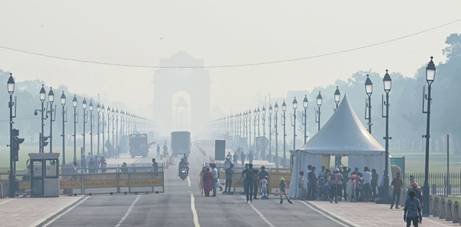
File image: haze over central Delhi (photo: DD News).
Subject: Environment – Urban Air Pollution
Paper: GS Paper 3: Environment – pollution; GS Paper 1: Urbanisation
UPSC Relevance: Delhi overtook Lahore to become the world’s most polluted major city on 13 November 2026, with air quality at hazardous levels and smog cutting visibility, according to IQAir readings reported by The Hindu; Indian monitors showed severe air with GRAP-III curbs in force.
Why in News
Delhi overtook Lahore to become the world’s most polluted city on Friday, 13 November 2026, as air quality reached hazardous levels and smog blanketed the city of 20 million people, with visibility dropping.
Swiss group IQAir’s readings put Delhi’s air quality index at 334 – in the “hazardous” band; other trackers showed Indian monitoring stations deep in the “severe” category, with GRAP-III restrictions reported in force across the NCR.
The spike follows the familiar post-Deepavali and post-harvest pattern: firecracker emissions, stubble burning in Punjab and Haryana, falling temperatures and slow winds trapping pollutants close to the ground.
Background
The Air Quality Index bands run Good (0-50), Satisfactory, Moderate, Poor, Very Poor (301-400) and Severe (401-500); a 334 reading is Very Poor nationally, while IQAir’s US-based labelling calls the same concentration hazardous – a reminder that AQI labels are not globally uniform.
The Graded Response Action Plan (GRAP), enforced by the Commission for Air Quality Management (CAQM), escalates curbs in four stages: Stage III restricts construction and older diesel vehicles and shifts schools partly online; Stage IV adds truck-entry bans and closures.
Delhi’s winter pollution is a chemistry of local and regional sources – vehicles, industry, dust, biomass and crop-residue burning – locked in by the season’s temperature inversion and low wind speeds.
Key Dimensions
1. The transboundary table: Delhi overtaking Lahore headlines a shared regional emergency: the Indo-Gangetic plain from Punjab to Dhaka is the world’s largest concentration of severe air pollution, and no single city can clean its own air alone.
2. The GRAP treadmill: Emergency curbs now arrive every winter on schedule – evidence that the crisis is structural, and that GRAP manages peaks rather than reducing the season’s baseline.
3. The health ledger: Hazardous air is a public-health event measured in hospital admissions, school closures and lost labour days; the poor, who work outdoors, absorb the largest dose with the least protection.
4. The accountability map: Vehicles, dust and waste are municipal; stubble is agricultural and inter-state; industry is regulatory – the pollutant mix mirrors a fragmented governance map that the CAQM was created to coordinate.
Significance
1. Air pollution is India’s deadliest environmental risk and a recurring GS3 theme linking health, agriculture, energy and urban governance.
2. The episode will test CAQM’s coordination powers and the political economy of farm-fire enforcement.
3. It sharpens the case for regional airshed management – treating the Indo-Gangetic plain as one pollution basin.
Challenges
1. Stubble-burning control depends on farm economics and machinery access, not just bans and fines.
2. Winter meteorology guarantees that any emission surplus becomes hazardous air; only emission cuts change outcomes.
3. Enforcing GRAP uniformly across NCR districts spanning three states and a union territory.
Way Forward
1. Watch CAQM decisions on escalating or relaxing GRAP stages over the coming week.
2. Track Punjab and Haryana farm-fire counts and enforcement data.
3. Note health-advisory measures – school closures, work-from-home orders – in Delhi and NCR.
Prelims Value Addition
- ‘Delhi became the world’s most polluted major city on 13 November 2026 (IQAir), with AQI around 334, in the hazardous band.’
- ‘AQI Severe band: 401-500; Very Poor: 301-400 (CPCB classification).’
- ‘GRAP has four stages and is implemented by the CAQM for the National Capital Region and adjoining areas.’
- ‘Temperature inversion and low wind speeds in winter trap pollutants near the surface.’
Mains Value Addition
- “India’s air-pollution crisis is a governance failure more than a meteorological one.” Discuss.
- Examine the case for airshed-level management of air quality in the Indo-Gangetic plain.
Topic 8: Outrunning Us: COP31 Opens With a Climate Finance Gap
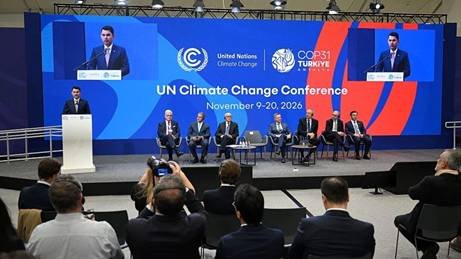
File image: the UN climate conference venue (photo: DD News).
Subject: Environment – Climate Diplomacy
Paper: GS Paper 3: Environment – climate change; GS Paper 2: International institutions
UPSC Relevance: COP31 opened in Turkiye on 11 November 2026 with urgent pleas from climate-vulnerable nations for finance meeting what Reuters described as a non-urgent response, as Western governments prioritise national security and living costs; the UN chief warned the climate crisis is outrunning us.
Why in News
COP31 opened in Turkiye with a Leaders’ Summit on 11 November 2026; the UN Secretary-General warned that the climate crisis is “outrunning us” and called for a faster phase-out of fossil fuels and increased climate finance.
Two years ago at COP29, rich countries agreed to triple climate funding for poorer countries to USD 300 billion per year by 2035, up from the earlier USD 100 billion target, with total financing from all public and private sources to reach USD 1.3 trillion annually by 2035.
Reuters reported that urgent pleas for cash from the nations most exposed to climate disasters risk a sluggish response, as Western governments put national security and living costs first; UN News said calls are growing for polluters to pay.
Background
The UNFCCC’s annual Conference of the Parties is the world’s climate legislature: Paris (2015) set the temperature goals, Glasgow (2021) the 1.5C resolve, Dubai (2023) the transition away from fossil fuels, and Baku (2024) the New Collective Quantified Goal of USD 300 billion a year by 2035.
COP31’s presidency was unusual – a partitioned arrangement between Turkiye and Australia after a contested host selection, reflecting how even venue politics now tracks geopolitical alignment.
The finance question is the regime’s oldest fault line: the 2009 promise of USD 100 billion a year by 2020 was met late, and the 2035 goal arrives as developing countries’ assessed needs run into trillions.
Key Dimensions
1. The delivery gap: The Baku goal exists on paper; COP31’s test is the pipeline – how much of the USD 300 billion is budgeted, mobilised and accessible to the poorest, not re-labelled development aid.
2. The sequencing conflict: Western governments face electorates focused on security and living costs; climate-vulnerable states face disasters now – COP31 stages this as a direct collision of political clocks.
3. The polluter-pays turn: UN-framed calls for polluters to pay signal a shift from voluntary pledges toward liability-flavoured mechanisms – taxes on fossil windfalls and high emitters feeding adaptation funds.
4. India’s lane: India negotiates as a developing economy with high vulnerability and high ambition: pressing for finance and technology transfer while expanding renewables – and defending developmental headroom on fossil phase-down timelines.
Significance
1. Climate finance is the single variable that decides whether the Paris architecture survives its implementation decade.
2. COP31 outcomes shape the next round of national climate pledges (NDCs) and adaptation funding for the most exposed states.
3. For GS3, it connects global negotiation mechanics to India’s energy transition and disaster-finance needs.
Challenges
1. Converting the USD 300 billion pledge into delivered, grant-heavy finance rather than loans that deepen debt distress.
2. Holding a fractured geopolitical consensus together inside a partitioned presidency.
3. Keeping fossil phase-out language alive against producer-state resistance – Venezuela told COP31 it has a sovereign right to pump more oil.
Way Forward
1. Watch the COP31 cover decision’s language on finance delivery and fossil fuels.
2. Track the operationalisation of the Loss and Damage Fund and adaptation-finance pledges.
3. Note India’s interventions on finance, technology transfer and equity.
Prelims Value Addition
- ‘COP31 opened in Turkiye on 11 November 2026, under an unprecedented partitioned Turkiye-Australia presidency.’
- ‘COP29 (Baku, 2024) agreed the New Collective Quantified Goal: USD 300 billion per year by 2035 for developing countries.’
- ‘The 2009 Copenhagen pledge was USD 100 billion per year by 2020 – delivered late.’
- ‘The UNFCCC was adopted in 1992; the Paris Agreement in 2015 sets the 1.5C/2C goals.’
Mains Value Addition
- “Climate finance, not ambition, is now the binding constraint on global climate action.” Discuss with reference to COP31.
- Examine India’s negotiating priorities in the UNFCCC process.
