
Topic 1: World Court Finds Myanmar Committed Genocide Against the Rohingya
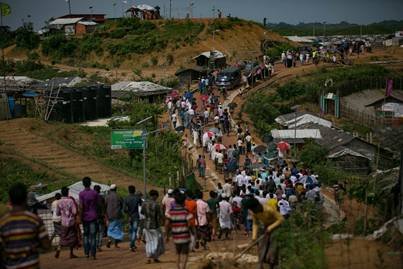
File image: Rohingya refugees at a settlement in Bangladesh (photo: DD News).
Subject: International Relations – International Law and Institutions
Paper: GS Paper 2: Important international institutions, agencies and fora; their structure, mandate and functioning
UPSC Relevance: The International Court of Justice on 19 November 2026 held that Myanmar committed genocide against its Rohingya Muslim minority in northern Rakhine State, ruling that the actions of Myanmar’s security forces in 2017 were carried out with the intention to destroy a substantial part of the group, the first time the World Court has found a state responsible for the crime of genocide.
Why in News
The verdict, read out by ICJ President Yuji Iwasawa in a sitting that ran for about three hours, concluded that Myanmar acted in violation of its obligations under the Convention on the Prevention and Punishment of the Crime of Genocide of 1948.
Judges found that Myanmar’s security forces killed thousands of members of the Rohingya population and committed widespread sexual violence during the 2017 military offensive, and that these acts met the demanding legal threshold of genocidal intent.
The finding of intent to destroy is the hardest element of genocide to prove, since it requires evidence of a specific purpose beyond killing or displacement; the Court’s willingness to infer that intent from the pattern of violence gives the judgment unusual legal weight.
The case was brought before the Court by The Gambia in 2019, an unusual instance of a small West African state, with no direct stake in the conflict, invoking the Genocide Convention on behalf of a persecuted people in Asia.
The judgment is the first in the Court’s history to hold a state itself responsible for genocide, converting a crime that has mostly been litigated against individuals into a question of state accountability at the highest judicial level.
The Court ordered Myanmar to enact legislation giving full effect to the Convention, to investigate and prosecute persons reasonably suspected of acts contrary to it, to provide assurances and guarantees of non-repetition, and to adopt restitution including the safe, voluntary and dignified return of displaced Rohingya and reunification of families.
Compensation to the Rohingya group was ordered in principle, with the amount and modalities reserved for a subsequent phase; Myanmar must report to the Court within two years on the restitution measures it has adopted.
The Court also found that Myanmar violated its 23 January 2020 provisional measures obligation to preserve evidence, while holding that Myanmar did not directly and publicly incite private persons to commit genocide, a finding on which one judge dissented in part.
Background
The Rohingya are a Muslim minority concentrated in Myanmar’s Rakhine State who have long been denied citizenship under Myanmar’s 1982 citizenship law and rendered effectively stateless.
In August 2017, Myanmar’s military launched clearance operations after attacks on security posts, driving more than seven lakh Rohingya across the border into Bangladesh, where most remain in the camps of Cox’s Bazar.
The Genocide Convention, adopted on 9 December 1948 in the shadow of the Holocaust, obliges parties to prevent and punish genocide and allows any party to bring another before the ICJ for breach of its obligations.
The ICJ had already ordered provisional measures in January 2020 directing Myanmar to prevent genocidal acts and preserve evidence, steps Myanmar was required to report on while the merits phase continued.
Myanmar’s political situation deteriorated further after the February 2021 military coup, with civil war, the rise of the Arakan Army in Rakhine and fresh violence complicating any prospect of safe return for the refugees.
India is directly touched by the issue: it hosts Rohingya refugees, is not a party to the 1951 Refugee Convention, and has treated the question primarily as one of migration and security while assisting both Bangladesh and Myanmar with humanitarian relief.
Key Dimensions
1. State responsibility versus individual guilt: The judgment operates at the level of the state, complementing rather than replacing criminal proceedings against generals, and it shows that the Genocide Convention was designed to bind governments, not only persons.
2. Intent as the decisive test: By inferring intent to destroy from the scale, pattern and targeting of the 2017 operations, the Court clarified how genocidal purpose can be established without a written order, a reading that will shape every future genocide case.
3. Enforcement gap: ICJ judgments are binding but carry no police force; implementation runs through the United Nations Security Council, where Myanmar’s protectors hold vetoes, so the legal victory must be converted into diplomatic pressure.
4. Unlikely litigant model: The Gambia’s initiative demonstrates that any party to the Convention can act for victims anywhere, a doctrine of common interest that widens accountability but also invites disputes about standing and selectivity.
Significance
1. Delivers judicial recognition to survivors after nearly a decade of denial and delay, establishing an authoritative factual record of the 2017 atrocities.
2. Raises the legal and diplomatic cost for Myanmar’s rulers and for states supplying them with arms, finance and political cover.
3. Sets a precedent that will be studied in every pending and future genocide case, tightening the evidentiary and legal framework.
4. Revives the preventive purpose of the Genocide Convention, whose promise has repeatedly outrun its performance.
Challenges
1. The ICJ cannot compel Myanmar to comply, and Security Council action remains hostage to veto politics.
2. Conditions for safe, voluntary and dignified repatriation do not exist in Rakhine, which is now a theatre of civil war.
3. Humanitarian funding for the Cox’s Bazar camps has been shrinking even as the legal process advances.
4. Major powers may treat the verdict instrumentally, invoking it selectively against adversaries while shielding friends.
5. The verdict arrives while Rakhine is contested between the military and the Arakan Army, so even willing compliance would face the practical problem of who controls the territory to which the Rohingya would return.
Way Forward
1. Track Myanmar’s compliance reporting and the remedial orders the Court issues on reparations and guarantees of non-repetition.
2. Watch whether the verdict energises parallel accountability tracks, including universal jurisdiction cases and targeted sanctions.
3. Follow the humanitarian response in Bangladesh, where the verdict strengthens the case for sustained burden sharing.
4. Note how regional groupings, including ASEAN and BIMSTEC, absorb the finding in their engagement with Myanmar.
5. Track whether states that supplied Myanmar with arms and finance reassess their exposure now that a court of final resort has characterised the conduct as genocide.
Prelims Value Addition
- The Genocide Convention was adopted on 9 December 1948 and entered into force in 1951; India has been a party to it since 1959.
- The ICJ, seated at The Hague, is the principal judicial organ of the United Nations with 15 judges; it settles disputes between states and gives advisory opinions.
- The International Criminal Court, also at The Hague, is a separate treaty-based body that prosecutes individuals; India is not a member of the ICC.
- The ICJ’s earlier genocide jurisprudence includes the 2007 Bosnia judgment, which found a failure to prevent genocide at Srebrenica but stopped short of finding the respondent state itself responsible for committing genocide.
- ICJ judges are elected to nine-year terms by the UN General Assembly and the Security Council voting independently, and no two judges may be nationals of the same state.
Mains Value Addition
- “The ICJ’s Myanmar verdict marks the coming of age of state accountability for genocide.” Critically examine, with reference to the limits of judicial enforcement.
- Discuss the significance of the Genocide Convention’s inter-state litigation mechanism, and evaluate what the Rohingya judgment means for India’s neighbourhood diplomacy.
Topic 2: Xi, Trump and Putin Issue ‘Declaration Towards Peace’ After First-Ever Trilateral
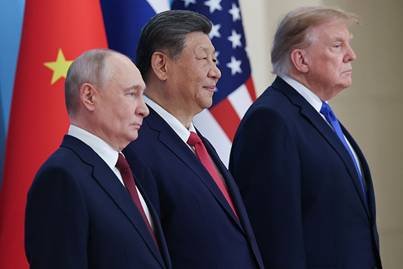
The US, Chinese and Russian Presidents at their trilateral meeting in Shenzhen, 19 November 2026 (photo: DD News).
Subject: International Relations – Great Power Politics
Paper: GS Paper 2: Effect of policies and politics of developed and developing countries on India’s interests; important international institutions
UPSC Relevance: The Presidents of the United States, China and Russia on 19 November 2026 concluded their unprecedented trilateral meeting at Shenzhen with a four-point ‘Declaration Towards Peace’, calling for United Nations reforms, committing to dialogue on reducing nuclear risks, outlining plans to raise the production and supply of refined petroleum products, and asserting that the International Criminal Court and similar bodies must not abuse their jurisdiction.
Why in News
The 90-minute meeting at the Kylin Villa in Shenzhen, held on the sidelines of the APEC summit hosted by China, was the first time Donald Trump, Xi Jinping and Vladimir Putin sat down together, giving the joint text a symbolic weight beyond its contents.
The declaration’s call for UN reforms places the question of restructuring the world body’s principal organs, including the Security Council, on the agenda of the three most powerful states, even though each understands reform differently.
The commitment to hold dialogue on reducing nuclear risks and preventing proliferation, framed around the reaffirmation that a nuclear war cannot be won and must never be fought, is the first trilateral acknowledgment that the arms control framework built for the US-Russia duopoly no longer fits a three-power nuclear age.
The pledge to expand production and supply of refined petroleum products is a direct response to the energy crisis roiling importing economies, signalling that the three powers intend to manage oil markets politically rather than leave them to OPEC-plus arithmetic.
The paragraph warning the International Criminal Court and similar bodies against abusing their jurisdiction reads as a pointed message to The Hague, delivered a day when international courts are asserting themselves against powerful states.
Background
The trilateral caps two days of high drama at the Shenzhen APEC summit, where Xi and Putin had opened bilateral talks on 18 November before Trump joined on 19 November for the three-way session.
None of the three powers is a member of the International Criminal Court: the United States unsigned the Rome Statute, Russia withdrew its signature, and China never joined, and all three have faced or resisted ICC processes.
Arms control architecture has decayed over the past decade, with the INF Treaty dead, New START weakened and China’s arsenal expanding outside any treaty ceiling.
The energy crisis referenced in the declaration flows from supply disruptions and conflict-linked sanctions that have kept refined product markets tight and importing countries, including India, exposed to price shocks.
The APEC host context matters: China has used the Shenzhen summit to present itself as convener of global order, and the declaration lets all three leaders claim statesmanship without conceding substance on Ukraine, trade or technology.
The venue carried its own message: Shenzhen is the showcase of China’s technology rise, and receiving the American and Russian presidents there let Beijing fold a story about peace into a story about its own centrality.
Key Dimensions
1. Concert diplomacy institutionalised: A joint declaration converts a one-off photo opportunity into a documented common position, a small but real step toward a directorate of three managing global problems over the heads of others.
2. UN reform opening: When the three permanent powers most resistant to Charter change themselves call for UN reforms, middle powers like India gain an opening to press their own cases, though the declaration specifies nothing about Security Council expansion.
3. Nuclear risk dialogue: Trilateralising nuclear risk reduction acknowledges structural reality, but a dialogue is not a treaty; the test is whether working-level talks on ceilings, transparency and de-escalation follow.
4. Courts under counter-attack: The ICC paragraph signals a coordinated pushback by non-member powers against international criminal jurisdiction, which could narrow the space for accountability even as the ICJ asserts itself elsewhere.
Significance
1. First joint document ever issued by the three leaders together, creating a template that can be invoked and repeated.
2. Legitimises trilateral crisis management on energy and nuclear risk, areas where bilateral frameworks had failed.
3. Gives China a convening triumph at minimal cost and lets Washington and Moscow claim peacemaking credentials amid unresolved wars.
4. Sharpens the debate on the future of international courts by putting three non-members on record against jurisdiction they call abusive.
5. For energy-importing economies such as India, even a loosely worded commitment by the three largest powers to expand refined product supply is a signal worth watching at a time of tight fuel markets.
Challenges
1. The declaration contains no timelines, mechanisms or verification, leaving each point vulnerable to quiet burial.
2. UN reform means incompatible things in Washington, Beijing and Moscow, and consensus among three is no guarantee of the wider membership’s assent.
3. Energy supply pledges may collide with sanctions regimes and OPEC-plus coordination, blunting delivery.
4. Excluding affected states and institutions from the trilateral format risks producing declarations that are celebrated in three capitals and ignored everywhere else.
5. The declaration’s silence on the wars in Ukraine and West Asia, the very conflicts that make peace rhetoric necessary, limits its claim to be a peace document rather than a framework statement.
Way Forward
1. Track whether foreign ministers or sherpa-level groups are tasked with follow-up on each of the four points.
2. Watch the language on UN reforms for any reference to Security Council membership, the question that matters most to India.
3. Follow nuclear-risk dialogue announcements for participants, agenda and any link to existing treaties.
4. Observe reactions from the ICC, European states and energy importers to gauge whether the declaration shapes behaviour or remains theatre.
5. Note whether the declaration’s energy language is followed by concrete supply measures or coordination with producer groups, which would separate substance from symbolism.
Prelims Value Addition
- APEC groups 21 Asia-Pacific economies and reaches non-binding decisions by consensus; India is not a member.
- The UN Security Council has five permanent members with veto power; its composition was last altered in 1965 when non-permanent seats rose from six to ten.
- The International Criminal Court was established by the Rome Statute of 1998 and began functioning in 2002; it prosecutes individuals for genocide, war crimes and crimes against humanity.
- New START, the last major US-Russia arms control treaty, capped deployed strategic warheads at 1,550 each; China has never accepted numerical limits on its arsenal.
Mains Value Addition
- “The Declaration Towards Peace is less a peace plan than a claim to manage the world.” Discuss with reference to the interests of middle powers like India.
- Examine the implications of trilateral great-power coordination for United Nations reform and for the international criminal justice system.
Topic 3: EPFO Board Approves Systematic Withdrawal Plan, Cuts Minimum PF Balance to 10 Per Cent
Illustrative image: the EPFO logo on a mobile phone (photo: DD News).
Subject: Social Security – Labour and Employment
Paper: GS Paper 2: Welfare schemes for vulnerable sections; GS Paper 3: Indian economy – employment and growth
UPSC Relevance: The Central Board of Trustees of the Employees’ Provident Fund, chaired by Union Labour Minister Mansukh Mandaviya at its 240th meeting in New Delhi on 19 November 2026, approved a Systematic Withdrawal Plan for retiring members, reduced the mandatory minimum balance in provident fund accounts from 25 per cent to 10 per cent, and cut the waiting period for final withdrawal from 12 months to 2 months.
Why in News
The Systematic Withdrawal Plan will let retiring members receive their accumulated provident fund in periodic instalments, monthly, quarterly or half-yearly, instead of a single lump sum, giving retirees a structured income while the remaining corpus continues to earn returns.
The facility is entirely voluntary and may be extended to eligible family members or beneficiaries; if a member dies during the payout period, the nominee can withdraw the balance or continue the periodic payments.
About 6.32 lakh EPF members aged above 55 with accumulations exceeding Rs 5 lakh are expected to be the initial beneficiaries of the SWP framework, which is also designed to extend social security thinking to gig and platform workers.
The proposal introduces UAN-linked mechanisms for direct voluntary contributions and third-party micro-contributions, such as customer tips, independent of employer payroll systems, with amendments to the EPF scheme and the Income Tax Act to follow.
The Board also approved relief in Employees’ Deposit Linked Insurance exemption cases, in-principle approval to invest up to 3 per cent of fresh accretion in eligible Alternative Investment Funds through government-backed entities, and reviewed the surrender of exemptions involving the transfer of about Rs 5,996 crore covering 1,44,437 members to EPFO’s direct administration.
The Board also approved the Revised Estimates for 2026-27 and Budget Estimates for 2027-28 of EPFO under the EPF, EPS and EDLI schemes, covering projected receipts, income and expenditure for the coming cycle.
Background
The EPFO administers the EPF Scheme, the Employees’ Pension Scheme and the EDLI Scheme for the organised-sector workforce, and is governed by the Central Board of Trustees, a tripartite body of government, employer and employee representatives chaired by the Labour Minister.
Recent reforms include raising the wage ceiling for mandatory EPF coverage from Rs 15,000 to Rs 25,000, simplified partial withdrawal rules and liberalised withdrawal limits.
The Centralised IT Enabled System, CITES 2.0, developed by C-DAC, has raised auto-processing of claims from 39 per cent to 71 per cent, cut the rejection ratio from 23 per cent to 7.82 per cent and brought average claim settlement time down from 11.15 days to 2.57 days.
India’s organised workforce has long faced a binary between the EPS pension, often modest, and the lump-sum PF withdrawal, which retirees frequently exhaust early; annuity-style options within the PF architecture were absent.
The changes approved at the meeting require notification by the Ministry before they take effect.
Key Dimensions
1. Retirement income design: The SWP converts a savings pot into an income stream, addressing longevity risk and reinvestment risk, the two ways lump sums fail retirees, while preserving ownership of the underlying corpus.
2. Flexibility versus adequacy: Cutting the locked-in minimum balance from 25 to 10 per cent and the waiting period from 12 to 2 months answers long-standing member demands for access, but every rupee freed for withdrawal is a rupee not compounding for old age.
3. Portfolio diversification: The in-principle nod for up to 3 per cent of fresh accretion in Alternative Investment Funds, initially through government-backed entities, is a cautious opening of India’s largest retirement fund to higher-yield assets within the existing investment ceiling.
4. Governance by data: CITES 2.0’s gains show social security delivery improving through centralised digital processing, which matters for trust: a 2.57-day average settlement changes how workers perceive the institution.
Significance
1. Moves India’s largest retirement fund from a savings account toward a retirement income system.
2. Directly benefits an estimated 6.32 lakh members above 55 in the first phase, with the option open to all future retirees.
3. Increases liquidity for millions of members while retaining a residual 10 per cent floor for old-age protection.
4. Signals that social security is being redesigned for portability, voluntary contribution and gig-economy inclusion.
5. The EDLI relief, a six-month window to renew expired exemptions with protection from contributions, interest and penal damages for verified transitional periods, clears a long-pending legacy backlog for establishments that maintained genuine group insurance cover.
Challenges
1. Sequencing notification, system readiness and member education will decide whether SWP becomes a default of choice or a footnote.
2. Lower minimum balance and shorter waiting period could raise premature withdrawal, undermining retirement adequacy for precisely the workers the floor was meant to protect.
3. AIF exposure, even capped and government-backed, introduces market and selection risks into a fund whose members have no choice but to trust its trustees.
4. The EPS pension’s structural inadequacy remains untouched; SWP supplements but does not repair the pension leg.
5. Extending SWP-style income streams to gig and platform workers requires contribution rails that do not yet exist at scale, and the UAN-linked voluntary mechanism is only the first plank.
Way Forward
1. Watch for the formal notification of the SWP rules, including payout frequencies, taxation treatment and family access.
2. Track the proposed Income Tax Act amendment and the treatment of voluntary and third-party micro-contributions.
3. Monitor early uptake among the 6.32 lakh eligible members and any extension to younger cohorts.
4. Follow EPFO’s disclosures on AIF allocations, safeguards and returns once the investment begins.
Prelims Value Addition
- The Employees’ Provident Funds and Miscellaneous Provisions Act was enacted in 1952; the EPF scheme covers establishments with 20 or more employees above the notified wage ceiling.
- The Central Board of Trustees is a tripartite body with representatives of the Centre, States, employers and employees; the Union Labour Minister chairs it.
- EPFO manages one of the world’s largest social security fund pools and invests predominantly in debt, with a limited equity component through exchange-traded funds introduced in 2015.
- The EDLI scheme provides life insurance cover to EPF members; the 2026 amendments resolve legacy exemption cases pending from the earlier 1976 scheme.
- The wage ceiling for mandatory EPF coverage was recently enhanced from Rs 15,000 to Rs 25,000 per month, widening the mandatory net to a larger share of the organised workforce.
Mains Value Addition
- “Periodic payouts rather than lump sums are the future of provident fund design.” Discuss in the light of the EPFO’s Systematic Withdrawal Plan.
- Examine the tension between withdrawal flexibility and retirement adequacy in India’s provident fund reforms, and suggest safeguards.
Topic 4: SRS 2024 Records National Sex Ratio at Birth at 918 as Central Board Reviews PC&PNDT Act
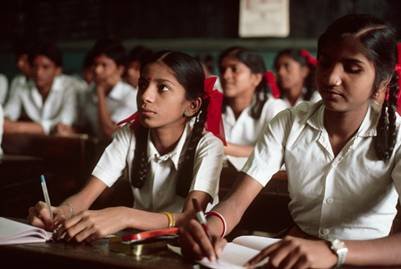
Representative image: schoolgirls in a classroom (photo: DD News); the SRS 2024 sex ratio at birth was 918 girls per 1,000 boys.
Subject: Society and Health – Demography and Gender
Paper: GS Paper 1: Salient features of Indian society, role of women; GS Paper 2: Issues relating to health and development
UPSC Relevance: The Sample Registration System 2024 report has placed the national sex ratio at birth at 918 girls per 1,000 boys, even as improved figures were recorded in many States and Union Territories; the data was discussed at the 32nd meeting of the Central Supervisory Board on 19 November 2026, chaired by Union Health Minister Jagat Prakash Nadda, which reviewed implementation of the Pre-conception and Pre-natal Diagnostic Techniques (Prohibition of Sex Selection) Act, 1994.
Why in News
An SRB of 918 means the natural biological balance, where about 950 girls are born per 1,000 boys, continues to be distorted by sex selection, leaving tens of thousands of missing girls every year.
The Board deliberated on recommendations of the High-Level Committee on Non-Financial Regulatory Reforms in the context of strengthening PC&PNDT implementation, and the Health Minister called on States to ensure regular inspections of registered facilities and prompt follow-up on violations.
Discussions covered digital processes, capacity building of Appropriate Authorities, engagement with medical professionals, targeted interventions and sharing of good practices among States and Union Territories.
Minister of State Anupriya Patel framed the issue within the government’s shift from women-centric development to women-led development, stressing education and mindset change as essential to gender balance.
The meeting acknowledged that diagnostic technology keeps evolving, from ultrasound to newer genetic techniques, requiring the Act’s enforcement to keep pace with methods of misuse.
Background
The PC&PNDT Act began as the PNDT Act of 1994, enacted to ban sex determination, and was amended in 2003 to bring pre-conception sex selection techniques within its scope.
The Act prohibits determination and communication of the sex of the foetus, regulates ultrasound clinics and diagnostic centres through mandatory registration, and creates Appropriate Authorities at State and district levels with search, seizure and prosecution powers.
India’s child sex ratio has been a long-standing concern: the 2011 Census recorded 918 girls per 1,000 boys in the 0-6 age group, among the worst in the world, prompting the Beti Bachao Beti Padhao campaign in 2015.
The Sample Registration System, conducted by the Office of the Registrar General and Census Commissioner, is India’s largest demographic sample survey and the standard source for fertility, mortality and SRB indicators between censuses.
Sex selection persists through a mix of son preference, dowry economics, small-family norms and a profitable, mobile supply of diagnostic services that often operates across district and State lines.
The 2011 Census recorded a child sex ratio of 918 girls per 1,000 boys in the 0-6 age group, down from 927 in 2001, which had made India one of the most skewed large populations in the world.
Beti Bachao Beti Padhao, launched in January 2015, combined PC&PNDT enforcement with education incentives and a media campaign, and became the umbrella under which the girl-child agenda is administered across ministries.
Key Dimensions
1. Data as alarm: The SRS figure matters because it is contemporaneous and official; a stagnant SRB despite three decades of law indicates that enforcement has bent but not broken the practice.
2. Enforcement architecture: The Act’s strength, a decentralised network of Appropriate Authorities, is also its weakness, since inspection quality, prosecution speed and conviction rates vary sharply across States.
3. Technology treadmill: Each advance in prenatal testing creates new channels for sex selection, so the Board’s emphasis on digital processes and monitoring reflects an enforcement race against innovation.
4. Norms before law: Improved SRB in many States shows change is possible, but durable correction depends on the perceived value of daughters, which schemes, education and women’s economic agency shape more than raids do.
Significance
1. Keeps sex selection on the national policy agenda with current official numbers rather than dated census figures.
2. Links regulatory reform, through the High-Level Committee’s recommendations, to a social legislation usually treated as purely criminal.
3. Reinforces inter-State collaboration against diagnostic services that migrate across borders to evade enforcement.
4. Connects the demographic imbalance to the broader women-led development framework the government has adopted.
5. Improved figures in many States and Union Territories show the trend is not uniform decline, giving policymakers identifiable success cases to study and replicate.
Challenges
1. Conviction rates under the Act remain low, and cases often collapse on procedural grounds, blunting deterrence.
2. Portable and informal diagnostic services, including cross-border and home-visit models, evade the registration net.
3. Son preference is economically reinforced by dowry, patrilineal inheritance and old-age security concerns, which health regulation alone cannot address.
4. A worsening SRB in pockets, masked by national averages, can escape notice until cohorts reach marriage age.
5. Small-family norms intensify the pressure: when couples plan one or two children, the preference for a son concentrates on fewer births and raises the temptation of sex selection.
Way Forward
1. Track State-wise SRB trends in successive SRS reports to identify where the improvement is real and where it is statistical.
2. Watch for amendments or rules flowing from the High-Level Committee’s recommendations on inspections and digital tracking.
3. Follow conviction data and the functioning of State Appropriate Authorities, not just registration counts.
4. Note integration of SRB monitoring with other missions, including maternal health and girls’ education programmes.
5. Watch State-wise disaggregation of the SRS 2024 figures when released, since national stability can conceal sharp deterioration in specific States or districts.
Prelims Value Addition
- The PC&PNDT Act, 1994 (amended 2003) bans sex selection before and after conception and penalises both providers and seekers of sex determination.
- The Central Supervisory Board, chaired by the Union Health Minister, oversees the Act; State Supervisory Boards and district Appropriate Authorities implement it.
- A biologically normal sex ratio at birth is around 943 to 952 girls per 1,000 boys; India’s SRS 2024 figure of 918 indicates persisting sex selection.
- The Beti Bachao Beti Padhao scheme, launched in January 2015, combines enforcement, education and media advocacy against gender-biased sex selection.
- The Registrar General and Census Commissioner publishes the Sample Registration System, which covers a large, continuously surveyed sample of households and provides annual demographic estimates between censuses.
Mains Value Addition
- “Three decades of the PC&PNDT Act show that law can police clinics but not preferences.” Critically examine in the light of the SRS 2024 sex ratio at birth.
- Discuss the institutional architecture for preventing sex selection in India and evaluate the role of technology, enforcement and social norms in its effectiveness.
Topic 5: Centre Revises PUC Validity: Three Years for New BS-VI Private Vehicles, Shorter for Older Ones
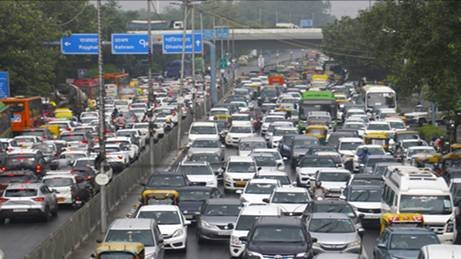
Representative image: heavy road traffic (photo: DD News); PUC rules govern vehicle emissions testing.
Subject: Environment and Transport – Pollution Regulation
Paper: GS Paper 3: Environment – pollution; infrastructure and regulatory policy
UPSC Relevance: The Ministry of Road Transport and Highways on 19 November 2026 notified revised validity periods for Pollution Under Control certificates, linking the frequency of mandatory emission testing to a vehicle’s emission standard and age, through an amendment to sub-rule (7) of Rule 115 of the Central Motor Vehicles Rules, 1989, with the new rules taking effect from 19 November 2026.
Why in News
The change links PUC validity to actual emission performance rather than a one-size-fits-all schedule: a new BS-VI private car emits a fraction of what a fifteen-year-old vehicle emits, so testing them at the same frequency wastes compliance effort.
Shorter validity retained for older vehicles concentrates inspection on the fleet segment that contributes most to vehicular pollution, improving the signal value of each test.
PUC certification is India’s only mass emission-surveillance instrument, touching nearly every registered motor vehicle, so its design determines whether the system detects gross polluters or merely collects fees.
Under the notified schedule, BS-I, BS-II and BS-III vehicles get a PUC validity of three months and BS-IV vehicles six months, while BS-VI non-transport vehicles get three years up to six years of age, one year between six and ten years, and six months beyond ten years; BS-VI transport vehicles get two years, one year and six months on the same age bands.
The revised validity applies to existing PUC certificates only when they come up for their first renewal after 19 November 2026, so the transition is phased rather than abrupt for current certificate holders.
A renewal-timing rule accompanies the schedule: certificates renewed within ten days before expiry take effect from the expiry date, preserving continuity, while those renewed after expiry take effect from the renewal date, penalising procrastination with a coverage gap.
The revision reduces the compliance burden and queuing costs for owners of new vehicles, a modest but widely felt ease-of-living measure for the growing BS-VI fleet.
The move lands in the middle of the winter pollution season, when vehicular emissions combine with meteorology to drive severe air quality episodes across northern India.
Background
PUC certification flows from Section 190(2) of the Motor Vehicles Act, 1988, read with Rule 115 of the Central Motor Vehicles Rules, 1989, which prescribe emission norms and testing; driving without a valid PUC certificate is a punishable offence.
India’s Bharat Stage emission standards were introduced in 2000 and progressively tightened; the country skipped BS-V and moved directly from BS-IV to BS-VI in April 2020, a leap of roughly one full generation of technology.
BS-VI petrol and diesel vehicles emit dramatically lower particulate matter and nitrogen oxides than BS-III or BS-IV vehicles, but the on-road fleet remains dominated by older vintages.
Vehicular emissions are among the largest contributors to urban air pollution in Indian cities, and winter episodes in Delhi-NCR routinely trigger the Graded Response Action Plan with curbs on older and more polluting vehicles.
PUC testing centres are licensed to private operators at fuel stations and workshops, an arrangement that has periodically raised concerns about perfunctory tests, fee-driven issuance and weak calibration.
The Graded Response Action Plan for Delhi-NCR, implemented by the Commission for Air Quality Management, restricts older diesel and petrol vehicles in stages as air quality deteriorates, making vehicle age and standard an established basis for regulation.
The Voluntary Vehicle Fleet Modernisation Programme provides the scrappage framework under which old vehicles can be retired against incentives, and PUC differentiation complements it by raising the cost of keeping aged vehicles running.
Key Dimensions
1. Risk-based regulation: Differentiating validity by emission standard and age is regulatory triage: frequent testing where the risk is, relief where it is not, a principle that could extend to fitness and inspection regimes.
2. Fleet vintage as policy: The real pollution problem is the tail of old vehicles; PUC design nudges owners toward scrappage or retrofit by raising the compliance friction of keeping an old vehicle on the road.
3. Ease of living: The three-year validity for new private vehicles removes a recurring chore for millions of owners and trims the transaction costs of the certification industry.
4. Integrity of testing: Longer validity raises the stakes of each test being genuine; if issuance remains fee-driven, fewer tests mean fewer chances to catch tampering, so enforcement quality must rise with the interval.
Significance
1. Aligns the compliance burden with emission risk across nearly the entire registered vehicle fleet.
2. Reinforces the policy trajectory of scrappage and faster fleet renewal toward BS-VI and electric vehicles.
3. Frees enforcement attention for older vehicles during the high-pollution winter months.
4. Modernises a colonial-era style universal rule into a differentiated, standards-linked instrument.
5. The revision quietly embeds emission standards into everyday compliance, so that a vehicle’s Bharat Stage rating, not just its registration, determines its regulatory treatment.
Challenges
1. PUC centres’ testing integrity is uneven, and longer validity magnifies the cost of each fraudulent certificate.
2. Older commercial vehicles, the heaviest polluters per kilometre, operate under economic pressure that encourages evasion.
3. Without real-time roadside monitoring or remote sensing, validity periods alone cannot detect in-use deterioration between tests.
4. Coordination with State transport departments and enforcement agencies, who implement the rules, will decide actual impact.
5. State transport departments and pollution testing infrastructure must update software, fee structures and certificates, and uneven implementation across States could create a patchwork of validity rules.
6. The benefit flows mainly to owners of new private vehicles, while commercial and two-wheeler fleets, larger pollution contributors per vehicle, see little relief or change.
Way Forward
1. Watch State-level adoption and system updates now that the notified rules are in force, since PUC centres and transport databases must reflect the new validity schedule.
2. Track whether the Centre pairs longer validity with stronger centre audits, calibration checks and penalties for fake certificates.
3. Follow integration of PUC data with VAHAN and enforcement databases for automatic flagging of lapsed certificates.
4. Note any move toward remote sensing or on-board diagnostics for in-use emission monitoring as the logical next step.
5. Follow State-level adoption, since motor vehicle rules operate through State enforcement machinery and real relief depends on local systems recognising the new validity periods.
Prelims Value Addition
- PUC norms are prescribed under Rule 115 of the Central Motor Vehicles Rules, 1989; the Motor Vehicles Act, 1988 makes a valid certificate mandatory for every vehicle.
- BS-VI emission norms took effect nationwide on 1 April 2020, skipping BS-V; they cut permissible particulate and NOx limits sharply from BS-IV.
- The Graded Response Action Plan imposes escalating restrictions on polluting vehicles in Delhi-NCR as air quality worsens.
- The Voluntary Vehicle Fleet Modernisation Programme, notified in 2021, provides the scrappage policy framework for phasing out old vehicles.
- Driving without a valid PUC certificate attracts penalties under the Motor Vehicles Act, and the certificate is also verified during insurance claims and at fuel stations in some cities.
Mains Value Addition
- “Differentiated PUC validity is sensible regulation only if testing integrity keeps pace.” Discuss in the context of India’s vehicular pollution control strategy.
- Examine the role of emission standards, inspection regimes and fleet renewal in reducing urban air pollution from transport in India.
Topic 6: Cyclone Akvan: Odisha Evacuates Over One Lakh as Storm Nears Gopalpur Landfall

File image: strong winds lashing trees during Cyclone Akvan’s approach (photo: DD News).
Subject: Geography and Disaster Management – Tropical Cyclones
Paper: GS Paper 1: Important geophysical phenomena; GS Paper 3: Disaster and disaster management
UPSC Relevance: Severe Cyclonic Storm Akvan over the west-central Bay of Bengal moved northwards at about 15 kmph on 19 November 2026 and is expected to cross the north Andhra Pradesh, Yanam and south Odisha coasts between Narsapur and Puri, close to the east of Gopalpur, by noon of 20 November with maximum sustained winds of 90 to 100 kmph gusting to 110 kmph, the India Meteorological Department said, as Odisha evacuated more than one lakh people.
Why in News
The evacuation, overseen by the Office of the Special Relief Commissioner, has shifted over one lakh people to safer places, including close to 10,000 pregnant women, a priority group whose movement reduces maternal and neonatal risk during the storm’s passage.
Ganjam district, under which the expected landfall point of Gopalpur falls, alone shifted over 50,000 people, while Gajapati and Kandhamal districts relocated about 16,000 and 3,000 respectively, showing concentration of effort along the projected track.
Odisha has also been emptying reservoirs in southern and coastal districts to create storage cushion ahead of the storm’s rainfall, a standard but critical step to prevent dam-safety emergencies and downstream flooding.
The wind band of 90 to 100 kmph, gusting to 110 kmph, is destructive to kutcha houses, trees, power lines and standing crops even if it falls short of the extreme category, and storm surge and heavy rain typically cause more damage than wind.
The system is crossing near Gopalpur, a stretch of the Odisha coast with a long cyclone history, which makes local preparedness protocols well rehearsed.
Alongside evacuation, Odisha positioned disaster response forces and readied shelters and relief supplies in the southern and coastal districts, the last-mile machinery built and drilled since the 1999 super cyclone.
Background
The Bay of Bengal is one of the world’s most cyclone-prone basins; its warm waters, funnel-shaped coastline and shallow continental shelf amplify storm surges along the Odisha, West Bengal and Bangladesh coasts.
India’s cyclone mortality record has been transformed since the 1999 Odisha super cyclone, which killed nearly 10,000 people, through early warning, evacuation drills, cyclone shelters and dedicated disaster forces.
The India Meteorological Department classifies systems from depression to super cyclonic storm; a severe cyclonic storm carries winds of 89 to 117 kmph.
Cyclones in the north Indian Ocean are named from a list contributed by member countries of the WMO-ESCAP Panel on Tropical Cyclones, a practice begun in 2004 to aid public communication.
Odisha’s disaster apparatus, built around the Special Relief Commissioner, the Odisha State Disaster Management Authority and ODRAF units alongside NDRF, is regarded as a national benchmark for last-mile evacuation.
Odisha’s cyclone management record includes the 2013 Phailin and 2019 Fani operations, when evacuations of around ten lakh people each held casualties to double digits, a transformation studied worldwide.
Cyclone shelters, raised platforms and all-weather roads built along the Odisha coast over two decades allow evacuees to move short distances to safety rather than fleeing inland, which makes large-scale evacuation logistically feasible.
Key Dimensions
1. Warning to action chain: The one-lakh evacuation within the warning window demonstrates the value of India’s cyclone early warning system, where forecast lead time converts directly into lives moved.
2. Targeting vulnerability: Prioritising pregnant women and low-lying settlements reflects risk-based evacuation rather than blanket orders, conserving shelter capacity and transport for those most exposed.
3. Water management as preparedness: Drawing down reservoirs before landfall treats dams as part of the disaster system, a lesson hardened by past flood events aggravated by full reservoirs.
4. Residual risk economics: Even a moderate cyclone imposes heavy costs on coastal agriculture, fisheries and power infrastructure, which bear the damage long after the headlines move on.
Significance
1. Tests the post-1999 Odisha model of zero-casualty-target cyclone management once again in live conditions.
2. Confirms IMD’s improving track and intensity guidance, which underpins the credibility of evacuation calls.
3. Reinforces the case for continued investment in shelters, embankments and resilient power networks along the east coast.
4. Highlights the growing importance of reservoir rule curves linked to cyclone forecasts.
5. The operation again showcases Odisha’s evacuation-first doctrine, in which the success metric is people moved before landfall rather than relief delivered after it.
Challenges
1. Evacuation compliance weakens when storms weaken or miss, breeding scepticism that raises the cost of the next call-out.
2. Post-landfall hazards, riverine flooding, waterlogging and disease, often outlast the wind event and strain local administrations.
3. Livelihood losses for fisherfolk and farmers are slow to be compensated, deepening coastal vulnerability.
4. Climate change is loading the Bay with warmer water, complicating intensity forecasts and extending the cyclone season.
5. A late November landfall underlines how the post-monsoon season is stretching, leaving coastal administrations with less predictable windows for maintenance, drills and fisheries advisories.
6. Standing crops close to harvest, fishing assets and salt pans along the Ganjam coast face losses that insurance and compensation systems reach slowly.
Way Forward
1. Track the actual landfall point, timing and intensity against the forecast to assess IMD’s accuracy.
2. Follow casualty and damage reporting from Ganjam, Gajapati and adjoining districts over the next 72 hours.
3. Note the performance of shelters, power restoration and relief distribution as indicators of system resilience.
4. Watch for the post-storm assessment of reservoir operations and crop loss compensation.
5. Track the IMD’s post-event report on track and intensity error, the standard instrument through which forecast skill is audited and improved.
Prelims Value Addition
- Cyclones in the Bay of Bengal peak in the pre-monsoon (April-June) and post-monsoon (October-December) windows, with the post-monsoon storms often the more intense.
- A severe cyclonic storm on the IMD scale has sustained winds of 89 to 117 kmph; very severe storms range from 118 to 165 kmph.
- The NDRF was constituted under the Disaster Management Act, 2005; States maintain their own SDRF and, in Odisha’s case, the specialised ODRAF.
- Storm surge, the abnormal rise of sea level driven onshore by cyclone winds and low pressure, historically causes the largest share of cyclone deaths.
- The 1999 Odisha super cyclone, with winds exceeding 250 kmph, killed close to 10,000 people and remains the benchmark against which the state’s preparedness revolution is measured.
Mains Value Addition
- “India’s cyclone story shows that disasters are managed, not merely suffered.” Discuss with reference to Odisha’s preparedness for Cyclone Akvan.
- Examine the components of an effective cyclone early warning and evacuation system, and the challenges of sustaining public compliance.
Topic 7: Health Ministry Proposes Central Oversight for Antimicrobials and Separate Licence for Bulk Drugs

Representative image: medicines and a stethoscope (photo: DD News).
Subject: Health – Drug Regulation
Paper: GS Paper 2: Issues relating to health; government policies and interventions; statutory and regulatory bodies
UPSC Relevance: The Union Health Ministry on 19 November 2026 proposed amendments to the New Drugs and Clinical Trials Rules, 2019 and the Drugs Rules, 1945 that would bring antimicrobials within the definition of New Drug, require manufacturers to obtain Central Licensing Authority permission before seeking a State licence, and create a dedicated licensing framework for the wholesale sale of bulk drugs through new Forms 19-BC and 20-BC.
Why in News
Bringing antimicrobials under the New Drug definition, through draft notification G.S.R. 983(E), responds to concern that manufacturing licences for antimicrobial products have been granted without adequate regulatory scrutiny, including bioavailability, bioequivalence and stability studies.
Requiring Central Licensing Authority clearance before a State manufacturing licence centralises the most consequential decision, a structural fix aimed at antimicrobial resistance, which the World Health Organization counts among the top global public health threats.
The separate application and licence forms for bulk drugs, under draft G.S.R. 987(E), end the current arrangement where a single common licence covers wholesale of both formulations and bulk drugs, enabling focused oversight of active and inactive bulk substances in the supply chain.
The bulk drug licence will capture the categories handled by each wholesaler, including drugs covered under the Narcotic Drugs and Psychotropic Substances Act, 1985, and sales must occur under the personal supervision of a competent person, tightening accountability where diversion risks are highest.
Both proposals carry institutional pedigree: the bulk drug framework was agreed by the Drugs Consultative Committee at its 67th meeting in November 2025 and the Drugs Technical Advisory Board at its 93rd meeting in February 2026, and stakeholders have been invited to file objections and suggestions.
A companion proposal would incorporate Good Storage and Distribution Practices guidelines into the Drugs Rules, 1945, extending quality assurance beyond manufacture into the warehousing and movement of medicines.
Background
Drug regulation in India is shared: the Central Drugs Standard Control Organisation under the Drugs Controller General of India handles new drug approvals, imports and clinical trials, while State drug authorities license manufacturing and sales within their jurisdictions.
The Drugs and Cosmetics Act, 1940 and the Drugs Rules, 1945 govern manufacture and sale, while the New Drugs and Clinical Trials Rules, 2019 created a modern framework for approvals and trials, including the category of New Drug that requires central permission.
Antimicrobial resistance arises when microbes evolve to survive drugs; misuse and overuse of antibiotics, including substandard products, accelerate it, and India carries one of the world’s highest burdens of drug-resistant infections.
India launched a National Action Plan on Antimicrobial Resistance in 2017 and has used tools such as Schedule H1 of the Drugs Rules, which mandates record-keeping for specified high-end antibiotics, to curb over-the-counter misuse.
Bulk drugs, the active pharmaceutical ingredients and inactive substances traded before formulation, move through wholesale channels that regulators have historically monitored less closely than finished formulations, creating gaps exploited by diversion and substandard supply.
Self-medication and pharmacist-level dispensing of antibiotics without prescription remain widespread in India, which is why supply-side licensing reform is only half of the antimicrobial resistance response.
Key Dimensions
1. Centralisation as antibiotic policy: The amendment treats antimicrobial quality as a national-security style problem: one gatekeeper at the Centre can impose uniform scientific scrutiny that fifty State licensing offices, unevenly resourced, cannot.
2. Supply chain visibility: A dedicated bulk drug licence creates a registry of who trades what active ingredient, the basic data infrastructure for tracing substandard or diverted material to its source.
3. Federal design: Central permission layered before State licensing adds a step without abolishing the State’s role, a cooperative-centralist pattern visible across Indian regulation, from environment clearances to food safety.
4. Compliance economics: New forms, supervision requirements and dual clearances raise costs for small manufacturers and wholesalers; the design must ensure compliance does not become so expensive that it breeds informality.
Significance
1. Marks the strongest regulatory assertion yet that antimicrobial quality is central to the fight against AMR, not peripheral to it.
2. Closes a structural gap in the pharmaceutical supply chain by separating bulk drug wholesale from formulation licensing.
3. Adds NDPS-linked tracking within the licensing system, joining the AMR agenda to the anti-diversion agenda.
4. Continues the incremental modernisation of the 1940-era drug law through targeted rules rather than a new statute.
5. Stakeholder consultation is built into the process, with objections and suggestions invited before final notification, giving industry and experts a formal channel into the rulemaking.
Challenges
1. State licensing capacity varies widely, and central clearance could become a bottleneck that delays legitimate manufacturing.
2. Enforcement against over-the-counter antibiotic sales, the demand-side driver of AMR, remains outside these amendments.
3. Small wholesalers may struggle with supervision and documentation requirements, inviting evasion rather than compliance.
4. The amendments proceed through delegated legislation and consultation, and industry pushback could dilute final texts.
5. Good storage and distribution requirements add compliance costs across thousands of small distributors and chemists, where record-keeping capacity is thinnest and the risk of paper compliance is highest.
Way Forward
1. Track the final notified text after the objections and suggestions window closes.
2. Watch whether the Centre pairs the new framework with a Schedule H1-style demand-side push on antibiotic sales.
3. Follow capacity-building of State drug regulators, whose inspectors will operate the new licences.
4. Note AMR surveillance data from the national network for early signals of impact.
Prelims Value Addition
- The Central Drugs Standard Control Organisation, headed by the Drugs Controller General of India, is the national drug regulator under the Health Ministry.
- The Drugs Technical Advisory Board is the apex statutory advisory body on technical matters under the Drugs and Cosmetics Act; the Drugs Consultative Committee advises on uniformity of administration across States.
- Schedule H1, introduced in 2014, lists antibiotics and other drugs that can be sold only against prescription with records retained for three years.
- Antimicrobial resistance is projected by international studies to cause millions of deaths annually by mid-century if unchecked, with a disproportionate share in low and middle income countries.
- The National Action Plan on Antimicrobial Resistance, launched in 2017, coordinates surveillance, stewardship and awareness across the health, animal husbandry and environment ministries.
Mains Value Addition
- “Antimicrobial resistance is a regulatory failure as much as a medical one.” Discuss in the light of the Health Ministry’s proposed drug rule amendments.
- Examine the Centre-State architecture of drug regulation in India and assess whether centralising antimicrobial approvals strengthens or strains it.
Topic 8: Electronics Exports Rise 44 Per Cent to 31.97 Billion Dollars in First Half of FY27

Illustrative graphic on India’s electronics exports (image: DD News).
Subject: Economy – Manufacturing and Trade
Paper: GS Paper 3: Indian economy – growth, industrial policy, exports and employment
UPSC Relevance: India’s electronic goods exports rose 44 per cent to 31.97 billion US dollars in April-September 2026-27 from 22.20 billion dollars in the corresponding period of the previous financial year, with non-smartphone electronics growing faster than smartphones and the export basket diversifying into components, printed circuit boards, communication equipment, memory products and storage devices, according to official data released in November 2026.
Why in News
Smartphone exports rose 35.8 per cent, from 13.38 billion to 18.17 billion dollars, but their share of total electronics exports fell from 60.3 to 56.8 per cent, evidence that growth is broadening beyond a single product.
Non-smartphone electronics grew 56.5 per cent, from 8.81 billion to 13.79 billion dollars, lifting their share to 43.2 per cent and signalling that the ecosystem is climbing from assembly toward components.
Exports of parts and accessories comprising mounted printed circuit boards jumped from 63.3 million dollars to 2.10 billion dollars, a growth of over 3,200 per cent, with Singapore as the leading destination at 1.87 billion dollars.
Exports of populated or stuffed printed circuit boards grew 304 per cent to 864.1 million dollars, with China the largest destination at 789.2 million dollars, an irony that underlines how electronics supply chains crisscross geopolitical lines.
Network transmission and routing equipment exports nearly doubled to 1.45 billion dollars, memory integrated circuits surged from 23.1 million to 562.4 million dollars, and solid-state storage devices rose from 14.6 million to 260.5 million dollars, spreading the base across high-value segments and markets such as Singapore, China, Hong Kong and Malaysia.
Background
Electronics has been the fastest-growing major export category since the Production Linked Incentive scheme for large-scale electronics manufacturing was launched in 2020, targeting mobile phones and specified components.
India’s smartphone sector, anchored by global contract manufacturers assembling for Apple and other brands, turned the country from a net importer into one of the world’s largest mobile phone exporters within half a decade.
The government has articulated an ambition of building a 500 billion dollar electronics manufacturing ecosystem by the end of the decade, spanning components, semiconductors, displays and design.
A component ecosystem has been the missing layer: India has historically imported printed circuit boards, camera modules, displays and semiconductors even as finished-device assembly boomed.
Complementary schemes, including the Semicon India programme, PLI for IT hardware and incentives for components and sub-assemblies, aim to deepen value addition within the country.
Smartphones remain the single largest electronics export line, having overtaken traditional categories within five years of the production-linked incentive regime, but the current data shows the rest of the basket growing faster than the leader.
Government targets for the sector envisage electronics becoming a several-hundred-billion-dollar manufacturing ecosystem by the end of the decade, and half-year export momentum of this kind is the metric by which that ambition will be judged.
Key Dimensions
1. From assembly to ecosystem: The composition shift, non-smartphone categories outpacing smartphones, is the metric that matters for value addition; assembly alone captures a thin slice of the final price, while components capture more.
2. Export geography: Singapore, China, Hong Kong and Malaysia leading component destinations shows Indian electronics plugging into East Asian production networks even as India positions itself as an alternative to them, a pragmatic interdependence.
3. Employment multipliers: Electronics manufacturing is among the more job-dense industrial sectors, and component fabrication adds higher-skilled engineering roles alongside assembly-line employment.
4. Resilience question: Dependence on imported semiconductors and displays persists, so the export boom coexists with import intensity; net value added, not gross exports, is the true measure of the sector’s strategic depth.
Significance
1. Confirms that PLI-driven manufacturing is converting into export scale, the clearest industrial policy success of the decade so far.
2. Diversification into components signals the early formation of a domestic supply chain, the difference between a tariff-arbitrage assembly hub and a genuine manufacturing base.
3. Strengthens India’s position in global supply chain realignment as firms hedge concentration risk in East Asia.
4. Builds the trade and technology credibility that underpins semiconductor and advanced-manufacturing ambitions.
5. The broadening base reduces concentration risk: a sector dependent on one product line and a handful of contract manufacturers is vulnerable, while components and equipment spread it.
Challenges
1. Component exports remain small relative to imports of the same categories; the net electronics trade balance is still deeply negative.
2. Scale in memory and storage devices is new and could be volatile if tied to a few contracts or one firm’s supply chain choices.
3. Domestic value addition per device, while rising, remains far below East Asian benchmarks, keeping margins thin.
4. Logistics costs, skills depth and policy stability will determine whether the boom survives incentive tapering.
5. Component exports to East and Southeast Asian hubs mean India is supplying the very networks it seeks to compete with, a workable interdependence that still caps strategic autonomy in electronics.
6. Incentive-driven growth must eventually stand on cost competitiveness; the sector’s post-PLI economics remain untested as schemes approach their sunset windows.
Way Forward
1. Track full-year FY27 electronics export figures against the half-year run rate.
2. Watch the composition: sustained component and PCB growth would confirm ecosystem deepening.
3. Follow the components PLI and semiconductor fab milestones that feed this pipeline.
4. Note monthly trade data for electronics imports to compute genuine net value added.
5. Watch quarterly data on electronics imports alongside exports; a narrowing gap between the two would be the strongest evidence that domestic value addition is genuinely rising.
Prelims Value Addition
- The Production Linked Incentive scheme for large-scale electronics manufacturing was notified in 2020 with incentives on incremental sales of mobile phones and specified components.
- Electronics overtook several traditional categories to become one of India’s top export segments, with smartphones the single largest item.
- The Semicon India programme, approved in 2021, extends fiscal support to semiconductor fabs, display fabs and compound semiconductor facilities.
- India’s merchandise exports are dominated by engineering goods, petroleum products, gems and jewellery, and increasingly electronics.
- The PLI scheme for large-scale electronics offers an incentive of a few per cent on incremental sales over a base year, disbursed after verification, and is credited with anchoring global assemblers in India.
Mains Value Addition
- “India’s electronics export boom is real, but its depth will be measured in components, not smartphones.” Discuss.
- Examine the role of production-linked incentives in transforming India’s electronics manufacturing, and the challenges of moving from assembly to a component ecosystem.
