
Today’s snapshot
1. India to Host ITU Plenipotentiary Conference 2030 (PP-30) (GS 2 & 3)
2. TRAI Notifies Interconnection (RIO) Amendment Regulations, 2026 (GS 3)
3. INS Vindhyagiri Delivered: Project 17A Frigate Programme Complete (GS 3)
4. NBA Disburses Rs 13.76 Crore in Access and Benefit Sharing Funds (GS 3)
5. Jal Jeevan Mission 2.0: Second Regional Conference Concludes at Agra (GS 2 & 3)
6. Power Ministers’ Conference: DISCOM Turnaround and the Rs 200 Lakh Crore Investment Horizon (GS 3)
7. Stable, Tunable White LEDs: CeNS-IIT Delhi Crack the Perovskite Colour-Blurring Problem (GS 3)
8. Prime Minister Meets IORA Foreign Ministers: 25th Council of Ministers in New Delhi (GS 2)
Topic 1: India to Host ITU Plenipotentiary Conference 2030 (PP-30)
Subject: International Relations and Technology – Multilateral Institutions and Digital Governance
Paper: GS Paper 2: important international institutions, agencies and fora, their structure and mandate; GS Paper 3: science and technology, telecommunications, digital governance
UPSC Relevance: The ITU Plenipotentiary Conference is the highest policy-making body of the UN’s oldest agency, and hosting it places India at the centre of global rule-making for telecommunications, spectrum and digital technologies at a moment when 6G and AI governance are being written.
Why in News
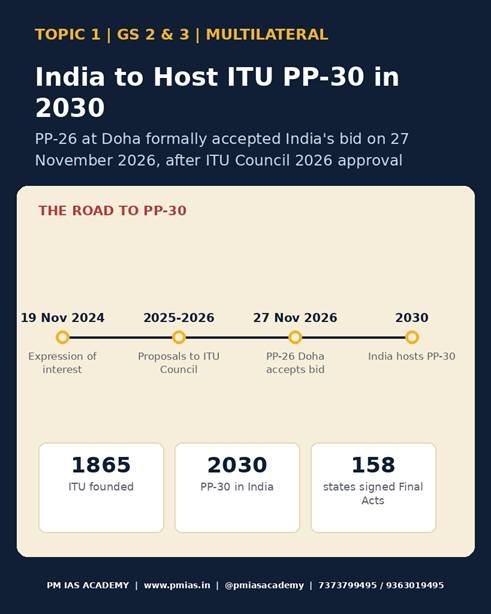
The Plenipotentiary Conference 2026 (PP-26), which concluded on 27 November 2026 at Doha, Qatar, formally accepted India’s proposal to host PP-30 in 2030, following earlier approval by the ITU Council at its 2026 session in Geneva, as per the PIB release (PRID 2342914).
Union Minister for Communications Jyotiraditya M. Scindia extended the invitation to Member States through a video message in the presence of ITU leadership and PP-26 delegates, noting India’s election to the ITU Council for the 2027-2030 term alongside the hosting mandate.
The ITU’s own release records that the Final Acts of PP-26 were signed by 158 Member States, and that Uzbekistan will host the World Telecommunication Standardization Assembly (WTSA-28) in Samarkand.
Background: The ITU and India’s Engagement
The International Telecommunication Union, founded in 1865, is the United Nations specialised agency for information and communication technologies; the PIB release notes India has been an active member since 1869 and a continuous member of its Council since 1952.
The Plenipotentiary Conference, convened every four years, is the ITU’s highest policy-making body: it sets the Union’s direction, adopts strategic and financial plans, and elects the senior leadership and the Council.
India hosted the World Telecommunication Standardization Assembly (WTSA-24) in New Delhi in October 2024, covering 6G, artificial intelligence, digital public infrastructure and sustainable digital transformation, which the release cites as demonstrating India’s convening capacity.
Key Dimensions
1. The process followed: India first submitted a formal expression of interest on 19 November 2024, made formal proposals to the ITU Council in 2025 and 2026, and the Council’s 2026 session approved the invitation and transmitted it to PP-26 for formal acceptance, completing the process at Doha.
2. What hosting means: The host convenes the conference on its soil; the agenda and decisions remain with Member States, so the gain for India is agenda-adjacent influence, visibility and ecosystem signalling rather than decision rights.
3. Council seat plus hosting: India’s election to the ITU Council for 2027-2030 means it sits in the governing body through the run-up to PP-30, a combined platform for shaping work on standards and development priorities.
4. Calendar of mandates: PP-26 (Doha, 2026), WTSA-28 (Samarkand, Uzbekistan), PP-30 (India, 2030): the sequence shows hosting rotating across regions, with India anchored in the 2030 slot.
5. Digital-governance stakes: ITU decisions on spectrum allocation, technical standards and development programmes shape the ground rules for 6G, satellite services and AI-era networks; candidates should link the hosting to India’s standards ambitions.
6. Atithi Devo Bhava framing: The Minister’s message paired India’s civilisational heritage with its digital-transformation journey, the standard soft-power-plus-technology template India now uses in multilateral tech fora.
7. Exam lens: Carry the chain: PP-26 accepted India’s PP-30 bid at Doha on 27 November 2026; India has been an ITU member since 1869, Council member since 1952, elected to the 2027-2030 Council; WTSA-24 was held in New Delhi in October 2024; the PP meets every four years and is the ITU’s highest policy-making body.
8. Distinction that Prelims tests: The Plenipotentiary Conference (policy and leadership), the World Radiocommunication Conference (spectrum) and WTSA (technical standards) are different ITU conferences; PP-30 hosting must not be confused with hosting a WRC.
9. Mains usage: The item illustrates India’s shift from rule-taker to rule-shaper in technology multilateralism, alongside WTSA-24 and its ITU Council tenure.
Significance
1. Multilateral weight: Hosting the ITU’s top body deepens India’s institutional stake in the rules of the digital economy.
2. Ecosystem signalling: A 2030 hosting commitment gives India’s telecom, satellite and startup sectors a fixed global showcase.
3. Development agenda: India can champion connectivity and digital-inclusion priorities of the Global South within ITU programmes.
4. Exam hook: The item connects international organisations, technology governance and India’s multilateral strategy in one verified development.
Challenges
1. Influence versus optics: Hosting confers visibility, not voting weight; outcomes still depend on coalition-building among Member States.
2. Four-year horizon: PP-30 is in 2030; sustaining preparatory diplomacy and domestic readiness over four years needs continuity.
3. Standards competition: Technical standards battles are fought in study groups between conferences, where sustained expert participation matters more than hosting.
4. Expectation management: Domestic audiences may read hosting as regulatory victory; the actual levers are slow, technical and consensus-based.
Way Forward
1. Build a PP-30 preparation track: Stand up a dedicated inter-ministerial preparation office with industry and academia to table substantive contributions, not only logistics.
2. Invest in study groups: Fund sustained Indian participation in ITU study groups, where the technical content of future conferences is drafted.
3. Champion the Global South: Use the run-up to consolidate developing-country priorities on affordable connectivity and capacity building.
4. Sequence with Council work: Align India’s 2027-2030 Council term priorities with PP-30 hosting so the two mandates reinforce each other.
Prelims Value Addition
- India will host the ITU Plenipotentiary Conference 2030 (PP-30); PP-26 formally accepted the bid at Doha on 27 November 2026 after ITU Council 2026 approval (PRID 2342914).
- India: ITU member since 1869, continuous Council member since 1952, elected to the Council for 2027-2030; WTSA-24 held in New Delhi, October 2024.
- The PP is the ITU’s highest policy-making body, convened every four years; PP-26 Final Acts were signed by 158 Member States; Uzbekistan hosts WTSA-28 at Samarkand.
- India’s expression of interest was submitted on 19 November 2024, with formal proposals to the Council in 2025 and 2026.
- The International Telecommunication Union was founded in 1865 as the International Telegraph Union and is the oldest agency of the United Nations system; India has been a member since 1869.
- The ITU works through three sectors: ITU-R for radiocommunication, ITU-T for standardisation and ITU-D for development; the Plenipotentiary Conference, held every four years, is its supreme policy-making body.
Mains Value Addition
- GS 2: ‘Hosting a multilateral technology conference is influence by instalments, not by event.’ Discuss with reference to India’s hosting of ITU PP-30 and its wider digital diplomacy.
- GS 2/3: Examine how India’s engagement with the ITU, from WTSA-24 to the PP-30 mandate, serves its ambition to shape global technology rules.
- Use PP-30 to argue that hosting multilateral technical bodies converts India’s market size into procedural influence: the host sets the agenda environment and showcases domestic capacity, even though decisions remain consensus-driven.
Topic 2: TRAI Notifies Interconnection (RIO) Amendment Regulations, 2026
Subject: Economy and Technology – Telecom Regulation
Paper: GS Paper 3: Indian economy, infrastructure, telecommunications; regulatory bodies; GS Paper 2: statutory and regulatory institutions
UPSC Relevance: Interconnection is the invisible plumbing of telecom competition: the terms on which networks connect decide whether consumers can call across operators at fair cost. TRAI’s 2026 amendment modernises a 2002 framework for the IP era, a clean GS 3 regulation item.
Why in News
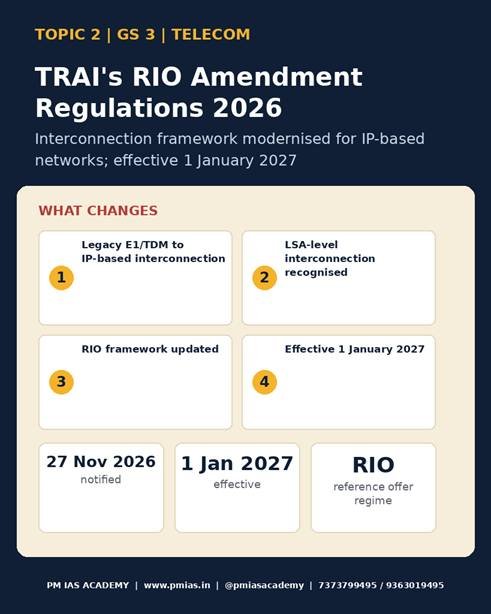
TRAI on 27 November 2026 released the Telecommunication Interconnection (Reference Interconnect Offer) (Amendment) Regulations, 2026, modernising the framework governing the Reference Interconnect Offer, as per the PIB release (PRID 2342598).
The amendment updates the framework for determination of Significant Market Power (SMP), submission and publication of RIOs, the Model RIO and RIO Guidelines, and interconnection arrangements, and introduces a financial disincentives framework for specified contraventions.
The regulations come into force with effect from 1 January 2027, following a review begun with a Pre-Consultation Paper of 3 April 2025 and a subsequent Consultation Paper.
Background: Interconnection and the 2002 Framework
Interconnection is the commercial and technical arrangement through which licensed networks connect so that users of one operator can reach users, services and networks of another; without mandated fair terms, a dominant network could choke rivals.
Sub-clauses (ii), (iii) and (iv) of Section 11(1)(b) of the TRAI Act, 1997 require TRAI to prescribe interconnection terms, ensure technical compatibility and effective interconnection, and regulate revenue-sharing arrangements among service providers.
The Telecommunication Interconnection (Reference Interconnect Offer) Regulation, 2002, notified in July 2002, ensured transparent, non-discriminatory and standardised interconnection terms, particularly where a service provider holds Significant Market Power.
TRAI first issued Reference Interconnect Offer regulations in 2002, requiring dominant operators to publish standard interconnection terms, and the framework has been amended periodically as networks and services evolved. Interconnection regulation exists because every subscriber must be reachable from every network, so operators cannot use denial of interconnection as a competitive weapon.
The broader setting is the transition of India’s telecom sector from voice-dominated circuit-switched networks to all-IP networks carrying converged voice and data, a shift accelerated by 4G and 5G deployment and recognised in the Telecommunications Act, 2023 framework.
Key Dimensions
1. Why a review was needed: The release records the shift from legacy circuit-switched, E1/TDM-based interconnection to packet-switched, IP-based networks and the emergence of LSA-level (licensed service area) interconnection, which the 2002 framework did not anticipate.
2. Significant Market Power updated: SMP determination is the trigger for stricter obligations on dominant operators; updating it aligns the interconnection regime with the current licensing and authorisation regime.
3. RIO mechanics: An RIO is the standing offer a significant operator must publish describing the terms on which it will interconnect; the amendment revises submission, publication, the Model RIO and the Guidelines.
4. Enforcement teeth: A financial disincentives framework for specified contraventions is newly introduced, converting breaches from dispute fodder into priced violations.
5. Process trail: Pre-Consultation Paper (3 April 2025), Consultation Paper, then the amendment regulations on 27 November 2026, effective 1 January 2027: candidates should note the consultative sequence as the standard TRAI method under the TRAI Act.
6. Competition rationale: Interconnection terms determine the cost structure of smaller operators; transparent, standardised offers prevent foreclosure and keep retail competition alive.
7. Exam lens: Fix the specifics: TRAI, 27 November 2026, RIO Amendment Regulations 2026, effective 1 January 2027, Section 11(1)(b) of the TRAI Act 1997, the 2002 original, SMP, Model RIO, financial disincentives, IP-based networks.
8. Distinction that Prelims tests: RIO obligations attach to significant market power; do not describe the framework as a universal licensing condition or as spectrum regulation.
9. Mains usage: Use the amendment to illustrate adaptive regulation: a statutory regulator revising a two-decade-old framework through consultation as technology changes.
Significance
1. Consumer interest: Effective interconnection underpins call completion, service choice and competitive pricing across networks.
2. Regulatory currency: Aligning the framework with IP networks removes the gap between the rulebook and the network reality operators actually run.
3. Deterrence: Financial disincentives give TRAI a compliance instrument short of litigation.
4. Exam hook: The item links a statutory regulator, competition economics and network technology migration in one notification.
Challenges
1. Transition management: Migrating interconnection arrangements to the new framework by 1 January 2027 demands operator readiness and dispute-resolution capacity.
2. Defining dominance: SMP determination in a converged, data-dominated market is contestable; expect litigation risk around determinations.
3. Legacy coexistence: During transition, circuit-switched and IP interconnection must interoperate without service degradation.
4. Compliance cost: Smaller operators face documentation and process obligations even as the framework aims to protect them.
Way Forward
1. Publish transition guidance: TRAI should issue clear migration instructions and model timelines so the 1 January 2027 switch is orderly.
2. Monitor SMP application: Track how SMP determinations are applied and contested, and publish the outcomes to build precedent.
3. Review disincentive working: After the first year, report how often financial disincentives were triggered and whether they deterred breaches.
4. Keep the cycle short: Commit to periodic interconnection reviews so the framework does not age another two decades behind the network.
5. Watch implementation: The 1 January 2027 effective date gives operators a defined runway; candidates should watch whether TRAI issues clarifications or further phases as IP migration proceeds across licensed service areas.
Prelims Value Addition
- TRAI released the Telecommunication Interconnection (Reference Interconnect Offer) (Amendment) Regulations, 2026 on 27 November 2026; effective 1 January 2027 (PRID 2342598).
- The amendment updates SMP determination, RIO submission and publication, the Model RIO and RIO Guidelines, and introduces financial disincentives for specified contraventions.
- Statutory basis: sub-clauses (ii), (iii), (iv) of Section 11(1)(b), TRAI Act 1997; original RIO regulation notified July 2002.
- Drivers: shift from circuit-switched E1/TDM to packet-switched IP networks and LSA-level interconnection; review began with a Pre-Consultation Paper on 3 April 2025.
- TRAI is a statutory regulator established under the Telecom Regulatory Authority of India Act, 1997, headquartered in New Delhi; it recommends on licensing and regulates tariffs and interconnection.
- Interconnection is the linking of two telecom networks so that subscribers of one can communicate with subscribers of the other; the charge one operator pays another for terminating calls is the interconnection usage charge.
- TRAI regulations are made under its statutory powers after consultation with stakeholders through consultation papers and open house discussions; an amendment regulation, like this one, modifies an existing principal regulation rather than creating a new framework.
Mains Value Addition
- GS 3: ‘Interconnection rules are the constitution of telecom competition.’ Discuss in the light of TRAI’s RIO (Amendment) Regulations, 2026.
- GS 2/3: Examine the role of statutory regulators in keeping economic regulation current with technology, using TRAI’s interconnection review as an illustration.
Topic 3: INS Vindhyagiri Delivered: Project 17A Frigate Programme Complete
Subject: Defence and Security – Indigenous Warship Building
Paper: GS Paper 3: security, defence indigenisation, defence production; GS Paper 2: governance of strategic sectors
UPSC Relevance: With the seventh and final Nilgiri-class frigate delivered, Project 17A closes as the most compressed major warship series in Indian shipbuilding; the delivery tempo and 75 per cent indigenisation are the substance of Aatmanirbharta claims in defence.
Why in News
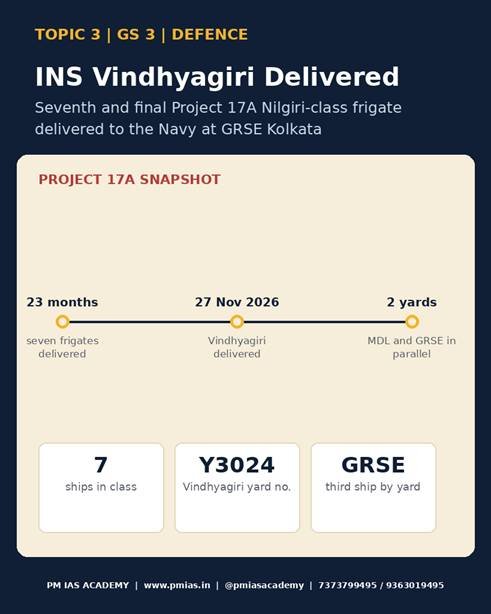
Vindhyagiri (Yard 3024), the seventh and final ship of the Nilgiri class under Project 17A and the third of the class built by Garden Reach Shipbuilders and Engineers Ltd (GRSE), was delivered to the Indian Navy on 27 November 2026 at GRSE, Kolkata, as per the PIB release (PRID 2342700).
All seven P17A frigates have been delivered within 23 months of the delivery of the first-of-class INS Nilgiri on 20 December 2024, and institutional learning compressed Vindhyagiri’s build period to 68 months against 84 months for INS Nilgiri.
The project carries an indigenisation content of 75 per cent and has involved over 200 MSMEs, as reported in the release.
Background: Project 17A and the Nilgiri Class
Project 17A is the follow-on to the Project 17 (Shivalik) class of stealth frigates: seven multi-mission frigates with advanced weapons and sensors, designed by the Indian Navy’s Warship Design Bureau (WDB), with construction split between Mazagon Dock Shipbuilders and GRSE.
Vindhyagiri is named after the Vindhyagiri mountain range in Karnataka and reincarnates the erstwhile INS Vindhyagiri, a Leander-class frigate that served from 8 July 1981 to 11 June 2012, 31 years of service, as the release records.
The P17A design features Combined Diesel or Gas (CODOG) propulsion driving Controllable Pitch Propellers, and an Integrated Platform Management System, giving the ships enhanced stealth, survivability and multi-dimensional warfare capability across anti-surface, anti-air and anti-submarine domains.
Key Dimensions
1. Delivery tempo: Seven frigates in 23 months is the headline: series production with two yards in parallel has delivered a rate of induction that earlier Indian warship programmes did not achieve.
2. Learning curve quantified: The build-period compression from 84 months (first-of-class) to 68 months (seventh ship) is the measurable return on series construction and institutional experience.
3. Design ecosystem: P17A ships were designed by the Warship Design Bureau and overseen by the Warship Overseeing Team (Kolkata) for the GRSE units, illustrating the in-house design-plus-public-yard model of Indian naval construction.
4. Indigenisation depth: The release states 75 per cent indigenisation content and participation of over 200 MSMEs, placing the programme within the broader defence-industrial ecosystem rather than a single yard’s effort.
5. Multi-mission capability: The class is configured for anti-surface, anti-air and anti-submarine warfare with an advanced weapons and sensors suite over the P17 class, relevant to the Navy’s carrier-escort and independent-deployment roles.
6. Continuity of names: Reincarnating legacy ship names, here the Leander-class Vindhyagiri, is a naval tradition that also signals fleet renewal; a Prelims trap pairs old and new classes.
7. Exam lens: Hold the set: seventh and final P17A ship, delivered 27 November 2026 at GRSE Kolkata, all seven delivered in 23 months from 20 December 2024, build time 68 versus 84 months, 75 per cent indigenisation, over 200 MSMEs, WDB design, CODOG propulsion.
8. Distinction that Prelims tests: Project 17A (Nilgiri class) is a frigate programme; do not confuse with Project 15B destroyers (Visakhapatnam class) or Project 17 Shivalik-class frigates.
9. Mains usage: Use the programme as evidence that public-sector shipbuilding with a stable series order can deliver both speed and indigenisation.
Significance
1. Combat power: Seven modern stealth frigates materially strengthen the Navy’s surface combatant strength for the Indian Ocean.
2. Industrial base: Two-shipyard series production sustains design bureaus, vendor chains and skilled yard employment.
3. Self-reliance evidence: A completed series at 75 per cent indigenisation is a concrete, countable marker of Aatmanirbharta in defence.
4. Exam hook: The item combines naval capability, defence production and industrial policy with precise, testable numbers.
Challenges
1. Sensor and weapon imports: The remaining 25 per cent includes critical systems; import dependence in weapons and sensors persists below the headline figure.
2. Next-generation gap: Sustaining the design ecosystem needs follow-on orders; a gap between series erodes the very learning curve the programme demonstrated.
3. Shipyard capacity: Public yards carry multiple programmes; delivery tempo must survive parallel commitments like next-generation frigates and destroyers.
4. Lifecycle support: Induction is the midpoint; weapons and sensor upgrades, spares and refits will test the support chain for decades.
Way Forward
1. Order the follow-on early: Place next-series orders while the design and vendor base is warm, preserving the compressed build timelines.
2. Deepen indigenisation: Target the imported quarter, particularly sensors and weapons, for progressive indigenous substitution.
3. Publish delivery data: Continue releasing build-period and indigenisation figures, which let Parliament and the public judge the programme.
4. Plan the refit cycle: Schedule mid-life upgrades and support contracts at induction, not after obsolescence sets in.
Prelims Value Addition
- Vindhyagiri (Y3024), seventh and final Project 17A Nilgiri-class frigate, delivered to the Indian Navy at GRSE Kolkata on 27 November 2026 (PRID 2342700).
- All seven P17A frigates delivered within 23 months of INS Nilgiri’s delivery on 20 December 2024; build period compressed to 68 months versus 84 for the first-of-class.
- 75 per cent indigenisation content; over 200 MSMEs involved; designed by the Warship Design Bureau; CODOG propulsion with Controllable Pitch Propellers and Integrated Platform Management System.
- The ship reincarnates the Leander-class INS Vindhyagiri (1981 to 2012) and is named after the Vindhyagiri range in Karnataka.
- Project 17A was cleared by the Cabinet Committee on Security in 2015; seven stealth frigates of about 6,670 tonnes were sanctioned, four to Mazagon Dock Shipbuilders, Mumbai, and three to Garden Reach Shipbuilders and Engineers, Kolkata.
- The Nilgiri-class frigates are designed by the Indian Navy’s Warship Design Bureau; the class name revives the earlier Nilgiri-class (Leander-type) frigates of the 1970s.
- GRSE, Kolkata, is a defence public sector undertaking under the Ministry of Defence; it has built more than a hundred warships for the Navy and the Coast Guard.
Mains Value Addition
- GS 3: ‘The completion of Project 17A shows that series production is India’s strongest shipbuilding reform.’ Discuss with reference to delivery tempo, indigenisation and the defence industrial base.
- GS 3: Examine the significance of indigenous warship design and construction for India’s maritime security, with Project 17A as the case study.
- For Aatmanirbharta in defence shipbuilding, Project 17A illustrates the twin-yard model: splitting orders between MDL and GRSE compressed delivery timelines, deepened the domestic vendor base and created redundancy in warship construction capacity.
Topic 4: NBA Disburses Rs 13.76 Crore in Access and Benefit Sharing Funds
Subject: Environment – Biodiversity Governance and Benefit Sharing
Paper: GS Paper 3: environment, biodiversity, conservation, environmental governance; international conventions
UPSC Relevance: Access and Benefit Sharing is where the Nagoya Protocol meets the Indian village: commercial users of biological resources pay, and the money is supposed to fund conservation. This disbursal is a working demonstration of the Biological Diversity Act’s machinery.
Why in News
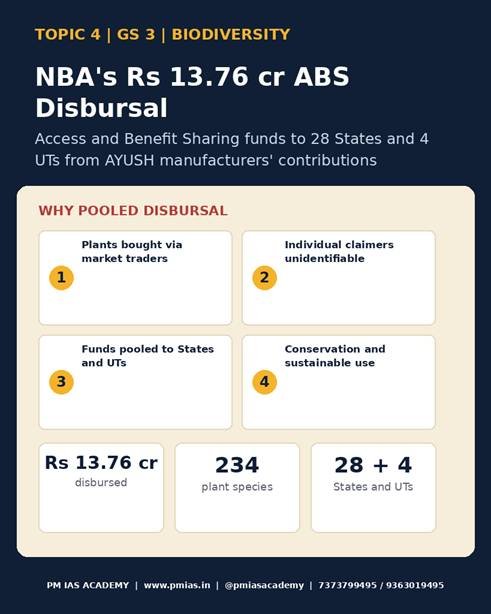
The National Biodiversity Authority (NBA) has disbursed Rs 13.76 crore across 28 States and 4 Union Territories to promote biodiversity conservation and sustainable use of biological resources, as per the PIB release of 27 November 2026 (PRID 2342671).
The funds are Access and Benefit Sharing (ABS) contributions received from AYUSH products manufacturing companies for commercial utilisation of medicinal plants and other plant-based biological resources, pertaining to three applications involving 234 plant species.
Ten species, Guggul, Ashwagandha, Bhringraj, Punarnava, Sarpagandha, Kalmegh, Black Pepper, Indian Gooseberry, Gokhura and Shalparni, account for Rs 6.45 crore of the Rs 13.76 crore, as reported in the release.
Background: The ABS Mechanism
Access and Benefit Sharing is the principle that those who use biological resources commercially must share the benefits fairly with the custodians and the country of origin; it is a core objective of the Convention on Biological Diversity, operationalised by the Nagoya Protocol.
In India, the Biological Diversity Act, 2002 created a three-tier structure: the National Biodiversity Authority at the centre, State Biodiversity Boards, and Biodiversity Management Committees (BMCs) at local bodies, with People’s Biodiversity Registers documenting resources and associated traditional knowledge.
The NBA has so far collected Rs 278 crore through the ABS mechanism, of which around Rs 218.86 crore has been disbursed, as the release reports.
Key Dimensions
1. The disbursal logic: Because the medicinal plants were procured through market and trader networks, individual benefit claimers could not be identified; the NBA therefore disbursed by State forest cover and occurrence of medicinal plants, a pragmatic proxy candidates should be able to explain.
2. Where the money goes: Maharashtra tops the list at about Rs 1.75 crore, followed by Arunachal Pradesh, Andhra Pradesh, Karnataka and Kerala; Tamil Nadu received about Rs 63 lakh, with the table covering 15 States plus an ‘Others’ category totalling the Rs 13.76 crore.
3. Permitted uses: The funds can strengthen local biodiversity governance, BMCs, updating of People’s Biodiversity Registers, documentation of biological resources and traditional knowledge, research and capacity building, community-led conservation, restoration, sustainable harvesting and biodiversity-based livelihoods.
4. Concentration in a few species: Ten of the 234 species contribute Rs 6.45 crore, nearly half the amount, showing how commercial utilisation concentrates on a small basket of high-demand medicinal plants.
5. AYUSH linkage: The payers are AYUSH products manufacturers, tying traditional-medicine commerce directly to conservation finance, a link answers should make explicit.
6. Scale check: Rs 13.76 crore across 32 States and UTs is modest in absolute terms; the item’s significance is the mechanism’s operation, not the quantum.
7. Exam lens: Carry the numbers: Rs 13.76 crore disbursed to 28 States and 4 UTs; 234 species across three applications; ten named species account for Rs 6.45 crore; cumulative ABS collections Rs 278 crore, disbursed about Rs 218.86 crore; top recipient Maharashtra.
8. Distinction that Prelims tests: The NBA (national level, foreign access and IPR matters), State Biodiversity Boards (Indian entities’ access) and BMCs (local documentation) have distinct roles; do not collapse them.
9. Mains usage: Use the disbursal to discuss how market-traded resources complicate benefit claimer identification and how proxy disbursal criteria keep the mechanism functioning.
Significance
1. Mechanism in action: ABS moving from collection to disbursal shows the 2002 Act’s financial loop closing, which answers can cite as implementation evidence.
2. Conservation finance: The funds create a small but direct resource stream for BMCs and local conservation, the weakest tier of the structure.
3. Traditional knowledge protection: Documenting resources and knowledge in People’s Biodiversity Registers strengthens claims against misappropriation.
4. Exam hook: The item connects an international protocol, a national statute, corporate payments and village-level institutions in one transaction.
Challenges
1. Claimant identification: Market and trader procurement breaks the chain to original custodians, forcing proxy disbursal that may miss the true stewards of the resource.
2. Absorption capacity: BMCs are often weak institutions; money without capacity risks under-use or misuse.
3. Quantum versus need: A few lakh rupees per State cannot fund large-scale conservation; ABS is supplementary, not core finance.
4. Compliance coverage: Collection depends on users disclosing utilisation; unreported commercial use escapes the mechanism.
Way Forward
1. Strengthen BMCs first: Pair disbursal with capacity building so Biodiversity Management Committees can plan and account for the funds.
2. Improve traceability: Encourage supply-chain documentation so benefit claimers can be identified rather than proxied.
3. Publish utilisation reports: Require States to report how ABS funds are used, closing the accountability loop.
4. Broaden the payer base: Bring more commercial utilisation sectors into the ABS net through clearer obligations and simpler compliance.
Prelims Value Addition
- NBA disbursed Rs 13.76 crore in ABS funds across 28 States and 4 UTs on 27 November 2026 (PRID 2342671), from AYUSH manufacturers’ contributions covering 234 plant species in three applications.
- Ten species, including Guggul, Ashwagandha, Kalmegh and Indian Gooseberry, account for Rs 6.45 crore of the amount.
- Maharashtra received the highest allocation, about Rs 1.75 crore; disbursal criteria were State forest cover and medicinal-plant occurrence because trader-network procurement obscured individual claimers.
- NBA’s cumulative ABS collections stand at Rs 278 crore, with about Rs 218.86 crore disbursed; the structure flows from the Biological Diversity Act, 2002 and the Nagoya Protocol.
- The National Biodiversity Authority is a statutory body under the Biological Diversity Act, 2002, headquartered in Chennai under the Ministry of Environment, Forest and Climate Change.
- Access and Benefit Sharing flows from the Convention on Biological Diversity (Rio Earth Summit, 1992; India ratified in 1994) and the Nagoya Protocol of 2010; the NBA notified detailed ABS Regulations in 2014.
- Under the Act, State Biodiversity Boards advise on access by Indian entities, while foreign access requires prior NBA approval; Biodiversity Management Committees at local-body level maintain People’s Biodiversity Registers.
Mains Value Addition
- GS 3: ‘Access and Benefit Sharing converts biological wealth into conservation finance only if institutions can absorb it.’ Discuss with reference to the NBA’s recent disbursal and the three-tier structure under the Biological Diversity Act, 2002.
- GS 3: Examine how the Nagoya Protocol’s benefit-sharing objective is implemented in India, and the challenges posed by market-mediated supply chains of biological resources.
- The pooled disbursal shows benefit sharing operating as a tax-like instrument on commercial utilisation when traceability fails; evaluate this against the Nagoya principle of bilateral sharing with identifiable providers.
Topic 5: Jal Jeevan Mission 2.0: Second Regional Conference Concludes at Agra
Subject: Polity and Governance – Rural Water Supply and Local Governance
Paper: GS Paper 2: governance, welfare schemes, devolution to local bodies; GS Paper 3: infrastructure, water resources
UPSC Relevance: JJM 2.0 shifts the flagship water mission from building tap connections to sustaining them, and the Agra conference’s stress on Gram Panchayat ownership is the hinge between infrastructure and governance that GS answers are graded on.
Why in News
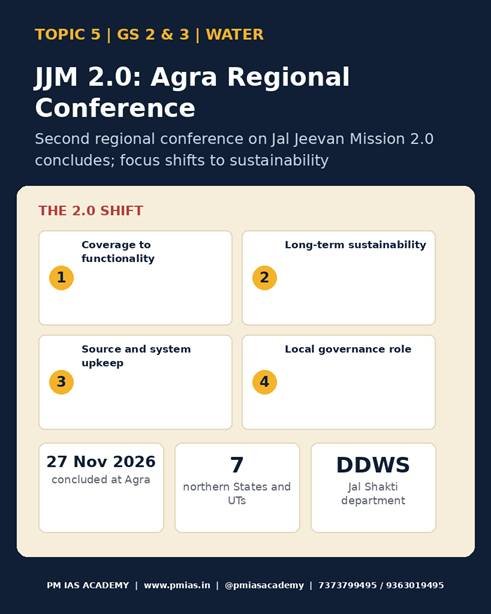
The second Regional Conference on Jal Jeevan Mission 2.0, organised by the Department of Drinking Water and Sanitation (DDWS), Ministry of Jal Shakti, concluded at Agra on 27 November 2026, bringing together seven northern States and Union Territories, as per the PIB release (PRID 2342708).
DDWS Secretary Ashok K. K. Meena visited rural water supply infrastructure and participated in the Jal Arpan Diwas celebration at the Badhera water supply scheme and the 456 MLD water treatment plant at Etah during the two-day conference.
The Secretary stressed transferring responsibility and ownership of drinking water infrastructure to communities through Jal Arpan, building the financial, technical and institutional capacities of Gram Panchayats, and convergence among the Departments of Panchayati Raj, Rural Development, Skill Development and Drinking Water.
Background: From Jal Jeevan Mission to JJM 2.0
The Jal Jeevan Mission, launched in 2019, set out to provide functional household tap connections to every rural household, moving rural water supply from standposts and handpumps to in-home piped water.
JJM 2.0 is the mission’s next phase, and the Agra conference agenda, sustainability, long-term functionality, community ownership, shows the policy centre of gravity moving from coverage to operations.
Rural drinking water is fundamentally a local service, as the Secretary put it, which is why the mission’s design assigns Gram Panchayats and local communities the ownership role.
Key Dimensions
1. Sustainability over coverage: The conference’s theme was accelerating implementation, strengthening sustainability and ensuring long-term functionality of rural drinking water systems, acknowledging that taps fail without maintenance systems.
2. Jal Arpan as the transfer device: Jal Arpan represents the formal handover of responsibility and ownership of drinking water infrastructure to communities; the Secretary called it an important step and linked it to capacity building of Gram Panchayats.
3. Field-demonstrated practices: The Secretary highlighted Uttar Pradesh’s use of solar energy for rural water supply schemes and command-and-control systems for monitoring and operation, encouraging States to replicate them.
4. Convergence instruction: The conference called for convergence among Panchayati Raj, Rural Development, Skill Development and Drinking Water departments to strengthen operation and maintenance, local capacities and source sustainability through Jal Sanchay Jan Bhagidari.
5. Quality surveillance: Regular water quality surveillance was named alongside infrastructure and management, keeping potability, not only supply, inside the mission’s frame.
6. Viksit Villages framing: The Secretary described Gram Panchayats as the foundation of Viksit Villages, tying the water mission to the broader Viksit Bharat village-development narrative.
7. Regional-conference method: Grouping States regionally for peer learning is the mission’s chosen instrument for spreading workable practices; this was the second such conference, the first having covered another region.
8. Exam lens: Carry the specifics: second regional conference on JJM 2.0 at Agra, concluded 27 November 2026, seven northern States and UTs, DDWS under Ministry of Jal Shakti, Secretary Ashok K. K. Meena, Jal Arpan Diwas at Etah, 456 MLD WTP, Gram Panchayat ownership, convergence with Panchayati Raj and other departments.
9. Mains usage: The item lets answers argue the general proposition that welfare infrastructure succeeds only when its operation is devolved and financed, using JJM 2.0 as the live example.
Significance
1. Governance lesson: JJM 2.0 is a national test of whether last-mile public services can be run by local governments with state support.
2. Public health: Functional, quality-monitored tap water reduces waterborne disease and the unpaid labour of water collection, largely borne by women.
3. Federal learning: Regional conferences create horizontal learning between States, a practical cooperative-federalism instrument.
4. Exam hook: The item combines a flagship scheme, local governance and water policy with named instruments (Jal Arpan, Jal Sanchay Jan Bhagidari) that reward precise answers.
Challenges
1. OandM finance: Gram Panchayats rarely raise own revenue for water; without predictable transfers, handover risks becoming abandonment.
2. Capacity gaps: Technical and financial skills at the panchayat level lag the assets being transferred.
3. Source sustainability: Tap networks fail when sources dry up or are contaminated; recharge and source protection must keep pace.
4. Data integrity: Functionality reporting depends on States; independent verification of whether taps actually deliver water remains essential.
Way Forward
1. Fund OandM predictably: Tie a portion of mission funds to community-managed operation and maintenance with transparent accounts.
2. Professionalise support: Create district-level technical support units that Gram Panchayats can call on, so handover does not mean isolation.
3. Verify functionality independently: Use third-party and sensor-based monitoring rather than self-reported functionality alone.
4. Protect sources: Link every scheme to source-sustainability works under Jal Sanchay Jan Bhagidari and convergence programmes.
Prelims Value Addition
- Second Regional Conference on Jal Jeevan Mission 2.0 concluded at Agra on 27 November 2026; seven northern States and UTs participated (PRID 2342708).
- Organiser: Department of Drinking Water and Sanitation, Ministry of Jal Shakti; Secretary DDWS Ashok K. K. Meena attended Jal Arpan Diwas at Badhera scheme and the 456 MLD water treatment plant, Etah.
- Key themes: sustainability and long-term functionality, Gram Panchayat and community ownership (Jal Arpan), solar energy and command-and-control monitoring, water quality surveillance, convergence with Panchayati Raj, Rural Development and Skill Development.
- Jal Sanchay Jan Bhagidari was cited for source sustainability; the JJM began in 2019 with the functional household tap connection goal.
- Jal Jeevan Mission was announced on 15 August 2019 with the goal of providing a Functional Household Tap Connection to every rural household by 2024; the mission is implemented by the Department of Drinking Water and Sanitation under the Ministry of Jal Shakti.
- The Union Budget 2025-26 extended the mission to 2028 as Jal Jeevan Mission 2.0, with an enhanced focus on source sustainability, greywater management and community participation.
- FHTC means a tap connection supplying at least 55 litres per person per day of prescribed quality on a regular basis; Har Ghar Jal certification is declared when every rural household has such a connection, verified through village-level resolution.
Mains Value Addition
- GS 2: ‘The second phase of the Jal Jeevan Mission is a governance reform dressed as a water programme.’ Discuss with reference to community ownership and Gram Panchayat capacity.
- GS 2/3: Examine why long-term functionality, rather than coverage, has become the central challenge of rural drinking water supply in India.
- Contrast the supply-driven National Rural Drinking Water Programme era with JJM’s demand-responsive, community-led design; the Agra conference signals that the remaining challenge is institutional, sustaining gram panchayat capacity, rather than physical coverage alone.
Topic 6: Power Ministers’ Conference: DISCOM Turnaround and the Rs 200 Lakh Crore Investment Horizon
Subject: Economy and Infrastructure – Power Sector Reforms
Paper: GS Paper 3: Indian economy, infrastructure, energy; mobilisation of resources; GS Paper 2: cooperative federalism
UPSC Relevance: DISCOM finances have been the power sector’s chronic wound for two decades; a reported collective profit in FY 2024-25, a national Centre-State conference, and a twenty-year investment estimate make this the year’s most examinable power-sector cluster.
Why in News
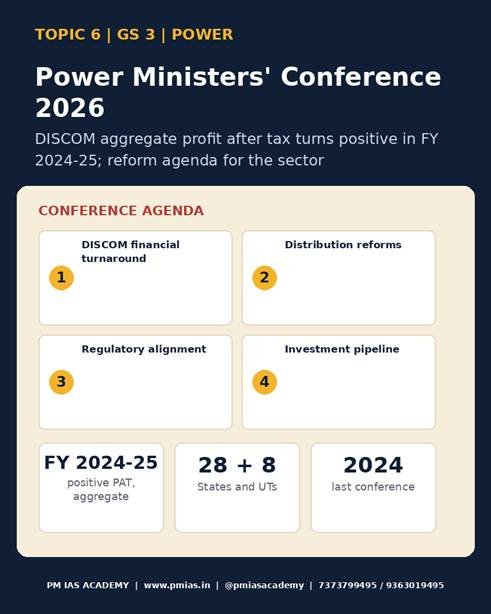
The two-day Power Ministers’ Conference commenced in New Delhi on 27 November 2026, chaired by Union Power Minister Manohar Lal, bringing together Power Ministers, senior officials and electricity regulators from 28 States and 8 Union Territories, as per the PIB release (PRID 2342431).
The Minister stated that DISCOMs as a whole turned a positive profit after tax during FY 2024-25, achieving profitability after a prolonged period, and stressed continuing the turnaround through policy, operations and regulation.
He estimated the country’s power sector presents an investment opportunity of Rs 200 lakh crore over the next two decades, called for integrated planning of generation, storage, transmission and distribution, and pressed States to implement smart meters, with Resource Adequacy implementation on the conference agenda.
Background: Why DISCOM Finances Matter
Distribution companies are the retail end of the power sector: they buy power, supply consumers and collect bills. Their losses historically cascaded into unpaid generators, stressed banks and repeated bailout schemes.
The Centre has run successive reform and liquidity schemes for DISCOMs, tying additional borrowing and support to loss reduction, metering and governance conditions; the claimed FY 2024-25 collective profit is presented as the payoff of that pressure.
The last national-level Power Ministers’ Conference was held in 2024, as the release notes, making this the first full stocktake of the sector since the turnaround claim.
The distribution segment has been the chronic weak link of Indian power reforms. The Ujwal DISCOM Assurance Yojana (UDAY), launched in November 2015, had States take over 75 per cent of DISCOM debt; losses and AT&C levels, however, persisted in several States.
The Revamped Distribution Sector Scheme, approved in 2021 with an outlay of about Rs 3.03 lakh crore over five years, ties central assistance to reform-linked results on loss reduction, smart metering and consumer service.
Key Dimensions
1. The PAT claim: Positive aggregate profit after tax for DISCOMs in FY 2024-25 is the headline; candidates should read it as an aggregate claim at the conference, with State-wise variation behind it, and note that tariff adequacy and subsidy discipline determine whether it holds.
2. Investment horizon: Rs 200 lakh crore over two decades covers generation expansion, grid buildout, storage and distribution modernisation; the figure is the Minister’s stated opportunity estimate, not a committed pipeline.
3. Integrated planning: The Minister called for generation, storage, transmission and distribution to be planned as interconnected elements of a single system, the planning doctrine for a grid absorbing variable renewable energy.
4. Smart meters: He stressed State implementation of smart meters as beneficial to consumers; metering underpins loss measurement, billing efficiency and demand management.
5. Resource Adequacy: The agenda includes implementation of Resource Adequacy, the framework that obliges utilities to contract enough capacity to meet their projected demand reliably.
6. Centre-State format: The conference is the sector’s cooperative-federalism table: 28 States and 8 UTs with regulators, since electricity is a Concurrent List subject and most delivery levers sit with States.
7. Exam lens: Carry: conference 27-28 November 2026, New Delhi, chaired by Manohar Lal, 28 States and 8 UTs; DISCOMs’ positive PAT in FY 2024-25; Rs 200 lakh crore investment opportunity over two decades; smart meters; Resource Adequacy; last national conference in 2024.
8. Distinction that Prelims tests: Positive PAT is an aggregate for DISCOMs as a whole, not a claim that every DISCOM is profitable; questions often inflate the aggregate.
9. Mains usage: Use the conference to discuss how fiscal discipline, metering and capacity planning interact in the electricity transition.
Significance
1. Fiscal relief: Healthier DISCOMs reduce contingent liabilities for State finances and payment stress across the generation chain.
2. Investment signal: A profitable distribution segment is the precondition for private capital across generation, storage and grids.
3. Consumer stake: Smart metering and loss reduction translate into more reliable supply and transparent billing.
4. Exam hook: The item links public finance, energy transition and federalism with a rare positive headline in a chronically stressed sector.
Challenges
1. Sustainability of profit: One year’s aggregate profit can rest on subsidy booking, tariff petitions or one-off items; durability is unproven.
2. State divergence: National aggregates conceal DISCOMs still deep in losses; reform pressure must stay on the laggards.
3. Metering execution: Smart meter rollout has historically lagged targets due to financing, installation capacity and consumer resistance.
4. Renewables integration: Rising renewable share stresses grid balancing, storage and DISCOM revenue models built on volumetric sales.
Way Forward
1. Publish audited State-wise data: Release DISCOM-wise audited accounts so the turnaround can be verified beyond the aggregate claim.
2. Condition support on metering: Tie central assistance to smart-meter installation and loss-reduction milestones.
3. Operationalise Resource Adequacy: Move State utilities from plans to contracted capacity with clear compliance timelines.
4. Reform tariffs with protection: Align tariffs with costs while shielding vulnerable consumers through direct benefit support rather than distorted pricing.
5. Track the State-level follow-through: The conference’s value depends on State electricity regulatory commissions and DISCOM boards acting on tariffs, metering and loss trajectories, so monitor tariff orders and RDSS milestones rather than conference resolutions alone.
Prelims Value Addition
- Power Ministers’ Conference, 27-28 November 2026, New Delhi; chaired by Union Minister Manohar Lal; 28 States and 8 UTs with regulators (PRID 2342431); last national conference in 2024.
- DISCOMs as a whole turned a positive profit after tax in FY 2024-25, as stated by the Minister.
- The Minister estimated a Rs 200 lakh crore investment opportunity in the power sector over the next two decades.
- Agenda includes integrated generation-storage-transmission-distribution planning, smart meter implementation and Resource Adequacy.
- The Power Ministers’ Conference is a national forum of the Union Ministry of Power with State and UT power and energy ministers; distribution, on the Concurrent List, depends on this cooperative format for national programmes.
- AT&C losses combine technical losses such as transmission dissipation with commercial losses such as theft and billing and collection inefficiency; the national aggregate has been the standard metric for judging distribution reforms.
Mains Value Addition
- GS 3: ‘A profitable DISCOM is the foundation on which India’s energy transition must be financed.’ Discuss in the light of the reported FY 2024-25 turnaround.
- GS 2/3: Examine the role of Centre-State conferences in driving power sector reform, with reference to the November 2026 Power Ministers’ Conference agenda.
Topic 7: Stable, Tunable White LEDs: CeNS-IIT Delhi Crack the Perovskite Colour-Blurring Problem
Subject: Science and Technology – Materials Science and Lighting
Paper: GS Paper 3: science and technology, developments and their applications in everyday life; nanotechnology, materials research
UPSC Relevance: White LEDs touch energy demand directly, and a low-cost, rare-earth-free, tunable route to white light from Indian labs is the kind of applied-science story Prelims loves: precise institutions, a named mechanism and an everyday application.
Why in News
Researchers from the Centre for Nano and Soft Matter Sciences (CeNS), Bengaluru, an autonomous institute under the Department of Science and Technology, with the Indian Institute of Technology Delhi, have developed a dual-protection strategy that enables stable, scalable, flexible and cost-effective white-lighting technologies, as per the PIB release of 27 November 2026 (PRID 2342511).
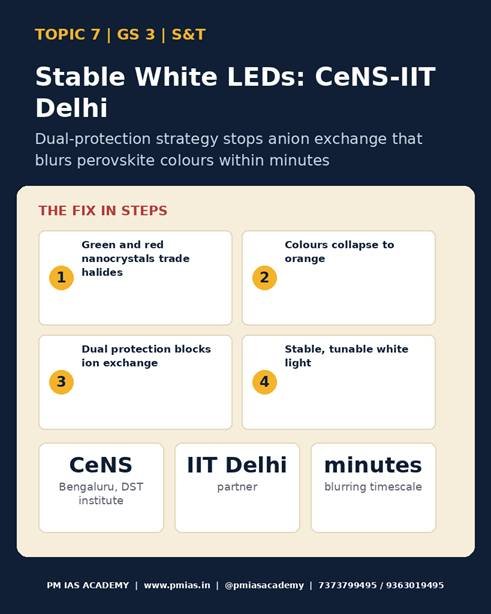
The work addresses anion exchange in all-inorganic halide perovskite nanocrystals (CsPbX3, where X is chlorine, bromine or iodine): when green-emitting CsPbBr3 and red-emitting CsPbI3 nanocrystals come into contact, halide ions migrate between them and the colours blend into an unwanted orange within minutes.
The team of Gauri Sharma, Swati Khurana, Sameer Sapra and Pralay K. Santra first reduced halide vacancies on the crystal surface using lead selenide, then applied atomic layer deposition (ALD) encapsulation with an ultrathin transparent protective layer, locking colours in place; they demonstrated phosphor-converted white LEDs on glass and flexible PET substrates with spray-coated micropatterning.
Background: How White LEDs Work
Commercial white LEDs are energy-efficient but rely on expensive rare-earth elements and complex, high-temperature manufacturing, and once built, the tone of white light is fixed, as the release notes.
Halide perovskite nanocrystals are an emerging class of bright, low-cost emitters of exceptionally pure colours; their colour is set by their halide composition, which is also their weakness, because the halide ions can swap between neighbouring crystals.
A phosphor-converted white LED combines a blue or ultraviolet diode with phosphor materials that convert part of the emission into other colours, mixing to white; perovskite nanocrystals promise to be better phosphors if their colours can be stabilised.
Key Dimensions
1. The problem in one line: Anion exchange: green and red perovskite nanocrystals in contact trade halide ions within minutes, collapsing two pure colours into an intermediate orange, which destroys colour rendering.
2. First shield, vacancy repair: Lead selenide treatment reduces halide vacancies on the crystal surface, removing the primary pathway for ion migration without degrading brightness or colour.
3. Second shield, encapsulation: Atomic layer deposition adds an ultrathin transparent protective layer, physically blocking ion exchange; ALD’s atomic-scale control is why the coating does not blunt the emission.
4. Manufacturing friendliness: The demonstrated devices were made on glass and flexible PET, with green and red micropatterning by spray coating, indicating compatibility with low-cost, scalable processing rather than high-temperature fabrication.
5. Tunability payoff: Because colours are locked, designers can mix nanocrystals to tune white tone after fabrication, addressing the fixed-tone drawback of conventional white LEDs.
6. Why it matters beyond lighting: Stable pure emitters also serve displays, so the same advance supports smartphone and screen applications named in the release.
7. Exam lens: Fix the facts: CeNS Bengaluru (DST autonomous institute) plus IIT Delhi; CsPbX3 perovskite nanocrystals; anion exchange defect; dual protection by lead selenide treatment and ALD encapsulation; demonstrated white LEDs on glass and flexible PET; team of Gauri Sharma, Swati Khurana, Sameer Sapra, Pralay K. Santra.
8. Distinction that Prelims tests: The advance is a materials-stability solution, not a new diode architecture; the white LED is phosphor-converted using stabilised perovskite nanocrystals.
9. Mains usage: Cite the work as Indian materials research moving from laboratory chemistry to device demonstration, the translation step science policy keeps demanding.
Significance
1. Energy relevance: Lighting is a large electricity end-use; cheaper efficient white light compounds India’s efficiency gains.
2. Import substitution: Rare-earth-free emitters reduce dependence on imported phosphor materials and concentrated supply chains.
3. Research ecosystem: A DST institute collaborating with an IIT to a device-level demonstration is the institutional model missions want replicated.
4. Exam hook: The item has clean Prelims hooks: institutions, chemical formula, the named defect and the two protective fixes.
Challenges
1. Lab to line: Device demonstration is not mass manufacturing; yield, lifetime and cost at scale remain to be proven.
2. Lead content: Halide perovskites contain lead; commercial deployment must manage toxicity concerns and regulations.
3. Durability over time: Heat, moisture and operating stress test encapsulation over years, not minutes.
4. Intellectual property capture: Converting a published advance into licensed manufacturing requires deliberate IP and industry linkage.
Way Forward
1. Fund pilot fabrication: Move the technology into pilot-scale production with an industry partner to test yield and lifetime.
2. Address the lead question: Invest in encapsulation integrity and recycling design, and track lead-free perovskite alternatives in parallel.
3. Protect and license: Secure IP and offer licences to Indian LED manufacturers early.
4. Extend to displays: Evaluate the stabilised emitters for display applications where colour purity commands a premium.
Prelims Value Addition
- CeNS Bengaluru (autonomous institute under DST) and IIT Delhi developed a dual-protection strategy for stable white-light perovskite devices (PIB, 27 November 2026, PRID 2342511).
- The defect addressed: anion exchange between CsPbBr3 and CsPbI3 nanocrystals, blending green and red into orange within minutes.
- The fixes: lead selenide treatment reducing halide vacancies, plus atomic layer deposition encapsulation with an ultrathin transparent layer.
- Demonstration: phosphor-converted white LEDs on glass and flexible PET substrates with spray-coated micropatterning; team of Gauri Sharma, Swati Khurana, Sameer Sapra and Pralay K. Santra.
- Perovskites are materials with the crystal structure of calcium titanate, named after the Russian mineralogist Lev Perovski; halide perovskites are leading candidates for solar cells and light-emitting devices because they combine cheap solution processing with strong light absorption and emission.
- CeNS Bengaluru is an autonomous research institute of the Department of Science and Technology, established in 1991, working on nano and soft matter; it is separate from ISRO and DRDO laboratories, a frequent prelims confusion.
- White light from LEDs is usually produced either by a blue LED coated with a yellow phosphor or by mixing red, green and blue emitters; the perovskite route promises tunable spectra with fewer components if stability is achieved.
Mains Value Addition
- GS 3: ‘Stability, not brightness, has been the bottleneck in perovskite optoelectronics.’ Discuss with reference to the recent CeNS-IIT Delhi advance and its implications for lighting and displays.
- GS 3: Examine the pathway from materials research to everyday technology in India, using perovskite white LEDs as an example.
- Link the result to India’s semiconductor and display ambitions: domestic control of stable emitter materials reduces dependence on imported phosphors and positions Indian laboratories in the value chain for next-generation lighting and displays.
Topic 8: Prime Minister Meets IORA Foreign Ministers: 25th Council of Ministers in New Delhi
Subject: International Relations – Indian Ocean Regional Cooperation
Paper: GS Paper 2: India and its neighbourhood, regional groupings, Indian Ocean diplomacy; GS Paper 3: security, maritime domain
UPSC Relevance: With India chairing IORA and hosting its Council of Ministers, the Indian Ocean’s premier regional body is in New Delhi at a moment when maritime competition, connectivity and blue-economy economics converge on the region.
Why in News
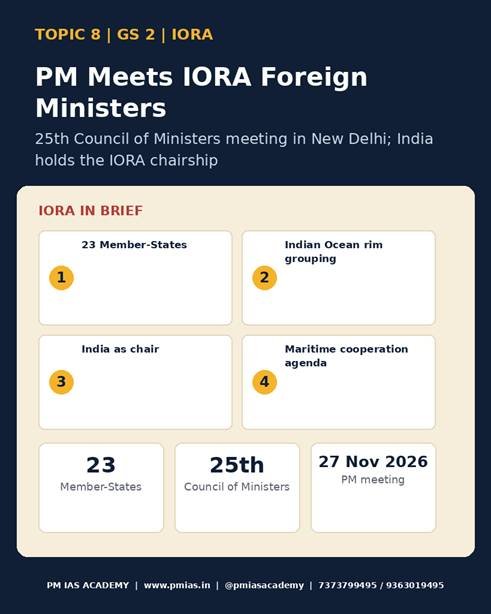
The Prime Minister on 27 November 2026 met the Foreign Ministers and Heads of Delegation of the 23 Indian Ocean Rim Association (IORA) Member-States, who are in New Delhi for the 25th Meeting of the IORA Council of Ministers, as per the PIB release (PRID 2342790).
Reaffirming India’s commitment as Chair of IORA, the Prime Minister emphasised advancing the vision of MAHASAGAR, Mutual and Holistic Advancement for Security and Growth Across Regions, to strengthen peace, security, stability and shared prosperity across the Indian Ocean Region.
The Prime Minister’s public message recalled that the Indian Ocean has connected its peoples for millennia and framed India’s chairship around close work with all member partners.
Background: IORA and India’s Indian Ocean Policy
The Indian Ocean Rim Association, founded in 1997 and headquartered in Mauritius, is the region’s intergovernmental grouping spanning trade, investment, maritime safety, fisheries, disaster risk and the blue economy; the release puts current membership at 23 Member-States.
IORA works through a Council of Ministers as its apex body, supported by a Committee of Senior Officials and working groups, with the chairship rotating among members; India currently holds the chair.
India’s Indian Ocean doctrine has evolved through articulated frameworks, SAGAR (Security and Growth for All in the Region) and now MAHASAGAR, which the Prime Minister’s message defines as Mutual and Holistic Advancement for Security and Growth Across Regions.
IORA was established in March 1997 at Mauritius as the Indian Ocean Rim Association for Regional Cooperation and adopted its present name in 2013; its secretariat is at Ebene, Mauritius. The Association groups 23 Member-States around the Indian Ocean, with dialogue partners that include major outside powers.
India’s engagement with the Indian Ocean region is framed by the SAGAR doctrine, Security and Growth for All in the Region, articulated in 2015, and operationalised through humanitarian assistance and disaster relief missions, coastal radar chain cooperation and platforms such as the Indian Ocean Conference and the Colombo Security Conclave.
Key Dimensions
1. Chairship as platform: Chairing IORA lets India set agendas and convene at ministerial level; hosting the 25th Council of Ministers in New Delhi is the visible peak of that role.
2. MAHASAGAR in the frame: The Prime Minister’s emphasis on MAHASAGAR signals continuity and widening of SAGAR-era policy toward a holistic regional-growth framing; answers should present MAHASAGAR as the current articulation, using the expansion the release gives.
3. 23-member breadth: IORA’s 23 members span Africa, West Asia, South Asia, Southeast Asia and Australia, making it the broadest Indian Ocean table; its consensus style also explains its measured pace.
4. What IORA does: Its work areas, maritime safety and security, trade and investment facilitation, fisheries management, disaster risk reduction, the blue economy, are non-controversial public goods where regional cooperation is feasible even amid geopolitical rivalry.
5. Strategic backdrop: The Indian Ocean carries the bulk of India’s trade and energy flows; institutional engagement complements, and does not substitute, naval capability and bilateral partnerships.
6. Exam lens: Carry the verified set: PM met Foreign Ministers and Heads of Delegation of 23 IORA Member-States, 25th Council of Ministers, New Delhi, 27 November 2026; India is the current Chair; MAHASAGAR expands as Mutual and Holistic Advancement for Security and Growth Across Regions; IORA was founded in 1997, headquartered in Mauritius.
7. Distinction that Prelims tests: IORA is an association of Indian Ocean rim states; do not confuse it with IONS (Indian Ocean Naval Symposium, a navy-level forum) or the Quad.
8. Mains usage: Use the meeting to discuss how India converts convening power into regional public goods and where minilateral and multilateral instruments differ.
Significance
1. Institutional leadership: Chairing and hosting IORA consolidates India’s claim to be the Indian Ocean’s natural convener.
2. Public-goods agenda: Maritime safety, fisheries and disaster preparedness deliver visible benefits to smaller members, building durable goodwill.
3. Norm setting: India can steer blue-economy and connectivity norms in a direction consistent with its interests.
4. Exam hook: The item links a specific summit, a named vision and an institution’s structure, the standard GS 2 package.
Challenges
1. Consensus constraints: 23 diverse members move at the speed of consensus, limiting how far security cooperation can go inside IORA.
2. Rival frameworks: Other powers push competing connectivity and security formats in the region, fragmenting attention.
3. Delivery gap: Declarations outnumber funded projects; IORA’s value depends on implementing its work programmes.
4. Limited hard-security mandate: IORA does not address military balance; expectations must match its cooperative design.
Way Forward
1. Fund flagship projects: Pick a small number of visible deliverables, such as disaster-response capacity or fisheries data-sharing, and resource them fully.
2. Institutionalise the blue economy: Build standing cooperation on sustainable fisheries and ocean data, where India’s capabilities are credible.
3. Link IORA to bilateral effort: Use the chairship to multiply bilateral initiatives into regional programmes.
4. Report progress annually: Publish chairship outcome reports so India’s stewardship is judged on delivery.
Prelims Value Addition
- The Prime Minister met Foreign Ministers and Heads of Delegation of 23 IORA Member-States in New Delhi on 27 November 2026, at the 25th Meeting of the IORA Council of Ministers (PRID 2342790).
- India is the current Chair of IORA; the PM emphasised the MAHASAGAR vision, Mutual and Holistic Advancement for Security and Growth Across Regions.
- IORA: founded 1997, headquartered in Mauritius; apex body is the Council of Ministers.
- India’s earlier articulation, SAGAR (Security and Growth for All in the Region), precedes MAHASAGAR in India’s Indian Ocean doctrine.
- IORA decisions are taken by consensus; its apex body is the Council of Ministers, supported by a Committee of Senior Officials and specialised working groups on priority areas including maritime safety, trade and investment, fisheries management and the blue economy.
Mains Value Addition
- GS 2: ‘Convening power is India’s cheapest strategic asset in the Indian Ocean.’ Discuss with reference to India’s IORA chairship and the MAHASAGAR vision.
- GS 2: Examine the strengths and limits of IORA as an instrument of India’s regional policy, distinguishing it from security-led minilateral formats.
- Use the 25th Council of Ministers meeting to argue that India’s Indian Ocean diplomacy now works simultaneously at three levels, bilateral HADR and connectivity, minilateral security groupings, and the IORA-wide consensus platform, with the Prime Minister’s meeting signalling top-level commitment to the multilateral tier.
Quick Bits: Revise for Prelims
Telecom, IT and digital economy
- TRAI issued a Direction extending the use of the 1601-series, allocated by the Department of Telecommunications for service and transactional voice calls, to additional sectors under Phase-II; retail chains, e-commerce, hospitals, diagnostic laboratories, telecom and internet service providers, automobile sales and servicing, travel agencies, airlines, food aggregators and ride-hailing aggregators become eligible, subject to criteria (PIB, PRID 2342597).
- The Software Technology Parks of India (STPI), under MeitY, inaugurated its 75th centre at Bareilly, Uttar Pradesh, to strengthen the state’s IT/ITeS and startup ecosystem; Union Minister of State Jitin Prasada inaugurated the centre (PIB, PRID 2342386).
Infrastructure
- NHAI received an encouraging bidder response for two elevated corridor projects along the Ganga and Varuna rivers in Varanasi, of combined length about 89.2 km, approved by the Cabinet Committee on Economic Affairs in July 2026; the Varuna corridor drew eight bids for Package-I and seven for Package-II (PIB, PRID 2342695).
- Indian Railways achieved the main breakthrough of Tunnel-14, 6.59 km long, on the Rishikesh-Karnaprayag rail project in Rudraprayag district, Uttarakhand, connecting the 4.7 km Portal-1 (Sumerpur) and 1.79 km Portal-2 (Marora) sections; specialised techniques including pre-excavation and multi-drifting were used near inhabited areas (PIB, PRID 2342624).
Social justice and empowerment
- The Dr. Ambedkar Foundation, under the Ministry of Social Justice and Empowerment, is implementing the revised Dr. Ambedkar Medical Aid Scheme, notified on 2 June 2026, providing financial assistance of up to Rs 3.50 lakh to eligible SC and ST patients for serious and life-threatening diseases (PIB, PRID 2342749).
- The Ministries of Women and Child Development and Skill Development and Entrepreneurship will jointly launch NAVYA 2.0, Nurturing Aspirations through Vocational Training for Young Women and Adolescent Girls, at Haridwar on 28 November 2026, building on the pilot phase (PIB, PRID 2342851).
- The Ministry of Women and Child Development marked two years of the Bal Vivah Mukt Bharat Abhiyaan with a national programme at Vigyan Bhawan, New Delhi, bringing together States and UTs, Child Marriage Prohibition Officers, Child Welfare Committees and civil society (PIB, PRID 2342751).
Practice MCQs
Q1. With reference to the ITU Plenipotentiary Conference, consider the following: 1. PP-26, which accepted India’s bid to host PP-30 in 2030, concluded at Doha on 27 November 2026. 2. India has been elected to the ITU Council for the 2027-2030 term. 3. Uzbekistan will host the World Telecommunication Standardization Assembly (WTSA-28) at Samarkand. Which is/are correct?
(a) 1 and 2 only
(b) 2 and 3 only
(c) 1 and 3 only
(d) 1, 2 and 3
Answer: (d). All three statements match the PIB release and the ITU’s own closing announcement of PP-26.
Q2. Regarding the Telecommunication Interconnection (Reference Interconnect Offer) (Amendment) Regulations, 2026, consider the following: 1. They were notified by TRAI on 27 November 2026 and take effect on 1 January 2027. 2. They respond to the shift from circuit-switched E1/TDM networks to packet-switched IP-based networks. 3. They abolish the Reference Interconnect Offer framework. Which is/are correct?
(a) 1 and 2 only
(b) 1 and 3 only
(c) 2 and 3 only
(d) 1, 2 and 3
Answer: (a). The regulations modernise, not abolish, the RIO framework governing interconnection between operators, so statement 3 is wrong.
Q3. Consider the following about INS Vindhyagiri (Y3024): 1. It is the seventh and final frigate of the Nilgiri class under Project 17A. 2. It was built by Mazagon Dock Shipbuilders, Mumbai. 3. The seven Project 17A frigates have been delivered within 23 months by two yards working in parallel. Which is/are correct?
(a) 1 and 2 only
(b) 1 and 3 only
(c) 2 and 3 only
(d) 1, 2 and 3
Answer: (b). Vindhyagiri is the third ship of the class built by Garden Reach Shipbuilders and Engineers (GRSE), Kolkata, so statement 2 is wrong; statements 1 and 3 match the Ministry of Defence release.
Q4. With reference to the National Biodiversity Authority’s recent Access and Benefit Sharing disbursal: 1. Rs 13.76 crore was disbursed across 28 States and 4 Union Territories. 2. The funds arise from contributions by AYUSH manufacturers covering 234 plant species. 3. The money was paid to identified individual benefit claimers from whom the plants were procured. Which is/are correct?
(a) 1 and 2 only
(b) 1 and 3 only
(c) 2 and 3 only
(d) 1, 2 and 3
Answer: (a). Because the plants were procured through market and trader networks, individual claimers could not be identified, so the NBA disbursed pooled funds to States and UTs; statement 3 is wrong.
Q5. The stable white LED technology reported by PIB: 1. Was developed by the Centre for Nano and Soft Matter Sciences (CeNS), Bengaluru, with IIT Delhi. 2. Addresses anion exchange between green and red perovskite nanocrystals that blurs colours within minutes. 3. CeNS is an autonomous institute under the Ministry of Defence. Which is/are correct?
(a) 1 and 2 only
(b) 1 and 3 only
(c) 2 and 3 only
(d) 1, 2 and 3
Answer: (a). CeNS is an autonomous institute under the Department of Science and Technology, not the Ministry of Defence, so statement 3 is wrong.
Q6. With reference to the Indian Ocean Rim Association (IORA): 1. It has 23 Member-States. 2. Its 25th Council of Ministers meeting was held in New Delhi in November 2026. 3. Its secretariat is located in New Delhi. Which is/are correct?
(a) 1 and 2 only
(b) 1 and 3 only
(c) 2 and 3 only
(d) 1, 2 and 3
Answer: (a). The IORA secretariat is at Ebene, Mauritius, so statement 3 is wrong; the Prime Minister met the visiting Foreign Ministers of the 23 Member-States in New Delhi on 27 November 2026.
Mains Practice Set
Q1. Hosting the ITU Plenipotentiary Conference gives India a convening role, not a voting advantage. Discuss what hosting PP-30 can and cannot deliver for India’s digital diplomacy. (250 words)
Q2. Access and benefit sharing links commercial use of biological resources with conservation finance. Examine the NBA’s pooled disbursal model for cases where individual claimers cannot be identified. (250 words)
Q3. DISCOM finances have turned an aggregate profit after tax in FY 2024-25, yet distribution remains the weakest link of the power sector. Assess the reforms needed to make the turnaround durable. (250 words)
