
Today’s snapshot
1. India and Japan Hold Fourth 2+2 Dialogue; Japanese Forces to Train at Indian Ranges (GS 2 & 3)
2. Cyclone Akvan Crosses Odisha Coast; Zero-Casualty Target Holds as Storm Weakens (GS 1 & 3)
3. Supreme Court Quashes Odisha Mining Land Acquisition, Upholds Gram Sabha Consent (GS 2)
4. Madhya Pradesh Scraps Two-Child Norm for Government Jobs After 25 Years (GS 1 & 2)
5. Foreign Portfolio Investors Buy Record 11.3 Billion Dollars of Indian Equities in November (GS 3)
6. Falling Coal Stocks Raise Power-Supply Concerns Ahead of Summer 2027 (GS 3)
7. Java4Shell Vulnerability Triggers Urgent Patching Advisories Worldwide (GS 3)
8. Environment Panel Recommends Study Terms for Limestone Mines Near Bustard Habitat (GS 3)
Topic 1: India and Japan Hold Fourth 2+2 Dialogue; Japanese Forces to Train at Indian Ranges
Subject: International Relations – India and East Asia
Paper: GS Paper 2: Bilateral, regional and global groupings and agreements involving India; GS Paper 3: Defence technology and indigenisation
UPSC Relevance: The fourth India-Japan 2+2 Foreign and Defence Ministerial Meeting, held in Tokyo on 19 November 2026, produced a Letter of Intent under which Japan Self-Defence Forces will for the first time conduct live-fire training at firing ranges in India, alongside decisions on the UNICORN communication system, maritime security, defence research and economic security cooperation.
Why in News
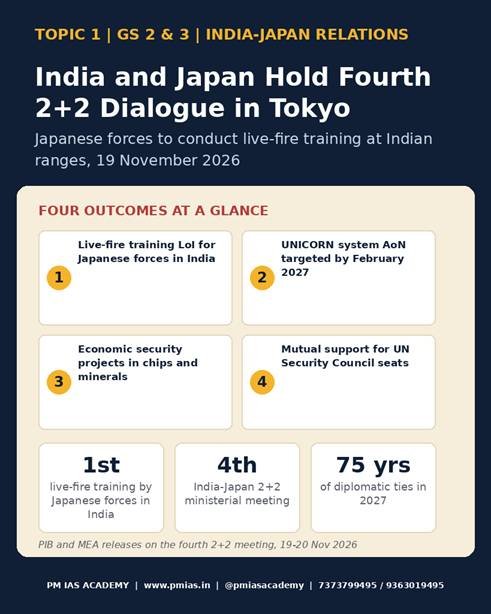
The Letter of Intent on live-fire training is the first arrangement of its kind between the two countries: Japan Self-Defence Forces will train at Indian firing ranges, including with surface-to-ship missiles, and both sides agreed to accelerate the supporting arrangements.
The two sides expect early arrangements on UNICORN, the shared secure communication mast for warships, with an Acceptance of Necessity targeted from the Indian side by February 2027 under the approach described as ‘Design with Japan, Make in India’.
The navies will build on the Memorandum of Arrangement on Maritime Security Cooperation, deepening work in maritime domain awareness, search and rescue, information sharing and humanitarian assistance and disaster relief.
A Joint Secretary-level Working Group will take up mine countermeasures and possible joint development in naval shipbuilding and design, an area where Japan possesses advanced capabilities.
DRDO and Japan’s Acquisition, Technology and Logistics Agency (ATLA) will carry forward research cooperation in missile and defence technologies, moving the relationship from buyer-seller logic toward co-development.
The ministers agreed to cooperate on trusted undersea cables, cybersecurity including AI security, and space situational awareness, extending the partnership into the digital and space commons.
On economic security, both sides raised concern over economic coercion through arbitrary export restrictions and non-market overcapacity that disrupts supply chains, and agreed on project-based work in semiconductors, critical minerals, ICT, clean energy and pharmaceuticals.
Each side backed the other’s bid for a permanent seat in a reformed UN Security Council and confirmed mutual support for non-permanent seats in 2028-29 and 2033-34; the year 2027, marking 75 years of diplomatic ties, will be celebrated as the India-Japan Year of Shared Horizons.
The meeting also reaffirmed cooperation on multilateral export-control dialogue and identified pharmaceuticals among the sectors for joint supply-chain resilience work.
For UPSC aspirants, the 2+2 format itself is important: only a handful of countries hold this dialogue with India, making each one a marker of strategic trust.
Background
India and Japan elevated their relationship to a Special Strategic and Global Partnership in 2014, and the first 2+2 ministerial dialogue was held in New Delhi in 2019, making the Tokyo meeting the fourth in the series.
Defence exercises have steadily deepened: the bilateral JAIMEX naval exercise and the multilateral Malabar exercise (India, Japan, the United States and Australia) were both hosted by Japan in November 2026.
India’s maritime frameworks include MAHASAGAR (Mutual and Holistic Advancement for Security and Growth Across Regions) and the Indo-Pacific Oceans’ Initiative, while Japan promotes its Free and Open Indo-Pacific vision; the 2+2 helps align these concepts.
UNICORN is a Japanese-designed integrated communication mast whose co-production in India would mark an early case of Japanese defence equipment being designed with and manufactured in India.
Economic security entered the agenda after supply-chain disruptions and export restrictions on critical inputs affected both economies, pushing them to treat semiconductors and critical minerals as strategic sectors.
Key Dimensions
1. From dialogue to joint operations: The live-fire training decision converts the partnership from consultation into shared operational practice on Indian soil, a step with few precedents for Japan’s post-war defence posture.
2. Co-development as the new centre of gravity: UNICORN, DRDO-ATLA research and naval shipbuilding work shift the relationship from procurement toward joint design and manufacture, consistent with India’s indigenisation goals.
3. Economic security as strategic policy: By treating semiconductors, critical minerals and undersea cables as shared security concerns, the two sides are building a supply-chain partnership that complements their military cooperation.
4. Multilateral alignment: Mutual support for Security Council reform and for each other’s candidatures shows the partnership extending into global governance, not only regional balancing.
Significance
1. Adds operational depth to deterrence in the Indo-Pacific at a time of concentrated great-power activity in the region.
2. Diversifies India’s defence technology partnerships beyond traditional suppliers and supports domestic manufacturing.
3. Builds trusted supply chains in critical sectors, reducing vulnerability to coercive export restrictions.
4. Strengthens India’s case for a permanent Security Council seat with explicit reciprocal backing.
Challenges
1. Japan’s legal and political constraints on defence exports and collective self-defence can slow implementation of training and co-development plans.
2. Interoperability requires common standards, secure communication systems and sustained budgets on both sides.
3. China is likely to read deeper India-Japan defence cooperation as balancing behaviour, adding friction to bilateral ties with both.
4. Delivery risk is real: targets such as the February 2027 Acceptance of Necessity have slipped in past defence projects.
Way Forward
1. Track the UNICORN Acceptance of Necessity and the concrete training calendar agreed after the Letter of Intent.
2. Watch the Joint Secretary-level Working Group on mine countermeasures and shipbuilding for its first outputs.
3. Follow project announcements under the economic security agenda, especially semiconductors and critical minerals.
4. Note how the 2027 Year of Shared Horizons is used to lock in long-term institutional links.
5. Observe whether the Letter of Intent converts into a signed training agreement with named ranges and schedules.
6. Track progress on co-production of defence equipment, which remains the partnership’s most difficult but most transformative agenda.
Prelims Value Addition
- The first India-Japan 2+2 ministerial was held in New Delhi in 2019; the Tokyo meeting of 19 November 2026 was the fourth.
- India and Japan established diplomatic relations in 1952; 2027 marks 75 years and will be observed as the Year of Shared Horizons.
- The Malabar exercise brings together India, Japan, the United States and Australia, the four Quad countries.
- ATLA, Japan’s Acquisition, Technology and Logistics Agency, is the counterpart agency for defence research cooperation with DRDO.
- UNICORN is a Japanese-designed integrated communications mast proposed for co-production in India under the partnership.
Mains Value Addition
- Keywords for answers: Special Strategic and Global Partnership, UNICORN, live-fire training, economic security, FOIP, MAHASAGAR, co-development.
- Data to quote: Letter of Intent of 19 November 2026; Acceptance of Necessity targeted by February 2027; 75 years of ties in 2027.
- Practice question: The India-Japan partnership is moving from dialogue to co-development and joint training. Discuss with reference to the fourth 2+2 ministerial meeting. (250 words)
- Answer framework: introduce the 2+2 outcomes; body on defence, technology and economic-security pillars; examine constraints; conclude with Indo-Pacific significance.
Topic 2: Cyclone Akvan Crosses Odisha Coast; Zero-Casualty Target Holds as Storm Weakens
Subject: Geography and Disaster Management – Tropical Cyclones
Paper: GS Paper 1: Important geophysical phenomena; GS Paper 3: Disaster and disaster management
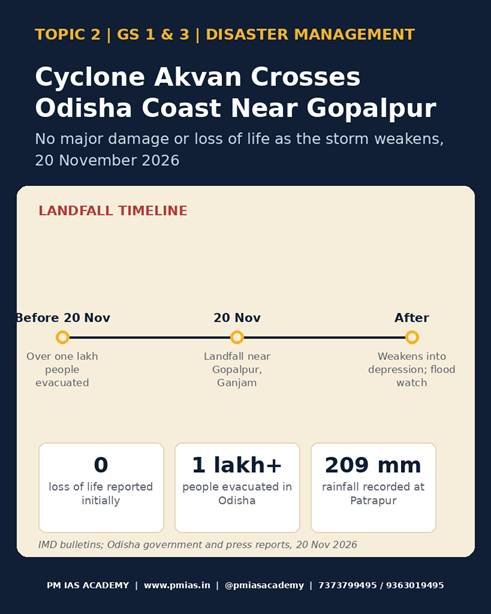
UPSC Relevance: Cyclone Akvan crossed the Odisha coast near Gopalpur on 20 November 2026 and weakened into a depression, with no major damage or loss of life reported after one of the largest precautionary evacuations in recent years, while heavy rain lashed Ganjam and adjoining districts and disrupted services in West Bengal.
Why in News
The landfall process completed on 20 November 2026 near Gopalpur in Ganjam district, close to where the India Meteorological Department had projected, and the system weakened into a depression over land.
No major damage or loss of life was reported in the immediate aftermath, a result state officials attributed to the evacuation of over one lakh people from vulnerable coastal settlements before landfall.
Ganjam and adjoining districts received very heavy rainfall, with Patrapur recording 209 mm, keeping the risk of localised flooding alive even after the wind threat receded.
Several districts of West Bengal were battered by rain, and flight and train services were affected, showing the wide footprint of the system’s rain bands beyond the landfall point.
The outcome is being read as another validation of Odisha’s post-1999 disaster-management model, which sets an explicit zero-casualty target and backs it with cyclone shelters, early warning and practised evacuation drills.
Authorities continued to warn of flooding from swollen rivers and waterlogging, stressing that the post-landfall rain phase can be as dangerous as the crossing itself.
The experience also underlined the value of the last 72 hours of preparation: mock drills, pre-positioned NDRF and ODRAF teams, and the restoration of power and road links began immediately after the all-clear.
The system weakened into a depression after crossing the coast, and the state government moved quickly to restore power supply and clear blocked roads in the affected blocks.
District administrations activated control rooms, cancelled leave for field staff and kept relief teams pre-positioned, reflecting standard operating procedures refined over two decades.
Background
The India Meteorological Department classifies systems from depression (31-49 kmph) through cyclonic storm to super cyclonic storm (222 kmph and above); Akvan reached severe cyclonic storm strength with winds of 89-117 kmph.
The name Akvan was contributed by Iran from the WMO/ESCAP panel list used for North Indian Ocean cyclones, a rotating naming system shared by thirteen member countries.
Odisha’s reputation in cyclone management was built after the 1999 super cyclone killed around ten thousand people; the state responded with cyclone shelters, the Odisha Disaster Rapid Action Force and community-level warning systems.
The National Disaster Response Force is constituted under the Disaster Management Act, 2005; states maintain their own SDRFs, and Odisha additionally raises the specialised ODRAF.
Evacuation remains the single most effective life-saving measure for storm surge and wind hazards, and Odisha has repeatedly moved lakhs of people in past events such as Phailin (2013), Fani (2019) and Yaas (2021).
Key Dimensions
1. Early warning as the foundation: Accurate track and intensity forecasts from IMD gave the state nearly three days of actionable warning, demonstrating the operational value of cyclone-specific ocean buoys, satellites and numerical models.
2. Evacuation logistics at scale: Moving over one lakh people requires transport, shelters with food and water, livestock management and trust built over years, capacities that cannot be improvised at short notice.
3. The zero-casualty doctrine: Treating every cyclone as a test of zero preventable deaths focuses the entire administration on life safety before property, a doctrine now studied by other coastal states.
4. Rain after the storm: Landfall weakens wind but not rain; river flooding and waterlogging demand continued vigilance, as the Patrapur rainfall figure of 209 mm illustrates.
5. Preparedness as governance: Regular mock drills, updated evacuation maps and trained volunteers are administrative investments that only prove their worth on the rare day a cyclone actually arrives.
Significance
1. Confirms that cyclone mortality is a governance variable, not an act of fate: preparation determined the outcome.
2. Enhances the credibility of IMD forecasts, which underpins public compliance with evacuation orders.
3. Provides a live case study of cooperative federalism, with central forces and agencies supporting a state-led response.
4. Builds the evidence base for investing in resilient infrastructure along the entire east coast.
5. Reinforces public trust in evacuation orders, which is the single biggest determinant of compliance in future events.
Challenges
1. Post-landfall flooding can still claim lives and livelihoods, and relief must reach cut-off villages quickly.
2. Repeated evacuations impose economic and psychological costs on coastal communities, requiring better shelter quality and livelihood support.
3. Forecast track shifts between bulletins complicate last-mile messaging and can breed scepticism if evacuations seem unnecessary in hindsight.
4. Climate change is increasing the share of rapidly intensifying cyclones, compressing the warning window the current system depends on.
5. Communication breakdowns in the final hours can still isolate villages even when evacuation has largely succeeded.
6. Urban flooding in low-lying habitations from intense rain bands remains a residual risk even when wind damage is limited.
Way Forward
1. Complete rapid damage and needs assessment in Ganjam, Gajapati and adjoining districts within the standard 72-hour window.
2. Document and audit the evacuation chain so that lessons from Akvan feed into standard operating procedures nationwide.
3. Invest in flood forecasting and embankment strength for the post-landfall rain phase, not only wind preparedness.
4. Sustain community drills and shelter maintenance in non-cyclone months so readiness does not decay.
Prelims Value Addition
- IMD scale: depression 31-49 kmph, deep depression 50-61, cyclonic storm 62-88, severe cyclonic storm 89-117, very severe 118-165, extremely severe 167-221, super cyclone 222 kmph and above.
- RSMC New Delhi of IMD issues tropical cyclone advisories for the North Indian Ocean.
- The WMO/ESCAP panel on tropical cyclones has thirteen members; Iran contributed the name Akvan.
- The NDRF is constituted under the Disaster Management Act, 2005; Odisha also raises the ODRAF.
- The 1999 Odisha super cyclone led to the creation of the Odisha State Disaster Management Authority, the first state-level disaster authority in the country.
Mains Value Addition
- Keywords for answers: zero-casualty target, early warning, evacuation, storm surge, ODRAF, Sendai Framework, last-mile connectivity.
- Data to quote: over one lakh evacuated; landfall near Gopalpur on 20 November 2026; Patrapur rainfall 209 mm; no reported loss of life.
- Practice question: Odisha’s response to Cyclone Akvan shows that disaster mortality is a function of governance, not geography. Discuss. (250 words)
- Answer framework: open with the landfall outcome; body on warning, evacuation and institutions; note residual flood risk and climate trends; conclude on replication.
Topic 3: Supreme Court Quashes Odisha Mining Land Acquisition, Upholds Gram Sabha Consent
Subject: Polity and Governance – Land Rights and Tribal Welfare
Paper: GS Paper 2: Governance, welfare of vulnerable sections, statutory and constitutional provisions; GS Paper 3: Land reforms and resource mobilisation
UPSC Relevance: The Supreme Court on 18 November 2026 quashed the acquisition of land in Odisha’s Sundargarh district for limestone mining by Dalmia Cement Bharat Limited, holding in Bibol Toppo v State of Odisha that prior consent of the Gram Sabha is mandatory for acquisition in Scheduled Areas under Section 41 of the Right to Fair Compensation and Transparency in Land Acquisition, Rehabilitation and Resettlement Act, 2013.
Why in News
A bench of Justices Dipankar Datta and Satish Chandra Sharma set aside the acquisition, along with the relevant notifications and orders, calling the acquisition unsustainable in law.
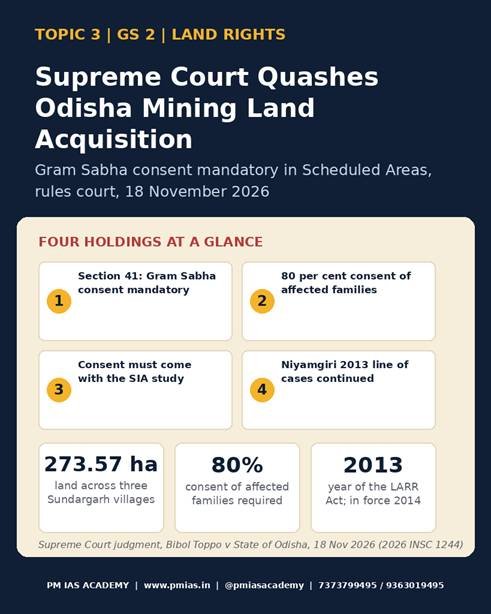
The case was brought by residents of Kukuda, Bihabandha and Lanjiberna villages, where the state government sought to acquire 273.57 hectares to give the company surface rights over a mining lease of 893.55 hectares that runs until February 2040.
The Court held that acquisition for a private company requires the prior consent of at least 80 per cent of affected families, and that this consent must be obtained along with the Social Impact Assessment study, not as a later formality.
The Orissa High Court had earlier upheld the acquisition, reasoning that consent was unnecessary because the state, not the company, was acquiring the land, and that consent-gathering could continue through the acquisition stages; the Supreme Court rejected both propositions.
The judgment extends the line of the 2013 Niyamgiri decision, in which the Court had held the Gram Sabha’s view decisive on the proposal to mine the Niyamgiri hills, and was welcomed by tribal-rights campaigners as a historic affirmation of community control over land.
The ruling clarifies that the consent requirement is mandatory rather than directory, closing a route by which states treated consent as an adjustable procedure.
The decision has immediate consequences for mining and industrial projects in Scheduled Areas, where surface rights, leases and land acquisition must now be planned around genuine Gram Sabha processes from the outset.
The judgment records that the concerned Gram Panchayats had unanimously rejected the acquisition proposal in January 2020, yet the State proceeded through later stages of the process.
Justice Satish Chandra Sharma authored the judgment on a bench that included Justice Dipankar Datta; the Court held the acquisition, its notifications and orders unsustainable.
Background
The Right to Fair Compensation and Transparency in Land Acquisition, Rehabilitation and Resettlement Act, 2013 came into force on 1 January 2014, replacing the Land Acquisition Act of 1894, and introduced consent and Social Impact Assessment requirements.
Section 41 of the 2013 Act makes special provision for Scheduled Areas, requiring prior consent of the Gram Sabha before land is acquired there, recognising the constitutional protection of tribal land under the Fifth Schedule.
The Panchayats (Extension to Scheduled Areas) Act, 1996 empowers Gram Sabhas in Scheduled Areas with control over land and resources, and its spirit informs the consent regime.
Social Impact Assessment studies, mandated by the 2013 Act, evaluate whether a project serves a public purpose and estimate its social costs, and are meant to inform the consent decision.
In the 2013 Niyamgiri case, the Supreme Court directed that the Gram Sabhas of affected villages decide whether the proposed bauxite mining violated their rights; every affected village voted against the project.
Key Dimensions
1. Consent as a substantive right: The judgment treats Gram Sabha consent not as procedure but as a condition of validity: acquisition without it is void, whatever the administrative convenience.
2. Timing matters: Requiring consent alongside the Social Impact Assessment prevents the practice of acquiring first and consulting later, which had emptied the safeguard of content.
3. State acquisition for private benefit: By rejecting the argument that state acquisition escapes consent requirements, the Court closed a structural workaround used in many industrial projects.
4. Development and tribal rights: The ruling does not bar mining in Scheduled Areas; it insists that development there proceed through the community’s informed agreement, balancing Fifth Schedule values against mineral-led growth.
Significance
1. Restores the protective architecture of the 2013 Act in the regions where land conflict is most acute.
2. Gives Gram Sabhas enforceable leverage, converting PESA-era principles into a judicially policed requirement.
3. Provides certainty to industry as well: projects designed around genuine early consent are less exposed to later litigation.
4. Continues the constitutional trajectory from Niyamgiri toward community-centred resource governance.
5. Strengthens the jurisprudence linking the Fifth Schedule, PESA and the 2013 Act into one protective framework for tribal land.
Challenges
1. Gram Sabhas vary in capacity, and without legal aid and information, consent processes can be captured by local elites or contractors.
2. States may respond with delays or by pressuring villages rather than reforming acquisition planning.
3. Balancing timelines for legitimate industrial projects with thorough consent processes will test administrative design.
4. Implementation gaps between Supreme Court doctrine and district-level practice have historically been wide in tribal areas.
5. Distinguishing genuine community consent from manufactured consent will require independent observation of Gram Sabha processes.
Way Forward
1. States should standardise Social Impact Assessment quality and publish consent records to make compliance verifiable.
2. Capacity building and independent facilitation for Gram Sabhas in Scheduled Areas would give the ruling practical effect.
3. Investors should front-load community engagement instead of treating consent as an end-stage hurdle.
4. Watch for follow-up litigation on compensation, rehabilitation and the treatment of acquisitions already under challenge.
5. Union and state governments may need to update acquisition manuals to reflect the mandatory timing of consent established by the judgment.
6. Aspirants should read the ruling alongside the Vedanta Niyamgiri precedent to see the evolving judicial consensus on community consent in Scheduled Areas.
Prelims Value Addition
- The LARR Act, 2013 came into force on 1 January 2014; Section 41 protects Scheduled Areas through prior Gram Sabha consent.
- Acquisition for private companies requires consent of at least 80 per cent of affected families under the 2013 Act.
- PESA, 1996 extends panchayat institutions to Scheduled Areas with Gram Sabha control over land and resources.
- The Fifth Schedule of the Constitution provides for the administration of Scheduled Areas and Scheduled Tribes; the 2013 Niyamgiri judgment made Gram Sabha decision central to mining proposals there.
- The ruling in Bibol Toppo v State of Odisha is reported as 2026 INSC 1244; it arose from Civil Appeal No. 8294 of 2026 against an Orissa High Court judgment of 6 September 2024.
Mains Value Addition
- Keywords for answers: Gram Sabha consent, Section 41, Social Impact Assessment, Scheduled Areas, PESA, Niyamgiri, tribal land rights.
- Data to quote: 273.57 hectares across three Sundargarh villages; mining lease of 893.55 hectares until February 2040; 80 per cent consent benchmark.
- Practice question: The Supreme Court’s ruling in Bibol Toppo v State of Odisha converts Gram Sabha consent from procedure into a substantive right. Examine. (250 words)
- Answer framework: state the holding; trace Section 41 and the 2013 Act’s design; assess implications for tribal rights and industry; conclude with implementation needs.
Topic 4: Madhya Pradesh Scraps Two-Child Norm for Government Jobs After 25 Years
Subject: Society and Governance – Population Policy
Paper: GS Paper 1: Population and associated issues; GS Paper 2: Government policies and interventions
UPSC Relevance: The Madhya Pradesh Cabinet, in a decision reported on 20 November 2026, scrapped the 25-year-old two-child restriction for government employees and job aspirants, citing declining fertility in the state and the country, and ordered the termination of disciplinary proceedings based solely on the norm.
Why in News
The Cabinet approved the removal of Sub-rule (6) of Rule 6 of the Madhya Pradesh Civil Services (General Conditions of Service) Rules, 1961, and deleted the clarification on ‘more than two living children’ in Sub-rule (4) of Rule 22 of the Conduct Rules, 1965.
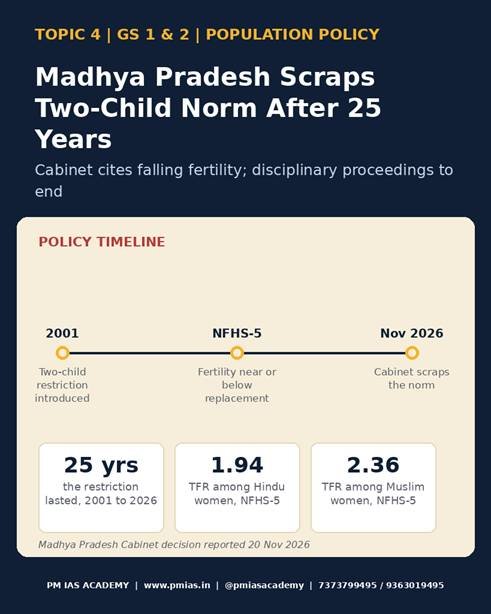
The restriction, introduced in 2001, had barred persons with more than two children from government jobs and exposed serving employees to disciplinary action for a third child.
The government justified the change by pointing to falling fertility: National Family Health Survey-5 (2019-21) recorded the total fertility rate among Hindu women at 1.94 and among Muslim women at 2.36, both well below earlier decades and close to or below replacement level.
All ongoing disciplinary proceedings initiated solely on the ground of having more than two living children will be terminated with immediate effect, though cases where final orders and penalties were already imposed will not be reopened.
The government argued that when society at large faces no such restriction, government employees should not be singled out, framing the move as administrative fairness as much as demography.
The decision was reported alongside a Pew Research Center study projecting shifts in India’s religious demography by 2070, which gave the announcement a wider political resonance beyond service rules.
With this step Madhya Pradesh joins the list of states revisiting coercive population norms inherited from the era when high fertility was the central demographic concern.
The Chief Minister said the restriction had caused many difficulties to employees and that when the rest of society faced no such rule, government workers should not be singled out.
The repeal also ends the anomaly in which public servants were penalised for private reproductive decisions that carried no legal consequence for other citizens.
Background
Two-child norms for elected representatives and government employees spread across several states from the 1990s, on the reasoning that public servants should model small families during a period of rapid population growth.
India’s total fertility rate has fallen to around the replacement level of 2.1, and NFHS-5 shows fertility decline across all major communities and states, changing the factual basis of coercive norms.
The National Population Policy 2000 had itself promised a target-free, voluntary and informed-choice approach, even as states legislated restrictions in service and panchayat rules.
Experience showed two-child norms produced perverse outcomes: disqualification of women candidates, concealment of children and abandonment, with limited measurable effect on fertility.
Several states have since withdrawn or diluted such provisions, and courts have varied in their treatment, upholding some restrictions as reasonable service conditions while questioning others.
Key Dimensions
1. Demographic transition changes the policy problem: With fertility near replacement, the challenge shifts from limiting births to planning for ageing, making coercive child-limit norms anachronistic.
2. Gender and equity effects: Two-child norms historically penalised women more, costing them candidacies and careers, so repeal has a distributive dimension beyond service rules.
3. Evidence-based versus political framing: The decision rests formally on fertility data, but its communal reception shows how population policy in India is never purely technical.
4. Federal variation: Population rules for public employment remain a state subject, producing a patchwork in which identical family choices are treated differently across state borders.
5. Service rules as social policy: The episode shows how conditions of government employment were historically used to pursue population goals, a tool now being dismantled as the demographic rationale fades.
6. Population policy evolution: India’s population policy has moved from coercive targets in the 1970s to voluntary family welfare, and now to concerns about ageing in several southern states.
Significance
1. Relieves thousands of employees and aspirants from a restriction that had outlived its demographic rationale.
2. Signals a shift from coercive to enabling population policy, in line with the National Population Policy’s stated philosophy.
3. Opens space for a serious policy conversation on ageing, labour-force shrinkage and the care economy.
4. Tests whether population debate in India can be conducted on data rather than anxiety.
Challenges
1. The political framing around religious demography risks crowding out the technical case for the reform.
2. Pending questions remain for employees already penalised, whose closed cases will not be reopened.
3. Other states retain similar norms, and uneven repeal complicates inter-state service comparisons.
4. A shift toward pro-natalist rhetoric in some quarters could create new pressures rather than neutral, choice-based policy.
5. A complete audit of pending and closed disciplinary cases will be needed to make the announced relief real on the ground.
6. With fertility below replacement in many states, policy attention is shifting to healthy ageing and labour-force participation.
Way Forward
1. Population policy should now prioritise reproductive health, women’s education and old-age security over numerical targets.
2. States retaining two-child norms should review them against current fertility data, as Madhya Pradesh has done.
3. Invest in demographic data systems so that policy responds to evidence rather than periodic alarm.
4. Keep the public conversation anchored in rights and health, not community competition.
Prelims Value Addition
- NFHS-5 (2019-21): total fertility rate of 1.94 among Hindu women and 2.36 among Muslim women, down from 3.3 and 4.4 respectively in 1992-93.
- The replacement level of fertility is about 2.1 children per woman.
- The National Population Policy was adopted in 2000 with a voluntary, target-free framework.
- Madhya Pradesh’s two-child restriction dated to 2001 and was scrapped by Cabinet decision in November 2026 after 25 years.
- The National Family Health Survey is conducted under the Ministry of Health and Family Welfare; NFHS-5 covered the period 2019-21.
Mains Value Addition
- Keywords for answers: demographic transition, replacement-level fertility, coercive versus enabling population policy, NFHS-5, ageing.
- Data to quote: TFR 1.94 and 2.36 by community (NFHS-5); 25-year-old restriction; rules amended: 1961 Service Rules and 1965 Conduct Rules.
- Practice question: The repeal of two-child norms marks India’s transition from population control to population management. Discuss with reference to the Madhya Pradesh decision. (250 words)
- Answer framework: state the decision and its data basis; analyse why coercive norms lost relevance; examine gender and federal dimensions; conclude with priorities for an ageing India.
Topic 5: Foreign Portfolio Investors Buy Record 11.3 Billion Dollars of Indian Equities in November
Subject: Economy – Capital Markets and Investment Flows
Paper: GS Paper 3: Indian economy – mobilisation of resources, capital markets and investment models
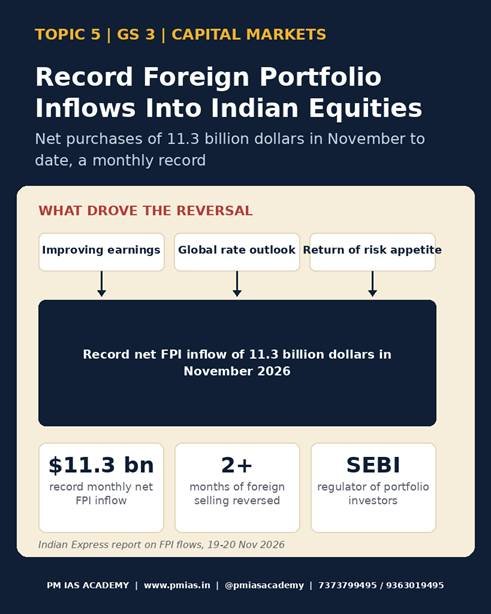
UPSC Relevance: Foreign portfolio investors made net purchases of about 11.3 billion dollars in Indian equities during November 2026 up to 19 November, reported as a record monthly inflow, reversing more than two months of selling and accompanying a recovery in the Nifty 50 and Sensex.
Why in News
The inflow of roughly 11.3 billion dollars within a single month was described as a record, notable because November had not even ended when the figure was reported.
The buying followed an extended phase of foreign selling, marking a sharp reversal in sentiment toward Indian equities.
Analysts attributed the return of foreign capital to improving corporate earnings, relatively strong domestic growth and changing global monetary conditions.
The inflows coincided with a recovery in benchmark indices, the Nifty 50 on the National Stock Exchange and the Sensex on the Bombay Stock Exchange.
Market participants cautioned that the pace might not be sustained, since portfolio flows are sensitive to global interest rates, risk appetite and exchange-rate expectations.
The episode illustrates how quickly capital-flow cycles can turn, with the same class of investors driving both the earlier sell-off and the current surge.
For policymakers, a record inflow month is welcome for liquidity and valuations but renews old questions about the reliability of hot money as a source of market support.
The record buying also coincided with India’s continued weight in major global equity benchmarks and a pipeline of large public offerings that attracted foreign participation.
The buying spree was spread across financial services, capital goods and new-age technology listings, suggesting breadth rather than a narrow thematic bet.
A stable domestic growth outlook relative to other emerging markets has made India a preferred allocation even at premium valuations.
Chief Economic Adviser V Anantha Nageswaran highlighted the scale of the reversal, noting record foreign portfolio purchases in the first 18 days of November.
Background
Foreign Portfolio Investment is investment by non-residents in financial assets such as equities and bonds, and unlike Foreign Direct Investment it does not seek lasting managerial influence over enterprises.
FPIs operate in India under regulations framed by the Securities and Exchange Board of India, which registers investors, sets disclosure norms and monitors flows.
Portfolio flows are the most mobile component of the capital account: they can enter and exit at short notice, which is why they are often called hot money.
India has historically run a current account deficit, making stable capital inflows important for balance-of-payments management and rupee stability.
Domestic institutional investors, especially mutual funds receiving monthly systematic investment plan inflows, have grown as a counterweight, absorbing foreign selling in several recent episodes.
Foreign portfolio investors include global asset managers, sovereign wealth funds, pension funds and hedge funds, whose mandates range from long-term index tracking to short-term trading.
Portfolio flows differ from foreign direct investment: FPI money can leave at short notice, which is why regulators monitor it as a source of external-sector volatility.
Key Dimensions
1. Liquidity and valuation support: Large FPI purchases raise demand for equities, lower the cost of capital for listed companies and lift index valuations.
2. Volatility is the price of openness: Because portfolio positions can be unwound quickly, record inflows can be followed by record outflows, transmitting global shocks into domestic markets.
3. Exchange-rate channel: Inflows support the rupee and add to reserves when the central bank buys the incoming dollars; outflows do the reverse.
4. Domestic counterweights: The rise of mutual funds and insurance and pension flows gives the market a stable domestic base that reduces, though does not eliminate, dependence on foreign capital.
5. Primary versus secondary markets: Inflows into new issues fund investment directly, while secondary-market buying mainly transfers existing shares, though both affect valuations and sentiment.
6. Valuation discipline: When foreign money chases a limited set of quality stocks, valuations can detach from earnings, storing up correction risk for retail investors who enter late.
Significance
1. Signals international confidence in India’s earnings cycle and macroeconomic management.
2. Deepens market liquidity at a time when Indian companies are raising record primary capital.
3. Strengthens the balance of payments and gives the central bank room to rebuild reserves.
4. Offers a live case study for students of how global and domestic factors interact in emerging-market capital flows.
5. Inflows into primary issues channel foreign savings into domestic investment and capacity creation.
6. Sustained FPI interest lowers the cost of capital for Indian companies and deepens market liquidity.
Challenges
1. Sustaining inflows depends on factors outside India’s control, including United States interest rates and global risk appetite.
2. Abrupt reversals could pressure the rupee and force the central bank to intervene in either direction.
3. High valuations driven by flows rather than fundamentals raise the risk of corrections.
4. Policy must avoid becoming hostage to market sentiment, which punishes necessary but unpopular decisions.
5. A sudden reversal driven by global rate cycles can transmit external shocks to domestic markets within days.
Way Forward
1. Deepen domestic long-term capital by widening pension and insurance participation in equity and bond markets.
2. Continue inclusion of Indian bonds in global indices, which brings steadier passive flows.
3. Maintain transparent and predictable regulation, the single strongest anchor for foreign investors.
4. Strengthen macro buffers, reserves and prudent external borrowing limits, against the day the cycle turns again.
5. Policymakers should distinguish stable long-term funds from fast money when designing tax and disclosure regimes.
6. Watch the composition of flows across quarters: a rising share of sovereign and pension capital is a healthier signal than momentum-driven trading money.
Prelims Value Addition
- FPI is regulated by SEBI; FPI and FDI are distinct, the latter involving lasting interest and control thresholds.
- The Nifty 50 belongs to the National Stock Exchange; the Sensex belongs to the Bombay Stock Exchange, Asia’s oldest stock exchange.
- Net flow figures account for both purchases and sales by foreign investors in a period.
- Hot money refers to short-term capital that moves quickly across borders in search of returns.
Mains Value Addition
- Keywords for answers: foreign portfolio investment, hot money, capital account, market depth, domestic institutional investors, exchange-rate channel.
- Data to quote: record 11.3 billion dollars of net FPI purchases in November 2026 to date, after two months of selling.
- Practice question: Record foreign portfolio inflows are both an endorsement and a vulnerability for Indian markets. Examine. (250 words)
- Answer framework: present the inflow data; analyse benefits through liquidity and confidence; analyse risks through volatility and reversibility; conclude with the domestic-capital counterweight.
Topic 6: Falling Coal Stocks Raise Power-Supply Concerns Ahead of Summer 2027
Subject: Economy and Infrastructure – Energy Security
Paper: GS Paper 3: Infrastructure – energy; Indian economy – growth and resource mobilisation
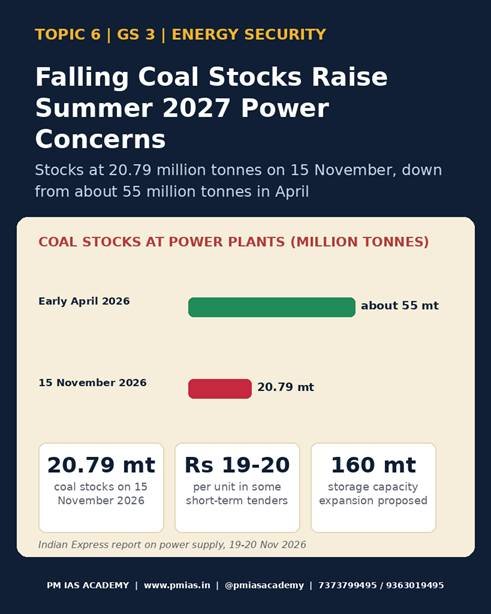
UPSC Relevance: Coal stocks at domestic coal-based power plants stood at 20.79 million tonnes on 15 November 2026, down from about 55 million tonnes in early April, prompting states including Tamil Nadu, Kerala, Rajasthan and Gujarat to seek additional power through short-term tenders at prices reaching 19 to 20 rupees per unit, and reviving proposals to double national coal-storage capacity.
Why in News
The drawdown from about 55 million tonnes in early April to 20.79 million tonnes by mid-November is steep, reflecting high thermal generation through a hot year and logistics constraints in coal movement.
Several states, among them Tamil Nadu, Kerala, Rajasthan and Gujarat, have entered short-term power markets to cover anticipated deficits.
Prices in some short-term tenders reached 19 to 20 rupees per unit, far above the average cost of coal-based generation, signalling scarcity expectations rather than current shortage.
Officials are discussing an expansion of coal-storage capacity from about 80 million tonnes to 160 million tonnes, though the proposal remains at the discussion stage.
The concern is forward-looking: planners are focused on the summer of 2027, when demand peaks combine with low hydro and variable solar output in evening hours.
The situation exposes the continuing centrality of coal in India’s electricity system even as renewable capacity expands rapidly.
It also highlights the financial dimension, since distribution companies with weak balance sheets struggle to contract power in advance, leaving them exposed to spot prices.
Officials indicated that plant-wise stock norms would be reviewed and that imported coal blending remained an option for coastal plants despite its cost.
The power ministry has also directed generating companies to import coal for blending where rail logistics cannot bridge the gap in time.
The shortfall is partly structural: power demand grows with incomes, cooling and electrification, while coal dispatch capacity expands more slowly.
Background
The Central Electricity Authority, functioning under the Ministry of Power, monitors fuel stocks, generation and grid performance, and advises on power-system planning.
The Central Electricity Regulatory Commission regulates interstate electricity markets, including the exchanges where short-term power is traded.
India’s power exchanges operate day-ahead and real-time markets, and a High Price Day-Ahead Market segment allows trading of expensive power such as imported-coal or gas-based generation.
Coal inventories act as the fuel buffer of the thermal fleet; norms prescribe the number of days of stock plants should hold, varying by distance from mines.
India’s electricity demand has been growing at high single digits in recent years, with air-conditioning and industrial recovery pushing peak demand to successive records.
Roughly three quarters of India’s electricity is still generated from coal, although renewables account for a rising share of new capacity added each year.
Key Dimensions
1. Fuel security versus capacity: Installed generation capacity means little without fuel and logistics; the coal-stock position shows that adequacy planning must integrate mining, railways and plant siting.
2. Market signals and scarcity pricing: Short-term prices of 19 to 20 rupees per unit are the market’s way of rationing scarce energy, but they shift costs onto distribution companies and eventually consumers.
3. The transition paradox: Rapid renewable growth reduces annual coal use yet can raise the value of dispatchable thermal capacity during non-solar hours, complicating decisions about coal investment.
4. Storage as the missing link: Both coal stocks and electricity storage, whether pumped hydro or batteries, are forms of buffer; the system currently has too little of each.
5. Regional imbalance: Coal is concentrated in the east while demand growth is nationwide, making railway capacity the system’s pressure point.
6. The import dependence paradox: India has the world’s fifth-largest coal reserves yet imports thermal coal because domestic coal has lower calorific value and because logistics favour imports for coastal plants.
7. Criticality ladders: Plants are classified by days of stock: supercritical and critical categories trigger escalated monitoring and priority rakes.
Significance
1. Energy security remains foundational for growth, manufacturing competitiveness and household welfare.
2. Early warning of a summer-2027 crunch gives planners a window to act through coal movement, imports and demand management.
3. The debate on doubling coal storage will shape infrastructure investment for the next decade.
4. State-level procurement behaviour in the coming months will test the maturity of India’s power markets.
Challenges
1. Railway rake availability and mine logistics constrain how fast stocks can be rebuilt before the summer.
2. Imported coal is costly and exposes plants to global price swings and currency risk.
3. Financially weak distribution companies delay procurement, which converts manageable shortfalls into crises.
4. Long-term coal expansion conflicts with climate commitments, forcing difficult sequencing choices.
5. Stocks are uneven across plants: pithead stations hold comfortable inventories while distant plants run critically low.
Way Forward
1. Front-load coal production and rail despatch through the winter months when demand is lower.
2. Fast-track the proposed storage-capacity expansion from 80 to 160 million tonnes with clear funding and siting.
3. Accelerate electricity storage, pumped hydro and batteries, so that solar output can cover evening peaks.
4. Deepen market reforms so that scarcity prices drive investment in flexibility rather than windfall gains alone.
5. Demand-side measures, including efficient air-conditioning standards, can shave peaks more cheaply than building new generation.
6. Expanding captive coal mining output from blocks allocated to states and private miners can complement Coal India’s production.
Prelims Value Addition
- The Central Electricity Authority functions under the Ministry of Power; the Central Electricity Regulatory Commission regulates interstate power markets.
- Coal stocks at plants were 20.79 million tonnes on 15 November 2026 versus about 55 million tonnes in early April.
- India’s High Price Day-Ahead Market is a specialised segment for costly generation sources.
- Coal India Limited is the world’s largest coal producer and supplies most domestic thermal plants.
- The Ministry of Power issues daily coal-stock reports classifying plants by days of fuel on hand.
- The Central Electricity Authority publishes a daily dashboard of coal stocks at thermal power stations across the country.
Mains Value Addition
- Keywords for answers: energy security, dispatchable power, coal stocks, scarcity pricing, power exchanges, storage, discom health.
- Data to quote: stocks of 20.79 million tonnes on 15 November 2026 against 55 million tonnes in April; tender prices of 19-20 rupees per unit; storage expansion proposal of 160 million tonnes.
- Practice question: India’s coal-stock decline ahead of summer 2027 exposes structural gaps in power-sector planning. Discuss. (250 words)
- Answer framework: state the stock and price data; analyse fuel, market and transition dimensions; assess the storage proposal; conclude with integrated planning.
Topic 7: Java4Shell Vulnerability Triggers Urgent Patching Advisories Worldwide
Subject: Science and Technology – Cybersecurity
Paper: GS Paper 3: Science and technology – developments and applications; awareness in IT; internal security through communication networks
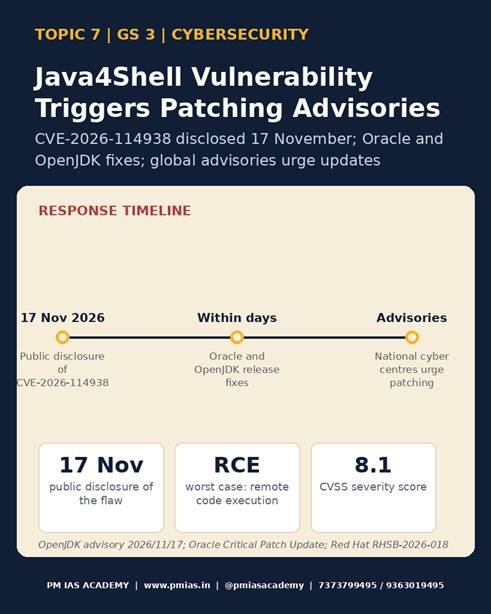
UPSC Relevance: Java4Shell, a serious vulnerability tracked as CVE-2026-114938 and publicly disclosed on 17 November 2026, can enable memory corruption and potentially remote code execution in certain Java runtime environments, prompting fixes from Oracle and OpenJDK and advisories from national cybersecurity authorities including the Canadian Centre for Cyber Security and CERT-EU.
Why in News
The vulnerability is a memory-corruption flaw in the HotSpot compiler component of Java on x86-64 systems, rated 8.1 on the CVSS severity scale, placing it in the high-severity band.
Under specific conditions it allows memory corruption and potentially remote code execution, the most severe class of software flaw, since an attacker could run unauthorised code on affected systems.
Oracle and OpenJDK released security fixes on 17 November, and national cybersecurity centres, including the Canadian Centre for Cyber Security, CERT-EU and NHS England Digital, issued advisories urging immediate updates.
The advisories examined did not establish widespread exploitation in real-world attacks at the time of disclosure, though the high severity rating made rapid patching imperative.
The public disclosure on 17 November followed the responsible-disclosure model, in which vendors are notified in advance so that fixes are ready when the flaw becomes public knowledge.
The episode has been compared to the Log4Shell crisis of 2021 in naming, but the affected component and conditions differ, and early evidence suggests a more contained impact.
Enterprises have been urged to inventory their Java installations, identify affected versions, test patches and deploy them, illustrating the discipline of modern patch management.
The flaw sits in the HotSpot just-in-time compiler, the component that turns Java bytecode into fast machine code, showing how performance-critical low-level code can harbour subtle security defects.
Because Java underpins a large share of enterprise backends, banking systems and government services, a JVM-level flaw has unusually wide exposure.
Security researchers noted that trigger conditions required specific runtime flags and code paths, which limited practical exploitability in the days after disclosure.
Background
CVE stands for Common Vulnerabilities and Exposures, a public catalogue maintained with coordination by the MITRE Corporation that gives each disclosed flaw a standard identifier such as CVE-2026-114938.
CERT-In, the Indian Computer Emergency Response Team, is the national agency for responding to cybersecurity incidents under the Information Technology Act, 2000, and issues advisories, alerts and vulnerability notes.
A zero-day vulnerability is one exploited or exposed before a fix exists; not every newly disclosed flaw is a zero-day, and Java4Shell had vendor fixes available at disclosure.
Java remains one of the most widely used platforms in banking, government and enterprise systems, which is why Java vulnerabilities command immediate attention even when conditions for exploitation are narrow.
The Log4Shell vulnerability of December 2021 in the Log4j library showed how a flaw in a ubiquitous component could expose millions of systems and take years to fully remediate.
The Common Vulnerability Scoring System rates flaw severity from 0 to 10; a score of 8.1, as assigned to Java4Shell, falls in the high-severity band.
The Common Vulnerabilities and Exposures system assigns unique identifiers so that vendors, governments and enterprises can coordinate patching on a shared reference.
Key Dimensions
1. Shared infrastructure, shared risk: A flaw in a common runtime is a systemic risk: thousands of organisations inherit exposure from the same component without writing a line of vulnerable code themselves.
2. The disclosure bargain: Responsible disclosure trades a short window of quiet patching against public knowledge; Java4Shell shows the system working when vendors, researchers and authorities coordinate.
3. Patch management as governance: Knowing what software you run, where, and in which version is the unglamorous core of cybersecurity, and most real-world breaches exploit known, unpatched flaws.
4. AI in security research: The discovery ecosystem increasingly uses AI-assisted analysis to find and to fix vulnerabilities, raising both defensive capacity and the speed of the offence-defence cycle.
5. Performance versus security: Compiler optimisations receive far less public scrutiny than application code, creating a recurring class of subtle defects across the industry.
6. Critical infrastructure exposure: Payments systems, identity platforms and tax portals in India run heavily on Java, making prompt JVM patching a matter of national digital resilience.
Significance
1. Tests the maturity of coordinated vulnerability disclosure five years after Log4Shell.
2. Reminds regulated sectors, especially banking and government, that runtime components are critical infrastructure.
3. Demonstrates the value of national advisories in translating a technical disclosure into administrative action.
4. Adds momentum to software-bill-of-materials practices, which tell organisations exactly which components they depend on.
5. Highlights the strategic importance of funding maintenance and security review for widely used open-source components.
Challenges
1. Legacy and embedded systems often run outdated Java versions that cannot be patched quickly or at all.
2. Patching production systems carries operational risk, so organisations delay, extending the exposure window.
3. Attackers reverse-engineer patches within days, so delay between disclosure and deployment is the critical vulnerability.
4. Smaller organisations lack the asset inventories and security staff to respond within the safe window.
5. Many organisations cannot immediately restart production JVMs, leaving a vulnerable window even after patches are released.
Way Forward
1. Organisations should maintain software bills of materials and automate dependency tracking to cut response time.
2. Regulators can require patch timelines for critical sectors, as some financial regulators already do.
3. Invest in coordinated disclosure institutions and in national capacity such as CERT-In and sectoral CERTs.
4. Track post-disclosure exploitation reports to judge whether the contained assessment of Java4Shell holds.
5. Enterprises should rehearse vulnerability-response runbooks so that a disclosure triggers a practised process rather than improvisation.
Prelims Value Addition
- CVE identifiers are standard names for publicly known vulnerabilities; MITRE coordinates the catalogue.
- CERT-In functions under the Information Technology Act, 2000 and is India’s national incident-response agency.
- OpenJDK is the open-source implementation of the Java platform; Oracle also ships a commercial build.
- The National Critical Information Infrastructure Protection Centre protects designated critical information infrastructure.
- CERT-In is the national nodal agency for responding to cybersecurity incidents under the Information Technology Act, 2000.
Mains Value Addition
- Keywords for answers: vulnerability, remote code execution, zero-day, responsible disclosure, patch management, CERT-In, software bill of materials.
- Data to quote: CVE-2026-114938 disclosed 17 November 2026 in the OpenJDK vulnerability advisory 2026/11/17; CVSS 8.1; fixes from Oracle and OpenJDK; no widespread exploitation established at disclosure.
- Practice question: Recurrent vulnerabilities in ubiquitous software show that cybersecurity is a governance problem as much as a technical one. Discuss in the light of Java4Shell. (250 words)
- Answer framework: describe the disclosure; analyse systemic risk of shared components; evaluate disclosure and patching institutions; conclude with governance reforms.
Topic 8: Environment Panel Recommends Study Terms for Limestone Mines Near Bustard Habitat
Subject: Environment – Biodiversity and Environmental Clearance
Paper: GS Paper 3: Environment – conservation, environmental impact assessment; biodiversity
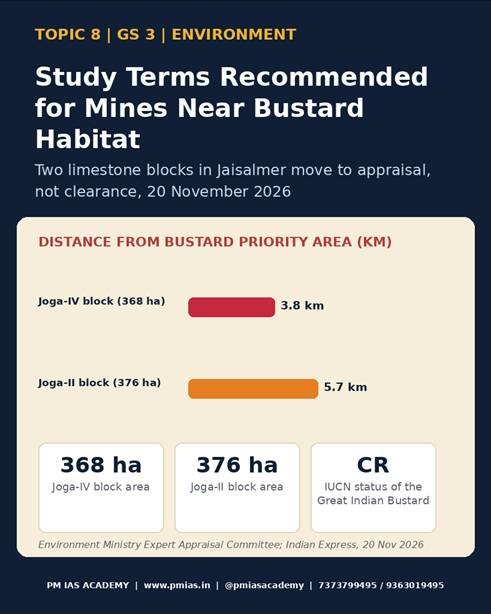
UPSC Relevance: An Expert Appraisal Committee of the Environment Ministry has recommended Terms of Reference for two proposed limestone mining blocks in Rajasthan’s Jaisalmer district, Joga-IV and Joga-II, located about 3.8 and 5.7 kilometres respectively from a Great Indian Bustard priority area, with the committee flagging concerns over transport routes, disturbance and habitat protection.
Why in News
The recommendations, reported on 20 November 2026, followed committee meetings held from 2 to 4 November and cover two blocks: Joga-IV of 368 hectares at roughly 3.8 kilometres, and Joga-II of 376 hectares at roughly 5.7 kilometres, from the bustard priority area.
Terms of Reference define the studies and data an Environmental Impact Assessment must contain; their recommendation starts the assessment process but is not an environmental clearance.
The committee raised specific concerns about transport routes, since haul roads carrying mined limestone can cut through grassland used by the bustard for feeding and movement.
The Great Indian Bustard, Ardeotis nigriceps, is listed as Critically Endangered on the IUCN Red List and protected under Schedule I of the Wildlife (Protection) Act, 1972, with its last stronghold in the Thar desert around Desert National Park.
The proposal lands in an already charged conservation landscape: the Supreme Court’s 2024 judgment in M K Ranjitsinh v Union of India recognised a right against the adverse effects of climate change and directed measures to protect the bustard from power-line mortality.
Limestone demand from the cement industry continues to push mining into western Rajasthan, where mineral-bearing land and bustard habitat overlap.
The committee’s emphasis on cumulative disturbance reflects growing recognition that project-by-project clearance can miss the combined effect of multiple mines in one landscape.
Conservationists point out that the bustard’s grassland habitat has no charismatic canopy and is frequently treated as barren land available for industry.
The proposal stage matters: once mining leases fragment a grassland landscape, restoration of the bustard’s habitat is practically impossible.
Background
Environmental Impact Assessment is a planning tool that examines likely environmental consequences before a project is approved; India’s EIA Notification of 2006 prescribes prior environmental clearance for listed activities.
The clearance process moves through screening, scoping (where Terms of Reference are set), public consultation and appraisal by an Expert Appraisal Committee, which recommends approval or rejection to the ministry.
The Great Indian Bustard population is estimated in the low hundreds, concentrated in Rajasthan, and survives in grasslands that are often misclassified as wasteland in revenue records.
Desert National Park in Jaisalmer district is among the last habitats where the bustard breeds, and conservation breeding centres have been established to supplement the wild population.
The Supreme Court has repeatedly intervened for the species, including directions to underground or reroute power lines in bustard habitat, whose collisions are a leading cause of death.
Key Dimensions
1. Process integrity: Terms of Reference determine what will be studied and therefore what will be known; weak study terms produce weak clearances downstream.
2. Cumulative versus project-level appraisal: Two blocks near the same habitat demand landscape-level assessment of combined traffic, dust and disturbance, not two isolated files.
3. Development-conservation balance: Cement limestone is an economic input, but its location decision is irreversible for the habitat; appraisal must compare alternatives, including other deposits.
4. Precaution in practice: With a critically endangered species, the burden of proof should sit with the project to demonstrate safety, not with conservationists to demonstrate harm.
5. Grasslands as ecosystems: The Thar’s open natural ecosystems support wolves, foxes, raptors and the bustard; treating them as wasteland undermines biodiversity policy.
6. Mitigation hierarchy: Best practice is avoid, minimise, restore and only then offset; skipping straight to offsets is the most common failure in environmental clearance.
Significance
1. The case will test whether the EIA system can protect a flagship species when economic pressures run the other way.
2. Field surveys ordered now will generate rare systematic data on bustard use of the Joga landscape.
3. A rigorous Terms of Reference here can set a template for mining appraisal across arid grassland ecosystems.
4. Visible due process protects both the species and the eventual legitimacy of any clearance decision.
Challenges
1. Baseline data on bustard movement and grassland ecology in the area are thin, risking weak assessment.
2. Once leases and investments harden, the room for genuine refusal narrows, whatever the studies show.
3. Road building and ancillary activity often escape the scrutiny applied to the mine pit itself.
4. Monitoring after clearance is historically the weakest link in Indian environmental regulation.
5. Even well-designed mitigation fails without funded, independent, long-term monitoring after any clearance.
6. Baseline ecological data for desert fauna is sparse, which weakens the evidentiary basis of impact assessments.
Way Forward
1. Require multi-season field surveys covering bustard presence, nesting, feeding and movement corridors before appraisal proceeds.
2. Keep transport alignments away from identified grassland patches and price in habitat mitigation from the start.
3. Publish the assessment and monitoring data so that independent experts can scrutinise them.
4. Evaluate cumulative impacts of all existing and proposed mines in the district, not only the two blocks.
Prelims Value Addition
- The Great Indian Bustard, Ardeotis nigriceps, is Critically Endangered on the IUCN Red List and in Schedule I of the Wildlife (Protection) Act, 1972.
- Desert National Park, associated with bustard conservation, is in Jaisalmer district, Rajasthan.
- The EIA Notification of 2006 governs prior environmental clearance; Expert Appraisal Committees recommend Terms of Reference and clearances.
- In M K Ranjitsinh v Union of India (2024), the Supreme Court recognised a right against the adverse effects of climate change and addressed bustard protection from power lines.
- Conservation breeding centres in Jaisalmer district aim to rebuild the wild bustard population through captive-reared releases.
Mains Value Addition
- Keywords for answers: Environmental Impact Assessment, Terms of Reference, Expert Appraisal Committee, cumulative impact, precautionary principle, Great Indian Bustard.
- Data to quote: Joga-IV at 368 hectares and 3.8 kilometres, Joga-II at 376 hectares and 5.7 kilometres from the priority area; committee meetings of 2-4 November 2026.
- Practice question: Terms of Reference are where environmental battles are really won or lost. Discuss with reference to the Jaisalmer limestone mining proposals. (250 words)
- Answer framework: explain the scoping stage; present the Joga facts; analyse cumulative and precautionary issues; conclude with survey and monitoring requirements.
Quick Bits: Revise for Prelims
International
- India and Japan hold their fourth 2+2 ministerial in Tokyo; a Letter of Intent allows Japanese live-fire training at Indian ranges for the first time.
- Cyclone Akvan crosses the Odisha coast near Gopalpur with no major damage reported; over one lakh people had been evacuated.
Polity and governance
- The Supreme Court quashes land acquisition for limestone mining in Sundargarh, Odisha, holding Gram Sabha consent mandatory under Section 41 of the LARR Act, 2013.
- Madhya Pradesh scraps its 25-year-old two-child norm for government employees, citing fertility near replacement level (NFHS-5).
Economy
- Foreign portfolio investors make record net purchases of about 11.3 billion dollars in Indian equities in November to date.
- Coal stocks at power plants fall to 20.79 million tonnes on 15 November from about 55 million tonnes in April; storage expansion to 160 million tonnes is under discussion.
Science, environment and reports
- Java4Shell (CVE-2026-114938), disclosed 17 November, prompts fixes from Oracle and OpenJDK and a CERT-In advisory.
- An Environment Ministry panel recommends study terms for two limestone blocks near Great Indian Bustard habitat in Jaisalmer; the bustard is Critically Endangered.
Practice MCQs
Q1. Which of the following best captures the significance of the India-Japan Letter of Intent on live-fire training?
(a) It is the first arrangement permitting a foreign force to conduct live-fire training at Indian firing ranges
(b) It establishes a mutual defence treaty between the two countries
(c) It makes Japan a permanent member of the Malabar exercise
(d) It creates a joint missile production line under ATLA
Answer: (a). The LoI is the first arrangement of its kind: Japan Self-Defence Forces will train at Indian firing ranges, including with surface-to-ship missiles.
Q2. In Bibol Toppo v State of Odisha, the Supreme Court set aside the acquisition primarily because:
(a) Compensation had not been paid at market rates
(b) The mining lease had expired before acquisition began
(c) Prior consent of the Gram Sabha, mandatory in Scheduled Areas, was absent
(d) The Social Impact Assessment agency was not accredited
Answer: (c). Section 41 of the 2013 Act makes prior Gram Sabha consent mandatory in Scheduled Areas; its absence made the acquisition unsustainable.
Q3. Madhya Pradesh’s scrapping of the two-child norm for government employees is best understood against which demographic reality?
(a) A Supreme Court ban on population-linked service conditions
(b) Total fertility falling to around replacement level, weakening the case for coercive measures
(c) A constitutional amendment securing reproductive choice
(d) Rising fertility across the Hindi heartland
Answer: (b). With fertility near replacement, the demographic rationale for penal service conditions has faded, a shift several states are now making.
Q4. Foreign portfolio inflows differ from foreign direct investment mainly because portfolio flows:
(a) Always carry management control
(b) Cannot exceed ten per cent of a company’s equity
(c) Are locked in for a statutory minimum period
(d) Can reverse quickly, transmitting external shocks to domestic markets
Answer: (d). FPI is financial investment without control intent; its speed of exit is what makes it a source of external-sector volatility.
Q5. Falling coal stocks at power plants matter most immediately because they:
(a) Force the immediate shutdown of thermal units
(b) Raise the risk of supply shortfalls and costlier spot purchases during peak demand
(c) Breach the Coal Mines (Special Provisions) Act, 2015
(d) Automatically trigger load shedding across states
Answer: (b). Low stocks compress the buffer before peak demand; states then turn to short-term tenders at sharply higher prices.
Q6. The Java4Shell episode most directly illustrates which governance concern?
(a) The dependence of critical digital infrastructure on shared components whose flaws have systemic reach
(b) The failure of telecom regulators to license software vendors
(c) The absence of any statutory cybersecurity institution in India
(d) The illegality of open-source software in government systems
Answer: (a). A single flaw in a ubiquitous runtime exposes thousands of organisations at once, which is why advisories urged immediate patching across sectors.
Mains Practice Set
Q1. The Supreme Court’s ruling in Bibol Toppo v State of Odisha converts Gram Sabha consent from procedure into a substantive right. Examine. (250 words)
Q2. Odisha’s response to Cyclone Akvan shows that disaster mortality is a function of governance, not geography. Discuss. (250 words)
Q3. Record foreign portfolio inflows are both an endorsement and a vulnerability for Indian markets. Examine. (250 words)
