
Topic 1: Deployment of ‘Agni-P’ (Prime) and the Shift in India’s Nuclear Triad
Subject: Defence / Science & Technology
Syllabus
- GS Paper 3: Science and Technology- developments and their applications; Indigenization of technology; Security challenges and their management.
Context
The Strategic Forces Command (SFC), in coordination with DRDO, has successfully operationalized the first batch of Agni-Prime (Agni-P) missiles. This marks a transition from older liquid-fueled systems to canisterized, solid-fuel technologies that enhance India’s “second-strike” capability.
Main Body: Multi-Dimensional Analysis
- Technological Advancement: Agni-P is a two-stage canisterized missile with redundant navigation systems. Canisterization allows for “stop-and-launch” mobility, making the missile harder for enemy satellites to track.
- Strategic Deterrence: Unlike the Agni-V (Intercontinental), the Agni-P is a medium-range ballistic missile (1,000-2,000 km) specifically designed to counter regional threats, providing a more flexible deterrent.
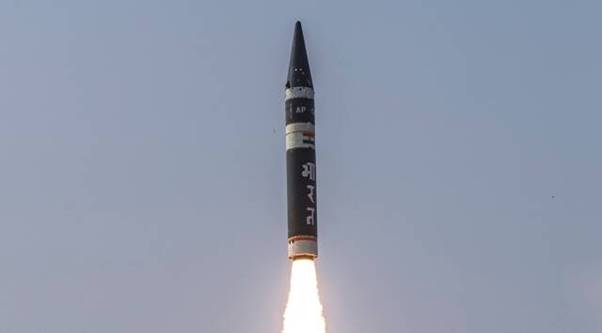
- Operational Readiness: The successful induction proves India’s ability to move from testing to deployment phases rapidly, strengthening the land-based leg of the nuclear triad.
- Indigenization: Over 85% of the components are indigenous, showcasing the success of the ‘Atmanirbhar Bharat’ initiative in high-end missile technology.
Positives, Negatives, & Government Schemes
| Dimension | Details |
| Positives | Enhanced mobility, faster response time, improved accuracy with high-end navigation. |
| Negatives | Increased regional arms race tensions; high maintenance costs for canisterized storage. |
| Associated Schemes | Integrated Guided Missile Development Programme (IGMDP), Atmanirbhar Bharat in Defence. |
Way Forward
- Integrate Agni-P with Rail-Mobile launchers to further increase survivability.
- Continue the development of MIRV (Multiple Independently Targetable Re-entry Vehicle) technology for smaller-range missiles.
Conclusion
The operationalization of Agni-P represents a modernization of India’s deterrence strategy, ensuring that the nation’s “No First Use” policy is backed by a credible and indestructible retaliatory capability.
Topic 2: RBI’s New Framework for Climate-Related Financial Risks
Subject: Economy
Syllabus
- GS Paper 3: Indian Economy and issues relating to planning, mobilization of resources, growth, and development.
Context
On May 5, 2026, the Reserve Bank of India (RBI) issued a comprehensive framework mandating all Scheduled Commercial Banks to perform Climate Stress Testing. This moves climate change from an environmental issue to a core financial stability concern.
Main Body: Multi-Dimensional Analysis
- Financial Stability: Banks must now assess how “physical risks” (floods, droughts) and “transition risks” (policy shifts toward renewables) impact their loan portfolios.
- Green Finance Disclosure: Banks are required to disclose their “green lending” ratios compared to “brown lending” (fossil fuels) to prevent systemic shocks.
- Global Alignment: This aligns Indian banking with the Task Force on Climate-related Financial Disclosures (TCFD) and the Network for Greening the Financial System (NGFS).
- Credit Availability: There is a concern that MSMEs in carbon-heavy sectors might find it harder to secure loans as banks de-risk their portfolios.
Positives, Negatives, & Government Schemes
| Dimension | Details |
| Positives | Long-term financial resilience, encourages investment in sustainable energy, transparency. |
| Negatives | Increased compliance costs for smaller banks, potential credit squeeze for traditional industries. |
| Associated Schemes | Sovereign Green Bonds, Panchamrit Goals (COP26), RBI Green Finance Guidelines. |
Way Forward
- Develop standardized “Climate Risk Rating” for Indian corporates to help banks assess risk.
- RBI should provide a “Transition Fund” to support MSMEs in adopting greener technologies.
Conclusion
By integrating climate risk into the core of banking supervision, the RBI is ensuring that the Indian financial system remains resilient against the inevitable economic shifts caused by global warming.
Topic 3: The Inter-State River Water Disputes (Amendment) Bill, 2026
Subject: Polity / Governance
Syllabus
- GS Paper 2: Functions and responsibilities of the Union and the States, issues and challenges pertaining to the federal structure.
Context
A new amendment bill was introduced in Parliament today to replace the multiple existing ad-hoc tribunals with a Single Permanent Tribunal to resolve inter-state river water disputes (like Cauvery or Krishna) within strict timelines.
Main Body: Multi-Dimensional Analysis
- Centralized Adjudication: The shift from multiple tribunals to one permanent body aims to reduce administrative delays and conflicting judgments.
- Strict Timelines: The Bill mandates that the Tribunal must give its verdict within two years, with a possible one-year extension, addressing the decades-long delays currently seen.
- Data Driven: Establishment of a central data bank for all river basins to prevent states from presenting conflicting hydrological data.
- Federal Concerns: Some states argue that a central permanent tribunal might undermine state autonomy and favor the Union’s hydrological agenda.
Positives, Negatives, & Government Schemes
| Dimension | Details |
| Positives | Faster dispute resolution, reduction in legal costs, standardized data collection. |
| Negatives | Potential for increased central-state friction, concerns over the neutrality of permanent members. |
| Associated Schemes | Jal Shakti Abhiyan, National Water Policy, Inter-linking of Rivers Project. |
Way Forward
- Ensure the permanent tribunal includes technical experts (hydrologists) alongside judicial members.
- Focus on “Mediation” as a compulsory first step before the case reaches the Tribunal stage.
Conclusion
The Amendment Bill is a necessary step toward “Hydro-Federalism,” where water is viewed as a national resource that requires swift, science-based legal resolution rather than prolonged political posturing.
Topic 4: India-ASEAN ‘Blue Economy’ Partnership Agreement
Subject: International Relations
Syllabus
- GS Paper 2: Bilateral, regional and global groupings and agreements involving India and/or affecting India’s interests.
Context
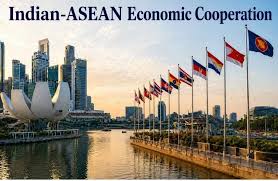
India and the ASEAN bloc signed a landmark agreement on May 5, 2026, to cooperate on the Blue Economy, focusing on sustainable deep-sea mining, maritime security, and plastic-free oceans in the Indo-Pacific.
Main Body: Multi-Dimensional Analysis
- Economic Frontier: The Blue Economy contributes significantly to the GDP of coastal nations. Collaboration focuses on sustainable fisheries and offshore energy.
- Security Dimension: By partnering with ASEAN, India strengthens its “Act East Policy” and counters unilateral maritime dominance in the South China Sea.
- Environmental Protection: Joint R&D into ocean thermal energy and coral reef restoration projects to combat rising sea levels affecting both regions.
- Logistics & Connectivity: Improving port infrastructure under the “SAGAR” (Security and Growth for All in the Region) vision to boost trade routes.
Positives, Negatives, & Government Schemes
| Dimension | Details |
| Positives | Boosts maritime trade, provides an alternative to land-based resources, enhances regional security. |
| Negatives | Conflicts between industrial deep-sea mining and traditional fishing communities. |
| Associated Schemes | Deep Ocean Mission, Sagarmala Project, Act East Policy, PM Matsya Sampada Yojana. |
Way Forward
- Standardize maritime laws across India and ASEAN to allow for seamless shipping and patrolling.
- Launch a “Blue Bond” market to fund sustainable maritime startups.
Conclusion
This partnership marks a shift from land-centric diplomacy to maritime-centric growth, positioning India as a “Net Security Provider” and a lead economic partner in the Indo-Pacific.
Topic 5: Introduction of the ‘One Nation, One Student ID’ (APAAR)
Subject: National Issues / Education
Syllabus
- GS Paper 2: Issues relating to development and management of Social Sector/Services relating to Education, Human Resources.
Context
The Ministry of Education announced the 100% saturation of the Automated Permanent Academic Account Registry (APAAR) ID for all school and college students in India today, creating a lifelong digital academic trail.
Main Body: Multi-Dimensional Analysis
- Digital Integration: The ID acts as a “DigiLocker” for education, storing everything from primary school certificates to Ph.D. degrees and sports achievements.
- Ease of Mobility: Students moving between states (e.g., from Tamil Nadu to Delhi) can transfer their academic credits instantly without manual verification.
- Skill Tracking: Integrates vocational training and informal skills into the formal academic record, aiding in the “National Credit Framework” (NCrf).

- Privacy Concerns: Questions regarding the security of student data and the potential for surveillance or “profiling” based on academic performance.
Positives, Negatives, & Government Schemes
| Dimension | Details |
| Positives | Eliminates forged certificates, simplifies admissions, tracks drop-out rates in real-time. |
| Negatives | Data privacy risks, digital divide issues for students in remote areas. |
| Associated Schemes | National Education Policy (NEP) 2020, Digital India, Samagra Shiksha. |
Way Forward
- Integrate the APAAR ID with the National Career Service (NCS) to help graduates find jobs based on verified skills.
- Implement strict blockchain encryption to prevent hacking of academic records.
Conclusion
APAAR is the “Aadhaar for Education,” providing a standardized digital infrastructure that could revolutionize how human capital is measured and managed in India.
Topic 6: Tamil Nadu’s ‘Global Semiconductor Strategy 2026’
Subject: National Issues (Tamil Nadu) / Economy
Syllabus
- GS Paper 3: Infrastructure: Energy, Ports, Roads, Airports, Railways etc.; Effects of liberalization on the economy.
Context
The Tamil Nadu government today unveiled its ‘Semiconductor & Advanced Electronics Strategy,’ aiming to become the “Silicon Coast of India” by offering 50% additional power subsidies and dedicated water pipelines for fabrication units.
Main Body: Multi-Dimensional Analysis
- Regional Competition: Tamil Nadu is positioning itself against Gujarat and Karnataka to attract global giants like TSMC and Intel by leveraging its existing automotive electronics ecosystem.
- Talent Pipeline: The state has mandated “Semiconductor Engineering” electives in all state-run engineering colleges to create a ready workforce.
- Infrastructure Lead: Development of a dedicated “Semiconductor Park” in the Thoothukudi-Virudhunagar corridor to utilize the upcoming spaceport’s ecosystem.
- Resource Intensity: High water and power consumption of ‘Fab’ units could strain local resources if not managed via desalinated water and renewable energy.
Positives, Negatives, & Government Schemes
| Dimension | Details |
| Positives | High-value job creation, positions TN as a global tech hub, reduces national import dependency. |
| Negatives | Environmental impact (chemical waste/water use), massive capital subsidy burden on the state exchequer. |
| Associated Schemes | India Semiconductor Mission (ISM), PLI Scheme for IT Hardware, Naan Mudhalvan Scheme. |
Way Forward
- Focus on “Compound Semiconductors” and “Design” (fabless) units which are less water-intensive than full-scale foundries.
- Establish an E-waste recycling hub alongside the semiconductor park to manage the product lifecycle.
Conclusion
Tamil Nadu’s aggressive entry into the semiconductor race marks its evolution from a manufacturing hub to a high-technology frontier, crucial for India’s electronic sovereignty.
Topic 7: Deployment of ‘AI-Patrol’ Robots for Border Surveillance
Subject: Defence / National Security
Syllabus
- GS Paper 3: Security challenges and their management in border areas; Role of external state and non-state actors in creating challenges to internal security.
Context
The Indian Army today inducted its first unit of AI-enabled autonomous patrolling robots along the Line of Control (LoC) to detect infiltration in high-altitude, sub-zero conditions where human patrolling is life-threatening.
Main Body: Multi-Dimensional Analysis
- Tactical Advantage: These robots use LiDAR and thermal imaging to detect movement in pitch darkness or dense fog, sending real-time alerts to command centers.
- Reduced Human Casualty: By replacing static pickets with autonomous rovers, the Army reduces the risk of sniper fire and frostbite for soldiers.
- Infiltration Counter: Integrated with “Smart Fencing,” these robots can identify the difference between an animal and a human intruder using AI algorithms.

- Technical Vulnerability: Risk of electronic jamming or “hacking” by state actors, requiring robust “Electronic Counter-Counter Measures” (ECCM).
Positives, Negatives, & Government Schemes
| Dimension | Details |
| Positives | 24/7 surveillance, works in extreme weather, high precision in threat detection. |
| Negatives | High cost of deployment, dependency on battery/power in remote areas, ethical concerns of autonomous systems. |
| Associated Schemes | Comprehensive Integrated Border Management System (CIBMS), iDEX (Innovations for Defence Excellence). |
Way Forward
- Develop “Swarm Technology” where multiple robots communicate to cover a larger area.
- Ensure a “Human-in-the-loop” system where the final decision to engage is always made by a commander.
Conclusion
The shift toward “Techno-Border Management” is essential for India to secure its vast and hostile borders with minimal loss of life and maximum efficiency.
Topic 8: Breakthrough in ‘Green Hydrogen’ for Heavy Industries
Subject: Economy / Environment
Syllabus
- GS Paper 3: Conservation, environmental pollution and degradation; Infrastructure: Energy.
Context
A major Indian steel conglomerate, in partnership with the Ministry of New and Renewable Energy, successfully ran the first Green Hydrogen-powered blast furnace today, a massive leap for decarbonizing “hard-to-abate” sectors.
Main Body: Multi-Dimensional Analysis
- Decarbonization: Steel production is one of the highest CO2 emitters. Replacing coking coal with Green Hydrogen reduces emissions to almost zero (emitting only water vapor).
- Energy Independence: Reduces the need to import expensive metallurgical coal, improving India’s trade balance.
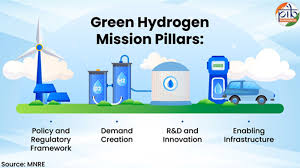
- Technology Leadership: India is aiming to become a global exporter of Green Hydrogen technology under the National Green Hydrogen Mission.
- Cost Barrier: Green Hydrogen is currently 2-3 times more expensive than coal-based processes, requiring heavy government subsidies for the transition period.
Positives, Negatives, & Government Schemes
| Dimension | Details |
| Positives | Massive reduction in carbon footprint, technological self-reliance, creates new export markets. |
| Negatives | High initial infrastructure cost, massive renewable energy requirement for electrolysis. |
| Associated Schemes | National Green Hydrogen Mission, SIGHT Programme, Carbon Credit Trading Scheme. |
Way Forward
- Establish “Green Hydrogen Hubs” near major ports and industrial clusters to reduce transport costs.
- Introduce “Green Steel” certificates to give producers a premium in international markets like Europe (CBAM).
Conclusion
The successful industrial application of Green Hydrogen marks the beginning of India’s “Second Industrial Revolution”—one that is sustainable, indigenous, and globally competitive.
Practice Mains Question:
“The transition from traditional security and economic models to AI and Green Energy-driven frameworks presents a unique set of administrative and ethical challenges.” Discuss with reference to recent developments in Indian border management and heavy industry. (250 words)
