
Topic 1: Sterlite, Eight Years On: Tamil Nadu Doubles Relief for Protest Victims

Illustrative image: V.O.C. Port, Thoothukudi (district administration photo) – the Sterlite plant’s locale, not the plant itself.
Subject: State Governance – Social Justice and Industrial Policy
Syllabus
Unit 8: Tamil Nadu administration – social justice; Unit 9: Environment and industrial conflicts
Context
Chief Minister C. Joseph Vijay on 11 November 2026 ordered an additional Rs 5.25 crore in relief for families of those killed and grievously injured in the police firing during the 2018 anti-Sterlite protests in Thoothukudi, acting on the recommendations of the Justice Aruna Jagadeesan Commission.
Main Body: Multi-Dimensional Analysis
1. The order: Families of the 13 people killed in the 22-23 May 2018 firing had received Rs 25 lakh each; they will now get Rs 25 lakh more, taking the total to Rs 50 lakh per family, at a cost of Rs 3.25 crore.
2. The injured: The 40 people who sustained grievous injuries will receive an additional Rs 5 lakh each, taking their compensation to Rs 10 lakh per person, at a cost of Rs 2 crore.
3. The basis: The additional relief follows the recommendations of the Justice Aruna Jagadeesan Commission – the one-member inquiry the state appointed in 2018 under a retired Madras High Court judge – and came after affected families appealed for further compensation.
4. The chronology: Protests against the Sterlite copper smelter’s expansion ran for 100 days before the firing; the state sealed the plant on 28 May 2018, the National Green Tribunal ordered its reopening in December 2018, and the Supreme Court stayed that order in February 2019, leaving the plant shut ever since.
5. The unfinished questions: Compensation addresses loss, not accountability: prosecutions of those who ordered and carried out the firing, and the Commission’s full findings – which flagged the role of officials and officers in the escalation – remain the measure of closure.
Positives, Negatives, & Government Schemes
| Category | Dimension / initiative | Explanation |
| Positive | Doubled compensation | Rs 50 lakh per deceased family is among the highest such reliefs in India. |
| Positive | Commission-linked | Relief follows a judicial inquiry’s recommendations, not ad hoc announcement. |
| Positive | Injured covered | 40 grievously injured persons see compensation doubled to Rs 10 lakh. |
| Negative | Eight-year wait | Full compensation arrived eight years after the firing. |
| Negative | Accountability gap | Criminal accountability for the firing remains unresolved. |
| Scheme | Justice Aruna Jagadeesan Commission | Inquiry into the 2018 Thoothukudi firing; recommended the enhanced relief. |
Examples
1. 13 people were killed in the Thoothukudi firing of 22-23 May 2018, on the 100th day of the anti-Sterlite protest.
2. The state sealed the Sterlite plant on 28 May 2018; the NGT ordered reopening in December 2018 and the Supreme Court stayed that in February 2019.
3. 40 grievously injured persons will now receive Rs 10 lakh each in total.
Way Forward
1. Publish and act on the Commission’s findings on responsibility for the firing.
2. Complete pending prosecutions with a fixed timeline.
3. Institutionalise a compensation framework so relief does not depend on appeals.
4. Frame a clear policy for handling industrial-protest situations.
Conclusion
Doubling compensation acknowledges the wound; closure will come only when accountability for the firing matches the generosity of the relief.
Practice Mains Question
Discuss the role of compensation and accountability in addressing state violence against protesters, with reference to Thoothukudi. (250 words)
Topic 2: TNPDCL Doubles Its Ask: 3,000 MW Procurement Plan Signals a Tighter Grid
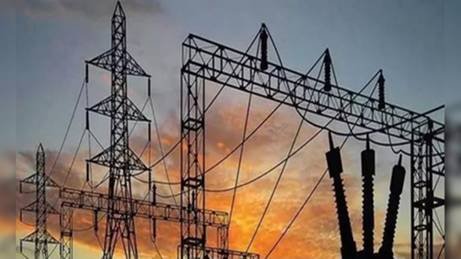
Illustrative image: power transmission infrastructure (photo: DD News).
Subject: State Economy – Power Sector
Syllabus
Unit 8: Tamil Nadu economy – energy; Unit 9: Infrastructure and public utilities
Context
The Tamil Nadu Power Distribution Corporation Limited has doubled its proposed medium-term power procurement from 1,500 MW to 3,000 MW, telling the Tamil Nadu Electricity Regulatory Commission that annual demand has risen to 22,000 MW and the state faces a 7,000 MW energy shortage by 2029-30.
Main Body: Multi-Dimensional Analysis
1. The proposal: TNPDCL first sought TNERC approval for 1,500 MW in February this year; it has now doubled the quantum, proposing to buy 3,000 MW of round-the-clock power for five years under the Finance, Operate and Own guidelines.
2. The demand math: Annual demand has climbed from an average 18,000 MW to 22,000 MW, driven by changing weather patterns, a growing migrant population and surging electric vehicle sales; a senior official cited demand of about 19,000 MW amid an extended summer.
3. The expiry cliff: Long-term power purchase agreements for 2,830 MW expire by 2028-29, forcing new procurement planning now – a classic utility trap where contracts signed a decade ago lapse just as demand peaks.
4. The cost: The medium-term procurement is estimated at about Rs 5.50 per unit, with annual expenditure pegged at Rs 6,150 crore.
5. The spot-market lesson: When the state faced a shortage this October, TNPDCL had to buy power at Rs 30 per unit to bridge the peak-hour gap – nearly six times the planned procurement cost, which is the economic case for contracting early.
6. The sector context: Tamil Nadu’s distribution utility operates in the structure created when the erstwhile TANGEDCO was unbundled into separate generation, transmission and distribution corporations; the state is among India’s wind-energy pioneers – the Muppandal belt is an early landmark – yet evening peaks still lean on thermal and market purchases because solar fades and wind is seasonal.
Positives, Negatives, & Government Schemes
| Category | Dimension / initiative | Explanation |
| Positive | Early contracting | Five-year RTC procurement avoids Rs 30 per unit spot purchases. |
| Positive | Demand realism | Application candidly projects a 7,000 MW shortage by 2029-30. |
| Negative | Rising purchase cost | Rs 6,150 crore a year adds to discom financial stress. |
| Negative | Renewables gap | RTC thermal procurement fills a gap renewables-plus-storage has not yet covered. |
| Scheme | TNERC regulation | Medium-term power purchase requires regulatory approval, with deviation requests. |
| Scheme | RDSS | The Revamped Distribution Sector Scheme targets discom losses and metering reform nationally. |
Examples
1. TNPDCL bought power at Rs 30 per unit during the October shortage – nearly six times the planned Rs 5.50.
2. Long-term PPAs for 2,830 MW expire by 2028-29.
3. The operating Koodankulam units (2 x 1,000 MW each) are among Tamil Nadu’s largest generation sources.
Way Forward
1. Pair procurement with accelerated renewable and storage additions.
2. Strengthen demand-side management to flatten peak-hour spikes.
3. Ensure TNERC scrutiny keeps the contracted tariff competitive.
4. Plan generation capacity additions beyond five-year purchases.
Conclusion
Tamil Nadu’s grid is buying insurance against a shortage it can see coming; the premium is worth paying, but the policy lesson is to build capacity before the next cliff.
Practice Mains Question
Examine the challenges of power-sector planning in Tamil Nadu amid rising demand. (250 words)
Topic 3: Seven Officers Arraigned: The Veeramani Case Reaches the Police Themselves
Illustrative image: the Supreme Court of India (DD News file photo) – not the court seized of this case.
Subject: State Governance – Police Accountability
Syllabus
Unit 8: Tamil Nadu administration – police and law enforcement; Unit 9: Child protection and POCSO
Context
The Special Investigation Team probing child sexual abuse cases against Gem Granites owner R. Veeramani has arraigned seven police officers, including two IPS officers who earlier served in the Greater Chennai Police, as accused in the first case, police sources said on 12 November 2026.
Main Body: Multi-Dimensional Analysis
1. The accusation: The officers are accused of failing to record information of a cognisable offence, resorting to falsification of records, and failing to report or record a case of child sexual abuse – the machinery of suppression, not of investigation.
2. The legal frame: Section 19 of the POCSO Act, 2012 makes reporting of child sexual abuse mandatory for any person who has apprehension or knowledge, and Section 21 punishes failure to report; for a police officer, refusing to register a cognisable complaint additionally collides with Section 173 of the BNSS (formerly Section 154 CrPC). In Lalita Kumari v State of UP (2013), a Constitution Bench held FIR registration mandatory on information of a cognisable offence; the BNSS adds only a narrow preliminary-inquiry window in Section 173(3), for offences punishable with imprisonment of three years or more but less than seven years; whether it applies turns on the precise offence charged and its punishment.
3. The accused profile: Seven officers including two IPS officers from the Greater Chennai Police: the case reaches into the senior leadership of the city’s police force, not merely the station level.
4. The SIT mechanism: A Special Investigation Team was constituted precisely because the regular force’s handling was itself in question; arraigning officers converts suspicion into formal accusation.
5. The systemic question: When those who must register crimes are accused of burying them, the integrity of the first hour of every investigation – the FIR – is what is on trial.
Positives, Negatives, & Government Schemes
| Category | Dimension / initiative | Explanation |
| Positive | SIT follow-through | Officers have been formally arraigned, not merely transferred. |
| Positive | Senior ranks included | Two IPS officers among the accused signals no rank immunity. |
| Negative | Institutional failure | The original complaints were allegedly suppressed by the police itself. |
| Negative | Delayed justice | Victims pursued cases while records were allegedly falsified. |
| Scheme | POCSO Act, 2012 | Sections 19 and 21 mandate reporting of child sexual abuse and punish failure to report. |
| Scheme | BNSS Section 173 | FIR registration for cognisable offences; s.173(3) permits a preliminary inquiry only for offences punishable with 3 years or more but less than 7 years. The mandatory rule descends from Lalita Kumari (2013). |
Examples
1. Seven officers, including two from the IPS, were arraigned as accused on 12 November 2026.
2. The case concerns abuse allegations against Gem Granites owner R. Veeramani.
3. In Lalita Kumari v State of UP (2013), the Supreme Court held FIR registration is mandatory for cognisable offences.
Way Forward
1. Complete the SIT probe and file charges within a declared timeline.
2. Audit how the original complaints were handled at each station level.
3. Strengthen independent oversight of FIR registration in sensitive cases.
4. Protect the victims and witnesses through the prosecution.
Conclusion
A police force earns trust one registered FIR at a time; arraigning its own officers is painful proof that the state takes that duty seriously.
Practice Mains Question
Discuss police accountability in the registration and investigation of child sexual abuse cases. (250 words)
Topic 4: Stalin vs TVK: The Opposition Finds Its Line of Attack
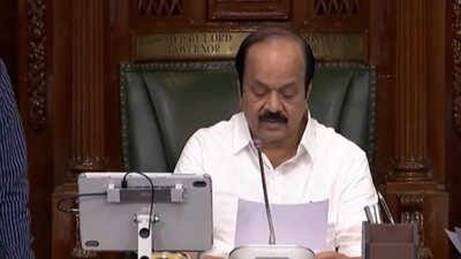
File image: Tamil Nadu Assembly proceedings (photo: DD News).
Subject: State Politics – Government and Opposition
Syllabus
Unit 8: Tamil Nadu polity – parties and legislature; Unit 9: Current political events
Context
DMK president M.K. Stalin on 12 November 2026 demanded that Chief Minister C. Joseph Vijay take “real action” against Deputy Speaker M. Ravishankar, accused of undermining the dignity of the Assembly, and TVK MLA Arul Vignesh, accused of sending an inappropriate message to the Kallakurichi District Collector. The allegations are contested and attributed here to their makers.
Main Body: Multi-Dimensional Analysis
1. The demand: Stalin said “delivering punch dialogues” would not solve problems and pressed for action against the two legislators – framing the ruling party’s internal conduct problem as the Chief Minister’s test.
2. The allegations: Deputy Speaker M. Ravishankar faces an assault allegation from a Thuraiyur resident, later withdrawn in contested circumstances; MLA C. Arul Vignesh is accused of an inappropriate message to the Kallakurichi Collector, which he has denied as dirty politics.
3. The government’s position: The Chief Minister had already warned MLAs against controversies at the 11 November Mahabalipuram meeting; reports say both legislators were separately warned and disciplinary action could follow.
4. The constitutional angle: Under Article 178, the Deputy Speaker is chosen by the Assembly itself and can be removed only by a resolution passed by a majority of all the then members, with 14 days’ notice – an allegation against the office therefore touches the House, not only the person, and presiding officers are expected to meet a higher public standard.
5. The political reading: For the DMK, the conduct issues are an opening to question the six-month-old government’s control over its own flock; for TVK, visible discipline is the counter – and with a majority assembled from 108 own seats plus support parties, every MLA’s conduct is also a stability question.
Positives, Negatives, & Government Schemes
| Category | Dimension / initiative | Explanation |
| Positive | Opposition scrutiny | Public pressure for standards in legislative conduct. |
| Positive | Internal warnings | TVK leadership has warned the legislators, per reports. |
| Negative | Conduct allegations | Two ruling-party legislators face public misconduct claims. |
| Negative | Institutional shadow | A Deputy Speaker facing allegations dims the office itself. |
| Scheme | Article 178 | Speaker and Deputy Speaker are chosen by, and removable by, the Assembly itself. |
| Scheme | Privileges and conduct norms | MLAs are held to standards of dignity; conduct complaints can go to privilege and ethics processes. |
Examples
1. Stalin demanded action against the Deputy Speaker and the Kallakurichi MLA on 12 November 2026.
2. The Kallakurichi MLA has denied the allegation, calling it dirty politics.
3. A Deputy Speaker’s removal needs a resolution passed by a majority of all the then members of the Assembly after 14 days’ notice (Article 179(c)).
Way Forward
1. Announce and complete a time-bound internal inquiry into both cases.
2. Act on findings transparently, whatever the outcome.
3. Codify MLA conduct rules with stated consequences.
4. Keep Collector-official complaints channels independent of party pressure.
Conclusion
Every ruling party is eventually judged by how it handles its own; for a six-month-old government, that judgment has simply arrived early.
Practice Mains Question
Discuss the importance of legislative conduct and accountability in a parliamentary democracy. (250 words)
Topic 5: The Low Pressure Arrives: Fishing Halted Along the Tamil Nadu Coast
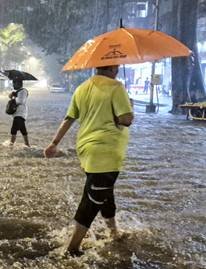
Representative image: heavy monsoon rain (photo: DD News), not of the current weather system.
Subject: Geography and Disaster Management – Northeast Monsoon
Syllabus
Unit 8: Geography of Tamil Nadu – climate and coastal economy; Unit 9: Disaster preparedness
Context
The low-pressure area forecast by the Regional Meteorological Centre formed over the Bay of Bengal around 13 November 2026 as expected, prompting authorities to stop issuing tokens to fishing boats from 13 November and to warn fishermen, with the system expected to intensify into a depression by 15 November.
Main Body: Multi-Dimensional Analysis
1. From forecast to event: The RMC had forecast on 11-12 November that a low-pressure area would form over the southeast Bay of Bengal around 13 November and strengthen into a depression by 15 November; the system has now formed on schedule.
2. The fisheries shutdown: Authorities stopped issuing fishing-boat tokens from 13 November because of the system – the standard precautionary closure that keeps small boats ashore when the sea turns hostile, and the token system itself is the administration’s headcount of who is at sea.
3. The monsoon logic: Tamil Nadu is unique among major states in receiving the bulk of its rain – roughly half of the annual total – from the northeast or retreating monsoon between October and December, when pressure patterns reverse and the Bay of Bengal throws systems at the coast; this is why a November low pressure is simultaneously the state’s main rain hope and its main marine hazard.
4. The livelihood cost: Every day of stopped fishing is lost income for coastal families; precautionary closures protect lives but compress already thin monsoon-season earnings.
5. The rain stakes: The system carries hopes of easing rainfall deficits in districts such as Cuddalore, Mayiladuthurai, Thanjavur, Chengalpattu and Tiruvarur – the same event is hazard at sea and promise on land.
6. The watch ahead: The IMD scale escalates from low-pressure area to depression (winds 17-27 knots), deep depression (28-33 knots) and cyclonic storm (34-47 knots, when it receives a name from the WMO/ESCAP panel list); the RMC is monitoring whether this system climbs that ladder, and its track, knowable only after strengthening, decides whether Tamil Nadu prepares for rain gain or storm damage.
Positives, Negatives, & Government Schemes
| Category | Dimension / initiative | Explanation |
| Positive | On-time forecast | The system formed on the predicted date, validating the early warning. |
| Positive | Precautionary closure | Token halt from 13 November keeps boats ashore before conditions worsen. |
| Negative | Income loss | Fishing closures cut daily earnings of coastal families. |
| Negative | Track uncertainty | Intensification and landfall zone remain uncertain. |
| Scheme | RMC Chennai monitoring | IMD’s regional centre tracks and warns on Bay of Bengal systems. |
| Scheme | Doppler radar network | Chennai, Karaikal and Sriharikota radars track coastal weather in real time. |
Examples
1. Fishing-boat tokens were stopped from 13 November 2026 due to the low-pressure formation.
2. The system is expected to reach depression strength (17-27 knot winds) by 15 November.
3. Tamil Nadu receives roughly half of its annual rainfall from the northeast monsoon (October-December).
Way Forward
1. Announce relief or compensation mechanisms for fishing days lost.
2. Keep coastal shelters and response teams on standby as the track clarifies.
3. Manage reservoirs for both flood safety and deficit relief.
4. Communicate updates in simple, local-language advisories.
Conclusion
A forecast kept is a warning earned; Tamil Nadu’s coast now trades a few days of fishing for the safety of the fleet – the right exchange, if relief follows.
Practice Mains Question
Discuss the impact of Bay of Bengal weather systems on Tamil Nadu’s coastal economy and preparedness. (250 words)
Topic 6: The Mahabalipuram Arithmetic: Inside TVK’s Battle to Keep Its Majority
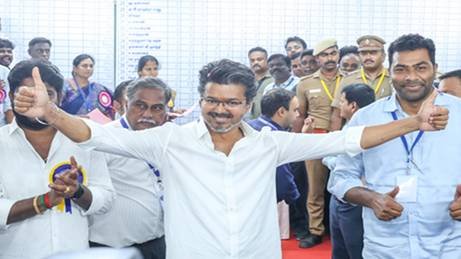
File photo: Chief Minister C. Joseph Vijay with party legislators (photo: DD News).
Subject: State Polity – Government Stability
Syllabus
Unit 8: Tamil Nadu polity – legislative process; Unit 9: Anti-defection and coalition dynamics
Context
An Indian Express account of Chief Minister Vijay’s 11 November meeting with TVK legislators describes a leadership exercise to guard the government against possible defection attempts, with MLAs told that rivals could move another no-confidence motion after 13 November – six months after Vijay won his floor test. These are reported claims, several not independently established.
Main Body: Multi-Dimensional Analysis
1. The floor-test math: TVK won 108 of 234 seats in April, short of the 118 majority; Vijay won the 13 May confidence vote 144-22 with five abstentions after the DMK walked out, with 25 AIADMK legislators backing him.
2. The six-month marker: Legislators were told the period after 13 November is crucial because another no-confidence motion becomes possible once six months have passed since the last one – a rule of the Assembly’s procedure.
3. The inducement allegations: TVK minister C.T. Nirmal Kumar alleged DMK-linked intermediaries offered ruling-party MLAs Rs 60-70 crore to defect; these allegations have not been independently established, and the DMK in turn accuses TVK of inducing AIADMK defections, which TVK denies.
4. The anti-defection frame: The Tenth Schedule, inserted by the 52nd Amendment (1985), disqualifies legislators who voluntarily give up party membership or defy the whip; the 91st Amendment (2003) deleted the one-third “split” exemption, so only a merger by two-thirds of a legislature party survives – the legal wall any defection bid must now climb.
5. The one-on-one method: Vijay met most legislators individually for a minute or two each, combining Diwali gifts and assurances with a firm message against entertaining rival offers – a loyalty audit as much as a review meeting.
6. The venue’s symbolism: Mahabalipuram – the Pallava-era UNESCO World Heritage town that hosted the second Modi-Xi informal summit in October 2019 – is where Tamil Nadu stages the meetings it wants remembered; choosing it for a survival huddle was itself a message.
Positives, Negatives, & Government Schemes
| Category | Dimension / initiative | Explanation |
| Positive | Proactive management | Leadership is engaging MLAs directly rather than discovering defections late. |
| Positive | Floor-test precedent | The 13 May confidence vote settled the majority question once, 144-22. |
| Negative | Horse-trading claims | Unverified Rs 60-70 crore offer allegations cloud the system. |
| Negative | Majority fragility | A 108-plus-allied arrangement needs constant tending. |
| Scheme | Anti-defection law | Tenth Schedule (52nd Amendment, 1985); 91st Amendment (2003) removed the split exemption. |
| Scheme | No-confidence interval | Assembly procedure bars a fresh no-confidence motion within six months of the last. |
Examples
1. Vijay won the confidence vote 144-22 on 13 May 2026.
2. TVK won 108 seats against a 118 majority mark in the 234-member Assembly.
3. The Supreme Court in S.R. Bommai (1994) made the floor of the House the only place to test a majority.
Way Forward
1. Publicise asset and induction disclosures to counter inducement narratives.
2. Let the anti-defection law, not hospitality, settle party loyalty questions.
3. Focus legislative business so stability rests on governance record.
4. Keep coalition partners’ support formal and transparent.
Conclusion
In a thin-majority government, every meeting is arithmetic; the Mahabalipuram message was that November 13 is a number as much as a date.
Practice Mains Question
Discuss the functioning of the anti-defection law in the context of thin-majority governments. (250 words)
Topic 7: No More Stopping at Sriperumbudur: Multi-Lane Free Flow Tolling Arrives
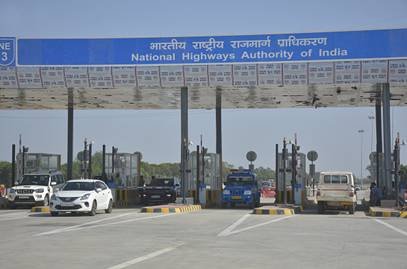
Representative image: a gantry-based MLFF toll plaza in operation (photo: DD News).
Subject: State Infrastructure – Roads and Technology
Syllabus
Unit 8: Tamil Nadu economy – infrastructure; Unit 9: Science and technology applications in governance
Context
From the midnight of 12-13 November 2026, motorists at the Sriperumbudur toll plaza on the Chennai-Bengaluru National Highway can drive through without stopping, as Tamil Nadu’s second multi-lane free flow (MLFF) tolling system went live – a plaza that handles over 1.25 lakh vehicles daily.
Main Body: Multi-Dimensional Analysis
1. How it works: Overhead gantries fitted with RFID readers and automatic number-plate recognition cameras read FASTag wallets and registration plates, and the system deducts the toll due – no boom barriers, no stopping, no queues.
2. The scale: The Sriperumbudur plaza caters to over 1.25 lakh vehicles a day on one of the state’s busiest industrial corridors, linking Chennai with the Sriperumbudur-Oragadam manufacturing belt and Bengaluru’s technology economy.
3. The national arc: FASTag, built on the National Electronic Toll Collection programme run by NPCI, was made mandatory nationally in February 2021 and now accounts for the overwhelming share of toll transactions; MLFF is the next step – removing the barrier itself. India’s first barrier-less tolling went live on NH-48 in Gujarat, and the government has announced a nationwide MLFF push.
4. The sequencing: This is the second plaza in Tamil Nadu to get MLFF, marking a phased rollout of barrier-free tolling on the state’s national highway network, most of which is operated under NHAI – the authority created by the NHAI Act, 1988.
5. The efficiency case: Barrier-free tolling cuts fuel waste, travel time and congestion at plazas, and plugs revenue leakage that cash and queue-based systems allow; studies of electronic tolling consistently show idling at plazas among the largest avoidable fuel losses on highways.
6. The compliance challenge: MLFF shifts enforcement from the barrier to the backend: accurate number-plate reading, working FASTags and penalty systems for non-payers decide whether free flow stays fair flow.
Positives, Negatives, & Government Schemes
| Category | Dimension / initiative | Explanation |
| Positive | Barrier-free travel | No stopping at a 1.25-lakh-vehicle daily plaza. |
| Positive | Fuel and time savings | Reduced idling cuts emissions and delays. |
| Negative | Enforcement backend | Non-payment must be caught digitally, not at a gate. |
| Negative | Transition friction | Users with faulty FASTags face penalty and dispute risks. |
| Scheme | FASTag / NETC | NPCI-run electronic toll collection, mandatory since February 2021. |
| Scheme | MLFF rollout | Gantry-based barrier-free tolling; Sriperumbudur is Tamil Nadu’s second. |
Examples
1. Sriperumbudur is the second MLFF plaza in Tamil Nadu.
2. The plaza handles over 1.25 lakh vehicles every day.
3. NHAI was established under the National Highways Authority of India Act, 1988.
Way Forward
1. Extend MLFF to other high-volume plazas on a declared schedule.
2. Publish accuracy and dispute-redress metrics for the system.
3. Integrate toll data with traffic management on the corridor.
4. Educate highway users on FASTag compliance before enforcement tightens.
Conclusion
A toll gate that no longer stops traffic is small engineering with large meaning: governance working best when it is least felt.
Practice Mains Question
Evaluate the role of electronic tolling systems in improving highway efficiency in Tamil Nadu. (250 words)
Topic 8: A New Alliance in Lucknow: The Samajik Parivartan Morcha
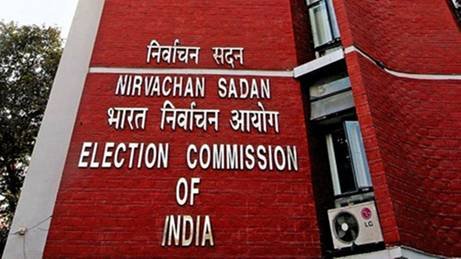
File image: Nirvachan Sadan, Election Commission of India headquarters (photo: DD News).
Subject: National Polity – Parties and Elections
Syllabus
Unit 9: Indian polity – political parties and elections; current events – national
Context
AIMIM leader Asaduddin Owaisi and Azad Samaj Party (Kanshiram) chief Chandrashekhar Azad announced the Samajik Parivartan Morcha in Lucknow on 12 November 2026 to jointly contest the 2027 Uttar Pradesh Assembly election, naming Azad as the alliance’s chief ministerial face.
Main Body: Multi-Dimensional Analysis
1. The partners: AIMIM brings an organised Muslim-vote outreach; the Azad Samaj Party, built from the Bhim Army movement founded in Saharanpur in 2015, brings Dalit assertion politics – together they target two of UP’s biggest voting blocs, Muslims (19.26%, Census 2011) and Dalits (20.7%).
2. The CM-face signal: Naming Chandrashekhar Azad, the junior alliance partner and Nagina MP since 2024, as chief ministerial candidate puts Dalit leadership at the front of the experiment.
3. The opportunity: The BSP’s decline – from a single-party majority in 2007 to one seat in 2022 – has left Dalit and Muslim voters partially unattached; the Morcha is a bid to inherit that space before the SP reclaims it.
4. The constraint: Neither party has booth-level machinery across UP’s 403 seats, and first-past-the-post punishes third forces whose votes spread thin: the 2022 bipolar result (BJP 255, SP 111) shows the wall, and the 2024 Lok Sabha result (SP 37, BJP 33) shows the volatility.
5. The national relevance: For TNPSC aspirants, the alliance illustrates how India’s party system renews itself: caste-community coalitions forming where older parties vacate representation – the same logic that produced the BSP in the 1980s and regional parties across the Hindi belt.
Positives, Negatives, & Government Schemes
| Category | Dimension / initiative | Explanation |
| Positive | Representation bid | Dalit-Muslim platform seeks space vacated by a declining BSP. |
| Positive | Dalit CM face | Symbolism of leadership from the asserted community. |
| Negative | Thin organisation | Limited booth-level presence across 403 seats. |
| Negative | Vote-split risk | May divide the anti-incumbent vote and aid the ruling party. |
| Scheme | 2027 UP Assembly election | 403 seats; alliance formed to contest jointly. |
| Scheme | Party recognition | ECI recognises national and state parties under the Election Symbols Order, 1968. |
Examples
1. The Samajik Parivartan Morcha was announced in Lucknow on 12 November 2026.
2. Chandrashekhar Azad won the Nagina Lok Sabha seat in 2024.
3. The BSP fell from a majority in 2007 to one Assembly seat in 2022.
Way Forward
1. Watch seat-sharing and candidate announcements.
2. Track responses from the SP, BSP and BJP.
3. Assess ground organisation as the campaign builds.
4. Note whether smaller caste parties join the front.
Conclusion
The Morcha will be measured less by seats won than by whether it reopens the question of who speaks for UP’s Dalits and Muslims.
Practice Mains Question
Discuss the role of new political alliances in India’s state electoral politics. (250 words)
